Monday, April 1, 2013

Fringe S1 Ep10: Safe

"Be patient with him.  His mind works in a different way."
-Agent Olivia Dunham on Walter Bishop to Charlie Francis-


We reach the midway point as we continue mining and digging deep into the world of Fringe.  Every effort is being made to plumb the depths of Season One and get a deeper understanding of what is in play here.  We've discovered not only is the mythology of Fringe dabbling in Fringe science, but it's also dealing with fringe technologies, in much the same way Star Trek: The Original Series delved into that wonderfully techie world of possibilities.  Fringe is not only using science and technology as the focus of each story, but its entire mytharc appears to be using it as a foundation for the story of a fringe universe itself.  Each new bit and piece of information is assembling into a pastiche, patchwork or pattern for something much grander and beyond our reality.  It's slowly coming together but the signs are clearly there for deduction.


Now the irony of the latest episode's title may be that, perhaps, Fringe has indeed played it safe to a degree particularly in establishing itself. It has certainly unabashedly borrowed ideas from the classics to more contemporary pop culture phenomenons and promises to do more of the same into the future but with its own unique Fringe stamp allowing viewers to be less aware of the homage or tributes within its stories. But then again, could these earlier story components, particularly the epilogue stories (Episodes 12-6) take on greater resonance as the series progresses allowing viewers to see them in an entirely different light as new information is provided?  That Observer never misses a moment.


I recently purchased one of the, generally-speaking, excellent compendium books by Benbella called Fringe Science: Parallel Universes, White Tulips, And Mad Scientists.  Now, I have not read the book.  I don't dare do it just yet, because the book delves into Season Two and Three of the series as well. So I have to be very careful.  Cautiously, I did give it a quick perusal so as not to catch any Season Two or Season Three spoilers, but there is an article that caught my attention by Paul Levinson called The Return Of 1950s Science Fiction In Fringe.  This aspect of the series has indeed captured my attention as I noted in Fringe, Season One, Episode 4, The Arrival.  It will no doubt continue to make additional nods to the era as well as sci-fi from the 1960s (Star Trek: The Original Series) and the 1970s (Altered States).  There has been some attention given here and elsewhere to the close resemblance of Fringe to a series like culturally influential The X-Files particularly in the early going, but with the arrival of Fringe, Season One, Episode 10, Safe, the series continues to compound and hone its own ideas, conventions and concepts into genre conventions and play them as anything but safe delivering a thrilling heist-styled, sci-fi thrill ride.  When Fringe delivers its own unique brand of science fiction it is notably impressive and we tend to forget the idea that this series is mimicking anything.  Episodes like Episode 4, The Arrival, Episode 7, In Which We Meet Mr. Jones and Episode 9, The Dreamscape were doubly impressive in this way.  Safe continues moving the needle of the series in that much more aggressive and original direction.


But the truth is anyone who thinks I might be picking on Fringe should know that I see it more as a form of flattery that the series has tipped its cap to a host of sci-fi classics than derivation.  I'm certainly not the only one who has noticed these aspects of the series and there is certainly more to come.  But in these efforts to mine old ideas within the Fringe universe, the series is developing its own original creation.


One quote from editor Kevin R. Grazier, from the aforementioned book, sees the series in much the same way as we've been recording here at Musings Of A Sci-Fi Fanatic.  He sees Fringe as homage.  "There is a saying in Hollywood, 'Steal from the best.'  Now the implementation of this is neither as cavalier nor as high-handed as perhaps it initially sounds: if you take a novel idea in another production that works particularly well, repackage the idea with your own unique spin, your creation should fare well" (p.37).  Certainly this is a tried and true approach to film and television that spans the decades from Space:1999 (1975-1977) to Stargate Universe (2009-2011).  Fringe is no exception and is not the only violator.  Grazier added, "Clearly the creators of Fringe excel at this.  Many of the sci-fi situations in Fringe have been done (sometimes done to death) previously, but the creators of the series excel at recycling," and recycle Fringe does and does often.  That's no slight of the series, because as it goes deeper into its mytharc Fringe is far less obvious about it, more refined, smarter and finds its own identity amidst conventions.


Fans who have visited here have noted the Fringe "spin."  I've been writing about it since the beginning. Grazier puts it nicely in context within that simple quote prefacing the aforementioned article from the book Fringe Science, but without reading it and without getting ahead of myself, I can assure you the comparisons and the contrasts will no doubt continue based on the evidence of Season One where the recycling is simply more apparent.  The key is embracing the geek connections and having fun with it and watching Fringe break some of those conventions and do something fresh with it.  As it goes deeper into the series it's clear Fringe does move into riskier waters.  It gets more and more dangerous with each passing episode.  Safe is a strong example of its convincing mytharc.

FBI Agent Mitchell Loeb, an alleged friend to Phillip Broyles, returns following his assassination of the extremely hot Joanne Ostler in Fringe, Season One, Episode 8, The Equation.  Loeb obtained the mathematical formula required for penetrating solid matter following the abduction of Ben Stockton.  Loeb purports to be a potential head of the hydra organization that is ZFT, a terror group.  He is on to his third bank heist with his target in Philadelphia.


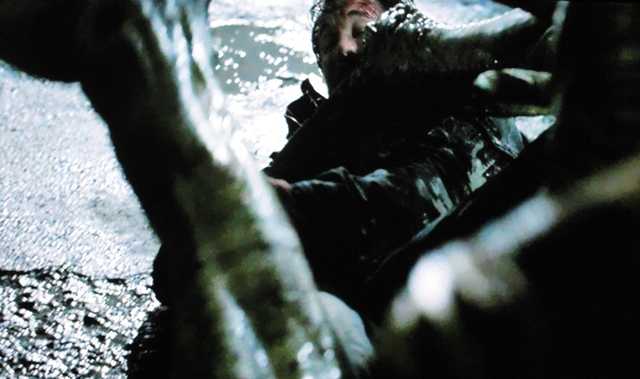
A group of men implement equipment to enter the interior wall of the Philadelphia Mutual Savings Bank.  The specific bank box number is extracted from within the safe.  The oscillation or vibration of the wall works on a timer suggesting the equipment has not yet been a perfected science. They have minutes to complete the extraction of their target safe deposit box 610.  A cable is harpooned through the wall to help pull themselves through because they cannot simply walk through the wall. Everyone escapes but in the final seconds, one man, a former marine, is locked and lodged within the solid wall.  Loeb simply eliminates the man with a shot to the head at point blank range.   It does not appear to be a clean plan with far too much identifiable evidence left behind, but Loeb is comfortable departing without requiring the removal of the head or fingers from identification. The loose end is apparently not a concern. But then neither was Joanne Ostler.

Welcome to the wonderfully unsafe world of Fringe, Season One, Episode 10, Safe.  The sci-fi thriller enjoys the kind of thrills that accompanied a film like Spike Lee's Inside Man (2006).  As television goes I enjoyed it that much.


The Fringe unit arrives in Philadelphia and Agent Olivia Dunham is clearly struck by the appearance of the man inside the wall.  She knows him.  He is a former marine. They both served in the Marines.  We learn more abut Dunham's military background and the fact she fancies herself a bit of a loner with only her sister as her best friend. Dunham recognizes the man as Raul Lugo, a former military unit friend.  She recalls that he is married and she even spent time at a dinner at his home in New Jersey.  The body is removed and gruesomely severed in parts and brought back for Walter to dissect.  It is revealed banks have been hit in Cleveland and Baltimore.

Meanwhile, the Bishops, Walter and Peter, visit a hardware store to acquire a blade for cutting "human tissue."  Peter tells the clerk not to contact the authorities.  Peter and Walter spend an interesting family moment together as Walter suggests Peter has not done enough with his life.  Peter sharply retorts that he has no right to comment nor does he know what he's been doing for the last many years since Walter's institutionalization.  Darin Morgan makes an appearance in the first season of Fringe.


In Wissenschaft, Germany, David Robert Jones, whom we first met Episode 7, In Which We Meet Mr. Jones, is informed Philadelphia was a success by his lawyer Mr. Salman Kohl.  He requests Kohl wire 100,000 dollars to Loeb and acquire certain items for their next meeting.

Dunham visits Susan, Raul's wife, from whom he was divorced two years ago.  Dunham tells her they have met before in her home and even recalls the layout of the home.  Susan is insistent she has never met Dunham and that she has never been to her home.  Only John Scott had been the night of her recollection.  Dunham is confusing Scott's memories with her own.


Loeb is able to peer into the stolen box but refuses to allow the others to see what he sees.  Meanwhile, Walter and Peter saw off the robber's hand.  Walter is attempting to find some explanation as to how these criminals could understand quantum physics and pass matter through a wall on an atomic level.

At Massive Dynamic, Nina Sharp indicates she needs her people to reconstruct the memories of John Scott.  She is in a race against "highly motivated individuals" alluding to a potential struggle with ZFT.  Scott's body remains in stasis and last scene in Episode 3, The Ghost Network.


Walter applies his efforts to explain the use of vibration to penetrate through solid matter by utilizing uncooked rice, some toys and a vibrating football table.  Now he's talking to me.  Remember vibrating football?  Not exactly precise football.  High frequency vibrations disrupt a solid structure to allow something to pass through.  I love seeing science simplified in this manner.  Short story: When I was in fourth grade I did a report on amoebas and the report was relatively interesting and, of course, fact-based, but then in typical Sci-Fi Fanatic fashion I jumped the shark so to speak and pulled out that green slime that was a popular toy product at the time.  I explained to all of my peers in front of my teacher that amoebas, while microscopic, might feel like the green slime if they were indeed big enough.  My friends loves playing with the slime.  They had a field day and I was a hero for that report, but my fourth grade teacher, Mr. Dolan, was less than impressed by my move toward show and tell. I may have lost some points there. Of course, long before Fringe, I was clearly channeling similar what if -styled science fiction scenarios.  I was geeking out Walter Bishop and Fringe-style long ahead of my time here at Musings Of A Sci-Fi Fanatic.  Oh well. I tried people. Damn it Jim! I'm a writer of all things science fiction not a scientist.

Walter indicates a feat such is passing through matter is not without consequences.  Radioactivity is a by-product, which would explain the self-applied shots by the likes of Loeb following the heist in Philadelphia.


Dunham gets a lead through Raul's wife regarding a friend in Cambridge, MA.  Olivia and Peter visit his bar applying a nifty example of social engineering and presenting the bartender with a scenario that isn't true to obtain information.  She gets a drop on Raul's VA center where he frequented with post-traumatic stress following the Gulf War.

Elsewhere ZFT is making a move to TF Green Airport, Providence, RI.  Their target is the Fairmont Savings Bank off Westminster Street.  Loeb also has a map of latitude and longitudinal lines of Germany. And Ryan Eastwick is suffering from a form of shaking frenzy or DTs (delirium tremens) following the events of the last heist.  Actually, it's more accurately a form of high-pressure nervous syndrome or high-pressure neurological syndrome.  This is associated with neurological and physiological disorders connected with compression.  You might recall Lt. Hiram Coffey in The Abyss (1989). In Fringe, they tie the shakes directly to radiation poisoning as well.


Dunham and Peter take in a bit of fun at the bar and through cards Dunham reveals the numbers on the safety deposit boxes at the given banks.  Dunham has an uncanny ability to recall numbers and sequencing.  It was a talent suggested in Episode 4, The Arrival and becomes ever more apparent and important in Episode 14, Ability.  Peter realizes the numbers, 233, 377, 610 are numbers also recited by Walter in his sleep.  Walter informs them the numbers are the Fibonacci sequence, whereby the next number is the sum of the two preceding numbers.  It is a well-known mathematical equation.  The numbers are even more significant than that because in Fringe, they are the numbers to safety deposit boxes belonging to genius Walter Bishop. Peter and Olivia help jar his memory.


Walter cannot recall where all of the boxes were placed, why he was protecting them or what exactly is in them.

It is revealed by technicians of Massive Dynamic that in fact the memories of John Scott may in fact be within Agent Dunham's mind.  An image extracted from Scott's optic nerve are of Olivia.  Sharp is informed they may have shared consciousness as noted in the Fringe debut, Pilot.  Plenty of connections are being made throughout Fringe.


Dunham pays a visit to a VA Hospital in Washington D.C. to determine exactly how Raul was recruited by this particular group.  It is there she obtains the names to four patients who had a chess club.  They are Robert Norton, Evan McNeil, Ryan Eastwick and Raul Lugo.

The FBI reaches the target bank, Fairmont Savings Bank on Westminster Street after Walter remembers the fourth.  Safety deposit box 987 is missing.  ZFT exit the sewer mains of Providence underneath the bank coming up on the city street just as the FBI Fringe division of the DHS puts it together and reach out to Providence Police for an exit point.


The getaway van gets away, as getaway vans do, but lose one of their own as Dunham fires a shot and takes down the shaking Eastwick from the escaping vehicle. Later, Loeb makes a call and indicates, "He's coming tonight."

Meanwhile, halfway across the world David Robert Jones, played with devilish delight by Jared Harris (Mad Men), creepily informs his attorney-on-retainer to file appeals, keep his ZFT group informed, and give him the items he requested: suntan lotion, US currency, an analog wrist watch (again playing with the idea of old technology and new), eye drops, pills and Dramamine. Kohl does.  Attorney Salman Kohn is informed to return in the morning, but to also inform his ZFT group to procure one last item - Olivia Dunham herself.


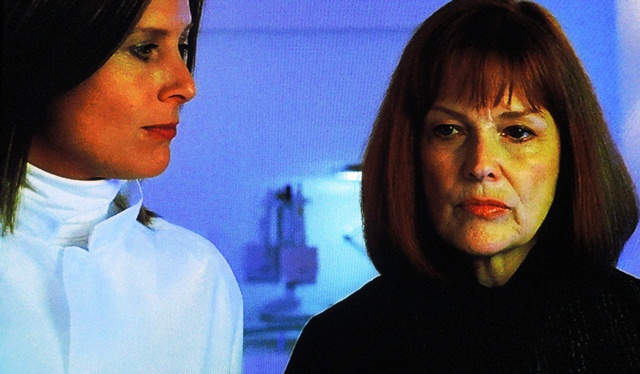


Later, Dunham interrogates Eastwick.  He offers name, rank and serial number.  Watching in the adjacent room through the interrogation window, Peter requests Charlie contact Olivia to let him give the interrogation a shot.  Francis is a little skeptical of Peter.  Peter approaches Eastwick from the perspective of science explaining that the radiation which is causing his hands to tremor is just the beginning.  It's the "walking ghost phase."  Internal bleeding and other issues will follow, but if untreated he will die.  "You violated the laws of physics and mother nature's a bitch."  He tells Peter he doesn't know the man's name.  He was never told.  He was merely a gun-for-hire.  The man is heading to a field in Westford, MA.  He is going to an abandoned air strip called Little Hill Field.  Remember code word Little Hill obtained for David Robert Jones to save a man, Joseph Smith, as Agent Dunham left the cell from Episode 7, In Which We Meet Mr. Jones.  The FBI mobilizes the forces.


Back at the lab in Harvard, Walter recalls that Peter almost died as a child from a rare form of bird flu called Hepea.  Walter was consumed with attempting to save his son.  Only one man had ever successfully cured a case of this flu.  The man's name was Alfred Gross, a Swiss man.  He died in 1936.  Walter designed a device to reach back in time cross and breakthrough the space/time continuum and bring Gross forward in time.  It was the components of this plan that Walter placed in his safety deposit boxes.  Peter is in disbelief.  Walter reveals that his son actually began growing healthy before he could test the device.  It was a miracle.  Walter admits that the science behind it in theory would work.  It could retrieve anyone from anywhere at any time.  But is there something more to Peter's miraculous recovery?  And how exactly did Jones know the locations to all of Walter's technology?


Loeb and his associates triangulate the coordinates and location of Jones in their effort to retrieve him and bring him to Little Hill.

Olivia Dunham nears Little Hill as the Fringe Division approach from different directions separately.  Dunham is surrounded by SUVs and tranquilized and abducted as she attempts to run on foot.


David Robert Jones is visited by attorney Kohl whom he kills.  He then wears the suit he requested Kohl wear upon his next visit, which, of course, was intended for Jones.  With Little Hill set up a ring of light glows and extends skyward.  Jones is coming home and escaping from the prison in Germany.

The plan of Loeb and Jones seems to come together flawlessly as Jones is transported through time and space to Little Field.  Ity goes smoother than setting up a personal computer.  The whole special effects sequence focuses on the idea of teleportation and it is achieved brilliantly as a visual set piece that certainly alludes to ideas first established in Star Trek: The Original Series without really considering that series here.  The application is unique within its context.


Broyles contacts Nina Sharp suggesting she might have something to do with Dunham's disappearance.  She assures "Phillip" she has not absconded with her. It suggests they know and trust one another well.

Loeb greets Jones and offers "nice trip."  Jones must head to a decompression chamber or thus suffer from tremors.  And then it's off to meet with Agent Dunham.

Whew! Safe is an exciting, exhilarating science fiction-styled thrill ride.  It's no joke.  Things are really coming together and many of the fascinating elements of Fringe's mytharc are adding up. Did others agree?


Actor Lance Reddick, who played Phillip Broyles, told The Los Angeles Times, "We found who we were in episode 10, the episode where Olivia got kidnapped... We were trying to hedge our bets and trying to be too many kinds of shows at once. I'm not saying we got rid of the procedural element because each episode still is on a case – a case in terms of the quote-unquote police work — but it's not formulaic, not like the early episodes." Travis Fickett of IGN called the episode "great!" He notes many of the aspects we've covered here regarding the importance of the earlier episodes.  "It capitalized on absolutely every scrap of promise the show has had in its first nine episodes. Tell your friends and neighbors, they're probably going to want to tune in when this returns after the break. Not only that, but this episode heightens and improves every episode that has come before – as now all the pieces are important."  The feeling was almost resoundingly universal echoing io9's thoughts that the installment was "crucial."  Entertainment Weekly's Jeff Jensen nominated Safe as the eighth best entry of the series.


Writer David H. Goodman comes up with a strong entry, the third of six for the man who would move on to become a big part of Once Upon A Time (2011-present).  Director Michael Zinberg (NCIS, Lost) brings solid credentials to Safe from his work in criminal justice television.  I would never have imagined Fringe was heading in this direction just a hand full of episodes ago.  But each new entry makes some connection to older episodes and those stories are beginning to have a much greater purpose.  It's a great plan and one I neither saw coming or would have envisioned.  The well-paced entry has all of the excitement of a heist scenario, but with loads of detail, mythology (linking back to In Which We Meet Mr. Jones and The Equation directly and perhaps even to titles like the vibrating cylinder of The Arrival indirectly) and the intriguing geek bits that complement great science fiction.  I generally start to go into withdrawal without a monster appearance every few episodes on any series (kidding), and yet I'm spellbound.  While the theme of the safe deposit boxes is reflected clearly in the title, as well as the escape of one David Robert Jones, it's relatively clear from this exciting installment that no one on Fringe is safe at all.  It has all of the danger and menace of classics like The X-Files, but is coming up with a new, vibrant, technologically-sophisticated game plan or scheme sure to differentiate itself from its predecessors when it's all said and done.


Safe: A-.
Writer: Jason Cahill, David H. Goodman. Director: Michael Zinberg.
Glyph Code: TRADE.

Thursday, March 28, 2013

Memo To J. Edgar Hoover: Flying Saucers Information Concerning (1950)

I've just finished a good long look at The X-Files Season Two, a full, whopping 25 episodes long.  How fitting a story connecting the FBI to Ufology should made headlines yesterday as I had just completed The X-Files, Season Two, Episode 25, season finale, Anasazi, which centers aspects tied to the very story making the news.  Anyone interested in all things Ufological would no doubt find interest.


Anasazi centers on the story of a computer hacker called The Thinker who taps into secret U.S. Government files including the mythic MJ-12 file (Majestic 12; codename assigned to a secret committee of scientists, military and government officials under the authorship of President Harry S. Truman in 1947 following Roswell -Operation Majestic Twelve) and the events surrounding Roswell, New Mexico.  Anasazi, suggesting the furtive group as an international collective, cleverly blurs the lines between fiction and non-fiction.  It ties the science fiction realities of Agents Fox Mulder and Dana Scully and the events of The X-Files, Season Two, Episode 5, Duane Barry directly to these elusive files.  Chris Carter was always masterful at weaving real life conspiracy mythology (?) with his own science fiction mythology and the events in yesterday's news are linked to the culmination of such ideas in the David Duchovny and Chris Cater-scripted Anasazi from Season Two.


So a one page memo, intriguingly connected to the often impenetrable world surrounding The X-Files, and Anasazi in particular, was released in April 2011 under the Freedom Of Information Act.  The memo is dated March 22, 1950.  The memo was directed to J. Edgar Hoover from a man named Guy Hottel, then head of the FBI field office in Washington D.C..


There's no shortage of myth and intrigue that surrounds the J. Edgar Hoover era.  In Chris Carter's Millennium (1996-1999), Season Three, Episode 14, Matryoshka, the writers, Erin Maher and Kay Reindl (look for an outstanding interview with those writers in the wonderful publication Back To Frank Black: A Return To Chris Carter's Millennium (2012) available from Lulu), intelligently weave the idea that Hoover was in effect a member of the secret society that was The Millennium GroupMillennium directly tied the then director of the FBI, Hoover, to the mysterious group.  The X-Files also explored its own mythology with Hoover directly linked to The X-Files, Season One, Episode 19, Shapes, when Fox Mulder suggests a similar case forty years earlier was in effect the first X-file opened by J. Edgar Hoover himself.  The Hoover connection is indirectly explored further in The X-Files, Season Five, Episode 15, Travellers.  Hoover was neck deep in it within the smartly-written confines of these wonderfully original sci-fi series at the hands of Chris Carter. Carter was so good at mythology-building it was sometimes difficult to determine what was truth and what was fiction, while remaining endlessly entertaining within a unique look and cinematography not revisited since the end of that impactful series.


So with The X-Files and Millennium directly linking the FBI to questionable and allegedly historical events, here we have the release of a memo with the subject header of FLYING SAUCER INFORMATION CONCERNING.

The memo reveals the recovery of three saucers 50 feet in diameter.  An Air Force investigator indicated there was a recovery of "three bodies of human shape but only 3 feet tall, dressed in metallic cloth of a very fine texture." *// So why is the memo making news today?  The FBI commented recently in a blog post that "The Hottel memo does not prove the existence of UFOs."  The FBI noted the events in Roswell July 1947 took place three years prior to the memo.  The FBI sees no connection and further remarked, "It is simply a second - or third-hand claim that we never investigated."  Really?  Wow.  And the Federal government wonders why people are skeptical of its transparency.  It's no surprise The X-Files was so overwhelmingly embraced for nine seasons.


The FBI noted, "The FBI has only occasionally been involved in investigating reports of UFOs and extraterrestrials. For a few years after the Roswell incident, Director Hoover did order his agents—the request of the Air Force—verify any UFO sightings. That practice ended in July 1950, four months after the Hottel memo, suggesting that our Washington Field Office didn't think enough of that flying saucer story to look into it."  Incredible. The point here is do you believe?  Like Mulder, I want to believe.

The latest update in the questions surrounding the world of Ufology merely serve to underscore the intelligence of Carter's series and its importance culturally. The government continues to control the flow of information just as The Cigarette-Smoking Man claimed throughout The X-Files. What do we know today? It's positively fascinating when creative people are able to integrate the political and cultural realities within science fiction as Carter managed so seamlessly and brilliantly with The X-Files and to know that over a decade on that that truth is absolutely still out there.


I had planned on spending some time on The X-Files Season Two this year and still do, but have placed that on hold to look more closely at Season One for both Fringe and Falling Skies.  I'm not exactly sure how I want to approach The X-Files.  It's massive in scale, scope, artistic integrity and sheer number of episodes.  I have such immense respect for the series and anything else by Chris Carter I'll definitely take it season by season.  The X-Files is definitely a series I look forward to spending some time on, whether in shorter posts or lengthier posts has yet to be determined.

Defiance: The First Fourteen Minutes

I had a film professor in college that used to tell his students if a film didn't get your attention in the first twelve minutes and give you, the viewer, a reason to stick around it probably failed in doing its job.  It was something to that effect, give or take a few minutes.  I understood the point obviously and for whatever reason I've often used that as a barometer on television and film, sometimes to my detriment.
 
The complex nature of television today sometimes requires a bit more patience.  Fringe anyone?  You know what I mean.  It's good to give these creative endeavors the chance they deserve.  The X-Files (1993-2002) blossomed.  Fringe (2008-2013) proved to be solid as first seasons go.  Babylon 5 (1993-1998) managed to survive an awkward start.  Terra Nova (2011), Surface (2005-2006), Threshold (2005-2006) just couldn't get over that hump.


So with the promise of another SyFy original (I know I cringe a little too), I await with baited-breath for Defiance.  I took a look at those first fourteen minutes last evening.  It certainly pulled me into unique science fiction fantasy escape.  The CGI was impressive enough to create a surprisingly original landscape.  Defiance promises to offer an impressive piece of world-building complete with intriguing characters, likable ones too, aliens and monsters.  That's a recipe for success if done right.

The fourteen minute preview had me at... well, Johnny Cash.  Two of the lead characters, one alien and one human, spend a good sequence playing duet to Jackson by Johnny Cash and June Carter Cash.  Damn!  You've got my attention.  Any science fiction series far out enough to capture the look and energy of something like Farscape (1999-2003) with its sense of Star Wars-like adventure grounded in the Earthly good tunes of one, late great Johnny Cash has my personal vote and support.  John Crichton knew how to draw on popular culture too.

It's no surprise it flexes Farscape-like muscles either.  Defiance, developed by Farscape creator and Alien Nation (1988) writer Rockne S. O'Bannon, has his fingerprints all over it.  He knows how to deconstruct the genre and build something new and refreshing.  It holds a lot of promise on this fact alone.


The sci-fi tech weaponry mixed with a little Mad Max-aesthetic of the rolling vehicles also promises to lend some thrills.  Very little is established initially other than the fact Earth has been terraformed by aliens and 33 years later Earth looks a whole lot different from altered vegetation to alien lifeforms, a fusion of the Earth we knew and one that has been altered dramatically.  It's an intergalactic melting pot.

Defiance appears to be surprisingly original while borrowing elements from Firefly (2002), Terra Nova, and Farscape.  There are definitely flavors from those aforementioned series that thread through the special mix on the series.  Obviously it's too early to tell, but I have been hopeful and based on those first fourteen minutes I remain optimistic.

Defiance offers plenty of potential for tapping into global and culturally-sensitive questions with regard to illegal immigration.  With characters clearly immersed within a combination of high tech Farscape and lo-tech Firefly where humans and aliens co-habitate Alien Nation style, it will be interesting to see if Defiance presents not a philosophy of us versus them, aliens versus humans, like Falling Skies, but rather present unions based on a shared philosophy and thinking not by lumping groups by ethnicity, but rather mixing them by thought and belief.  God knows America is at a crossroads between the belief in big government and personal freedom free from extensive intrusion.  I look forward to seeing how Defiance frames and works these societal debates within what should be a thrilling science fiction saga.


Maybe, just maybe, this SyFy Original will be one of those rare efforts to come along and stick around for at least four seasons.  At least the cable channel is finally sinking some money into actual science fiction.  Now there's an idea.  The cable channel struck success with Farscape and Battlestar Galactica (2004-2009).  Perhaps the effects-heavy Defiance will be their next big thing, and I sure as hell hope so, because most of their original programming ain't worth a damn and I haven't seen them plug for a series of any interest in quite some time, plus I'm hungry for it.  For once, they have this discerning Sci-Fi Fanatic's attention and I'm hopeful this one is a keeper.  Don't get me wrong I love Erik Estrada, but I don't want to see another Chupacabra Vs. The Alamo (2013).

Tuesday, March 26, 2013

Falling Skies S1 Ep3: Prisoner Of War

"It's not war. It's survival."
-tagline to the Battle: Los Angeles (2011) poster-


"There are hundreds of people out there with missing kids.  We rescue those kids, as many as we can - we keep their hope alive.  We give up on those kids - those people are gonna give up hope too."
-Tom Mason to Captain Dan Weaver-


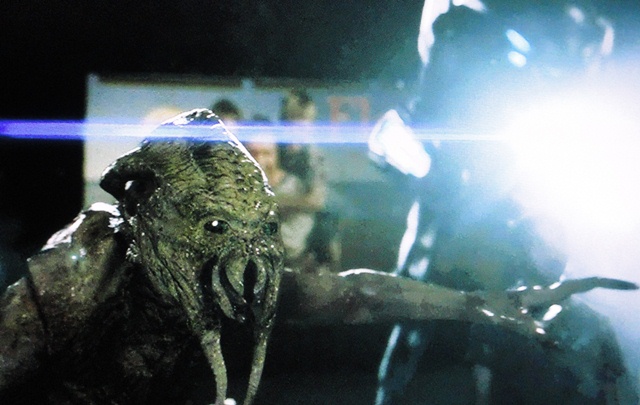
Former teacher Tom Mason and his select group from the Second Massachusetts scope out the whereabouts of their beloved children now harnessed by the alien invaders.  The kids now work tirelessly, mindlessly and drone-like on the top of buildings dismantling metal and scrap like busy worker bees while under the strict watch of Mechs and Skitters.  The effects work of which is outstanding on Falling Skies seamlessly integrated into the new world reality.


As Tom and the group peer out over the top of a neighboring building, Karen Nadler knocks off a loose brick sending the group quickly retreating as a Mech begins unleashing firepower toward the rooftop without hesitation.  The group will return for their own in Falling Skies, Season One, Episode 3, Prisoner Of War.


The group returns to their makeshift base of operations, for now, the John F. Kennedy High School.  The returning group is peppered with questions by worried parents concerned for their missing children.  They are asked to place the details and photos of their children on a cork board in the school.  The concept serves both to aid in identification of their loved ones and as a preservation of their memory and keeping hope alive in the encampment.


A meeting called by Colonel Jim Porter, played by Dale Dye (the former US marine captain appeared in HBO's Band Of Brothers and The Pacific, Casualties Of War, Saving Private Ryan, Outbreak and the genrific Starship Troopers), recognizes other resistance groups have formed in other parts of the country (the good news) and that alien structures like the one looming over Boston are being built in other cities (the bad news).  Dye certainly lends Falling Skies a credible presence.  Troops are ordered to gather munitions and other weapons to help fortify the insurgency as well as gathering intelligence on the aliens.


Tom wishes to save as many harnessed kids as possible against Captain Dan Weaver's wishes.  There have been three recent attempts to remove harnesses from the children.  All have died.  The science team thinks they now have an answer. Porter gives Tom his blessing to rescue just one more child - Ben.  Tom knows the guinea pig is Ben and it's clearly a personal coin toss to keep hope alive as life and death hangs in the balance.


A sweet moment in the school gymnasium between Tom and his son Matt sees Tom assure his son that Ben is going to be okay when the harness is removed.  He wants to give his son hope and believe himself that his son Ben won't die in the process.  The men, particularly Tom, clearly need to be strong leaders for the survivors.


A nice character moment between Uncle Scott and the imprisoned John Pope reveals Pope to be a bit of a chef schooled in the culinary arts.  It also reveals precisely the opposite for Uncle Scott, that he isn't much of one at all.  Scott believes Pope might best be served as the group's resident chief cook and bottle washer.  Colin Cunningham relishes his role on Falling Skies and he does bring a certain energy to his crazed degenerate.  "For the love of God could someone please find me some olive oil."  Pope's a classic and with not much in the way of supplies to work with he still happily accepts his new found position among the ranks. My grandmother would easily refer to Pope as "a real character."  She would say, "Oh, he's a real character alright."


Actor Steven Weber (Wings) guests as Dr. Michael Harris, the man with the alleged solution to removing the harnesses.  Burn them off at their spike insertions.

Weber and Tom discuss how Weber survived the air attacks, scarred but saved by the resistance.  Weber explains how he wishes he could have saved Tom's wife Rebecca.  Tom indicates they tried looking for him after finding Rebecca dead. Clearly Weber was one of the last to see Tom's wife alive, but Tom is clearly suspicious of the events as they transpired. Changing the subject, Weber thinks he can save Tom's boy, Ben.


The mission is a go.  Tom, Hal, Mike Thompson, Dai and Karen Nadler look to find Ben, but instead manage to snag Mike's son Rick. As the group furtively plans its assault Mike jumps into the fray spotting his son and responds with overwhelming emotion, absolutely no control, and two Mechs attack.  One is destroyed with a car bomb while the other corners Hal and Karen while the others escape including Tom wounded by a Mech missile assault.  Now, not only does Tom not have Ben, but his son Hal is now missing as well.

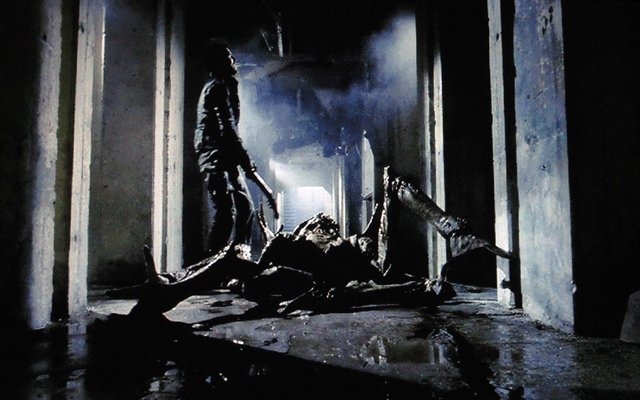
After recovering in one of the endless abandoned buildings Tom strikes out on his own.  Heading down a darkened hall Falling Skies delivers one of those terrifically timed jump-from-your-seat, scared-in-the-dark moments.  Director Greg Beeman times it perfectly as Tom's flashlight fails and he shakes it in the dark only to shine the light upon a Skitter's hideous face up close and personal.  The scene absolutely pops and viewers jump as Tom struggles for his very life.


In the thrilling action sequence Tom employs the very method John Pope described to him in Season One, Episode 2, The Armory shooting out two of the Skitters' legs slowing its attack before finishing it off by bashing it in the head with the butt of his shot gun a la The Walking Dead.  Only Tom doesn't kill the hardly mindless creature.  It's alive and he brings it back to the school alive as a prisoner of war.  Meanwhile Dai and Mike have returned to the school with Rick as well.


"Captain Weaver I brought you a prisoner of war," declares Tom before Weaver.  The moment really spoke to the essence of the episode.  Throughout the episode the focus by viewers was a preoccupation on the human prisoners.  Not for a minute did I see it coming that Tom would return to the high school with a prisoner of war of his own shifting the focus of the episode on both camps.  The third episode angles from both sides of the fight with this revelation and it's one that really worked as an unexpected surprise. Though, and it's far too early now, but it would be interesting in the future if writers managed to give us a more comprehensive perspective from the aliens.  Offering the vantage point of the enemy a la something like director Wolfgang Peterson's Das Boot (1981) always makes for fascinating viewing. Think the perspective of The Others in Lost (2004-2010). Viewers would no doubt welcome the alternative in the future. Weaver wonders how he did it, but Tom, as he has always said, just had to get close enough and a close encounter it was indeed.  Tom heads back out for Hal, Karen and Ben once again, this time - alone!


It's nightfall and back at the site of Rick's abduction, Hal and Karen awaken after being stunned by the Mechs only to have Hal witness Karen's abduction.  Abduction could have been a great title for this one, but Prisoner Of War works beautifully in the framework of a major war in the making.  You can't help but imagine that a series conclusion to Falling Skies could certainly be epic.  If not, there are plenty of options even if budgets keep things on a smaller scale.  Karen is hauled away by harnessed children one of whom is Ben.  Hal attempts to get his bearings as a Mech towers near him shining a blinding light into his eyes.  In an allusion to the atrocities of our own Earth wars, the Mech lines up five of the harnessed children in a firing squad-styled line up.  A Skitter points Hal's attention and focus to the children where he is forced to witness their execution by the Mech droid.  It recalls the worst moments of Vietnam on our own soldiers and Hal screams at the sights of their murder.  The aliens are sending a message.


Prisoner Of War is filled with terrific special effects moments. They are simple, but detailed and beautifully rendered for television seamlessly woven into the gritty action.  I continue to be surprised at the level of quality here.  This is merely complemented by the effective use of sound effects for the Skitters and the Mechs creating an entirely alien environment that is slowly enveloping and impacting humanity - a truly foreign insurgency.  It's truly exceptional.


Inside the high school Harris prepares to cut or burn through Rick's harness. Removing the harness has caused death, but, as barbaric as it is, Harris believes burning through the harness connectors to the child and then supplementing the child with drugs could ween them off a reliance on the device gradually.

There is clearly a combative relationship between Harris and Weaver and Harris is downright antagonistic in character. He's hardly amiable and won't be around forever.


As the harness glows in a throbbing fashion, Harris prepares to burn off the harness.  To do this he must burn through the "needles," vein-like appendages that penetrate the human body and connect the body to the bulk of the harness.  Those needles appear to be feeding the host.  Harris' theory is that the harness synthesizes an opiate-like substance drugging the children.  If you sever the needles you cut off the drug sending the children into a kind of withdrawal that leads to potential shock and then death.  The doctor has Anne Glass affix a morphine drip to bridge the child to safety.  The scene is rather grueling and even grotesque as the alien harness drips a green fluid from its severed needles.  There isn't anything about the scene that makes you feel good or feel like it's going to go well.  And since Tom's son, Ben, was suppose to be the test subject that wouldn't seem to bode well for Mike's son, Rick.


A good deal of alien information is gleaned from the scene offering a hint of alien biology or potential anatomical traits.  Harris further describes how the needles work.  They penetrate the spine in a hardened form.  Once they have entered the human body, they soften and establish roots bonding with a human's central nervous system.  Lovely stuff. The scene suggests a bio-mechanical nature to these creatures and hardened materials with the potential to inevitably become organic working in their favor.  Harris and Glass deduce that the host and the harness, if given enough time fuse together, inevitably becoming one. Ironically, evidence suggests the host becomes a kind of parasite eventually requiring the harness as host or it will die. Often in Earth biology the host to organisms of a parasitic nature are typically much larger. Think tapeworm, fluke and fleas.  The X-Files, Season Two, Episode 2, The Host is a beauty. The reverse is true here in Falling Skies.


Tom finds a near traumatized Hal after seeing the kids murdered by the invaders.  Hal has been essentially left unharmed by the Skitters and the Mechs. Tom suspects its standard from the war playbook.  The aliens leave a survivor to send their message back to the resistance.  Tom analogizes the move to the Nazis during World War II.  They would sometimes leave an allied soldier alive to send a message.  "You're the messenger," believes Tom to Hal.  Tom is certain if they return they must save all of the children or they will die.


Back at camp the Skitter is imprisoned.  Dr. Harris will remain with the Second Massachusetts for a time to study the physiology of the creature or the "conquerors" as he calls them.  Tom is fairly incensed by the remark.  "We're not conquered unless we give up."  The scene much more effectively captures the intimacy of the human struggle that a feature length film like Battle: Los Angeles simply doesn't have the time to do.  In fact, the tagline to the film, "It's not war.  It's survival.," speaks more fittingly to the nature of the conflict in Falling Skies.  It underscores the intimacy of the struggles, while Battle: Los Angeles (2011) is much more a cinematically epic, big scale production equating to war with aliens.  Sure, it's survival, but a series like Falling Skies actually takes time to underscore the nature of what that actually means with each passing step.

Back in the medical room the stumps of the former needle insertions still line Rick's penetrated back.  The hope is they can be removed as he stabilizes.


At the site of the caged Skitter the pompous Harris discusses how some feel that surviving the first wave of the invasion made them the best of the best to a degree.  He doesn't seem to see the nobility of hiding or running.  Tom wonders and even asks if that is how Harris survived.  Running?  Hiding?  Is that why Rebecca was left to die?  Tom presses Harris dubious of his story even knowing he may have ran and left his wife to die.  She was found holding provisions and a duffel bag to heavy for her to handle alone.  It's an uncomfortable moment between Harris and Tom because Harris ran away a coward. How would any of us respond in such a critical moment of life and death?  We certainly hope that we would choose the noble option.  We hope we would find the courage not to skitter and run, but stand our ground to save our fellow human beings.


Harris, in a disgusting display turns the tables and tells Tom he knows that she was supposed to be with Tom that morning and that Rebecca left Tom home to sleep.  He calls Tom just as responsible for his wife's death and a man with a clearly "guilty" conscience after being slugged by Tom. The juxtaposition of the argument between Tom and Harris is interesting as it takes place near the imprisoned alien, the very creature we are supposed to be fighting yet we fight among ourselves.  And we fight among ourselves for all to see including the enemy. Tom tells Harris as he walks away, rather hopefully, "And no matter how each of us survived maybe we owe it to those who didn't to become the best of mankind."


The final moments see a misty-eyed and reflective Tom Mason pin a picture of his son, Ben, to the school cork board before resting next to his two surviving sons, Matt and Hal, who hold one another sleeping. Falling Skies is not afraid to get sentimental now and again and it does it at just the right moments without getting overly sentimental.


The final image sees the Skitter stirring in its cell.  It's eyes open wide as the camera closes in on its face juxtaposed by a close zoom in on Rick's face lying in the medical room.  Rick's eyes open and somehow a kind of psychic connection appears to still be established between Skitter and formerly harnessed child. The questions remain and the potential remains wide open for Falling Skies.


Prisoner Of War: B+. Writer: Fred Golan. Director: Greg Beeman.

Surprisingly, up next, Falling Skies, Season One, Episode 4 and 5, Grace and Silent Kill, respectively, directed by none other than Fred Toye a.k.a. Frederick E. O. Toye, the man behind production and direction on eight episodes of the other series we've been covering here, Fringe, as well as production and an episode on Lost.