
Monday, August 15, 2011

Wednesday, August 10, 2011
Fire In The Sky
 Fire In The Sky [1993] is one of those small, science fiction film diversions that remains a minor classic in the alien abduction film sub-genre. Robert Patrick is a big part of its success.
 The film purports to be "based on a true story." You should always question the measures of truth and fiction ultimately in play within said end product. Battle: Los Angeles [2011] was based on true events too. But, of course, the last time we checked, an all out military/ alien ground war has yet to occur despite vivid depictions of an invasion in the film to the contrary, but that's entertainment. Fire In The Sky makes more of an effort to get things right, with its obvious application of artistic license, but it's more in keeping with reality.
 Fire In The Sky partly centers on the 1975 abduction of Travis Walton, a logger, from the White Mountains of Northeastern Arizona. It's based on Walton's book The Walton Experience. The screenplay is based on that source material and written by Tracy Torme. Science fiction fans will recognize Torme from his scriptwriting credits on Star Trek: The Next Generation. His episodes include Season One's Haven, The Big Goodbye and one of the better entries in that season Conspiracy. He also wrote Season Two's The Schizoid Man. He also penned three installments of the impressive, but ephemeral HBO series Carnivale [2003]. Fire In The Sky is one of his finest moments.
  Separate from the abduction component of Travis the film focuses on the aftermath of that abduction through the eyes of a primary second character, his best friend, Mike Rogers. Travis Walton is played by D.B. Sweeney who offers a solid, emotionally-troubled turn, and Mike Rogers is delivered with affecting, convincing sincerity by none other than Robert Patrick [The X-Files].
  Mike Rogers is the focus for the first two-thirds of the film, while the final act is refocused on the returned Travis Walton. Sweeney presents Walton's experience of the hypothetical, grisly alien encounter. It is the re-enactment of those events that falls into question the most according to those who have documented the case for years. The studio plays fast and loose with that portion of the Walton account, but it certainly lends the film a rousing conclusion and one that genuinely feels foreign and alien to the audience. The sequence is successfully effective and affecting.
  For me, the most stirring portion of Fire In The Sky is through the eyes of Robert Patrick as Rogers. It is through his reactions and the perceptions of him as a man by those around him from his small, close knit town that garners the most satisfying reaction from viewers. Rogers grounds the film and sells the account to an audience that invests itself emotionally.
  Robert Patrick is magnificent as Rogers and captures the essence of a film that spends more time on the humanity of its Earthbound victim than it does on UFOs and aliens. Sweeney's character and the abduction informs the Rogers character and his emotional response, as well as the response of those around him, throughout the picture. Rogers is undeniably the heart of the film. In many ways there's an irony in his performance. Two years earlier Patrick delivered one of the steely-eyed, coldest turns in science fiction as a credible, unrelenting T-1000 in James Cameron's Terminator 2: Judgment Day [1991].
  I was always struck by that performance and Cameron's choice of Patrick as the anti-Arnold in size and stature. Patrick sells the T-1000 as a smaller, but more stealth, powerful and ferocious unit seeking to destroy Arnold's T-800, the sexy Linda Hamilton's Sarah Connor and her son savior John Connor. Patrick was unstoppable in that role and as an unknown to me at the time, I fully accepted that Patrick was a terminating unit. It was an ice cold role, but delivered brilliantly and immortalized the character in science fiction legend. This role years earlier is why Patrick's role in yet another genre performance in Fire In The Sky is so fascinating and powerful. The character transformation and contrast is as staggering as the T-1000's ability to freely adapt from liquid metal to physical juggernaut. His work is truly remarkable here.
  The actor has fostered a love affair within the genre. Beyond T2, Patrick fortified my desire to stay with The X-Files for Seasons Eight and Nine for his brilliant portrait of FBI Special Agent John Doggett. In fact, it was Patrick's role in the film, Fire In The Sky, that caught the eye of Chris Carter. I was not among those quick to discount those final seasons of The X-Files as a result of David Duchovny's departure. In fact, most of all, I was impressed with what Robert Patrick brought to the series. Those were large shoes left vacant by David Duchovny that Patrick had to fill. It was no small task and Patrick was clearly up to the required task. Harsh criticisms are often levied on those final two seasons of The X-Files. Well, say what you will, it wasn't for lack of talent. Fans simply seemed less inclined to buy the Scully and Doggett combo as much as they were sold and invested in the Mulder and Scully relationship they had grown to love for seven years. As it turned out, Patrick was a terrific casting choice for that series and he delivered.
  Robert Patrick delivered a small, but mighty and meaty turn in Stargate Atlantis' premiere episode Rising. It was the series opener to the second incarnation of that remarkable franchise. Patrick was there to witness Stargate Atlantis rising and see Stargate SG-1 evolve into an exciting, more globally-appealing creation. His role is ephemeral, but his presence as an actor is always immense and lends weight to the proceedings of the very cinematic opener. In fact, ironically, in Rising, Patrick would finally be the recipient of an alien abduction himself, as victimized by The Wraith, years after the visitors arrived in Fire In The Sky and first missed their chance.
  Fortunately director Robert Lieberman cast Patrick in one of the two leads for Fire In The Sky as Rogers and allowed him to show us the fiery intensity behind those eyes that Patrick hadn't the chance to unleash until this film. He's a big reason Fire In The Sky succeeds, but there is more.
  The ensemble cast features Peter Berg [an impressive career in his own right including Late For Dinner and A Midnight Clear], Henry Thomas [E.T.] in an oddly fitting role and Craig Sheffer [A River Runs Through It] who really flesh out the kind of small town vibe populated by American characters that make this film worth of your time. It's rare to see a science fiction film reveal itself without the prerequisite big effects and big aliens. Fire In The Sky breathes before the big reveals and those are impressive. It's a treasure really.
  By the time we do get to that third act the creators let us have it between the eyes with some astounding effects work [Industrial Light and Magic] that still looks staggeringly real nearly twenty years later. The camera work and editing of those effects is stunning. It could be used in film class dissections. That intimate work coupled with Mark Isham's score makes for a truly unnerving experience. The director takes us into the world of Travis Walton and his abduction experience aboard an alien ship. The juxtaposition of Walton's experience through the corridors of a hospital upon his return and images aboard an alien vessel are of nightmarish proportions.
  The title of the film is equally appropriate as the film certainly mixes reality with fiction to a degree. How often do events of this magnitude simply get explained as something natural. UFO? I'm sure it was just a flash of light or a fire in the sky. The truth is always explicable.
  Susan Granger of American Movie Classics wrote "the last 10 minutes are so terrifying you'll be gripping the edge of your seat." I wouldn't necessarily go that far, unless of course you're twelve then she'd be right. A midnight viewing and the lights out will certainly lend the necessary atmosphere. There were a number of critics who felt the film was uncertain of its genre identity or that scripting by Torme was weak. To the contrary, I felt Fire In The Sky was unafraid to tell its story based overall on the events depicted by Walton and the dialogue was fairly natural to small town, rural America. I thought the film made efforts to be true to its source material and location and for that it should be applauded never sacrificing reality for spectacle. The depiction of the alien imprisonment is certainly the one area that falls into question, but without artistic license would we have a film to enthrall the imagination of filmgoers? Roger Ebert wrote, "The scenes inside the craft are really very good. They convincingly depict a reality I haven't seen in the movies before, and for once I did believe that I was seeing something truly alien, and not just a set decorator's daydreams." It's a valid point and seeing it today won't change that opinion. This is a gifted effort.
  The picture certainly can't compete with the speed and energy of today's big budget science fiction vehicles, but as small films go Fire In The Sky is an entertaining little gem and much better for it. It's the kind of science fiction story you miss seeing more of today. Seeing a character-driven picture is always a pleasure and Fire In Sky is notable if just for the performances between the group of loggers and the investigators, one played by James Garner. The film is missing some elements to make the story more compelling in general. But as a microscope on human behavior and what people are willing to believe of one another without all of the facts is a big part of the picture's strength.
  There aren't many surprises here. This is just a fine little science fiction film and one that got by me when it first arrived in cinemas. The abduction happened all too quickly I suppose. I purchased an imported Canadian copy on the cheap and while it's not Alien or The Abyss, I did enjoy the small town American charm of the film's setting. Much has been talked of the innacuracy of the film and its sensationalized depiction of the events surrounding Travis Walton's alien isolation. Maybe the use of his name is about the only speck of truth to the tale, but as entertainment goes, Fire In The Sky is cinematic X-Files-like fare. That's never a bad thing.
  Fire In The Sky fails at giving us a greater understanding of the actual alien abduction surrounding Travis Walton. You'll be as perplexed by the end as you were when it began. Where the film succeeds is its ability to depict human nature and how it's pressed under the weight and pressure of extraordinary events. People's behavior and a focus on human nature is always more fascinating than an alien microscope or alleged experimentation. Like District 9 [2009], and the tragic story of dear Wikus van de Merwe, it's the potential for human wreckage by inexplicable events that makes Fire In The Sky a fascinating little tale.
Fire In The Sky: B+
Extract from Starlog #189: This extract is actually an updated component of the entry. I recently read a unique segment called True Documentarian by Kim Howard Johnson. The writer's information was fascinating as it offers insights by director Robert Lieberman that evaded me when I initially wrote this entry.
Lieberman on the film: "This is much more science fact than science fiction. Fire In The Sky is is based on a true experience. There were seven eyewitnesses, who all passed lie detector tests independently of each other." Lieberman was attempting to fuse his film with a documentary style. "No one had ever approached this sort of material on a very real, Earth-based level. The only thing close to it was Communion, and I don't believe that film really did it justice-it dwindled down to a silly fantasy. This one doesn't." He also pointed to Tracy Torme as a "true believer" too.
Lieberman on Travis Walton: "Travis was skeptical, but once Tracy had won his confidence, Travis was very enthusiastic in cooperating on the film's making. These are not timid people unwilling to discuss the experience. They're very detailed and verbal in their descriptions, which makes it all the more believable."
Lieberman on Robert Patrick: "He believed in this project so much that on his drive from New York to the interview with me, he drove through Snowflake, Arizona, went to a phone booth, looked up Travis Walton, and drove by his house. He didn't stop-Travis was mowing the lawn with his kids. ... He just observed him." Lieberman loved the "vulnerability" of Patrick. "Robert was unbelievably personable and lovely, and when he did his audition, it was heart-wrenching and brilliant." Lieberman felt eventhough "he has never really had to carry a big movie like this one" he was up to the task.
Lieberman on the final minutes of the film: "If the film works, the last few moments will bring a tear to your eye. It has a tremendous range of human feeling."
Coming Soon: The Abduction Sequence - Frame by Frame.
 Actor footnote: Robert Patrick [1958-present]. American. Patrick has had a very impressive career. Here's a sample. Die Hard 2 [1990]/ Terminator 2: Judgment Day [1991]/ Fire In The Sky [1993]/ Copland [1997]/ The Faculty [1998]/ From Dusk Till Dawn 2: Texas Blood Money [1999]/ Ladder 49 [2004]/ Walk The Line [2005]/ Flags Of Our Fathers [2006]/ We Are Marshall [2006]/ Alien Trespass [2009]/ The Men Who Stare At Goats [2009]. His television work includes the obvious powerhouse role of Agent John Doggett on The X-Files [2000-2002], three episodes of The Sopranos [2000] in The Happy Wanderer, Bust Out and Funhouse from Season Two, a guest spot on Stargate Atlantis for the premiere Rising [2004], an appearance on Lost in Outlaws [2005] from Season One, and a recurring role on The Unit [2006-2009]. This is just to name a few.
 Here's just one of his terrific moments in Fire In The Sky.
Wednesday, August 3, 2011
The Six Million Dollar Man: Wine, Women And War [2nd Pilot]
 If it stars Britt Ekland, can James Bond ... or The Six Million Dollar Man be far behind?
It's pretty clear from the opening minutes of The Six Million Dollar Man's second pilot, Wine, Women And War [1973], the creators had some intentions for Lee Majors that perhaps deviated from Author Martin Caidin's original concept found in Cyborg. The original pilot was mostly true to that original vision. That Pilot was a vintage, slow-paced, table setter for the re-birth of damaged pilot Steve Austin as The Six Million Dollar Man, but Wine, Women And War gets right down to business with an international flavor, a handful of women and a secret agent vibe.
 Herbie J. Pilato wrote in The Bionic Book, "Larson believes pilot films or episodes that kick off a series should have flashy, ear-catching opening credits, with a 'movie feel' and other large scale attributes." Writer/ producer Glen A. Larson added, "We were not that far from the James Bond heyday." Yes, even the pilot has a Bond-like baddie. The whole thing comes dangerous close to the world of writer Ian Fleming or producer Albert R. Broccoli's vision of 007.
  The first several minutes take place in exotic Alexandria and Steve Austin is clearly being established and groomed here as an American version of James Bond 007. It's no surprise or coincidence that Swedish beauty Britt Ekland, Bond girl extraordinaire from the film The Man With The Golden Gun [1974] starring opposite Roger Moore, would feature in this second effort if the 007 cocktail is what they had in mind. A submarine, binoculars, sharp suits and you're suppose to the idea very quickly.
  Martin Caidin was truly incensed by what was happening to the property that was born from his book Cyborg. Pilato wrote, "He became extremely dissatisfied with the show's direction. He refused to be associated with the project...." Caidin demanded, "I wanted my name off the credits. Creatively they were grasping at straws. I was embarrassed." Pilato reported Caidin's words. "They didn't need that Bond shit. Those first few shows were pure crap. They were ridiculous from a technical standpoint, and had nothing to do with reality. Larson was a very successful producer, but we didn't get along. When he turned it into James Bond, I raised holy hell with Dick Irving. I said, 'Dick, you're gonna kill the damn thing. We've got a great thing going here and you're gonna blow it completely with this bullshit!"
  Conversely, Larson had his own thoughts on Caidin calling him a "CIA groupie." He recalls fondly, "He sat down one day and told me 12 ways to kill someone without anyone ever finding out it was murder." Larson points to a frequent problem between writers and television producers calling Caidin "a little too attached to his prose," and not understanding "television very well."
  The one and only Richard Anderson. Take a look at the opening credits. This is a unique alternative to the opening title sequence we would come to know and love, but worth a look for giving us that retro agent 70s style. You'll note Oscar Goldman, formerly played by the late, great Darren McGavin in the first pilot film, has now been replaced by the equally terrific and certainly iconic Richard Anderson in the part.
 The Wine, Women And War story was penned by none other than Larson. Larson would later move on to Battlestar Galactica [1977-1978] territory and would take Britt Ekland with him for The Gun On Ice Planet Zero episode. Of course, Larson would also deliver us good things with Buck Rogers In The 25th Century [1979]. He would also produce Lee Major's other network effort The Fall Guy [1981]. Larson certainly has a flair for the dramatic adventure and he leaves his stamp upon this second outing.
 Steve Austin has twelve minutes to complete his mission. The American sub that waits on standby simply cannot believe he could finish such a mission is such a brief period of time, but of course, what they don't know - this is the Bionic Man.
 Austin boards a yacht and his green bionic retina does its scanning. Unable to complete his mission Austin narrowly escapes diving overboard as the yacht explodes in a ball of gunfire and flames.
 The approach is clearly more comic book in nature with this second pilot. Austin swims at great speeds. Aquaman would be proud. The creators use stock footage from war films as Austin's enemies drop depth charges. The editing in the sequence is dodgy at best. It's a little hard to fathom ;). Austin unites with his submarine team and escapes. Austin is hurt and his arm is badly damaged. Medivac is en route. The Captain submits they must forget what they have seen and if they don't get help soon they're "going to lose what must be the most valuable man in the world." Wow. That's heavy. Yes, human worth seems to be less an issue here given the price tag associated with Austin.
While McGavin was a wonderful actor it's refreshing to see the face we knew and loved in Oscar Goldman - the face of Richard Anderson. This is the very first exchange between Lee Majors and Richard Anderson in their respective roles. It's clear from the very beginning their was immense chemistry between the two. Further, Anderson really picks up where McGavin left off with the character. This is a wonderful sequence.
 It's pretty clear in this entry too that Austin is still getting his bearings within his new modified body and his frustration and anger has justifiably carried over from the first outing.
 Dr. Rudy Wells is informed by Goldman that Austin is tasked with finding a nuclear arms catalogue. It went missing in the nuclear black market. Goldman makes the eerie suggestion that the Unites States has populated the globe with weapons itself and of course, "naturally we've lost a few." Oh well.
Dr. Wells is clearly a confidante to Goldman and the OSI. Wells admits Austin is less than enthusiastic to work with Goldman and his organization. Goldman expects Austin's help "with or without his cooperation."
Wells mediates giving Austin no small comfort that he has the full run of the floor within the assigned building. The floor? Steve understands the limits of his freedom as a protected government asset. Steve, quick to temper, declares, "I'm nobody's robot!" He exits and runs into Harry, an old military comrade. The man suggests Austin head to the Bahamas for a little relaxation. Austin makes his escape and knocks the bars from his room window. Harry sees him to the airport and after his departure Harry makes a phone call alerting an unknown party that Austin is "on his way."
 On the plane Austin meets the always delightful Britt Ekland. He believes she has been set up to meet him by Harry. She slaps him in the face and Austin crushes his second glass of the episode, just in case we weren't fully aware of his strength. It highlights his lack of control.
 It's funny, but as much as they try to give Austin a Bond swagger you never quite picture him in the British role and thus it never quite works. In fact, Majors is no Roger Moore and I love them both. With time it might have worked, but the creators wisely reeled their Bionic creation back down to Earth for the ensuing season.
Austin checks in with Wells and explains he is experiencing body malfunctions [i.e. the crushed glass]. Wells explains it's merely a power surge resulting from an adrenaline rush.
 Midway through the episode, with his new found freedom, Majors finally seems to be relaxing into the role. He's less wooden and that Bionic Man swagger we remember begins to shine through.
 Majors discovers his neighbor is Ekland whom he met on the plane. He attempts to apologize to her, but is greeted by a Russian with a gun. Russians with guns and beautiful women never smack of Bond. Still, the cold war analogies will know no bounds for a series of this vintage.
Later, he meets another Barbie play thing. Yes, the life of a playboy does have its benefits. Cynthia Holland is a friend of Harry. Her friends call her Cyn. Yes, we can imagine.
On the golf course with Cyn, Austin spots Ekland again. She's accompanied by the businessman, Mr. Finletter, owner the exploding yacht Austin narrowly escaped in the beginning. Austin hits a golf ball and nearly sends it into outer space catching everyone's attention. It's a humorous moment, but one that gives his enemies a chance to take notice. Is that a sensible or good thing?
Here's a cute moment between Austin and Cyn.
 The Spy Who Loved Me? Of course, Wine, Women And War pre-dates the Roger Moore error, except for Live And Let Die and pays tribute to the Sean Connery period. Austin plays the women and Bond card nicely in the episode, which is paced a little better thanks to the scripting hand of Glen A. Larsen, but I still prefer the first film. Austin is like an American version of The Saint, but fortunately they moved away from this formula inevitably. Austin meets with his Russian friend, Alexi, and they each smash glasses together. That's four at this point. One more and we may start losing count.
 It turns out Alexi Kaslov knows quite a bit about Austin, but Austin is unfamiliar with the Russian mission regarding Finletter. As Austin attempts to depart he is shot. The Russians expect to buy arms from Finletter. It's relatively clear that a web of international spy connections is being established on a television scale to present their 007 scenario.
 Harry arrives in the Bahamas. Austin is captured by the Russians. He is kept aboard another yacht with a bikini-clad Ekland. No, imprisonment can't be all that bad. The gorgeous Ekland insists Austin is "a guest of the Soviet Union," but that he musn't use the radio or cause trouble unless shagging and the removal of cottonware is involved. Two men stand by with machine guns, but Austin plays along with Ekland. Wouldn't you? Like Bond, Austin score on Ekland. He gets the undergarments off and offers his best Roger Moore in bed impersonation. Majors has scored Barbara Anderson and Britt Ekland in just two episodes - not bad for a cyborg! Of coure, if you're the Bionic Man that has to resonate well with the ladies in the stamina arena. Ekland was one heck of a babe.
A romp in the hay, a french kiss and a crushed wall later and Austin escapes his captors once again. Austin arrives back at Harry's place only to cold cock him and discover Harry set him up. Oscar Goldman had Harry send Steve to the Bahamas as part of his incompleted mission. Austin wants out yet again, but learns that an innocent woman was killed by Finletter, injecting his character with the humanity we always loved in him.
 There's an added dimension in that Oscar never used the murdered girl to manipulate Steve. He learns of this through a colleague, but it gives Oscar the first sign of humanity and additional unexpected depth.
 Austin stows away aboard Finletter's car as Finletter escorts Austin's Russian friend to another location as part of their business transaction.
In a very Bond-esque conclusion, they are brought to a massive weapons facility. War games are the rule of the day. The installation looks like something right out of the Bond classics.
 Armed with new information Austin returns to Harry and is informed the mission is over. Harry Donner doesn't believe Finletter has any weapons of mass destruction, but Austin has other evidence concerning the weapons silos.
 Harry takes a bi-plane skyward and Austin parachutes in for the final confrontation. The cheese factor is undeniable. Dusty Springfield closes out the pilot in vintage Bondian, 70s style soundtrack fashion.
Finally, none of the trademark sound effects or brilliant bionic powers are ever on display here. There's an ocassional wall punch, broken phone and crushed glass [okay, several crushed glasses], but The Six Million Dollar Man we know and love is still to come.
 Classic Quote: Ekland: "In Russia they say all American men are soft." Austin: "We rise to the ocassion" [as he breaks his chains].
 Majors to Ekland: "Sorry I had to violate your porthole" [breaking through the wall after sex].
I laughed at several of these goofy one liners and The One To Be Pitied made fun of me, calling me several unflattering names, and indicated that it appealed to my inner nine year old. What's wrong with that?
 Nice stunt double. Not unlike Caidin's strong opinion on the matter, I can't deny The Six Million Dollar Man has a way to go. And listen, Ekland is a beauty, but a solid actress she's not. Solid thighs yes, solid delivery, not so much. That about sums up the problem with The Six Million Dollar Man on the surface in its presentation of Wine, Women And War.
  Harve Bennett was quoted in SciFiNow #55 in a TimeWarp section on The Bionic Woman about Glen Larson. "Without denigrating Glen, he made a conceptual mistake. And that was deciding he was going to do James Bond and put Lee Majors in a tuxedo with a blue-ruffled shirt. That's not Lee Majors. There's an image in the original pilot of Lee Majors coming from a flight ar Edwards Air Force Base. He's wearing khakis and he's got a toothpick in his mouth. That's Lee Majors. He's a shit-kicker." See Pilot.
 Lee Majors is meant to be human and he's missing something here as James Bond-lite. Majors is not Roger Moore and that's a good thing for The Six Million Dollar Man. He's American and he's The Six Million Dollar Man, which is the humanity this second pilot seems to side-step. The influence of wine and women can have that effect. Wine, Women And War: C. Writer: Glen A. Larson. Director: Russ Mayberry.
Wednesday, July 27, 2011
Farscape S1 Ep9: DNA Mad Scientist
 The stunning creation of Namtar. Namtar is just one of the many astounding aspects of the extraordinarily vibrant world of Farscape.
 If DNA is the root of life, the code or building block of creation, then greed is undeniably the root of all evil on a sociological scale. Greed is the root of the problem here as it finds its way into the hearts of our dear, would be team of space adventurers in Farscape. The functioning dysfunctional family of reluctant travellers steps back from the progress of their personal connections to date for one another in an exciting if disturbing turn. Be prepared for this Farscape favorite. Here comes Farscape, Season One, Episode 9, DNA Mad Scientist, where desire and want affects us all in ways that are less than becoming.
This brief introduction to Ratman, better known as Namtar, sets the tone for a vivid exercise in Farscapism.
 Namtar summons the assistance of his disfigured, mutant female helper, Coronada. Namtar secretes DNA from the all too accessible crew of Moya. They willingly submit themselves in the hopes Namtar may reveal the exact location of their homeworlds through the extraction of their genetic information. The crew desperately clings to the hope astronomical mapping of their homeworlds can be determined for their respective returns. The information alludes Moya's data banks. Of course, nothing is free. Everything comes at a price. Namtar's reputation as a DNA scientist somehow precedes him, and as the old saying goes, 'if it's too good to be true it probably is' exists for a reason. Namtar selects "beautiful" Pa'u Zotoh Zhaan first. A holographic display presents an interpretation of planetary locations across the Farscape galaxy. Namtar's database holds the genetic markings of over 11 million lifeforms. The genetic sample allows him to pinpoint the genetic location of its origin. The moment, the music is quite cinematic for television. It's beautiful. Farscape continues to demonstrate why it is a grade A production.
 The price: One of Pilot's arms. Yes, Namtar requires a sizable genetic sampling of the species. Is the price too high? Is the desire to obtain this information so great the crew of Moya would compromise one of their own? Could they - would they turn their backs? This is the moral dilemma. Despite Pilot's value and pivotal role to the crew of Moya's very survival, how do they see Pilot? Is Pilot a thinking, living, emotional being that is part of this makeshift family of castaways, or but a mere creature of higher intellect with something of value they deem expendable? This is the question. And if Pilot is expendable who isn't?
Earth is nowhere on the radar. John Crichton queries, "Am I in the neighborhood here?" He simply can't believe Earth doesn't register.
 Aeryn Sun refuses access to her eye by Namtar to take the DNA sample. [Sorry, there's no way I could allow a needle into my eye!] For Sun, her reasons are more out of an imperative to avoid Peacekeeper detection. Sun can't go back, "ever." Crichton, being human, knows that unless Pilot volunteers an arm they'll all be leaving the planet shortly. Being a human, of sound mind, he is not inclined to allow such an atrocity to occur to Pilot. Sun isn't so sure the others will allow Pilot the option, but rather taking one of his arms by force. You see, the thought never crosses the mind of American Crichton, because it defies all that he believes. It would defy anything an all American boy raised in the Carolinas would believe acceptable. It's quite simply a hideous act.
 Meanwhile, back on Moya, Pilot is literally being assaulted, wrestled and forcefully removed of an arm by Zhaan, Ka D'Argo and Dominar Rygel XVI. It is an ugly display of alien nature as blood from Pilot's arm sprays upon his face. It is a truly disturbing moment and as much as Zhaan would rather not do it, she does and this position by these three crew members is something that truly stuns us as viewers. Rygel, maybe, D'Argo perhaps, but Zhaan is shocking.
 On the whole, we are horrified by their actions. If science fiction offers us a window to the soul or a look at human nature in unique ways, this is a perfect example saved only by the fact Crichton is not among the violators. Crichton is our center, our human identification, our moral compass, but all represent the mistakes we make and the gamut of emotions we feel. It is a maneuver that will remain with us for some time and speaks to their characters. Desperation. Need. How far are willing to go when pressed? This is a glimpse at our flaws and the atrocities we commit. We are taken to dark places - all of us. Where will the crew of Farscape go from here?
 Sun, who appears to share a connection with Pilot, would not return to Moya. We are all faced with difficult decisions in life. Think Sophie's Choice [1982]. Despite her objections, Sun essentially removes herself from the proceeding and does nothing to prevent it. Perhaps, her opposition would not matter. This is undetermined. But does not her silence make her just as guilty. Crichton too. We are forced to ask that of ourselves.
 D'Argo and Zhaan return to the planet upholding their end of the bargain. Namtar indicates it will take some time to load the cartographs of their homeworlds into the crystal. The crew of Moya is less than trusting of Namtar. It turns out he's a rather disturbed or "mad" scientist. In a dark room within his quarters, he retreats with Coronada and we find a mutant creature chained to the wall, a victim of Namtar's experiments, like Coronada complete with her massive, freakish hand. His hope is that the Pilot DNA will further his sick, demented genetic cocktails.
On board Moya, Crichton is troubled to find Pilot is now one arm short of four. He arrives to speak with Pilot as one of the DRD's finishes soldering repairs on Pilot's arm joint and wound. This is an insightful moment regarding Pilot's species and its regenerative capabilities and the creature's mission.

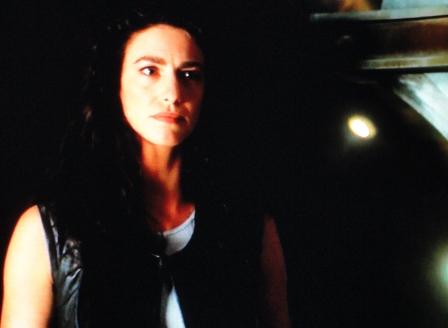 Naturally we have such empathy for Pilot. This is clearly a forgiving species. How can one harm a creature so seemingly giving and kind? I mean those Pilot eyes will melt the coldest of hearts. Much of the information found in this episode will be cause for greater reflection in an even more horrifying entry found in Season Two when it comes to the question of behavior and motivation. Sun asks the moral question we should all ask.
 Crichton is disturbed by the display of violence against what he considers, like Sun, one of their own. He calls their status, "the odd men out." Sun worries all will be going home. She fears, internally, Crichton will find home. She's always been one among many as a Peacekeeper and she's never been alone, but she feels alone. Crichton tells her he would take her home to Earth. Sun appears caught between her role as lost soldier and her new existence. Her Peacekeeper life was clearly a stern, almost grim existence. She is a severe character and humor and joy do not come easily to her.
Elsewhere, D'Argo discovers Rygel has been packratting food supplies needed by the crew. The more you see of Rygel the less reason he gives you to like his character, if he has any. Having said that, just when I've given up on the despicable alien cretin he turns it around for me and gives me pause so that I don't completely give up on him.
 Shortly thereafter, Zhaan and D'Argo discuss the price to pay for information concerning one's homeworld. She is surprised by Crichton's less than enthusiastic support for the others. There is clearly a difference of ethics and morality in play. D'Argo believes Crichton would have sacrificed his memocks [a penis?] for Earth's location. This is where, I believe, D'Argo does not genuinely understand the human condition or at least, more specifically, Crichton's sense of camaraderie beyond genetic or the specie-specific boundaries of Farscape. D'Argo will no doubt learn. But, God knows the human condition has its fair share of participants who would resort to the reprehensible.
Zhaan suspects she would sacrifice if it was required. Would she? Then, D'Argo asks the most prescient, telling question, given his knowledge- why does Namtar work under cloak of darkness in the Uncharted Territories? The question comes too late. D'Argo can't understand it. Namtar's knowledge could bring wealth, fame even power. Zhaan reckons it would change the basis for astral-navigation. D'Argo believes it could affect how war is waged. D'Argo touches his eye. Clearly, Crichton, D'Argo and the others are all feeling the effects of Namtar's experiment. The question is what did Namtar do to them? One thing is certain, desire may indeed bring out the worst in us.
 On the planet below, Namtar's frustration illuminates the truth of his own existence as a genetically endowed creature with psi-powers. Coronada cringes in fear of his powerful psychological rage. He turns to find Aeryn Sun has arrived for the eye fluid extraction. Don't we all want to belong? Sun requires a home she can "fit in" of a Sebacean heritage. Unlike the others, the sensation burns. She inquires when she will discover the results. "It won't be long at all." The Namtar creation is one Henson's creepy best! It is a sensational work from the Creature Shop.
Back on Moya, the crystal has arrived with the results. Rygel wishes to return home first given it was he who made arrangements with Namtar. How Namtar retains a notable reputation based on the disfigurement of his assistant is any one's guess. Only a desperate man would trust Namtar of which our fleeing crew appears to be. Zhaan believes all should return to their homes based upon the logic of proximity. Rygel calls Zhaan a "blue-assed bitch!" Crikey! What a line! Pilot chimes in to inform the crew that Moya is not drawing data from the crystal. A decidedly guilty or remorseful Zhaan inquires as to Pilot's well being. Zhaan is not thrilled with her actions, but her kindness feels unwanted despite her sincerity. Pilot notifies the group that the crystal is useless and, incensed, that they did not trade anything of "REAL value" for it. Zhaan believes they can access one of the three maps, but two will have to be destroyed to retrieve the data. Thus choices must be made again. Rygel suggests returning to Namtar for three separate crystals. Pilot begs the question of Rygel, "if he should ask for it, what body part are you willing to offer your eminence?" Rygel grabs the crystal and runs.
 Meanwhile, Sun is clearly feeling out of sorts. Blurred vision and a ringing head speak to the fact Sun is not responding well to Namtar's genetic extraction. Crichton happens upon her and lets her know that "Larry, Curly and Moe" are having trouble with the crystal.
In the meantime, D'Argo is in Rygel's quarters searching for the crystal. Rygel tells him he won't find it. Once again, D'Argo is willing to make major conscessions for what he needs. D'Argo tells Rygel if he sides with him against Zhaan and returns him home first, he will gather a Luxan army to strike against his Hynerian cousin upon Rygel's return. Rygel calls D'Argo a fugitive offending the warrior Luxan.
 Sun returns to the planet with the knowledge something is happening to her as the result of Namtar's work. Sun goes on the attack and comes up behind Namtar twisting his arm. She demands to know what he did to her. He has turned his nerve centers from pain to pleasure and is unharmed by her strongarm tactics. It's almost kinky, erotic and Sadomasochistic in tone when Namtar tells Sun to "push harder." He enjoys it and his outfit screams the kind of sexual undertones that permeate the world of Farscape. He gives Sun the bad news. She is in phase one of transformation.
Back on Moya, Zhaan and D'Argo join forces against Rygel. The joining of forces illustrates how quickly greed turns allies to enemies and enemies to allies. There are power plays at work and greed is rotting them to their core. All sense of reason and good will achieved is being thrown away.
 Elsewhere, Sun, back on Moya, visits Pilot to determine his health. Sun herself can sense aspects of the ship as never before. She is attuned to the ship like never before. She can feel the power generators and hydraulics of Moya and the DRDs. Sun has clearly been injected with Pilot's DNA. This is confirmed when she shows exhibit A to Pilot - her disfigured hand. She is changing with physical alterations and attributes denoting the skin tone and color of Pilot. Crichton arrives and Sun informs him of her changes. She is frightened. For the first time that I can recall, Sun is feeling more alone and more vulnerable than we've seen her to date, save for maybe her near death brush in Episode 3, Exodus From Genesis.
 Zhaan pays a little visit to Rygel hoping to strike up a bit of bargain with Rygel by offering, well, sex. Rygel is intrigued by the proposition. Zhaan continues to surprise. This particular installment does not exhibit the best features of the Delvian priestess. Power grabs are not working between the threesome aboard Moya.
Sex is indeed an operating factor in the wild world of Farscape. One day I look forward to reading Farscape Forever! Sex, Drugs And Killer Muppets! by Glenn Yeffeth. I'm intrigued by the handling of the topics.
On the planet below, Crichton takes Sun to obtain help and expects Namtar to make things right. Crichton first approaches Coronada who screams. The psychic scream captures Namtar's attention as he arrives upon the cantina-like bar scene.
 Crichton angrily confronts Namtar that what he did to Sun wasn't part of their deal. Namtar arrogantly informs him that a deal connotes equality and equality is something the two do not have in common. Namtar is a genetic freak and believes himself to be a superior being as well as a genuine rat bastard. Namtar suspects Sun is nearing the end of phase two. Crichton charges Namtar, but is struck down with a powerful psi-burst indicated by the sweep of Namtar's hand. Namtar summons Sun forth and observes her as the mad doctor he is. She pleads that he stop her mutation. He refuses. He sees her moving toward sentient perfection. Her physical affectations are nothing compared to her psychic acuity and multi-tasking powers [Pilot's powers]. She pulls a weapon on Namtar and fires. Unfortunately his powers are so great he immediately heals the grisly, gaping hole shot through his side.
 Is this an old school oversight a la Lost In Space? I'm still not sure how, but Namtar is able to repair the clothing that bonds his freakish body together too. Go figure. Still, it's such a damn fine episode you're willing to forgive the imperfection. Namtar moves Sun into his testing facility after knocking Crichton unconscious.
Zhaan and D'Argo pay a visit to Rygel who has been locked inside his quarters by D'Argo. Turnabout is fairplay as Zhaan and D'Argo enter, Rygel exits through an alternate route and locks the door behind them.
On the planet, Coronada tells Crichton he should leave. Coronada reveals the lab was once hers. She was once the project leader there. The cantina-like creatures in the bar area were facility employees. She was working on quantum genetics isolating the "essentials of thought itself." Namtar was a test subject, a "laboratory creature", a rat. He increased his size and traits from a variety of lifeforms and the more intelligent he grew. Elsewhere, Sun is changing and Namtar is excited by her intellectual potential. Namtar is a vile, grotesque creature and well voiced by Julian Garner. A Pilot-like claw reaches out from behind a curtain as the transformation end grows closer.
On Moya, Rygel looks at the crystal. As Zhaan and D'Argo plot their escape they both realize they have been manipulative and dishonest in their respective deals. Is it ever too late to learn?
 Crichton brings Coronada on board Moya to meet Pilot. She is astonished by the creature that is Pilot calling him "magnificent." Crichton asks for Pilot's help, not demanding it, to save Sun and he obliges "without hesitation."
A new piece of information surfaces as Pilot indicates Rygel is close to obtaining the cartogrpahic information from the crystal. There's more bad news. Coronada informs Crichton and Pilot that Namtar created a crystal that will erase all of the data from Moya's databanks if uploaded so that the crew will be hopelessly stranded. Essentially, the crystal would "erase Moya's memory." The value of life is underscored when the show brings the living ship into its story. It's a fascinating aspect of the series and how it weaves into the lives of the other crew members.
Crichton slaps the crystal from Rygel's hand. It shatters as D'Argo and Zhaan enter following their escape. The crystal releases a deceptively pretty map into the room, but the viral release would have been Moya and the crew's entire downfall. Following Coronada's work aboard Moya with genetic cocktails she returns to Namtar.
 On the planet, Namtar informs Coronada that the final stage serum is close to completion. He needs her help. Crichton wants to see Aeryn, but Namtar informs him that she is gone. He will enjoy meeting the creature that has replaced her. "Rise" [reminisces of the Vader sequence in Star Wars III: Revenge Of The Sith]. Namtar draws back the curtain to reveal a mutant version of Sun crossbred with Pilot.
This is a great scene that asks us to consider the morality of experimentation and how far we are willing to go. The line between good and evil, gods and monsters is thin as noted by Crichton. This is a terrific scene that illustrates Darwinism in its purest form. Further, Sun's metamorphosis speaks to the concept of body horror that is often eloquently expressed and illustrated in science fiction. It's also worth noting the wonderful set design by the Henson group.

 At the right moment, Crichton secures Namtar's arm. Coronada quickly injects him with a serum of her making. Namtar writhes in pain and agony as he is reduced to his original state, an alien lab rat. Coronada and Crichton inject a serum into Sun's eye to reverse the process and return her to genetic normality. Clearly, it's a major leap to think Sun's severe mutation, and that of Namtar's physique, could ever be altered to begin with or to be returned to original form. This is indeed the precondition to riding this science fiction wave. Farscape pushes those boundaries, but has a whole lot of fun doing it. It takes ideas like genetics and through far out execution begs the questions humanity must ask of itself.

 Back aboard Moya, the crew is reunited. How they respond going forward to such an ugly episode in their young relations will be interesting. Sun appears to be changed to some degree by these events. Her connection to Pilot is one of interest and will continue to be a source of fascination. This physical link was an intriguing exploration. Sun tells Crichton she is changed by the experience. The "real me" was affected inside beyond the life and death struggle of her Peacekeeper identity. This is a simple moment, but one that illustrates how Crichton and Sun are growing closer.
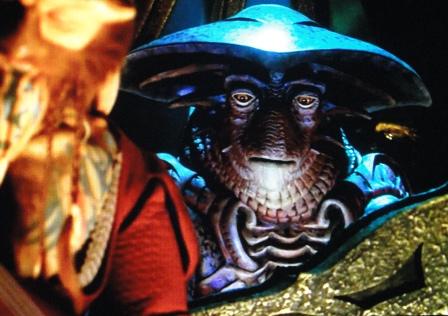 D'Argo reaches out to Pilot asking if his arm is healing. D'Argo indicates he would do it again. Pilot understands, but also understands Luxans "are not given to apologies," of which D'Argo clearly is offering in his own way. The scene is telling. It is a wonderful illustration of acceptance, understanding and forgiveness. This is a touching closing moment for Farscape. Perhaps, with all of the questions of Darwin and behavior abound, our dear comrades are indeed learning. The truth is it's never too late.
 Apologies do not come easy and neither does trust. This was an interesting crossroads. This coherent, complete, nightmarish tale certainly leaves one reflecting on the possibilities before us in the great unknown. When it comes to the question of evolution DNA Mad Scientist poses a great many questions from Josef Rudolf Mengele's human experiments to the untapped possibilities and horrors linked to the age of stem cell research or biological research. This installment, the second for director Andrew Prowse [Premiere], speaks to the wonders of the sci-fi genre when it's done right. One of Farscape's finest Season One moments to date is like nearing science fiction nirvana.
DNA Mad Scientist: B+
Writer: Tom Blomquist. Director: Andrew Prowse.
Pop Culture Reference: The Three Stooges.
 Additional thought and commentary:
 First and foremost is the ongoing chemistry between this wonderful, family-like alliance. There was that huge shocking moment, as noted earlier, when Zhaan, D'Argo and Rygel all team together and lop off one of Pilot's arms. Most of us reeled, repulsed by such alien thinking. It was so remote and antithetical to our own sense of self-preservation. At this point, Pilot was like a trusted friend more than a beloved family pet. How could this happen? It highlights "the dysfunctionality of the group," according to Farscape The Illustrated Companion. Actress Virginia Hey was "horrified" by the amputation of Pilot's arm, a friend as she saw him. She notes her character, Zhaan, didn't even apologize for the drastic action even by episode's end. These complex dynamics combined with staggering decisions have consequences that continue to inform the development of the group as a family.
 Secondly, the visual effects continue to be of noteworthy inspiration. Farscape The Illustrated Companion revisits the phenomenal creature effects applied to Namtar, calling him "part medical manual, part fetish magazine." As the product of self-genetic experimentation, Namtar was the culmination of excessive experimentation, like a woman with too much cosmetic surgery. Terry Ryan explained in the book, "We wanted his whole body to be held together by something from the outside. That's why we did the metal callipers and spine, and the hinges and bolts that came out and held his joints and body together... hence the callipers on his legs."
 The heavy reliance on prosthetic make-up and genuine creature effects a la the Brian Henson Creature Shop continue to astonish. So many films today would have created a film like this and relied solely or largely on CGI. This is just one big reason to love and thank the creators of Farscape. The CGI that is employed is a complement to the tangible realities of the character work. It is stunning work. Namtar is the kind of revelation that is ultimately rare in film, nevermind television. Farscape is a treat and one that can be relished for its four seasons of magic.
As Creator Rockne S. O'Bannon put it in Starlog #261 regarding animatronics and prosthetics this is off the charts. "The level of prosthetic work we're doing is leaps and bounds beyond what you would normally see on television." Boy - Amen.
 Special Effects guru Dave Elsey [of the Australian branch of the Jim Henson Creature Shop] offered additional input in Starlog #261 on why Namtar offers viewers such a treat. The amount of work that goes into these productions is often sadly overlooked. "We're very fond of Namtar... That was a pretty full-on monster for a TV show, with leg extensions and a crazy mechanical head and contact lenses." Adrian Getley deserves credit for being inside that costume. The Jim Henson Creature Shop proved time and again why each episode is a veritable treat to behold beyond the strong writing and great characterization. Despite all of that, it is often a visual feast for the senses and DNA Mad Scientist is the perfect example.
Subscribe to:
Posts (Atom)