-Sutton Roley, Starlog Magazine #218 (p.70)-
Tuesday, April 12, 2022
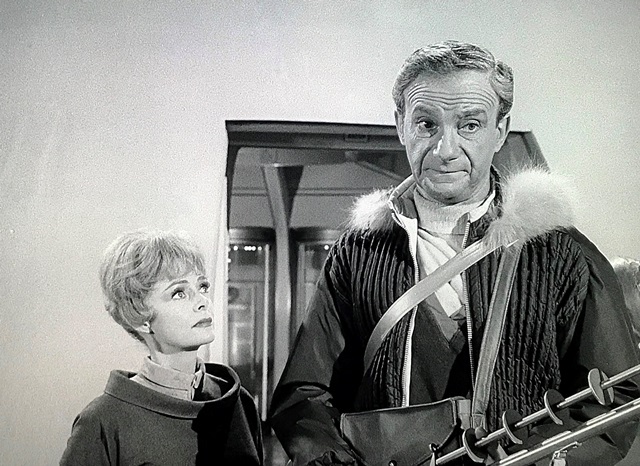
Sutton Roley: On Lost In Space Wish Upon A Star
"That was the best script I ever had for Lost In Space. It had some heart to it and had something to say about family values. I found Guy Williams and June Lockhart very pretentious. They were always holding hands and playing it lovey-dovey. It got to be throw-up time. Whenever the kids were in peril, Guy and June raced for each other first. I would say, 'Forget that! Let's be concerned with the kids for a moment."
Monday, April 11, 2022
Lost In Space S1 E11: Wish upon A Star
"Theories and conjecture, nonsense and jabberwocky.
We have the gift horse, let us not examine its mouth too closely."

-Dr. Zachary Smith-
Greed is the root of all evil. Just as John Robinson declares, "like most people it wasn't enough for him," noting Dr. Zachary Smith "had to have more."
In Lost In Space, Season One, Episode 11, Wish Upon A Star, not only is Dr. Smith lured by the wondrous enticement of this wishing machine or thought translator or the Lost In Space version of the Aladdin's Lamp as Penny calls it, but the entire family is marched down the rosy path of this alien device's many promises and it affects and influences the judgment of all on the planet.
The idea of greed's impact on humankind dates back centuries. One perfect literary example is The Pardoner's Tale, one of the tales from Geoffrey Chaucer's The Canterbury Tales (1387). It's decaying effect on man is undeniable, which explains why the weak-minded Smith would be less than enthusiastic to lend self-examination to the conundrum that befalls the Robinsons and company.
This powerful theme has been revisited time in memoriam in literature, television and film. Think of the horrors that would await those with the cube or puzzle box in Clive Barker's terrifying Hellraiser (1987).
Still, Wish Upon A Star is a more akin to the morality plays in a traditional sense. Writer Marc Cushman summarized the entry insightfully in Lost In Space: The Authorized Biography Of A Classic Sci-Fi Series Volume One noting the episode "has it all - ... and a moral" calling it a "1965 television equivalent to an Aesop's Fable." He correctly notes John Robinson as a "symbol of wisdom," which is indeed the burden he must carry throughout the series as the family patriarch and head of the mission. The opposite extreme is held by Dr. Smith who Maureen Robinson notes has no understanding of "moral integrity." Yes, the drumbeat of greed goes on and is captured here to great effect in this morality play remastered nourish black and white for a future outer space tale dubbed nicely as Wish Upon A Star.
Smith never falls short of word play. His character would become such a wordSMITH (pun intended) through the series. "You're wish is my command," he declares announcing the running theme of the episode in its very opening moments first heard in the epilogue of The Sky Is Falling (E10). He also speaks the now famous line "Never Fear Smith Is Here" in the final moments of both the last entry and this entry though author Marc Cushman notes in his book Lost In Space: The Authorized Biography Of A Classic Sci-Fi Series Volume One this is the first time Harris utters the now iconic phrase. But this may or may not be unofficially the third episode in which it appears.
Through it all Professor John Robinson remains the steady, calming, parental voice of reason espousing the ethical and moral dilemmas the device consistently presents the family. It continues to compromise principles and sow seeds of discontent and distrust.
The episode is notable for establishing a "bonding" between Smith and William Robinson as noted by Cushman. Will professes, "I know he was always doing things that were wrong, but underneath, I like him that's all." It is quite clear from the empathetic eyes of Will during Smith's exile he is quite concerned for and even attached to the man. Will notes to Major Don West in the opening minutes that Smith has some "good qualities" despite West's protests to the contrary. Will is also keeping secrets with Smith over the alien device. Smith identifies with the child-like persona of Smith. Conversely, Smith too, though cowardly, has a certain soft spot developing for Will and it is evidenced here to the greatest extent to date. It is this relationship that would be so downright entertaining over time and keep eyes glued to the screen for three complete seasons. Cushman notes "the bonding between these two characters happens here." Will would inevitably become Smith's greatest proponent and the two along with Robot would forge the true triumvirate of the series. They would be to Lost In Space what James T. Kirk, Spock and Dr. Leonard Bones McCoy would be to Star Trek (1966-1969).
Though Wish Upon A Star shines for the Smith and Will characters, Judy and Penny along with Professor Robinson get to share some real highlights here for another fine ensemble tale.
Wish Upon A Star was Barney Slater's first full writing assignment. His work here earned him a spot with Herman Groves on the previous The Sky Is Falling, which of course aired first. And as always Irwin Allen had a hand in scripting suggestions.
Wish Upon A Star is another shining, sparkling Season One beauty and genuinely entertaining many decades on. In keeping with the discovery of the wish machine Cushman called the entry "a true treasure." Which of us in this life hasn't dreamed of the possibility of a wish machine? This is the kind of science fiction that brings all of that fantasy to life in colorful ways yet accented in gorgeous black and white film.
Writer: Barney Slater. Director: Sutton Roley.
Tuesday, April 5, 2022
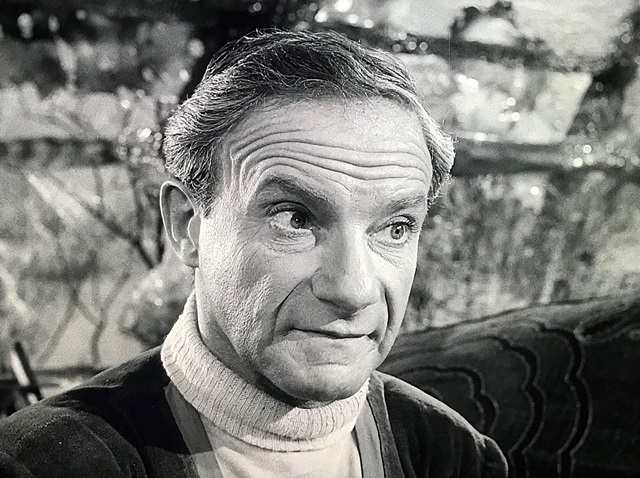
Jonathan Harris: On The Chemistry Of Will Robinson And Dr. Zachary Smith
"We needed each other. I'm no fool, I needed that young boy. He was very, very important to me. He was also a wonderful actor, I thought. We needed each other and we used each other. I helped him a lot and he helped me a lot. I think we both came off sound and shiny, actually."
-Jonathan Harris speaking candidly in a 1986 interview with Willam E. Achors, Jr. in The Lost In Space Encyclopedia II [p. 350]-
Wednesday, March 30, 2022
Battle Of The Planets E22: The Fiery Lava Giant
“Those men were giants all of them.”
Despite the occasionally disappointing choices for the American adaptation there is incredible emotional power in the US series and all of it is brought to fruition by way of its talented, compelling American voice cast.
-a respectful nod to the men of Mount Rushmore-
Battle Of The Planets (1978-1980), like a lot of 1970s television of all genres, was a little casual about editing continuity or attention to detail. After all, it was only at the very end of 1976 that the VHS was essentially born. The idea that our favorite shows and films would actually make it to the home market or even be seen again seemed fairly unlikely to many. Rewinding, pausing, looking at the details simply wasn't considered. Gerry Anderson of Thunderbirds, UFO and Space: 1999 acclaim made this very point on the subject in the book What Made Thunderbirds Go! The Authorized Biography Of Gerry Anderson. So, there are some significant editing snafus from the era that simply weren't a huge concern. An American-edited children’s cartoon called Battle Of The Planets, sourced from Science Ninja Team Gatchaman, is no exception.
One particular editing snafu seems to forget the rescuee. After the character of Amelia is saved at one point Amelia then suddenly appears to no longer be with the team. Okay, maybe she was sent back to the Phoenix. Okay we can go with that. But then suddenly she is back with the team in Spectra’s lair and Tiny abruptly goes missing. Okay perhaps Mark has sent Tiny to get the Phoenix. Yes, that appears to be it as it is then confirmed visually that Tiny is in the cockpit. Oh no, but when the Phoenix arrives to pick up Mark, Princess, Jason and Keyop along with Amelia, Amelia is once again no longer there. Poor girl. When the team jumps up and into the Phoenix Tiny is surprisingly back with the team on the ground. My gosh what is happening? Always five acting as one apparently. But a serious question then, who the hell is flying the Phoenix? At some point I will have to check out the Science Ninja Team Gatchaman (1972-1974) original (The Magma Giant, Emperor Of Hell) on this one. Either the Americans sliced and diced the original to shreds reconfiguring it all out of order for Battle Of The Planets or simply extracted the errors from a poorly edited Japanese original. Alas we would one day have VHS, DVD and more to completely dissect these inconsistencies for a good bit of fun. Despite the imperfections in these productions they are truly magnificent and made lovingly by hand. As kids we were far more forgiving. Those were the days.
As simple as these productions are it was always the animation and out of this world design work that would seize and win the day for this writer and they have kept me coming back for more nearing 50 years later.
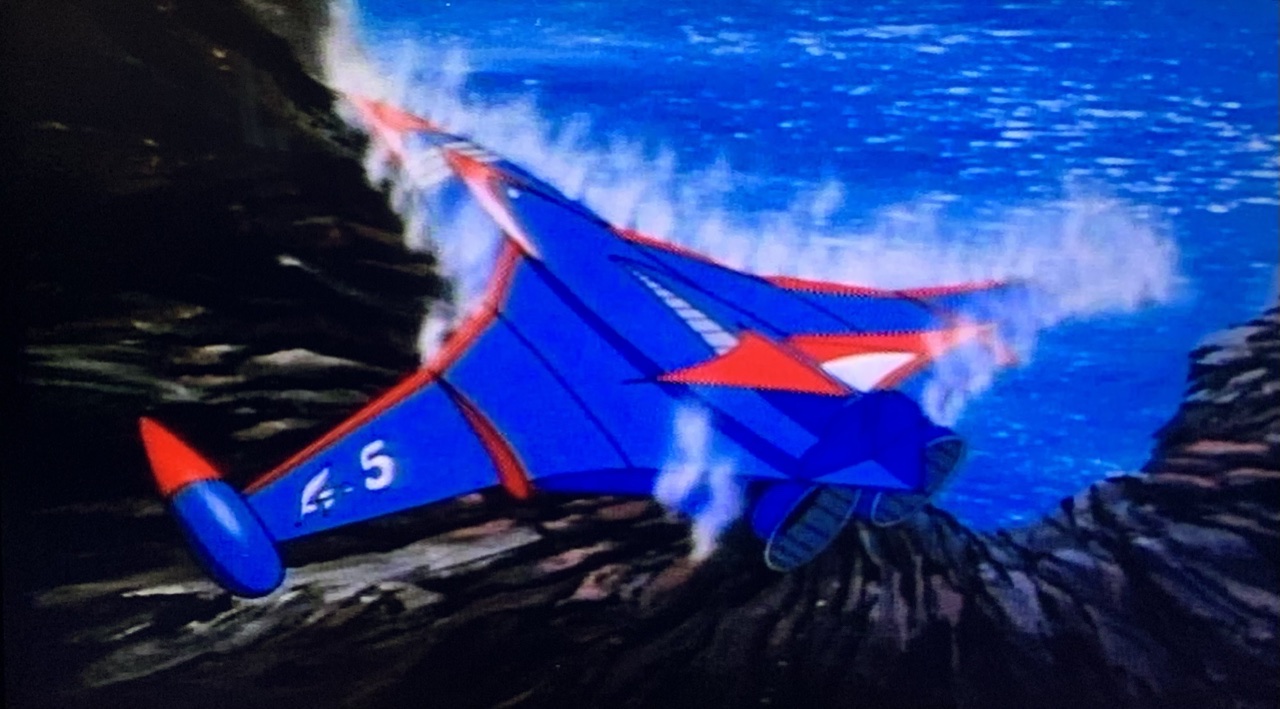
As such I've provided plenty of images of the wonderful moments included in the entry spotlighting the many vehicles used by the team in the form of the Summit or Sonic Jet, Space Mobile, Space Buggy and Sonic Cycle.
A respectful homage is paid to the men of Mount Rushmore in monument mountain as the team dispatches to Space Island.
It’s ironic the American translation of Science Ninja Team Gatchaman for Battle of The Planets felt the need to supplant alleged violent images from the Japanese original with footage of 7-Zark-7. This is noted as I watch Battle Of The Planets, Episode 22, The Fiery Lava Giant, only to be reminded how often the writers of this American version felt the compulsion to script dialogue for the robot in the form of his fosdick. The sexual innuendos fly often between Zark and his faceless female love Susan. Apparently these writers were clearly horn dogs and felt compelled to incorporate some adult humor in place of the violence. It’s amusing, but the original animation is an irreplaceable and flawless work.
Despite the occasionally disappointing choices for the American adaptation there is incredible emotional power in the US series and all of it is brought to fruition by way of its talented, compelling American voice cast.
*Footnote: This writer and fan of the series continues to examine each and every Battle Of The Planets episode by matching the English-adapted equivalent in corresponding order to the Science Ninja Team Gatchaman release. There are missing adaptations from that original series. So there are gaps. But episode 22 here corresponds with the next episode of the Japanese original in chronological order.
Science Ninja Team Gatchaman title: The Magma Giant, Emperor Of Hell.
Up next: The Bat Ray Bombers.
Subscribe to:
Posts (Atom)