Friday, April 3, 2020

The Sci-Fi Fanatic BIG 5: Science Fiction Franchises

In this short life of ours, no matter what science fiction has to offer and throw my way, this writer tends to have his go to series that he enjoys returning to time and again.


Some science fiction concepts, stories, ideas come and go never to register in the synapses again, but there are those that are faithfully returned to as some of the best science fiction comfort food a man or woman could wish for.

The concept of exploration is key and never grows old. Many of these franchise properties have that variable in common.


This is my personal Sci-Fi Fanatic BIG 5: Science Fiction Franchises or properties that seem to have a life of their own and continue to provide enjoyment to me years after they completed their runs as evidenced here at Musings Of A Sci-Fi Fanatic.


1. Star Trek. The most obvious choice for a science fiction fan. The franchise for Star Trek is like Star Wars in terms of abundance. There is just no shortage of material. ST: TOS (1966-1969). ST: TAS (1973-1974). ST:TNG (1987-1994). ST:DS9 (1993-1999). ST: Voyager (1995-2001). ST: Enterprise (2001-2005). ST: Discovery (2017-present). ST: Picard (2020-present).


Like Star Wars, it's fairly relentless and yet in terms of story quality, particularly at this point, Star Trek is head and shoulders above Star Wars for this writer.


Take your pick in terms of television runs and there is plenty for the franchise fan. Star Trek is currently clocking in at eight (8) official TV series. Gene Roddenberry's vision seems infinitely interesting. Sadly, the world of George Lucas has become a rather messy spectacle.


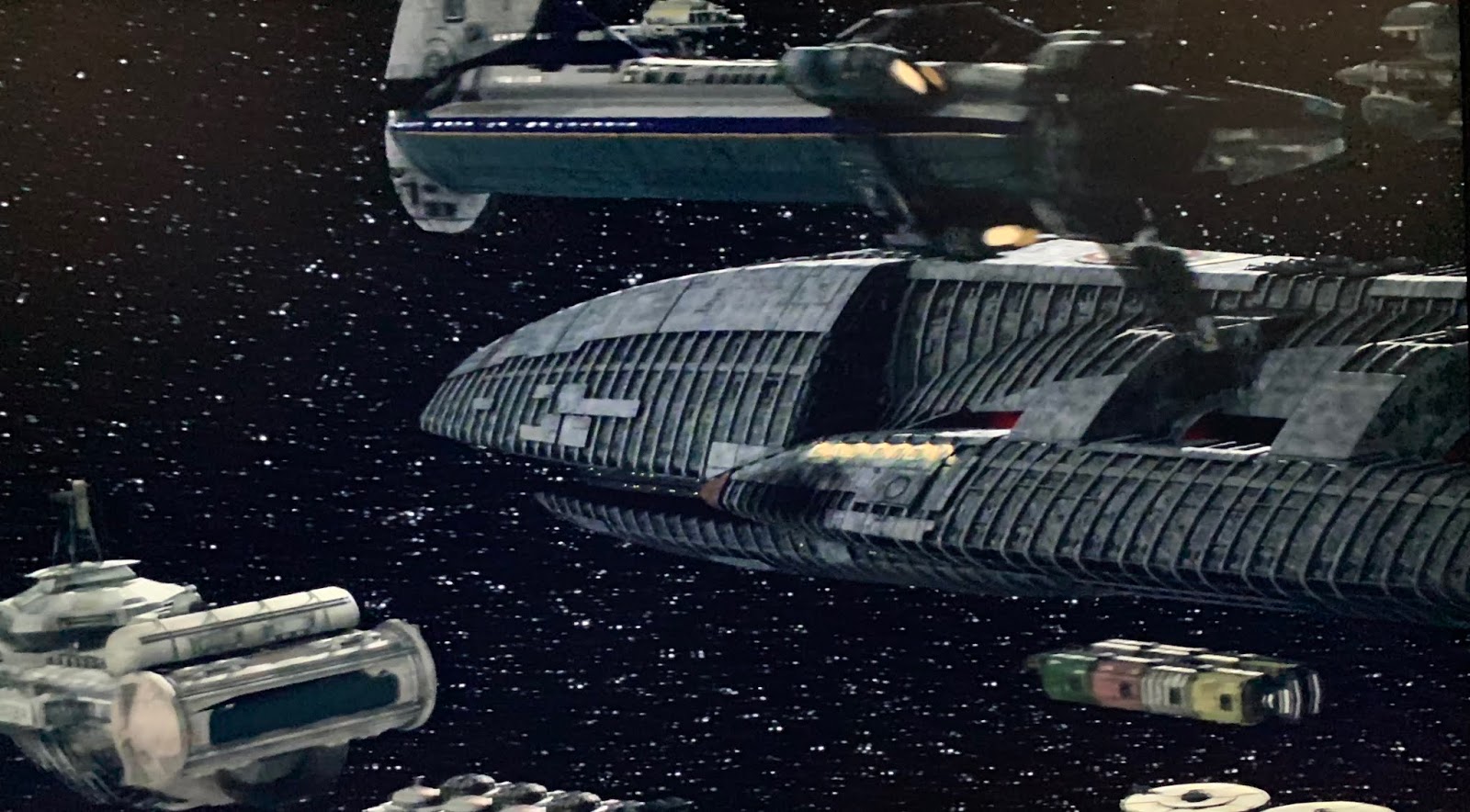
2. Battlestar Galactica. I can't be alone in this camp, but the two TV versions of Battlestar Galactica (1978-1979; 2003-2009) remain treasures. I love them both for very different reasons. One is filled with inspiration and hope, while the other is more often pessimistic, brutal and internally grim when it comes to the human heart. Yet the Glen A Larson original and the Ronald D. Moore reimagining both have their moments of despair and hope.

Without the original we wouldn't have had Moore's work which is important, but without Moore we might not have had this wonderful franchise that makes this list.


Meanwhile, Caprica (2010) and Battlestar Galactica: Blood And Chrome (2012) are good, while not as memorable, but it's time for a return. The books and comic books are excellent as well. Still, I'm ready for a new series or that much fabled, heralded would be film that always seems to be shelved.


Did I mention Galactica 1980 (1980)? OK, maybe that was intentional.

3. Stargate. Ten seasons of the original series, Stargate SG-1 (1997-2007), based on the Dean Devlin and Roland Emmerich film coupled with a solid adventure spin-off in Stargate Atlantis (2004-2009) and capped off by the darker, more atmospheric and even cerebral Stargate Universe (2009-2011), this is a property that just got better and better.


There are no shortage of books and comic books to worm your way through either.


4. Space:1999. Just two seasons (1975-1977) of stimulating mind-fucking sci-fi greatness and then nothing. What a shame. But the series has endured and lived on in the form of some wonderfully creative book stories (Powys Media) that any fan of the original series would want to pick up and have on their book shelf resting next to their run of The Expanse. There are some great comic books to seek out there as well.


Alongside Battlestar Galactica the franchise continues to deliver some of the greatest toy collectibles on the market to boot. The Gerry Anderson classic has also been in the mix for a TV remake, but that Eagle has yet to lift off. Nevertheless, when it comes to those Gerry Anderson/ Brian Johnson designs and the series production work it's tough to mess with perfection.


5. Gatchaman/ Battle Of The Planets. The original Science Ninja Team Gatchaman (1972-1974) was one of the best in anime. Simple in its focus, but executed with seeminly uncompromising artistic perfection. The Japanese super hero team adapted from American superhero concepts was then adapted in the USA for Battle Of The Planets (1978-1980).


Gatchaman II (1978-1979)and Gatchaman Fighter (aka Gatchaman F) (1979-1980) followed. A Japanese live action film (2013) was made. Others have been announced and dropped. A reimagined anime OVA (1994) was created from the property. Gold Key comic books (1979-1980) happened. Still, I'm waiting for something as good as the Top Cow comic books (2002-2003) in live action or animation form again. This one remains my dream. Keep dreaming right? Thus it fills my number five spot.


Common variables within these series that draw me back to them beyond the characters is their ship and production designs. Each and every one of these is a feast for the eyes. Space:1999 and Battlestar Galactica may be at the top in this area for me. Science Ninja Team Gatchaman is a close second along with SGU.


This writer wishes he could have included Thunderbirds for its design work and Irwin Allen's Lost In Space. Sadly, the original series of the latter property is the only one that matters and counts for this fan of science fiction. All other iterations including the Netflix series simply pale in comparison. Yet all of the other franchises continue to create varied series or books that remain relevant and stimulating in terms of science fiction adventure.


If I had to choose a franchise ready for reintroduction Space:1999 would be at the top. But I'm just as ready for some more Battlestar Galactica or even another animated Battle Of The Planets. In the meantime, these remain the five best for this writer thus far. G-Force!

Wednesday, April 1, 2020

Ronald D. Moore: On Battlestar Galactica Reimagined

"The roots of the original show are embedded in our show. Our show's premise is the same as the premise they had in 1978. Hopefully, what we're doing with our show is embracing that premise and trying to be honest with it. We're asking what would really happen in that situation. What would really happen if your world was destroyed? What would really happen if you were trapped on these ships? What would really happen to people---rather than archetypes---if this happened to them? I've always felt we were trying to really embrace the core that is Battlestar Galactica."

-Ronald D. Moore, Battlestar Galactica: The Official Companion, p.155-


There's so much to love and appreciate in both versions of the series, the first from its original creator Glen A. Larson to Ronald D. Moore's reimagined work. They are both exceptional top flight science fiction sagas.


I'm not sure why it has to be one or the other for some people.

For me, these are two exciting, unique, throughtful, thoroughly realized and colored series worthy of your reflections. They are both refreshingly different.


This writer never tires of returning to both. How lucky we are to have them. Of course the latter wouldn't have existed without that original and yet the new series gave the franchise new life.


Monday, March 30, 2020

Battlestar Galactica S1 E2: Water

"There's a reason why you separate military and the police. One fights the enemy of the state. The other serves and protects the people. When the military becomes both then the enemies of the state tend to become the people."

-Commander William Adama-


With the beleaguered remnants of humanity on the run following the fall of Caprica, the pressures to survive mounts. Humanity labors in who to trust making efforts to distinguish between humans and Cylon sleeper agents. Compounding those issues are the harsh realities of rationing the basic necessities of sustenance and resources in space. Moore's warship carrier the Galactica is indeed in a crisis situation as the series moves forward.


Battlestar Galactica, Season One, Episode 2, Water sees the Galactica making efforts to share its water recycling system with other ships within the fleet when the tanks are unexpectedly ignited by a saboteur. Was it a Cylon? A Cylon sympathizer? A human traitor? Moore would challenge our perceptions throughout the series.


In science fiction, humanity always battles the odds when it comes to resources in the new frontier of space. With BSG not only was the Galactica facing a shortage of water, that shortage is compounded and made worse by sabotage and detonation of existing tanks upping the dramatic ante.

Water and resource issues plague space stations and New Terra in the series The Expanse (2015-present).


Stargate Universe (2009-2011) endured its own resource issues includiing a water shortage aboard the Destiny in a first season episode of its own also called Water. In these aforementioned entries in sci-fi all are excellent and handled with nail-biting credibility within the genre.


Battlestar Galactica's Water is particularly gripping as the fleet's inhabitants must ration and fight a two-prong war against the Cylons and/or thirst and starvation. You'll recall similiar dire days in Saga Of A Star World from the original Battlestar Galactica (1978-1979. Have you seen grocery stores the world over during the Coronavirus pandemic of late?


Battlestar Galactica makes for a thrilling exercise in survival with its Water entry into the resource story book of science fiction.


Despite these fairly straightforward storylines in the first two episodes, what is most fascinating is every small, interpersonal interaction on board the Galactica. Every episode digs deeper into character and the complexity of human behavior, the responses to circumstances as well as the environment and politics.


The triangle of William Adama, Laura Roslin and Lee Adama is established with an almost natural maternal leaning for Lee toward Roslin. Kara "Starbuck" Thrace and Gaius Baltar are introduced to one another. Number Six and Baltar continue to intrigue psychologically. Motivations by all involved are complex, credible, natural and evolve with great intricacy throughout the series.


Additionally, through Sharon Boomer Valerii the writers present inner human struggle within the Cylons that would become part of the series. Boomer clearly is tortured between a Cylon mission and her realization of self-determination and free will and what it means to be a human.


This is what makes this new Battlestar Galactica such a riveting experience---believable crisis in character and events aplenty.


Writer: Ronald D. Moore. Director: Marita Grabiak.


Thursday, March 26, 2020

Ronald D. Moore: On Battlestar Galactica's Flawed Characters

"Our people are deeply flawed, deeply human characters. They are not, by nature, innately heroic or noble creatures. They are simply ordinary people who find themselves in extraordinary circumstances. They do not always make the right decision and they do not always do the right thing. They make mistakes, act out of pettiness and spite, and occasionally do things that are reprehensible. However, they are also capable of growth, or change, of learning to overcome their flaws and rising to the challenges laid before them and performing great and mighty deeds."

-Ronald D. Moore, Battlestar Galactica: the Official Companion, p.96-


Extracted from Moore's Battlestar Galactica series bible, those words ring true and echo forth the series as the anti-Battlestar Galactica Classic as envisioned by Glen A. Larson. In many respects the new version of Battlestar Galactica is the antithesis to it, the mirror universe. This prism of human nature is much less noble filled with some of the worst and most base of human qualities.


If it becomes too much there's always the hopeful optimism of the original Battlestar Galactica the arms of which await you.


Moore's perspective on humanity is much darker than the original. The truth of humanity falls somewhere in the middle of the two and this writer likes to lean toward Larson's more hopeful vision. Nevertheless the flawed universe of Moore's world is a fascinating rumination on human nature at its worst despite those moments of "growth." In fact, some might believe Moore's grim world to be a bit too dark.


There is of course a place for both and again the truth falls somewhere in the middle.

These alternate views of humanity are why I love both series equally, two sides of the human coin. Both are riveting and exceptional and often beautiful in their execution.


Tuesday, March 24, 2020

Battlestar Galactica S1 E1: 33

"There are limits to the human body and the human mind."
-Gaius Baltar-


"We make mistakes. People die."
-Commander William Adama-

"Yes we're tired. Yes there's no relief. Yes the Cylons keep coming after us time after time after time. And yes we are still expected to do our jobs."
- Colonel Saul Tigh-


As much as Battlestar Galactica (2003-2009) held a mirror up to humanity post 9/11, revisiting the series one could easily apply our own current viral reality in the fight against corona virus to the series grim unease and distrust.

It's been roughly 17 years since Ronald D. Moore reimagined the classic Battlestar Galactica by Glen A. Larson drawing upon the despair of a nation utilizing the allusion of the terrorist attacks by radical Muslims on September 11, 2001.


In many respects Battlestar Galactica (BSG) is just as relevant today unintentionally touching upon a similar zeitgeist with the onset of the Wuhan/Corona Virus (COVID-19) that originated in China.

Where the series once worried about which of us was the terrorist, so too does the series reflect the unsettling times we live in today regarding who exactly is sick or contagious around us. Could they be in the very same room?


There are differences of course with respect to motive or lack thereof to do harm, but the concerns are there. New issues supplant old ones and BSG endures.

BSG so deftly captured the concept of the unseen enemy. Who was a Cylon? Could they have infiltrated the Olympic Carrier or another vessel in the civilian fleet?


Today, who on board is an asymptomatic carrier? Who could potentially destroy us through a pathogen? Are we willing to reintroduce a missing ship back into the fleet not knowing the potential damage it could inflict on the remaining survivors of the human race? How fitting to watch this series in these times.

And so begins Moore's imperfect but powerful allegory. His existential story on what it means to be human began with the splendid Mini-Series (2003), but capitalizes on all of it more officially with the near meticulous science fiction opener, Battlestar Galactica, Season One, Episode 1, 33.


The attack by the Cylons resulted in "fundamentally altering Colonial life" (p17, (Re)Framing Fear: Equipment for Living In A Post-9/11 World, Cylons In America). When reflecting on episode 33, one could easily replace the 9/11 attacks with the current viral seige across the planet. The scourge is changing how we live.

"The action is chaotic, the military and leadership disorganized, and the survivors shocked and fearful" (p17). The realities of March 2020 would reflect a similar reality. While it's clear our world is impacted daily with new facts and new ideas, there is no doubt about the efforts being made every day, but the struggle is real as the saying goes. Despite our inability to pinpoint what the future holds we endure and remain steadfast in the battle as much as Commander William Adama.


In this inaugural episode of BSG, 33, a perfect title if ever there was one, represents the theme and content of the opener. It also represents the pressure and stress upon humanity through a measurement of time as the Cylons relentlessly locate the fleeing humans every 33 minutes.

"Time is constructed as an oppressive and potentially destructive force second only to the omnipresent Cylon threat" (p213, Authorized Resistance: Is Fan Production Frakked?, Cylons In America). The threat of time running out is real in the series as humans race against the clock. Equally, it couldn't be more real in humanity's race against the community spread of a contagion in 2020. Every minute costs lives.


The return of the missing ship, the Olympic Carrier, in 33 even stokes fears of a viral infection impacting the fleet of a technical kind as noted in the entry. How appropriate. Fear and anxiety are in rich supply.

As Moore noted himself about episode 33, "we're in the middle of a crisis" (p232, "Kobol's Last Gleaming, I And II": Battlestar Galactica As Quality Television, Finding Battlestar Galactica). The applicability of the series then and now is resounding and almost shocking.


The series begins in crisis for the Battlestar Galactica and its survivors. Weary, exhausted and on the run, the tireless Cylons force our human survivors to jump every 33 minutes. There are thrilling moments visually that feel like an allusion to predators striking a wounded animal when it comes to the space combat of BSG. Sci-fi fans will rejoice in those sequences. When the Cylon Base Ships surround our human brethren, the scene works like a strong, modern day visual metaphor akin to the hunt of Moby Dick where seamen once pursued the great leviathan. In this story the Galactica is our massive, imperiled whale.


The great Battlestar Galactica slips away escaping destruction at the hands of the Cylons through the blessings of FTL (faster than light) jumping technology. This is perhaps my favorite technique in science fiction alongside the recent effects employed for the Discovery on Star Trek: Discovery.


The episode concentrates on the oppressive weight felt by our human characters and 33 shines. Only a brief glimpse of those dodgy (especially now) CGI Cylons reminds us why it was always the human component of Moore's BSG that kept us fully engaged and absorbed to the human plight. Maybe one day they could clean up those Cylon effects. They are flawed especially when compared to the still breathtaking space battles.


33 is a minute by minute thriller that opens the series with the fate of the Olympic Carrier and the establishment of the human race fleeing the Cylon tyranny.

This is a scary, gripping, thrilling work of television that raised the bar and set the tone for a remarkably strong science fiction series that is more a reflection on human behavior than nearly any other. This is easily one of the best television openers in science fiction history.


As for the fate of humanity today amidst a global pandemic, as Apollo says from the cockpit of his viper in 33, "Let's be careful out there."

Writer
: Ronald D. Moore. Director: Michael Rymer