Thursday, May 28, 2015

Tatsunoko Productions: A Brief History Of

"... Just like in Seven Samurai, we gathered people from all sorts of fields. It was a time when, for the most part, if you could draw, if you said you wanted to make things in a group, if you liked art, you could participate in animation."
 
-Ippei Kuri, Newtype USA, [Inside] Tatsunoko Production, August 2004 (p.16)-


Heavily influenced by American comic book superheroes, not to mention martial arts films, a trio of talented brothers forged and founded what would become Tatsunoko Productions in October 1962. Artist Tatsuo Yoshida, scriptwriter Kenji Yoshida and Toyoharu Yoshida (better known by pen name Ippei Kuri) laid the framework for the still active and thriving Tatsunoko.

The studio's first statement came with Space Ace (1965) followed by Mach Go Go Go (1967-1968), fondly remembered as Speed Racer in America.


Tatsunoko, represented by a seahorse symbol, would become famous for productions like Time Bokan (1975-1976) and Tekkaman: The Space Knight (1975).

The three productions that meant the most to us here in the United States on a grander scale were likely Mach Go Go Go or Speed Racer, Kagaku Ninja-Tai Gatchaman (or Science Ninja Team Gatchaman) (1972-1974), infamously and famously edited stateside as Battle Of The Planets (1978) and finally Casshan (1973-1974).


Tatsunoko took the costumed hero of American comic books and maintained a generally realistic physique and musculature and even added a popular feminine heroine capable of much ass-kicking of her own for the ongoing Gatchaman franchise.

Gatchaman II (1978-1979) and Gatchaman F or Gatchaman Fighter (1979-1980) would follow suit.

Tatsunoko also infused a good deal of emotional depth and passion into its characters.


Gatchaman II and Gatchaman F were derided slightly later. Sadly, many felt the saga of Gatchaman that followed the original first series became predictable and/or overly simplistic when compared. Of course producing 105 episodes of a TV series can certainly have that detrimental effect particularly when Tatsunoko and other companies were hard-pressed to stray far from original formulas. Neverhtheless while Tatsunoko changed up the series with different mecha and variations on villains, the animation was generally not regarded as highly as it was under the guidance of founder Tatsuo Yoshida. *// Unfortunately Yoshida passed away in 1977 a year before Gatchaman II and Gatchaman F were to see fruition. Left in the care of his brothers, a significant guiding light on that series had been silenced with his death.


Still, Tatsunoko would be one of the great forces in anime to generate attention and grow its popularity internationally.

A big inspiration for anime TV Tatsunoko would be a financial backer to the popular Macross (1982) series also edited and brought famously to America as the wildly popular (with kids) Robotech (1985) also a superior robot series to the likes of copy cat works such as Transformers.


Later, Tatsunoko would revisit its popular properties like Gatchaman and Casshan with new interpretations. Using the employ of character designer Yasuomi Umetsu, who Robot Carnival's extraordinary Presence, Casshan Robot Hunter (1993) and Gatchaman (1994) were recrafted and reborn for a new generation and met with modest success.

But it was the series from the 1970s by Tatsunoko that has left its most enduring mark and legacy, at least for me personally.


Science Ninja Team Gatchaman was directed by Hisayuki Toriumi (1941-2009). Toriumi was a remarkable talent for Tatsunoko and his input should not be understated. His work had a profound influence on all three components of the Gatchaman franchise. But Toriumi would one day co-write Dallos (1983) with Mamoru Oshii and direct Area 88 (1985) vacating Tatsunoko in 1979 and helping to found Studio Pierrot that same year. But Toriumi was there for Tatsunoko from the start even working on Speed Racer. He was indeed a gifted animator.


Today Tatsunoko is owned by Nippon Television and others including Production I.G. still making anime. For me, they were certainly one of the formative best in the field.


Wednesday, May 27, 2015

Ippei Kuri: On Anime

"Anime is a product of desperation.
It's a history that was born out of hard work and experimentation, from a lack of funds."
 
-Ippei Kuri, President of Tatsunoko Production, Newtype USA, Aug 2004 #8 (p.16)-

Tuesday, May 26, 2015

Casshan Ep1: An Immortal Challenger

"He abandoned the only life he had. And now he's been reborn as an immortal. He destroys the iron evil. Who will do it if not Casshan?"

-Opening of Casshan-
 

On my quest to unearth all that is Battle Of The Planets (1978), the adapted stateside version of Tatsunoko's Science Ninja Team Gatchaman (1972-1974), it seemed a good opportunity to look at Tatsunoko's Casshan (1973-1974), which also spawned something of a small cottage industry inside Japan.

Like the original property Science Ninja Team Gatchaman, Tatsunoko's Casshan was yet another original property, not based upon a manga like so many anime.

Casshan is also known as Casshern and Neo-Human Casshern. The latter title refers to the combination of the primary protagonist of the series, human Tetsuya Azuma, with an invincible body and taking the name Casshan assigned to him by his father.


Yes, Tetsuya Azuma was his son who volunteered to be transformed to save humanity from a raging invasion of androids transformed accidentally by the hand of Casshan's scientist father coupled with an electrical storm. Tetsuya's father, Kotaru Azuma, intended to help mankind by building androids to clean up one of Japan's greatest thematic concerns in science fiction, pollution - See director Yoshimitsu Banno's Godzilla Vs. Hedora (1971). Next to radiation, pollution is one of the great evils of man, and also the result of man like radiation.

Thus this new human Casshan is the great work of a collaboration between father and son, a bond held with great respect in Japan.


The foundation for this story has since spawned a four episode OVA (1993; the final episode animated by Studio Gainax), a loosely adapted live action film (2004), which actually looks quite strange given the character's predicament, and a rebooted series dubbed Casshern Sins (2008-2009), the latter produced by Tatsunoko and animated by Studio Madhouse. The thirty-five (35) episode series begins with Casshan, Episode 1, An Immortal Challenger.

The first story in the series tends to feel slightly dated, but the animation is still generally solid thanks to writer/founder of Tatsunoko Tatsuo Yoshida.


In general my initial introduction to Casshan was not as overwhelmingly positive as my experience with Science Ninja Team Gatchaman. The material simply doesn't hold up as well. The writing attempts to build a layer of emotional depth given the protagonist's transformation but it feels a little awkward and rushed. Tetsuya essentially dies to save his family becoming Casshan the robot or android hunter. There is great pain and suffering by his mother, Midori (a name also given to a character in the popular early era Gaiking covered here) over the loss of his humanity despite the fact it feels like he is the same young man but now in a suit he can never remove a la Robocop. His father too grieves over the decision. Yet, unfortunately, the creators really don't spend the required time on building this emotional connection. Even the father's decision to transform his son essentially killing him seems awfully quick.


This portion of the story is lacking significantly in properly developing a sympathetic hero. It fails to capitalize adequately on the tragic nature of Casshan's fate, one he willingly shoulders and accepts upon himself. The creators want to mine that territory but are definitely holding back given the parameters of the audience. It would have been nice to see them push further at the emotional core of Casshan.

Tatsunoko's hero is indeed an unforgettably character designed good guy dressed in white, similar to Mark from Battle Of The Planets. This is a traditionally approached series where the heroes wear white whilst battling the hordes of Tatsunoko villainy.


When Casshan is eventually brought to life, there is a bit of sci-fi hocus pocus, not that much different I suppose than the transmute achieved by G-Force on Battle Of The Planets, and then wah-lah Testuya is gone and Casshan is born. Unlike the costume transformation and the sell of that concept in Science Ninja Team Gatchaman it never quite works on an emotional level but Tatsunoko is indeed reaching for a depth and a humanity not often witnessed in animation in the early 1970s particularly for a kid's show.

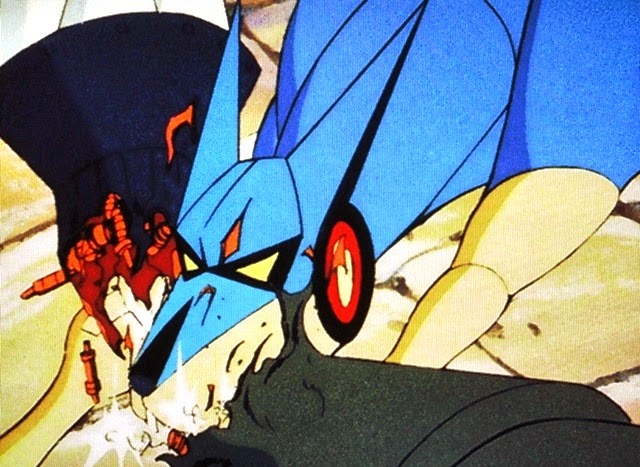
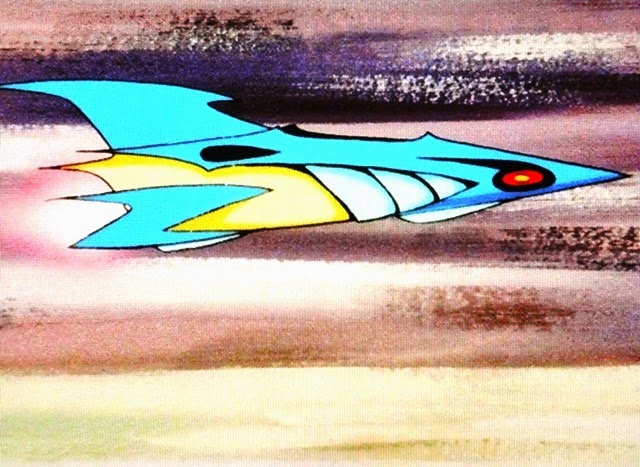
Ultimately Tetsuya's best friend, a dog named Lucky, is also killed and a robot hunting dog is created called Friender. Friender is really quite something because not only is he a very powerful robot hunter he can also transform into a jet and other transporting mecha.


These outlandish leaps seem a little hard to swallow, but then as a kid I believed the Phoenix could alter itself molecularly into the fiery Phoenix and back. So is it really that hard to buy? Or am I just getting old? Casshan simply doesn't quite make the jumps in a credible fashion I'm afraid.

Casshan joins forces with another character also introduced in the first episode, a beautiful girl named Luna Kozuki. The fifteen year old girl was saved by Tetsuya's dog originally. Lucky was killed (clearly not so lucky) protecting her from the android army built by the lead villain and antagonist Buraiking Boss, a robot that came to life as a result of electricity in family Azuma's castle. From there Buraiking Boss began building his own army of machines.


Casshan has a decent sci-fi premise and a good cast of characters, but lacks some of the charms and basic logic of Science Ninja Team Gatchaman and definitely some of the warmth of Battle Of The Planets at least based on the premise and set up here.

Casshan is a newly built man or not exactly human and as a result it even feels a touch robotic at times. It's also not nearly as grounded in real world moments as Science Ninja Team Gatchaman and its American counterpart. The aforementioned group of youngsters from those series brought the space saga down to Earth and accessible. Casshan feels just a bit out there with its far out newly built man premise. I mean Steve Austin still felt real even after he became the Six Million Dollar Man.


Well, Casshan was a kid's show and perhaps a considerable amount of rope should be given and it's early, but the series has just thirty-five episodes to completely explore the character and concepts. In the end, will it succeed in delivering a classic series like Tatsunoko's Science Ninja Team Gatchaman that still stands the test of time? Will it build on its mythology in a credible fashion? This is all to be determined. The opening entry does end on a cliffhanger as Casshan's parents are abducted by the androids and heads to the rescue. Stay tuned true believers to find out.

Actually, really not so lucky.