Thursday, February 24, 2011

Ergo Proxy Ep2: Confession

The serial experiment that is Ergo Proxy continues.

At the conclusion of Ergo Proxy, Episode 1, Awakening, it was determined there was more than one Proxy on the loose. Producer Akio Matsuda offered some insights on this noirishly goth series in the now defunct Anime Insider #35. As he informed, the images and storyline are "focused on psychological suspense, a nice slice of action, and an accompanying sense of wonder." The series opener certainly captured the atmosphere the creators were aiming to achieve. As for those nasty looking Proxy, "There are many, not just one- and their fighting styles are completely different." Matsuda indicates Ergo Proxy is filled in equal parts "physical" and "psychological" aswirl with "unanswered questions." This certainly offers additional information to aid our efforts into discovering more about AutoReivs, Romdo and the Proxy, as well as the many interesting characters that color this deceptively utopian city and those inhabitants outside its domed walls.

A narrated look to the future at the end of Episode 1, Awakening, offered this: "The Security Bureau is out of control. The silence of the Intelligence Bureau. The manipulation of Entourages. They're all connected to the monsters. The points are forming a line. That's when a truth no one knows about appears."

Here we are with Ergo Proxy, Episode 2, Confession (Confession Of A Fellow Citizen).

Ergo Proxy offers a presentation steeped in digital from the 2D and 3D digital animation of today's anime to the technically designed digital world within which the story thrives. For me, digital animation takes some getting used to. It's a bit like receiving a new prescription for a pair of glasses. It all feels a little different when you put those glasses on at first. When one is conditioned to enjoy the breathtaking pencil sketches of 2D hand drawn cel animation, the 2D digital work can seem a bit jolting in its pristine touch. It feels too pure, too clean, too refined, sometimes too simple in its level of detail. It feels cold and free of the warmth and detail of traditional anime. I'm not the greatest fan of its artifice. New isn't always better.

To be honest, and perhaps this is the geek in me, you know-the old school guy that simply won't let go, but I prefer the beauty of the hand drawn animation of Gatchaman or The Wings Of Honneamise. There is a richness and beauty and feeling to those images that have yet to be duplicated and mined by a computer. Getting accustomed to digital for the likes of Last Exile and now Ergo Proxy takes some time, but there's no use fighting it. Digital is the wave of the future and that future is now. Just as CGI has replaced the classic modelling effects of the best in science fiction television [Space:1999, Star Trek: TOS and Battlestar Galactica], digital animation has supplanted the loving detail transferred from hand and pencil to cel. There's no getting around it. Digital is here to stay and as much as I might love models, latex and hand drawn cel animation this is the new world order. Some science fiction television and to some degree anime has suffered as a result too. Having said all of that here is where I bloe my own theory out of the water. Somehow the slight feel of artificiality and the starkness of this reality seems to translate well for Ergo Proxy and works wonders for its digitized, cold, isolated world quite beautifully and quite fittingly. Further, a recent viewing of Evangelion: 1.11 You Are (Not) Alone blew me away. It was stunning in its level of detail despite the notable differences that I still argue remain between 2D hand drawn and 2D digital animation. More on those differences at a later date.

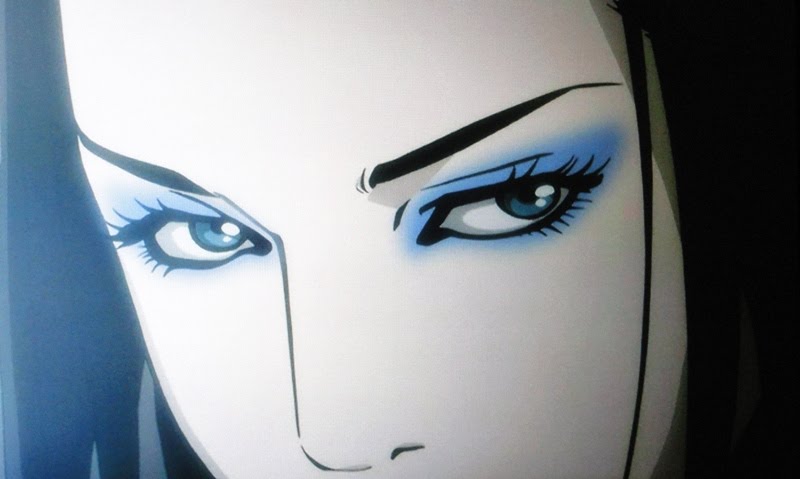
The story begins as Re-l works through a digital photo line-up with some frustration. Previously, Re-l was attacked by a monster in the introductory episode of Ergo Proxy and the photo line-up reveals nothing. Her Entourage and cameras offer no corroborating evidence of her story and no one seems to buy her story either. Strange given her profession as a criminal justice practitioner. Her anxiety rises as she calls the whole thing a "conspiracy." She points to the Security Bureau as erasing any evidence of the event.

Her interviewers patronize Re-l due to her relationship with the Regent of Romdo [her grandfather]. She is less than pleased with the proceedings. The interviewers indicate Vincent Long was found not far from her home unconscious. They indicate he may have feelings for Re-l and may have been her stalker. Exasperated over the suggestion, the interview is terminated.
Shots of the city reveal more digital, electronic billboards urging "Fellow Citizens" to consume more. This theme, coupled with the controls over the AutoReivs, certainly pays homage to the works of George Orwell, Philip K. Dick or even films like George Lucas' THX-1138 and others. Iggy and Re-l drive. Iggy informs Re-l her replacement home will be ready shortly. A home is needed following the destruction that ensued of her home at the end of Episode 1. Iggy indicates she will need a release from the doctor to return to the Intelligence Bureau.

The funny thing about the Iggy character is the level of trust we have for him. Trust is a factor int his relationship, which keeps the audience uneasy. It's not entirely there. Despite his likability he is an AutoReiv and we simply don't know how sincere or programatically free he is in his processing of decisions or of his loyalty to Re-l. The level of comfort regarding his character simply isn't there for us at this time. Given his ability to receive downloads from higher up will it ever be? It is a complex question. Iggy comforts Re-l.


Re-l has been relieved of her duties by the Security Bureau. Re-l argues her case with the Intelligence Bureau. She turns to Iggy for his support regarding what was uncovered at the murder scene, but Iggy blankly turns to her unaware of the information. "What are you talking about?" His memory has been erased. Do you see the Iggy conundrum? How Re-l tolerates the accompaniment of such a partner is a question mark. Re-l will need a psychiatric evaluation from the Health and Welfare Bureau.

Re-l silently puts the pieces together regarding the Security Bureau, her unit's silence over the matter, Iggy's erased data files and that thing-the monster. "The points are forming a line."

An AutoReiv talks with Raul Creed, Director-General of the Security Council, inside the Security Bureau indicating all traces of the Proxy were eliminated from the scene of the crime. They will classify Re-l's statement regarding her encounter with the Proxy as a moment of "temporary insanity as a result of the stalker attack." They've done what is required. "The secret of the Proxy takes priority above all else." The AutoReiv calls it a "psychological war." He understands Re-l is the Regent's granddaughter, but mustn't interfere. The search continues for the Proxy.

Re-l meets with her physician, Daedalus Yumeno, head of the Proxy Research team. She realizes he, too, does not believe her and suspects the Security Bureau has indeed gotten to him as well. She is unaware he is very much apart of the Proxy project. He wishes to run a detailed brain scan. While Daedalus and his two AutoReivs exit the room, Re-l accesses the computer database on the console. She notes there is a specimen analysis on a Proxy in the database. This clearly becomes a red flag to Re-l concerning her doctor's role.

In the car, Re-l requests Iggy connect her to the Main Intelligence Bank and search on the word "Proxy." "CONNECTION TERMINATED." As much as I do like the Iggy character he is clearly compromised and indubitably a wild card in the Ergo Proxy series.


Iggy switches on/off his remote access like a manic depressive off medicine has personality swings. He is at once her partner, confidante, database and connection to those around her, trusted or untrusted. He is going to play a part in this series of some significance or at least he should.

The visual appeal and scope of the series is impressive as noted in the previous sequence. It is visually stunning, vivid and vibrant in widescreen.

Elsewhere, Vincent performs a retina scan to retrieve his professional equipment. Unaware, he is being monitored by a Proxy from the shadows. The creature hangs upside down in a darkened corridor. It is CREEEPY!

Re-l stands before her grandfather, Donov- Romdo's Regent, apologizing that she has not responded to his calls. Her grandfather appears aged and connected to some life-sustaining equipment. Re-l doesn't mince words. She gets right to the heart of it in an interesting sequence that speaks to the level of complexity surrounding the government structure and protocols within Romdo through the overseeing Council.


Re-l speaks directly to the surrounding stone statues. There are four. They are the Regent's Council of Entourages and his four proxies [substitutes or stand-ins] in his weakened condition. The four voices are Berkeley, Derrida, Husserl and Lacan. Collectively, they are referred to as the Council, the Collective or the Administrative Bureau.

Raul Creed see to his AutoReiv's dismissal from his office so that he may examine computer evidence of "two Proxies." He is legitimately stunned. "I don't believe it."

Now at her new place, it's good to see Re-l suspicious of Iggy's actions. Her disappointment is genuine in that Iggy is clearly monitored and controlled to an extent. She feels she is even being "guided" as the Regent sees fit.


Re-l gives Iggy the slip. "Fellow Citizens: Do your part and make waste." At a shopping mall, Creed's wife is with her AutoReiv child and her newly adopted human child. Raul Creed arrives with his AutoReiv. Raul notes gunfire as Vincent runs from an attacking Proxy. The Proxy ravages everything in its path in this stunning sequence.


Oddly, Creed cooly instructs his AutoReiv to have all "armed" AutoReivs deployed and sections of the mall sealed off while his wife and child are quickly struck down and murdered. Only his AutoReiv child, Pino, lives. The sequence definitely tips its cap to an action sequence in The Untouchables [1987] in its construction and execution complete with baby stroller in peril.

Later, she waits at home for her father to arrive, but is visited by two AutoReiv Control Division employees. During the chaos at the mall, Vincent's flight from the Proxy is a relatively thrilling moment in Ergo Proxy's second installment.


The mall is left eviscerated with the slaughtered remains of Romdo's citizens. Forty-two people are killed. Creed is informed the "specimen" broke through the partition and is "at large."

As the episode closes, Re-l investigates her former home for evidence from her encounter with the Proxies away from the watchful eye of her partner Iggy and thus the Regent or Security Bureau.

Now, never discount information that seems trivial in a solid production. Ergo Proxy may be one such anime. The end of this fine second outing offers some additional new information. In Episode 1, Awakening, during her investigation, Re-l informs Vincent he should dispose of his necklace calling it nothing more than "things that smell of Mosk." Mosk is another domed city. Well, it turns out that necklace has a little more significance as Re-l determines here in another terrific ending sequence.


"It was him." Is Vincent a subject of transformation? Why? What about Mosk? What of this relentless Proxy? What the hell is going on in Ergo Proxy's domed city of Romdo!? Where do the characters stand? It's all very ambiguous and the mystery deepens ending with a confession of a sort.

Confession (Confession Of A Fellow Citizen): B
Writer: Yusuke Asayama/ Dai Sato

Monday, February 21, 2011

Land Of The Lost S1 Ep2: The Sleestak God

Land Of The Lost was particularly noteworthy and special for establishing a real sense of place. Nearly every location shot in its pocket universe is so well designed and storyboarded the series created one of the most memorable worlds ever committed to television. Further, they did it on a shoestring.
*
The continuing adventures of Marshal, Will and Holly pick right up where they left off. Writer David Gerrold returns for his second scripted installment and brings a bit of continuity to the proceedings with the return of a splinted Cha-Ka. Gerrold properly sets the tone in the series by really establishing a mythology and a sense of place right from the start. He would return later in Season One for three more scripts.
*
Land Of The Lost, Season One, Episode 2, The Sleestak God really builds upon the universe first established in the opener. The images included really speak to some of those classic sites from the series often revisited.
*
Apart from Cha-Ka's ongoing fascination with water, we are introduced to Allosaurus Big Alice, a Triceratops, the Sleestak temple and other dry ice-laden props and goodies. Honestly, how Cha-Ka knows "ota!" [fire], but appears intrigued by water seems a bit incongruous. After all, there does appear to be running water in this world for sustenance. Truthfully, I don't expect Land Of The Lost to get it right every time. It was hardly intended for ruthless dissection by the adult mind to be fair. But, Land Of The Lost establishes its own rules and its own special guidelines and is fairly consistent in playing within its framework. Moments like this have The One To Be Pitied wishing I was taking on something a little more challenging like Daniel Defoe's A Journal Of The Plague Year [1722].
*
Land Of The Lost is a fully immersive experience because of the "bottom-up" storytelling established in the first two episodes by Gerrold. The adventure begins and sets the tone of the lost Marshall family as they are clearly making the best of a clearly very bad situation and wisely making that little cave their home away from home in the meantime.
*
Siblings Will and Holly are sent on the daily water run and Will eludes to getting to the water hole via a shortcut. It's just like kids to find the quickest route in their neighborhood or surroundings to get home and these folks are getting to know their terrain well. The creators are also establishing this lost pocket world and its dangers very quickly, but it's never rushed.
*
Will and Holly stumble upon our first real look at the lost city and Sleestak temple and their first run-in with Big Alice on their trek for water. Cha-Ka shadows the siblings. Cleverly adapting, Will and Holly communicate in code, via mirror and light refraction, to their father informing him they have found a lost city and are okay.
*
The one flaw in the writing early on by Gerrold is making Will dumber than he appears. Given his age he should be a little sharper as tools go. Some of his retorts to Holly are just plain stupid. Holly deserves better intel, but he's a great big brother.

*
So, walking in circles Holly continues to sound smarter than her elder brother. This may have contributed to my belief that girls were smarter than boys growing up, well, that, and a girl from my elementary school. Anyway, both surprise Cha-Ka who has been following them. Cha-Ka runs and Will gives chase smack dab into the loving arms of Spike, the resident, friendly, neighborhood Triceratops. The cheesy effects are amazingly believable. Even today I still enjoy what they were able to pull off once upon a time despite the horribly low budget.
*
It's also worth noting that whoever mixed the audio track on these video to DVD transfers did a horrendous job as sound effects and music, including a moment in the initial theme song all slow down and speed back. That's unforgivable. You'll laugh out loud. It's audibly clear to the human ear and is simply unconscionable in this day and age.
*
Will, Holly and Cha-Ka duck off behind a rock and evade the pursuing dinosaur. Will removes Cha-Ka's splint established in Episode 1, Cha-Ka.
*
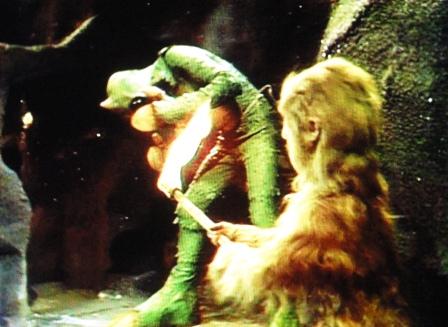
Will and Holly stumble upon some spray-painted writing on a rock, "BEWARE OF SLEESTAK." Who could have written those words in this crazy world? Of course, someday we'll find out more. Until then, suddenly, the bug-eyed Sleestaks swarm upon the kids with their scary hissing sound and abduct them. Cha-Ka runs off to find Rick Marshall to inform him of their abduction with his crazy Pakuni speak. Saturday morning adventure just got a whole lot more exciting with the arrival of one of the 1970s scariest creations. This was the stuff of nightmares for children the world over. NO BLOODY QUESTION ABOUT IT!

*
Genuine Alien abduction!
Cha-Ka expresses with great fear and excitement that Will and Holly have been abducted. "Sareesa tacca! Sareesa tacca! Two sassa!" [translated as "Sleestaks! Sleestaks! Two children"- that's my take]. It's something to that effect, but see for yourself as Rick himself finally gets the hint that he needs to drop the conversation with monkey boy and move along from this first of many wildly frantic Cha-Ka pleas to come his way.

*
The creepy accompanying score provides a good bit of mood to the series. The soundtrack is a wonderful accompaniment throughout the series, which is why it's so maddening to see the DVD producers paid little mind to getting it right. Truth be told, it doesn't appear much care was given to the video or audio mastering and was more or less a one shot deal at getting the series onto DVD with no budget. Adherence to a standard appears to have been a non-option.
*
Will and Holly are ensnared in a net and hanging over a smoking pit where far below a great beast bellows a frightening, grumbling growl. It is none other than the Sleestak god. As a child the Sleestak god was more frightening than the dinosaurs. It was even more frightening than those horrifying Sleestaks. As kids we were scared of the Sleestaks to be sure, but here they were worshiping a faceless creature dubbed the Sleestak god. It had to be monstrous! It had to be uglier and worse than those green humanoid bugs if they were attempting to satiate its anger with the promise of human meat. Our youthful imagination ran wild over the potential that lived inside that smoking pit. We kept imagining a great beastly hand rising from the dry ice smoke below the net. But as Holly put it best, there was a "what's his name down there" and that was enough for us.
*
Will finally proves to have some wit about him as a daring escape is made, but foiled by the nasty old Sleestaks.
*
Against some extremely convincing mattes of this lost world and mysterious forgotten city, Rick Marshall and Cha-Ka band together complete with "torcha!," as Cha-Ka knows it, to ward off the incoming Sleestak and save the kids. Inside the creepy city's dark passageways and seemingly deep into the catacombs, Will and Holly are once again strung up netted and hanging over that pit of smoke in dire straits. Admittedly, quiet moments like this, in any great series, where the characters offer a bit of themselves, are the ones that lure us in with our affection for them.

*
As Rick and Cha-Ka proceeded into the dark catacombs those bright, cheery, Captain Crunch-infested Saturday mornings quickly became a terrifying place. No amount of Franken-berry or Boo-Berry could lighten the mood from those few terrifying moments until you knew the Marshalls were safe in that cave once again.
*
One thing is certain Sleestaks do not like fire or bright light, thus I'm not exactly sure why they were prowling about in the middle of the day abducting Will and Holly. Perhaps it is the heat and not the light, which makes them recoil. Fortunately, Sleestak, as frightening as they are, are hardly fleet of foot. As a kid, I remember thinking the Sleestaks were so freakishly scary it appeared the sheer touch by one of them might very well melt your skin. I was terrified. Part of me secretly hoped and prayed they would rear their ugly heads on Saturday mornings, while part of me hoped for the sweet serenity of dinosaurs. Sleestaks were just off the scare charts! But again, they weren't fast, otherwise why Rick didn't just grab them and throw them to their deaths into the great void of their own Sleestak god comes as a surprise now. Yes, those Sleestaks were so scary the sheer sight of them could have you paralyzed in fear. Yes, Rick we forgive you.
*
I was completely digging this Cha-Ka cam!
The sound of a great, roaring beast envelopes the cavernous city underground as the Sleestaks close-in on Rick Marshall and Cha-Ka. The torcha is knocked into the pit and into the horror below. The room is alight with anger and bright orange red light. The diversion lasts long enough for a rescue as the Sleestaks flee and the kids are saved. All escape in a nick of time. Even Cha-Ka is safe, who, funny enough, sat happily playing with Marshall's Zippo lighter in the bowels of the cavern pre-escape unwittingly awaiting the Sleestak's return before being pulled along to safety by the Marshalls. I wonder if Rick has a Zippo from Japan Zippo Station. I doubt it.
*
In the end, the siblings still haven't filled those water jugs, but efforts to gather water have never been more fun or scary. These were short adventures on Saturday mornings and thank the Sleestak god, because my heart couldn't take much more. It was another childhood adventure from the imagination of Gerrold and the Krofft brothers. They brought to life the insanely well-crafted world of Altrusia in exciting and amazingly informative 22 minute Land Of The Lost classics. Series have done far less in 50 minutes. Though the video quality is near video transfer, getting lost inside this old land's charms may be worth the fun.
*
The Sleestak God: B+
Writer: David Gerrold
Director: Dennis Steinmetz

Sunday, February 20, 2011

Friday, February 18, 2011

My Neighbor Totoro

The stunning animation and storytelling of Hayao Miyazaki in My Neighbor Totoro. The Bus Stop scene is one of those great, classic, cinematic moments.

"Hayao Miyazaki's greatest work, and hence probably the best anime ever made." - Jonathan Clements & Helen McCarthy

Rule: Fans of anime are always fans of Hayao Miyazaki. Fans of Hayao Miyazaki [and other Studio Ghibli productions] are not always fans of anime.

Yes, ho hum another Hayao Miyazaki masterpiece of cinema for all the world to adore. It could certainly appear that way. The quality of the work appears effortless. The man is a machine of animating genius and works pure, unadulterated animation magic into every thoughtful story. As filmmakers know, it’s certainly no easy task to come up with one masterpiece, let alone one after another and continue to produce at Miyazaki’s level, but Miyazaki does it every single time. He is one of those rare, elite filmmaking talents that is able to out-Disney Disney itself. In fact, My Neighbor Totoro [Tonari No Totoro in Japan] [1988] may be his most Disney-esque picture, but they all have a kind of magic that lends itself to those comparisons. When you get right down to it, Miyazaki films are uniquely Miyazaki. And thankfully Disney found the good sense to import his special brand of animation that even Disney can't quite replicate. He is special indeed. His pre-Princess Mononoke [and Mononoke included] films contain the elaborate, skilled, hand drawn beauty and majesty often associated with the pictures of Disney. My Neighbor Totoro may be the odds-on sentimental favorite that gets you weak in the knees akin to something like Bambi.

Like Kiki’s Delivery Service, My Neighbor Totoro soars with enchantment and the wide-eyed discovery of a child seeing an animated classic for the first time. Walt Disney would agree by striking a licensing deal with Miyazaki's Studio Ghibli for distribution of each and every one of his works stateside along with other studio productions by the likes of Directors Isao Takahata [Grave Of The Fireflies, Only Yesterday, Pom Poko and My Neighbors The Yamadas] and Yoshifumi Kondo [Whisper Of The Heart].

A tip of the cap certainly goes to Mickey for the move! That said it makes you wonder how a major studio/ company like Walt Disney couldn't have been aware of other anime classics that allegedly may have influenced other Walt Disney productions. The late Director Osamu Tezuka's Kimba The White Lion [19650-1966] was believed to be the uncredited inspiration for Disney's The Lion King [1994]. Nadia The Secret Of Blue Water by Studio Gainax and Director Hideaki Anno bore some significant resemblances to Disney's Atlantis: The Lost Empire. Certainly much has been made of the similarities between these productions, but those are stories for another day.

Disney was wise to recognize one of Japan's greats in Miyazaki by bringing his feature films to the shores of America. Each of these Studio Ghibli productions are given professional voice dubbing treatments and a healthy dose of extras. My Neighbor Totoro is a family gem, pure and simple, because it is a work that timelessly reaches across generations with its wholesome innocence. It is powerfully moving in its understated, simple joys and like all of Miyazaki's work it is loaded with heart. It is considered one of his finest moments. Truth be told, a case for his best film could easily be argued and endlessly debated for each and every one of his cinematic treasures.


Not anime, but rather the classic, simple drawing of a child. You gotta love that!
My Neighbor Totoro centers on the daily discovery of the natural world by two young sisters, Satsuki and Mei, who move to the country with their father while their mother remains in a nearby rural hospital. The adorably likable, irresistible kids are led into a kind of Alice In Wonderland-like spirit world where joy-filled freedoms, lead to all sorts of unearthings with a wide-eyed wanderlust. The two protagonists or shojos [a Japanese term for young, cute, independent girl] are often the focal point for Miyazaki's films. Author Susan J. Napier makes a terrific point regarding Miyazaki's films playing against a cultural type in Japan in her book Anime From Akira To Howl's Moving Castle. In the male-dominated culture of heroes, Miyazaki's female heroines are a unique take and the male director knows how to work these wonderful characters despite the gender difference. He understands his characters and they are written with a greater depth and realism than most characters, male or female.

Sweet family moments like this one would be sadly considered politically incorrect by today's standards.
Napier writes noting Miyazaki's trademark style, "Miyazaki is perhaps best known for two particular elements in his works, his richly realized fantasy worlds and his female characters are always recognizable Miyazaki creations. His intensely colored animated worldscapes filled with his trademark images of flying machines, soaring clouds, and supernatural creatures take on a breathtaking life of their own while his brave, inquisitive, and risk taking young female characters are far removed from the identity confusion that characterizes many shojo [young girl] characters." This is expertly put by Napier describing these distinctive constants in Miyazaki's characters as "often quite assertive and independent." My Neighbor Totoro is no exception.

It wouldn't be anime without the ever beautiful shot of powerlines. Miyazaki accentuates his message of man and the natural world by offering the juxtaposition of the two in shots like this one.
Mei and Satsuki discover cute, but dirty little soot sprites in their new home. The creatures appear as a kind of natural protector and extension of the forest. Their wise, older neighbor they call Granny smiles upon their innocent delights. She also knows only through a child’s eyes of wonder can these creatures really be seen. Totoro and company play out like fantastical imaginary friends. Mei is the link to a world of fantasy and Satsuki too, both open to the possibilities. It is their first encounter with the forest spirits and the introduction of Miyazaki’s tender theme of harmony within the natural world between man and nature, the past and present; he so eloquently merges into his tales time and again. The sweet adventure begins.


Do you remember the joy of catching tadpoles?
The theme of Forest spirits and the spiritual world are often stunningly represented in Miyazaki’s fantasies [Spirited Away, Princess Mononoke] as a reminder of our living Earth. Through his fearless, young protagonists, the audience is awakened to the ancient past and our precious natural history. Miyazaki allegorically sprinkles Buddhist temples and shrines across his landscape symbolizing his attempts at reconciling the beauty of past tradition with modern culture. Miyazaki’s colorfully painted forest characters represent the children’s mental connection to the natural treasures to be discovered in the physical world.


The fictional world is slowly revealed as Little Mei spots and follows two small mini-Totoro creatures down a proverbial rabbit-hole straight out of Lewis Carroll’s literary classic, Alice In Wonderland, except Miyazaki’s homage is visualized through a rooted grove of bushes tunneling under brush that leads to an incredibly muscular and fantastic Camphor tree. Through a hollowed chute Mei stumbles down inside the tree and is greeted by a warm cavity. It is there Mei discovers nestled and slumbering one gigantic and fluffy Totoro, an almost updated version of Miyazaki's own Panda from Panda! Go, Panda! [1972]. Totoro is a wonderfully over-stuffed beast, a simple but spectacular looking thing. The images in the film are unforgettable and this moment is no exception.

Miyazaki’s further Alice In Wonderland-styled deference comes by way of an immense, orange, magically-propelled, 12-legged, grinning cat bus that looks eerily like the infamous Cheshire cat from Carroll’s story or to some extent the one from the Walt Disney film version. It's a beauty.

As an aside, in 2003, Miyazaki created a film short for the Studio Ghibli Museum called Mei To Konekobasu or Mei And The Kitten Bus exclusively for visitors at the museum along with eight other exclusive shorts. More reasons why I must go to Japan.


Totoro may be one of the most endearing and lovable animals ever imagined for the screen. The furry, plump giant with striking, thick claws is a goofy, strange beast. Overcome with her great discovery, Mei proceeds to grab the massive, cuddly, bear-like Totoro with innocent, eye-popping wonder and ever-trusting zeal. The innocence of a child as they say. When Totoro’s big eyes meet Mei’s big, sweet smile, it’s not only love at first sight for them but for us too. They bond instantly. Totoro bellows and flashes a wide-toothed grin as only a forest god welcoming pure goodness could. This scene is a classic in the annals of anime moments. The scene leaves you smiling from ear to ear and there are many other moments like this.

The rainy bus stop sequence featuring a clever and memorable interplay between Totoro and Satsuki holding umbrellas is another remarkable one. That moment is frozen in time. Fortunately for Satsuki she remains young enough that these forest spirits speak to her as much as they speak to Mei, and thus, unlike adults can see Totoro. In other words, Satsuki has not been damaged by man and society. She remains open, but that change is coming. The coming-of-age often brings with it a loss of wonder and that reality closes us to the possibilities, the possibilities that clearly still exist for Satsuki.


The girls’ playful childhood existence is made all the more magical by chasing down golden acorns, growing trees with Totoro, mini-Totoro and itty, bitty wee Totoro and gliding through the sky winds above the beauty of the forest. They learn to enjoy and respect their new surroundings with their new found friends. This is the stuff of dreams as a child and Miyazaki brings these feelings to life.

The film’s only restlessness and unease comes when Mei disappears in an attempt to visit her ailing mother. Totoro and the cat bus become Mei and Satsuki’s saviors. The film gradually unfolds and offers us a window into the lives of Satsuki and Mei. The message is clear, but it never intrudes on the simple fact that My Neighbor Totoro is a lovely, vibrant picture that entertains over and over again. It is a mostly sweet, meandering tale. It has a laid back quality that never fails to engage with its many colorful characters. When it's over you’ll be wishing the world were filled with neighbors like Totoro, Granny, Mei or Satsuki. My Neighbor Totoro is all heart.

Miyazaki places many subtle messages throughout his work combining quality film entertainment with important thematic elements. The strong bonds between Satsuki, Mei, their father and mother will make you laugh and illustrates Miyazaki’s important message of respect and love for one another and for our environs. The message is subtle, but it resonates profoundly. When Mei reaches out to her father to express to him what she has seen in the forest, he listens to her rather than discarding her pleas as nothing more than the rants of a young child. The girls, led by their father as teacher, stand before the great camphor tree and pray. “Magnificent tree, it’s been around since long ago, back in the time when trees and people used to be friends. When I saw this tree I knew this would be a good place for our family to live… so let’s give this tree a nice greeting… thank you for watching over Mei and making us feel so welcome here. Please continue to look after us.”

Further, Mei and Satsuki's mother is bed-ridden in the hospital and it isn't clear whether she will die or not, but Miyazaki could be gently reminding us here that we all leave this Earth behind for the next generation's care. We need to remember these things.

The film reminds us of those moments from our own spirited upbringings. It captures the feeling of those liberating early years running unhampered through the yard or field with overactive imaginations and only the wonderment of boundless discovery. He manages to create storybook films that not only entertain, but enlighten. Miyazaki demonstrates a deep respect for heritage and reverence for the land and harmony within it. His experiences easily translate universally, which is why so many connect with his films.

Miyazaki’s enchanting tales also execute an acute sense of place given his strong adherence to Japanese tradition. Each and every one of his films has a refreshing Japanese flavor alongside his many original and fanciful ideas some with European influence. It’s just refreshing to experience actual location shots from another part of the world and see a director remain true to his vision. Of all his films, My Neighbor Totoro feels the most definitively Japanese.

Napier alludes to the messages incorporated in Miyazaki's films, in essence, treasuring the natural world before it is "lost." She writes referring to "what is lost," as "a world in which nature is not yet dominated by humanity and exists as a powerful force in itself, strong in its identity as the nonhuman Other." Look no further than Nausicaa Of The Valley Of The Wind, Princess Mononoke and My Neighbor Totoro as evidence of "Miyazaki's privileging of forests and trees."

The Pixar-favored filmgoer may need a little coaxing, but there's nothing more beautiful than the hand drawn 2D animation of Hayao Miyazaki. Like the earlier Disney animation, these Studio Ghibli pictures are inspired works that are sure to broaden the horizons of any cinephile. This is the beauty of film isn’t it? The gift to bring the world to your home when you can’t take your children there.

My Neighbor Totoro was never on my radar at all, yet it was one of the finest animated family pictures I've ever seen. The script is beautifully written and never insults its audience with the kind of potty humor associated with many of the animated American films including Toy Story. That formula is tiresome and entirely unnecessary and it’s just not funny. My Neighbor Totoro took us all by surprise. We were blown away. It easily rivaled Kiki’s Delivery Service, another favorite with the Girl Wonder. It may have something to do with appealing to the inner child and the child-like wonder that permeates every cel of this film. It amplifies every thing great about being a kid and the explosive joy to explore bursting from every fiber of their being. Kiki’s coming-of-age adventure is equally inviting to youngsters. Totoro is for those who still remain the child at heart. It’s timeless animated perfection.

The animation is warm and the pastoral scenery is filled with lush, rolling green hills, bushy trees and blue skies. It’s like a watercolor canvas come to life. Miyazaki’s gorgeous, hand-painted backdrops always take the breath away like staring out at the vast sea or a mountains skyline. The details are astounding from tree roots to bugs on a plant stem. Key animation contributions apart from Studio Ghibli came by way of upstart Madhouse in the day. Madhouse Inc. is the studio behind the works of the late Satoshi Kon on Perfect Blue, Millennium Actress, Tokyo Godfathers and Paprika, as well as The Girl Who Leapt Through Time [2006]. The company also collaborated with Studio Ghibli on Spirited Away [2001], Howl's Moving Castle [2004], Ocean Waves [1993] and Gedo Senki [Tales From Earthsea] [2006]. Walt Disney lovingly transfers the color palette to its rightful splendor.

The concept of voice dubbing Japanese animation is a particularly tricky proposition for fans. Most true fans often love the original Japanese audio tracks. There are exceptions where the English dub somehow manages to work better than the original. I'm a fan of listening to both. There are nuances and differences in tone and sometimes even content that make the translations interesting. The dubs provided for the Studio Ghibli films are really top shelf with solid casting by mostly professional actors. Personally I love voice actors that work in the business whereby voice acting is their stock and trade. Tiffany Grant comes to mind, the voice of Asuka in Neon Genesis Evangelion [1995]. Actors and actresses like Grant are a pleasure to hear. In the case of My Neighbor Totoro the English dub is splendidly cast by selecting sisters Dakota and Elle Fanning to play the parts of Satsuki and Mei respectively. I'm afraid I have not heard the Japanese audio track though I suspect it is very good. The Fannings offer genuine, natural chemistry to the two sibling protagonists' banter. It's another reason these Disney releases spared no expense.

As far as composers of choice for directors, Mamoru Oshii often turns to Kenji Kawai [Patlabor, Ghost In The Shell], Hideaki Anno to Shiro Sagisu [Evangelion, His And Her Circumstances], while Miyazaki turns to mainstay confidant Joe Hisaishi [Spirited Away, Ponyo, etc.]. He pumps up the jubilation factor with a wonderful score and two bouncy, breezy numbers compliments of effervescent country pop singer Sonya Isaacs [not sounding 'a little bit country' here]. These songs are the English translations of their Japanese counterparts. Unfortunately, these gorgeous Disney-sponsored Studio Ghibli theme songs are unavailable for purchase anywhere, and the film lacks a 5.1 Dolby track. It would have been terrific to hear the rain falling, the cicadas singing or Totoro bellowing those enormous growls in a booming, layered, punctuated surround sound environment.

Trust me, even without children, you'll enjoy spending time and smiling with My Neighbor Totoro. Remember, when those winds blow against your face and through your fingers, give pause to those friendly forest spirits that surround you.

My Neighbor Totoro: A
Writer: Hayao Miyazaki
Director: Hayao Miyazaki


Additional commentary on My Neighbor Totoro: When the initial pitch was made for My Neighbor Totoro it was actually rejected by Studio Ghibli's financiers. The second pitch was accepted. This second pitch included the double bill with Studio Ghibli’s Grave Of The Fireflies by Director Isao Takahata. Producer Toshio Suzuki was desperate to get backing. Two different publishing houses supported the films. Both films needed resources. There were two production teams and two promotional campaigns. Both films miraculously competed despite their dramatically different tones and both were immensely successful. They pushed the envelope of artistic boundaries and expectations set previously within the industry. Grave Of The Fireflies is a harrowing, hardcore depiction of two children starving in Japan as a result of a shortage in the food supply during World War II and those responsible turning their backs on them. You don't get a much starker contrast to My Neighbor Totoro. Roger Ebert was a fervent advocate of Grave Of The Fireflies, but also praised My Neighbor Totoro as “one of the most beloved of all family films.” Nevertheless, they are two masterstrokes of animation. Despite their differences, the films offered an interesting juxtaposition painting powerful portraits of life in the Japanese countryside based upon a significantly dissimilar set of variables. One thing is sure, two classics were born.

The following two images while strikingly similar in their presentation of a boy and young girl inhabit worlds in stark contrast. Takahata's Grave Of The Fireflies and Miyazaki's My Neighbor Totoro, respectively here, played on a double bill. The strength is in the storytelling of these distinct pictures.
Writers Jonathan Clement and Helen McCarthy called My Neighbor Totoro Miyazaki's "greatest work and hence probably the best anime ever" in their book The Anime Encyclopedia. That is a bold statement given all of the wonderful competition surrounding the film not to mention the variety of presentations whether it be film, OVA or TV series [the three Japanese formats]. There's certainly a case to be made for it as much as there are case to be made for others utilizing similar statements. Given all of Miyazaki's work this statement could easily prompt debate among fans of Miyazaki alone. With all of the wonderful works to choose from some would hardly consider My Neighbor Totoro his best. I suspect it would be unfair to denounce My Neighbor Totoro as a mere children's film. There's so much going on in the film and there is so much detail and heart that one simply cannot reduce My Neighbor Totoro's qualities given its widespread appeal to children. It would be easy to place Spirited Away or Princess Mononoke ahead of this work, but My Neighbor Totoro is equal parts substance immersed in beauty. It is a subtle, strong film that should not be discounted by its delicious surface aesthetics, though they are immmense. Clements and McCarthy aren't wrong.

The writers note this is a personal film for Miyazaki in his love for the Japanese countryside and the history of a land that permeates it. The feel good strenth of the film may not appeal to those preferring a darker edge, but the fact of the matter is My Neighbor Totoro is a hopeful, spirited picture. Clements and McCarthy nail the film's jubilant spirit by noting the film is told "through the unquestioning, uncritical, undaunted eyes of a child." And honestly, what's wrong with that?

Director footnote: Hayao Miyazaki [1941-present]: Director/ Screenwriter/ Animator/ Artist/ Character Designer Miyazaki is legend. He founded Studio Ghibli. His works are many and these are some of his best: Nausicaa Of The Valley Of The Wind [1984], Laputa: Castle In The Sky [1986], Kiki's Delivery Service [1989], Porco Rosso [1992], Princess Mononoke [1997], Spirited Away [2001], Howl's Moving Castle [2004] and Ponyo [2008]. His hand can also be felt on a number of other Studio Ghibli productions including Whisper Of The Heart [1995] and Isao Takahata's Pom Poko [1994] and Only Yesterday [1991].
*For all your anime needs be sure to check out Robert's Anime Corner Store.

Wednesday, February 16, 2011

My Neighbor Totoro Polystone

An image of little Mei, Satsuki and Totoro [complete with frog] at the bus stop in the rain from the classic, delightfully adorable film My Neighbor Totoro. A gorgeous painted Polystone diorama released in February 2006.
*
This delightful little collectible was originally slated for the Fancave. It resided there in its box for some time. The Japanese import captures a particularly unforgettable moment in the otherwise entirely unforgettable film My Neighbor Totoro directed by Hayao Miyazaki. Walt Disney purchased the rights to the productions of Studio Ghibli. There's isn't a bad film in the Studio Ghibli bunch. Most of the works of Director Hayao Miyazaki, Isao Takahata and Yoshifumi Kondo are available stateside. I'm still waiting for a release of Isao Takahata's Only Yesterday and the made for Japanese television film Ocean Waves by Tomomi Mochizuki. I'm not sure the latter two will ever see the light of day here in the states, but I remain forever hopeful. Would Miyazaki have it any other way? The works of Studio Ghibli are like paintings come to life. Immense, lovingly detailed, colorful works as represented in this beautiful PVC collectible, a perfect snapshot from My Neighbor Totoro.
*
My kids love My Neighbor Totoro and truth be told I do too. It is an infinitely watchable film for all ages.
*
So one Christmas I decided the Totoro figure was better suited on display as a conversation piece for my Girl Wonder and her friends than sitting in a box collecting dust. The collectible and film remain popular favorites in our home.
*
Actually, I don't have the box any longer unfortunately. It was a rare momentary lapse of reason from this collector to throw it away after opening. Gosh, what the hell was I thinking? I'm not even sure if this item is still available. It seems fairly elusive at this point. The collectible is returning to the Fancave until such time it can safely remain in the loving dustfree arms of a Girl Wonder without a bedroom that looks like a bomb went off in it! It's a miracle that little frog is still around. If you haven't seen the film it's time for you to relive the joys of your youth.