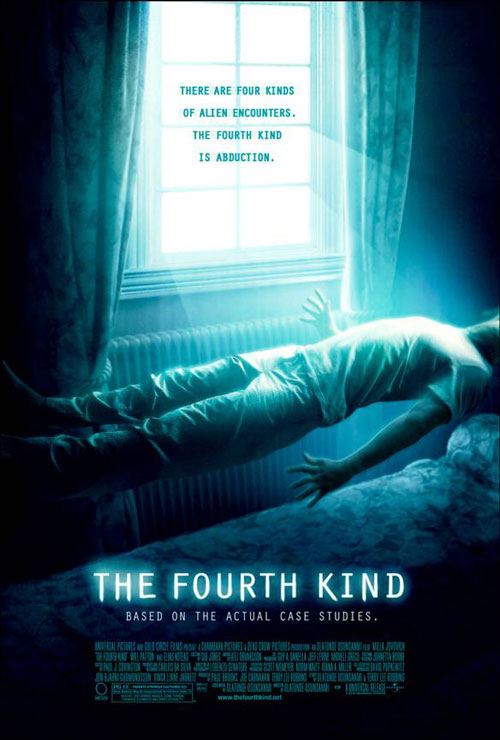
"How could they remember what they are being forced to forget?" -Dr. Abigail Tyler [The Fourth Kind]-
That question is perfectly appropriate thematically for a film that's less about content and more about questioning credibility and what one chooses to believe. Even better, how could they believe what they are being forced to believe?
Director Olatunde Osunsanmi certainly taps into the zeitgeist of popular American film when it comes to the UFO encounter through implementation of a title that immediately recollects Close Encounters Of The Third Kind [1977] by director Steven Spielberg whether intentional or not. It's strictly through the title of his film, The Fourth Kind [2009], that Osunsanmi achieves his desired effect. Though I suspect the director's intent is by design as The Fourth Kind is a purely manufactured fabrication.

For the most part The Fourth Kind works on pure atmosphere and style within the employ of a small budget and generates a palpable sense of dread without ever delivering any real event or physical alien presence. In fact, the most unsettling image is that of a white owl, as John Kenneth Muir correctly identifies in his alternate take on the film as a kind of alien "avatar." It spooks and immediately recalls the extra-terrestrial grey men with those great big eyes. Was it actually an owl? But as an entertainment it doesn't fully engage us or satisfy us with the kinds of characters we loved in such films as Fire In The Sky [1993] or Communion [1989]- characters we cared about.
 Still, again, those pictures had more in common with the narrative structures of films like Close Encounters Of The Third Kind despite Fire In The Sky's claim of being a reality-based story sourced from an account of abductee Travis Walton. The Fourth Kind plays with our sense of reality and credulity by mixing Hollywood actors against split screens of footage highlighting less notable actors doubling as authentic people who have actually witnessed said abduction events or experienced real encounters.
 Taking a step back, so what is the fourth kind really? Of course, the fourth kind denotes not just contact but actual alien abduction - the differentiation is worth noting. The fourth kind is always a sticky wicket as actual proof of such an event is rarely glimpsed or evidenced.
 We can take our understanding further through the scientific identification or classification of close encounters in ufology as founded by astronomer and UFO researcher J. Allen Hynek. His hierarchy of classification was first noted in The UFO Experience: A Scientific Inquiry [1972]. The scale generally works as follows and has been modified accordingly through the years with variations on the theme through input by various ufologists, whose numbers are vast. In simple terms, the first kind of close encounter refers to a UFO sighting. The second kind refers to not only the sighting of a UFO, but the observation of its physical affect [crop circles, heat signature, etc.]. The third kind is notes the physical appearance of animate beings or entities. Again, the fourth kind is an extension of the Hynek scale and revolves around the physical abduction of humans. Interestingly enough, could Osunsanmi's film title have been referring to the hypnotic visual abduction of viewers? Might The Fourth Kind? have been a better label? For those interested, The fifth kind refers to joint communication. The sixth kind of close encounter involves the injury or death of the contacted. The seventh kind of encounter is sexual in nature. It is the sexual encounter and mating between a human and extraterrestrial and involves a hybrid birth dubbed the Star Child. Yes, this science fiction gets deep.
  The intentionally creepy look of an alleged doctor. In The Fourth Kind the director is interested, as evidenced by a blurred opening image of actress Milla Jovovich and her claim that events captured for the film are disturbing. Blurring the lines between what is real and what is either a fictional or non-fictional dramatization is the primary directive. But asking us to believe these events through the use of a Hollywood actress as a spokesperson is the first mistake. Employing actors as a trusted source of fact is a poor technique in the film maker's charade.
  Implementing archival footage, historical audio interviews, unintelligible Sumerian language bites and split screens of the alleged "real" Dr. Abigail Tyler and the actress playing her is a sound method of distraction. It's the art of the illusion at its best. Osunsanmi's story even takes place in the very real town of Nome, Alaska.
 For me, many of the events that are re-dramatized from the archival footage are just a little, too clean and too perfect. The slight of hand felt revealed at points in the picture. While other times, particularly in the final minutes of the film, they are surprisingly unnerving.
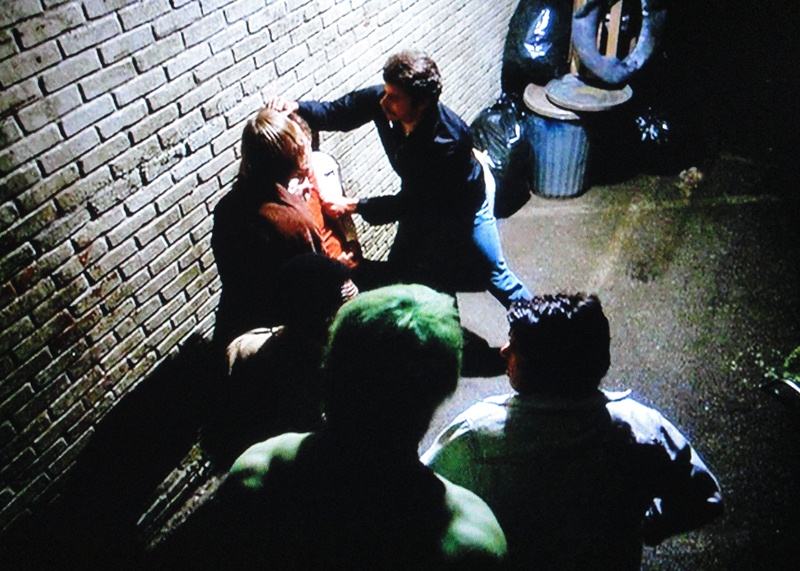
 In one scene, one of Tyler's previously hypnotized patients actually murders his own family one evening. The sequence is reenacted to the letter from the allegedly captured, authentic coverage. It may be one of the film's most thrilling moments and yet the techniques were ultimately distracting and seemingly implausible to me. In other words, it felt contrived.
 Referring back to the video montage of the white owl, Muir and I agree the sequence fails to generate any real thrills. Muir does not believe the film fails, but simply the scene. As he notes accurately, "There's no sense of learning, no graduation of suspense, no escalation of terror." I felt this throughout The Fourth Kind in parts particularly an understanding of events. I didn't necessarily need to see aliens, but additional information might have made for a more suspenseful picture.
 There are scenes where police surveillance through more archival footage would indicate the video cameras are interrupted by ufological interference and influence or perhaps a paranormal affect. There's never any proof apart from scrambled video. Once again, what do you believe? Dr. Tyler's daughter is allegedly abducted and and her son is removed from her care, but when Tyler attempts to explain events the on-site police officer is nowhere to be found to corroborate her story. This is a problem. Where's the testimonial on her behalf even if Dr. Tyler isn't real?
 The actual Tyler abduction sequence is fairly intense. It doesn't hold a candle to Fire In The Sky [1993], but it's effective within the context of this film awash in blurry blue and white tints if a tad over edited. The comparison is probably unfair too comparing apples to oranges in terms of technique. The creators of both films are shooting for entirely different styles, but both beg similar questions. What are we willing to believe? Both films present these themes in their own contexts.
 The film's final moments see Tyler awake in bed with a broken neck resulting from the abduction. She is informed her husband Will was the victim of suicide. The police official questions Tyler on her daughter Ashley's whereabouts. The bottom line is we don't know.
 By the film's end we learn Ashley has never been found and Dr. Tyler has relocated to the East Coast estranged from her son. She is bedridden and her health continues to deteriorate as a result of the ambiguous nature of her experience.
We're to believe the FBI has allegedly visited Nome over 2000 times since the fourth encounter cementing the falsification of the The Fourth Kind.
 As a result of the lie, critics were unkind. Those critical of the film had some truly tough words for the production giving it a 17% splat over at Rotten Tomatoes. "No, no, no, no," declared Michael Phillips [At The Movies]. A.O. Scott [At The Movies] dubbed the movie "dull" and "clumsy." Amy Biancolli [The San Francisco Chronicle] saw the film as melodramatic with "narrative segments... too glossy and over-stylized." Some critics found the archival footage a little too transparent. Cynthia Fuchs of Pop Matters asked, "Where's Fox Mulder when you need him?" But wouldn't the question be more appropriately, where is Agent Dana Scully? Other descriptors include: "arrogant," "ignorant," "silly" and "laughable" [and that was by a critic who liked the film]. Milla Jovovich can't escape the knives either. Ken Hanke wrote, "The first line in The Fourth Kind has Milla Jovovich calling herself an 'actress,' so we know right away the film is lying." Ouch. Mark Palermo reduced it to an entry for "Unsolved Mysteries." Andre Wright noted, "If this was made in the '70s, it'd be narrated by Leonard Nimoy and chock-full of yetis and the Devil's Triangle." Writer John Kenneth Muir places the film in a similar, but better articulated historical perspective. Laura Clifford declared, "I'd love to be at a screening of "The Fourth Kind" in Nome, where it's sure to be greeted as a comedy." Mark Dujsik wrote, "A lot of nothing happens in The Fourth Kind." Some saw the influence of Orson Welles, but that the director had more "chutzpah" than skill. Jeff Vice dubbed it, somewhat unsurprisingly, "Close Encounters Of The Worst Kind."
 Joshua Starnes [Comingsoon.net] fell somewhere in my camp noting a series of interesting ideas, but not a complete picture when he said "the whole doesn't really seem equal to the sum of its parts." Could everyone be so wrong? There's certainly a theme here and the problems with The Fourth Kind are varied, but the general opinion is universal. I certainly see what works, but as a complete picture it does not.
 There were some who felt it was "a sophisticated hoax" or "out-Blair Witch'd The Blair Witch Project." I might agree with that last one. One called it a "valiant original." Another said it was scary enough but, "just don't Google the flick before you see it." That may be the response from your average moviegoer too. Bob Bloom enjoyed the film and indicated "you spend more time debating with yourself whether what you are watching is truth or fiction." This almost works against the film as a distraction. Honestly, the director actually succeeds with his mixed film attempt overall, but the artificially clever film isn't enough to deliver the thrill of the paranormal for its full 90 minutes. The list goes on.
 Ultimately The Fourth Kind feels almost schizophrenic in its effort. Instead of engaging us and riveting us in a tale about the people of Nome, Alaska, Osunsanmi, an understudy of director Joe Carnahan [The Grey], delivers a film founded more in style and technique than an actually compelling paranormal story. It's a great looking film shot on location in Bulgaria and British Columbia. The Hollywood portion is glossy and The Blair Witch Project approach appears sufficiently believable.
 By comparison, the director works some simple magic on a shoestring budget of ten million, while Close Encounters Of The Third Kind made a sizable impression with its twenty million in the day. Despite a critical hammering The Fourth Kind earned 47 million marking it a mild success. Believe that!? As Muir points out in his piece, The Fourth Kind is not a failure. In fact, artistically, it's a decent attempt and merely a partial success.
 Unfortunately, The Fourth Kind is more like a lost opportunity had a stronger tale been told. It's a bit like Communion-lite. It's like paranormal mood music at a novelty shop.
The film lacks in credibility with Milla and Osunsanmi as representatives or voices and purveyors of the story's alleged truths. There is little weight given to character. The daughter is missing, but who cares? Some events are merely presented to the audience without the much required tension. Yes, the attempt at Sumerian voices is scary and a nice touch, but The Fourth Kind is all style over substance. It never becomes a film about the event, but rather what we, as Milla suggests at the opening of the film, decide to believe. Were residents visited by aliens? Was it demonic possession? Or were the town people suffering from some other psychosis? How about none of the above, because none of it is real. While The Fourth Kind was an initially intriguing exercise it just failed to deliver beyond the promise of the always intriguing genre premise [for me].
 On the other hand, The One To Be Pitied watched the film and offered an alternate take of her own. She called The Fourth Kind "crazy bananas" scary and was stunned to discover it was merely PG-13. She objected to the rating given the intensity of its real content. She's not wrong. I can assure with a great degree of certainty my kids would have categorically no interest in seeing the film without suffering from nightmarish seizures under their bed covers or a thorough scarring for life, but it doesn't take much for some. The One To Be Pitied felt the mix of archive footage and reenactment was indeed disturbing in ways reminiscent of William Friedkin's The Exorcist [1973]. These things are indeed subjective as you can see.
 This reaction from The One To Be Pitied gave way to an intense investigation of the subject matter and the alleged archival footage of Dr. Abigail Tyler. The One To Be Pitied quickly revealed The Blair Witch Project-like truth behind the mockumentary. The staged archival fakery is aided by a stamp of authenticity from the real Chapman University, a genuine liberal arts school. The artifice of the film is compounded by actress Charlotte Milchard as the real Abigail Tyler who is terrifyingly mediocre as a doctor on the edge. Yes, the false film will work for some. The One To Be Pitied was disappointed it was not of The Factual Kind.
I always sort of shrugged after seeing The Blair Witch Project and felt it never really went anywhere. The One To Be Pitied enjoyed that one too. I won't discount its influence on film, but pictures like these can certainly be influential without being entirely stimulating.
 So The One To Be Pitied and myself experienced two entirely different reactions. She found it troubling even if it was a scam. I found it to be far less engaging than a film like Fire In The Sky. The Fourth Kind just felt a little confused. Its mundane approach just never really caught fire, so to speak.
 Admittedly, the film, despite its apparent flaws, became mildly unsettling at times, but like a smart little fish, I nibbled without fully grabbing that hook I suppose.
Look, if The Fourth Kind, clearly The Blair Witch Project of alien abductions, was true I can assure you Nome, Alaska would be off limits though it's unlikely I'll ever visit. When I think about it I'm not certain if the artifice behind The Fourth Kind was clever or as crazy as the real Dr. Abigail Tyler, but I know one thing, good or bad, it will force a reaction. More importantly, I am however looking forward to the next installment of Resident Evil starring the real Milla Jovovich. She'll probably look amazing too.
The Fourth Kind: C-
 Additional commentary: Again, John Kenneth Muir offers an alternate perspective on the pseudo-documentary/ mock documentary or mockumentary that is The Fourth Kind over at John Kenneth Muir's Reflections on Film/TV citing the film as a good attempt at "out-and-out horror."
 He begins and, as always, weaves a terrific historical perspective through his use of film and television to give The Fourth Kind a legitimate context.
Muir does note the opening on camera address by Jovovich as she breaks the "fourth wall" as appropriately "cheesy," an establishing moment for the film that is a truly novice and ill-advised move. This attempt to draw us into the film actually had the reverse affect on me. I immediately began to question the motivations of the film.
Muir makes note of Tyler's arrival to isolated Nome, Alaska by plane over the treeline. Muir accurately refers to the very real town of Nome, Alaska, as "the perfect "test tube" environment for alien abduction and experimentation." The set up is a good one.
Muir enjoyed the use of the Sumerian and cuneiform angles taken by the filmmaker and I agree. It immediately taps into "the rules of that genre" and the idea of aliens from outer space. I always enjoyed those undercurrents with regard to Stargate and even Battlestar Galactica, classic or re-imagined. This is a well-established rule within science fiction television. It may have been the most effective portion of the film.
 The make-up is effective. I never imagined I would see a film where Milla looked like crap so there's that. In the final analysis Muir makes two points. I agree with one of the two.
 He accurately points out from his always well-founded perspective in horror and science fiction that The Fourth Kind is essentially taken out of context by critics. "Critics may not be familiar with the style and history of the UFO pseudo-documentaries of the 1970s, and thus don't understand the genre the film is deliberately and delicately aping. They have no idea that this is an updating of a historical movie form. Therefore, they have no way to put The Fourth Kind into any kind of meaningful context for their readers." I would easily count myself among those lacking a historical perspective on the UFO documentary or mockumentary films, but my learning curve persists.
He also points out critics disliked the idea of being "tricked" or "outsmarted," which may have played into the backlash of the film for some critics to be sure, but not all.
But I would submit that, while The Fourth Kind was technically savvy, it was not effective in "entertainment value" as I had hoped as Muir received it. This of course is entirely subjective and as I mentioned The One To Be Pitied enjoyed the mental challenges of the film. I found myself generally unmoved and disconnected over the anemic proceedings. I certainly enjoyed The Fourth Kind's cerebral, effects-omitted attempt within the genre, but never fully accepted the characters or story.
 Muir see The Fourth Kind as a "supremely effective" horror film and it does have its moments. It's pretty clear author Muir knows his horror, but as a film it left me a little detached and unconcerned with its principals. I simply wasn't drawn into their world. I didn't care about them. And if it is effective as a horror film to some it may be why I didn't enjoy it from the perspective of someone looking for science fiction. Elements of alien possession were tantamount to demonic possession.
 And while it's not entirely fair to compare, as Muir points out, The Fourth Kind doesn't give us proof of alien abduction. Of course, there rarely is that, but with Fire In The Sky, as a picture, following the alleged alien abduction, I cared about the fates of Travis Walton and Mike Rogers. For some reason, I wasn't seduced by the style of the film. I didn't really care about Dr. Abigail Tyler or her missing child. I wasn't invested in them. It didn't feel real to me. They didn't feel real to me. It stands to reason since the entire event and film wasn't authentic.
"What you believe is yours to decide," offers Milla. It would seem most either didn't believe it or simply didn't enjoy the film. You can tip your cap to the risks taken with the film, but buying into the approach as entertainment is another kind of story.