"You need to get out more."
-Rodney McKay-
"We're in another galaxy. How much more out can you get?"
-Dr. Carson Beckett.

... and in a galaxy far, far away.
Finally, part II.
Sandwiched somewhere in time and space between a whopping, powerhouse, ten season run of Stargate SG-1 [SG-1]and a sorely under appreciated and misunderstood two seasons of Stargate Universe [SGU] was an intense five season missing link between loaded shot in glorious greens and blues dubbed Stargate Atlantis [SGA]. In many respects this series nicely bridges the other Stargate sagas. Each really distinguishes itself and offers its own character, color and narrative palette and identity.

SGA is something of an amalgamation of the best in science fiction borrowing formula from its progenitor, SG-1, and injecting it with the kind of energy found in vibrant, irreverent sci-fi series like Farscape. SGA felt a little more UN and Euro-centric in vision over the American-centric, more militarized version that was SG-1. SGU takes us even further from the American establishment. In fact, SGU takes us even further from the Earth establishment and formula of the previous two outings.
Without question many of the archetypes that worked on SG-1, reappear here on SGA. That, of course, is for a reason - they were successful and terrific archetypes.


Still, SGA brings its own flair and muscle to its colorful cast.
To pass the torch it came as no surprise SGA would team Joe Flanigan as John Sheppard with Richard Dean Anderson's General Jack O'Neill in pilot episode Rising. SGA would find its way but O'Neill would pass the baton to the equally sharp, handsome, funny and dynamic lead embodied in Flanigan.
Torri Higginson headed the SGA expedition as Dr. Elizabeth Weir, the logical counterpart to SG-1's Samantha Carter as portrayed by Amanda Tapping.
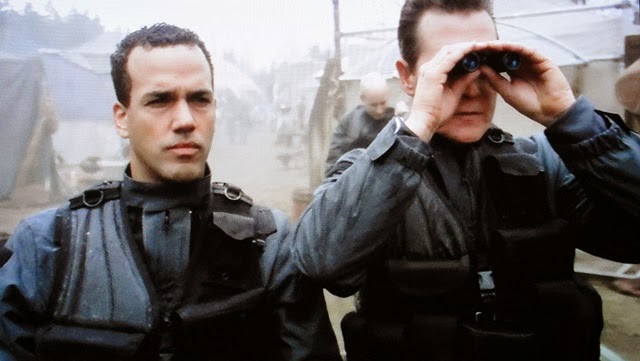
David Hewlett played the role of scientist-with-a-sense-of-humor Rodney McKay, an exquisite choice as SGA's resident scientist to fill the shoes of the quirky cool Daniel Jackson as brought to life by Michael Shanks. In many respects, the naturally gifted Hewlett is perfect as a comedic foil. The character of McKay made his initial appearance in SG-1 S5, Ep14, 48 Hours. Many characters guested on each of the franchises as the series often cross-pollinated between the two while the shows overlapped in production.

Paul McGillion would play Scottish medical chief Carson Beckett, an ideal mix of Dr. Leonard "Bones" McCoy and Montgomery Scott of Star Trek: The Orginal Series. The colorful Beckett was SGA's answer to SG-1's equally popular Dr. Janet Frasier.
On the alien front, new arrivals to replace Teal'c included a soft, feminine, warrior Rachel Luttrell as Teyla Emmagan and Jason Mamoa as bad ass Ronon Dex. Dex delivered a nice action-based injection into Season Two as the alpha male answer to Teal'c.

There are noteworthy identifications without diminishing the talents each actor brought to their respective roles. The dynamic of the ensemble was once again casting gold as SGA soared flawlessly into the Pegasus Galaxy for a new look and new identity.
SGU would take the archetype formula and essentially toss it out the window genuinely approaching its large ensemble cast of humans as multi-faceted and flawed. Unfortunately, as impressive as it was, this new approach to the third arm of the series was just one aspect that pissed off a fairly extensive fan base.


SGA's cast was just one of the series greatest achievements. Unlike SG-1, there were no immediately identifiable big names. SG-1 had Richard Dean MacGyver Anderson after all. SGA was relying on solid casting and the existing franchise name to sell it.


As writer, executive producer Robert C. Cooper pointed out in Stargate Atlantis: The Official Companion Season 1, it worked. "We couldn't afford any big-name actors." Of course, the cast, just like the cast of SG-1, went on to become fairly bankable commodities like Jason Mamoa (Conan, Game Of Thrones).

Each and every cast member made a remarkable impact on the series. Surprisingly, David Hewlett, who would eventually appear in a total of seven SG-1 episodes, was not initially a done deal as Dr. Rodney McKay. Martin Wood, Robert C. Cooper and Brad Wright all wanted the venerable actor, but MGM saw things differently. Much like the fight for Gillian Anderson as Agent Dana Scully, by Chris Carter for The X-Files, Wood, Cooper and Wright won and the right man was landed for the mission. Hewlett is truly essential to the chemistry established throughout the SGA run. Hewlett was such a last minute decision he arrived for day two of filming on Rising following the contract signing. Personally, he's my favorite in the cast, but I imagine is a love/hate proposition or an acquired taste for some. Still, his curmudgeon personality is brilliantly executed.
Cooper recalled establishing the different relationships for the show, but overly heated exchanges never seemed to quite fit the "tone" of SGA. "Maybe because it's an expedition and they are so far from home," reckoned Cooper. But, much of the friction and fireworks came from Hewlett as McKay. It was always "the more amusingly abrasive dynamic between McKay and just about everyone else" that certainly lured this viewer. He's the guy you love to hate, but still love.

Interestingly, there is a real window into the soul of Cooper here and what was being attempted on SGA and clearly where these writers wanted to go ultimately leading to SGU. Maybe they right. This battle of wills and for the hearts and minds and trust in the hearts of men would be taken to dark places with SGU. The question would always be, were fans ready for that kind of dynamic. Clearly, they weren't quite willing to go that far with SGA, but it was indeed where they wanted to go, where they wanted to push the envelope and why SGU exists as it does today. It was definitely the maturation of a writer's dream. Unfortunately, did Stargate become too dark for fans? For many, the answer was undeniably yes.
SGA may have seen its fair share of compromise, but it spared no expense in its astounding level of detail and gorgeous production and set design. You are transported to a place not of this world and it's tropical colors carry us someplace pleasurably foreign far from the military browns of the SG-1 universe.

The late Keith Wilson floored us with his work on Space:1999 giving Moonbase Alpha a sense of space and depth. His production work was second to nine. Both Battlestar Galactica's impressed us from their command bridges. Like the difference between Space:1999 Year One and Year Two, there was indeed a difference in size and scope to Battlestar Galactica's command posts. The classic was large, wide and epic, whereby the new series was smaller, darker and more claustrophobic. Star Trek: The Original Series gave us breathing room as well as real vision on the bridge of the U.S.S. Enterprise. SG-1 too set expectations with its gritty interpretation of Cheyenne Mountain. Well, like Space:1999, SGA took the franchise to the next level establishing Atlantis with a positively fresh, vibrant and wide open working environment that was unique and vivid in its realization of that universe. It is a set of the highest quality and may arguably be one of the best of the franchise.

Production Designer Bridget McGuire spent eight years on the earthy-toned appearance of SG-1, but with SGA she was given the opportunity to really let down her hair and do something special architecturally and geometrically. Atlantis was given a very angular look inside of the "snowflake" exterior of the lost city.
The aesthetic is truly awesome. Bubbling tubes of water dart the city adding to the effect. The lighting is stunning. The style and color was applied to the very Stargate itself. The new digital ring functions through lighting rather than the traditional spinning and locking of chevrons found with the militaristic heaviness of the SG-1 approach. Overall, Atlantis "bright and airy" reflecting "the lines and light from all around." It is an ornate, pristine beauty architecturally made with real affection by McGuire and her team.


Thomasina Gibson wrote in Sci Fi Magazine in August 2004, "The room where the Atlantis Stargate is housed is an entire soundstage, a facility arranged on several different levels, each one resplendent with intricate detail. Magnificent stained-glass panels adorn the entire facility." The designs were the inspiration of architect Frank Lloyd Wright. According to art director James Robbins the command center and Atlantis was an "homage to his genius." Executive producer Cooper was in awe calling Atlantis as one of the "most incredible constructions." It's nothing short of perfection.
Color was indeed a significant marker for the series in differentiating itself from the original SG-1. Illustrator James Robbins said it best to Sharon Gosling for her Season 1 companion. As someone versed in the earth tones of SG-1, Robbins was delighted to bring out the resplendent color of SGA. "The color palettes for the shows are very different, as are our lighting and environments."

Accenting all of this exciting new visual stimulus would be composer Joel Goldsmith with his stirring "pastoral" score, a mix of "European" and "Americana." The late Goldsmith truly understood the franchise adopting a unique style with each new arm. The zenith of his work resides in the incredible score he constructed for SGU. It is a criminally unrecognized achievement, unavailable on CD, as much as SGU was ignored.

Derision for the series seemed almost instantaneous too. Virgina Heffernan of The New York Times called Stargate Atlantis "densely produced" and disliked the "Art Deco game-show decor." She found Rising to be "dull" and "tedious." Sometimes there's just no pleasing people. Say what you will of the series formula, much craft and care went into Stargate Atlantis and it's hardly dull. What would Heffernan make of Earth 2? Space:1999? Not enough color? I can't recall this much glorious color since Star Trek: The Original Series or maybe Star Trek: The Next Generation.
The greatest slam of all is a killer blow to one of Stargate's original strengths - humor! She was not amused. That's unfortunate, because McKay is often one man wrecking ball when it comes to funny often working in tandem with hysterical straight man Shepard. This gets refined going forward albeit repetitious to some. But, there's no pleasing everyone.


Impressively, SGA ran simultaneous to critical darling Battlestar Galactica, but proudly boasts a unique sense of style and adventure without receiving an ounce of the critical accolades of the latter. SGA held firm in its vision never attempting to incorporate Ronald D. Moor's series into its own personality. SGA was indeed secure in its identity and stood tall on those merits.
SGU, on the other hand, arguably borrowed inspiration from the Moore series, but it would be unfair to pigeonhole SGU as a mere copy of that series. SGU was indeed darker, more cerebral and approached its third franchise with a series of different filming techniques, but it never borrowed strictly from Moore's outing.


Unlike SGU which tamped down the humor-based release valve, SGA still retains, for better or worse, much of the good nature and humor of its predecessor SG-1. All of the humor, charm and chemistry that established SG-1's classic dynamic is clearly on display in SGA. SGA, too, had the good fortune of establishing chemistry out of the, er-herm, gate. The cast's comic timing is simply unopposed and may explain why these first two iterations of the franchise are more closely identified. SGU definitively downplays the humor of their situation. Humor exists but isn't implemented to defuse every moment of the series. The cast is cut off from anything remotely recognizable in SGU and their situation is even more dire and handled with a sense of helplessness as people grasp for understanding.

Stargate Atlantis, Season One, Episode 1 and 2, Rising is where it begins for this second incarnation of the franchise. Rising, Part I was covered here.
The Atlantis expedition arrives in the fabled lost city of Atlantis through a wormhole established with power supplied by a ZPM [Zero Point Module] between the Milky Way and the Pegasus Galaxies. It's a one-way ticket to new worlds, new discoveries, new adventures, new enemies, new characters and a new home. Upon arrival, sheer movement awakens Atlantis and its power grid, which is seemingly dedicated to a razor thin shield or force field that holds back the oceans around the submerged Atlantis. It's truly glorious, epic television and the cinematic nature of this latest variation on Stargate proves itself light years ahead of Stargate SG-1's original effects capabilities as the city emerges from the ocean.

On Blu-Ray, it's a stunning tour de force for TV. There's plenty of action amidst the standard character introductions and interactions, but somehow, with all of the information packed in, like Farscape's Premiere, it manages to pull off the proceedings almost effortlessly. The opener is breezy and well-paced. It's certainly a wonderful teaser of things to come for the series.

Particularly exciting is the arrival of a new enemy in the shark-like Wraith (though bug-related). My Boy Wonder immediately felt the alien race was far creepier and far more intriguing than the Go'a'uld and he loved the snakeheads. But The Wraith present something sinister, malevolent and certainly darker. They are like unstoppable sharks, a ferocious race of creatures who relentlessly aim to control the Pegasus galaxy. The new villain offers the writers and creators the opportunity to investigate new ideas and engagements, not to mention a brand new species.

Teyla says with a troubled heart, "If the Wraith have never touched your world you should go back there," surprised the humans have never heard of the Wraith. The Wraith are indeed the biggest fish in the Pegasus pond and obviously strike fear into humanoid hearts across the vast, dark expanse for a reason. Where SG-1's Go'a'uld took hosts and created a dynamic mythology, The Wraith, too, present a fierce breed of creature that feasts on its prey, like vampires, sucking the very life blood and essence from one's existence. It presents new avenues for mythology-building to be sure.
Atlantis technology presents another unique element inherent to the series new style and direction. Puddle Jumpers, Ancient chairs and more. Yes, Rising promises to be an irresistible ride.


Undeniably, the show takes all of the built-in formula of SG-1 and it's ability to oscillate between a delicious blend of character tension, action and moments of reflection and the story serves its stunning cast immaculately. The cast is the series greatest strength. Perhaps familiarity bred contempt with critics as SGA was clearly a fan darling and less the giant leap forward creatively that SGU would become.
Still, SGA is like a fuel-injected sports car. It is fast, fun, sharply penned with a cast delivering dialogue at rapid fire, it moves filled with attitude and emotion.
It's easy to understand why fans were stunned by SGA's cancellation, a reaction that turned to anger and ultimately rejection of the less funny, darker, even more "cerebral" SGU. SGA certainly had more fuel in its tank when it expired. At the very least, SGA is good, old-fashioned sci-fi adventure and Rising presents a cinematic snapshot of the kind of energy, excitement and chemistry that would be the hallmark of this underrated series and what viewers could expect.

SGA, in retrospect, like SG-1, may not run as deep or capture the psychological subtext of SGU or Battlestar Galactica, preferring action adventure and light comedy over harder science fiction with a sense of real jeopardy, but this is a quality production through and through. The expertly woven interplay and flawless performances are a hell of a lot more fun than most science fiction adventures and most television period. SGA proved trust and humor could carry the day as much as despair and distrust.

Rising (Part II): B+.
Writer: Robert C. Cooper/ Brad Wright.
Director: Martin Wood.


