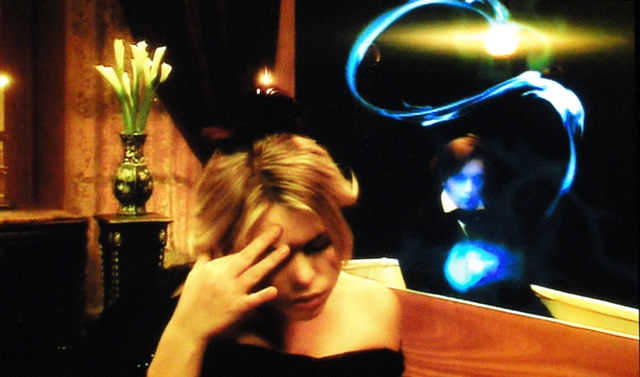
"I could save the world, but lose you."
-The Doctor to companion Rose [World War Three]-
With a title like Doctor Who's Aliens Of London, you'd think I'd be entirely all-in and on board this spaceship, but, alas, the two-part Aliens Of London and World War Three don't quite set the world ablaze despite their share of thrilling moments. The highlights certainly make them both worthwhile, but the fart humor just never quite cuts the cheese for me.


I like alien flatulence as much as the next sci-fi fanatic, but the focus on the aliens, a group known as Slitheen, tended to pull away from the real character strengths of the Doctor and Rose and character portraits in general in favor of a bigger, more epic storyline. This character omission was a problem that would be redressed beautifully in Series 1, Episode 11, Boom Town, which actually incorporated one of the guest characters from these two episodes. Boom Town would take the approach of really exploring the Slitheen. Russell T. Davies would be responsible for the entirety of these three Slitheen-centric episodes, but Boom Town is ultimately the one with a real sense of explosive, methane-like character-based power or at least lights it up more effectively like a lit match to the crotch of a pair of jeans. Don't ask, but the Spanish exchange student and roommate had a gift back in the day.
So load up your gas bags and prepare to clear the room for Doctor Who, Series 1, Episode 4, Aliens Of London and its sequel Doctor Who, Series 1, Episode 5, World War Three, the official first Series 1 two-parter.
This is the first time Series 1 has spread the story across two episodes reminding us of the days of Classic Doctor Who. Back then the length of four and even six installments for a story tended to pad the length of the tale unnecessarily. As a result, good stories tended to lose momentum or at least run in fits and starts. Doctor Who, like any science fiction, works best when its tight, but comparing the new series to the classics is a bit unfair. The 1970s allowed for a great deal of leeway and viewers were far more forgiving and let those tales breathe at their own pace. I certainly wouldn't change those classics. They are wonderfully nostalgic time capsules on top of a number of stories with generally strong material. Having said that, these new entries in the legacy of Doctor Who are hardly slow and move along at a brisk pace.

The arrival and introduction of the Slitheen in their first official appearance here within the Doctor Who mythology is mighty impressive. Calcium-based and hatched from eggs the Slitheen hail from the planet Raxacoricofallapatorian. Say it ten times and you'll remember it. While the CGI is good or at least fair, it's the costume and prosthetic designs for the creatures that are truly fantastic. The One To Be Pitied found them a tad too cuddly looking with their puffy cheeks to be truly frightening. She likes to yank my chain. Trust me, if she ran into these things in a dark alley she wouldn't be poking fun at them at my expense. In all honesty these things are the stuff of nightmares, a seeming hybrid between massively deformed ETs with green skin complete with major bellies combined with the arms and claws of the Stan Winston classic Pumpkinhead. Those things are the stuff of Doctor Who legend when it comes to the alien recidivists within the Whoniverse. Yes with their flatulent ways the Slitheen stand tall and fit nicely next to the likes of the Zygons, the Daleks and the Cybermen. Perhaps the Slitheen will never reach the status of those heralded creatures beloved by fans the world over but they deserve a spot in the conversation. These are the kind of things that gave me nightmares as a child, except for me it was the Zygons. Young kids diving into this series today or enjoying their appearances on The Sarah Jane Adventures will one day speak of their arrival to their children. God bless Russell T. Davies. He and his team continue to re-imagine and energize a long silent franchise giving it entirely new life. Wonderful. It's really hard to complain and believe me I'm not. Even a generally disappointing episode, within the scope of Series 1, like Aliens Of London has some genuine thrills combined with the kind of soap opera-like dramatics to trigger geek nirvana.

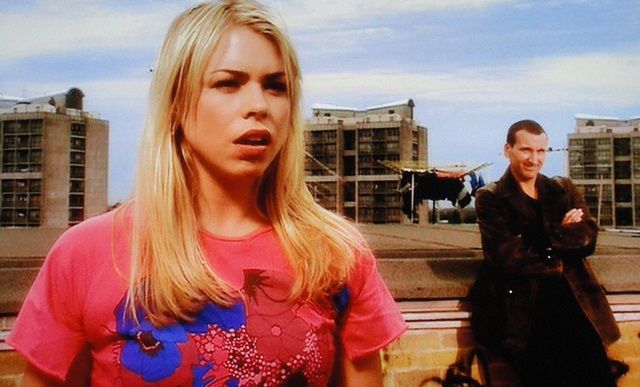
Some of the strengths of Aliens Of London surround the return of Rose Tyler via the TARDIS to London. The Doctor informs her they've been gone just twelve hours. A small explanation should curtail any problems until the Doctor sees a missing person sign with Rose' face upon it. Unfortunately, it hasn't been twelve hours but rather twelve months, a full year. The consequences surrounding that late arrival between Rose and her mother, Jackie Tyler, as well as her boyfriend Mickey [or Rickey as the Doctor call him in a bit of button-pushing], really resonates on an authentic emotional level. All of it rings true, which is a real testament to the writers pulled in for this revival. Of course, Russell T. Davies is responsible for this two-parter and he's very good at building the character work within the respective sci-fi tale. The Doctor and his companion must never be forgotten. They are central, but forgotten they are from time to time.
There are real ramifications generated from the previous episodes that reverberate forward here. Aliens Of London does an exceptional effort with this aspect of the story, but the required build toward World War Three does slow some elements of the episode. Two-parters can have their problems.

Essentially Rose and the Doctor arrive in present day London to witness the crash of an alien spaceship through Big Ben and landing in the River Thames. Again, it's twelve months later and the Doctor and Rose must contend with the fallout of that absence as filtered through Jackie and Mickey. Meanwhile, the Slitheen have infiltrated Parliament as MPs [members of Parliament] and other government officials. With a genetically-altered space pig, alien Slitheen unzipping from their human confines and much farting, Aliens In London offers a wild start.
World War Three concludes as a rather exciting, if overly silly, affair whereby the Slitheen are electrified following the electrifying cliffhanger of Aliens Of London giving the surviving humans a chance to escape the clutches of the alien invaders. Most of the survivors are the Doctor's closest associates.

Once the Slitheen are free of their own devices to be left to their own devices it's back to the business of rounding up the humans and taking over 10 Downing Street.
The Doctor and Rose seal themselves in the secured cabinet room, surrounded by interlocking steel walls installed in 1991 as a kind of panic room. In effect, there is no way in or out.
The flatulence and hot air continues between the aliens.
Additionally, the return of secondary characters in Rose's mum and boyfriend Mickey continue to shine in their small roles in the series. They are a believable good bunch of fun and that says a lot about the care Davies gave his creations.

The Doctor, as always, is there to explain the Slitheen's ability to compress into human suits utilizing their alien neck compression field gadgets. This allows the creatures to shrink, but also fart extensively due to the incredible air pressure. Lovely. They are anything but silent, yet deadly - perhaps so. In fact, they are obnoxious farters, loud and unruly, with no shame whatsoever. Can you imagine farting so fearlessly and freely in school when you were a child? Back in the day it was all about quietly farting. Lest a fart squeak out and give your position you'd be done for. The aroma of farts in elementary school were nearly unbearable and everyone within a given circumference was an immediate suspect. People would smell the fart and writhe in pain giving their best performance. Even the guilty party joined the fray to allude detection. No one wanted to be tied to their own fart. It was terribly difficult maneuver especially when you consider the logic of a fart essentially infecting a small radius. If a pattern developed, people had the potential to put the puzzle pieces together and thus to deduce the farter. But I digress, because, to the contrary, the Slitheen are indeed proud flatulaters.
Rose's mum asks the question of the Doctor all mothers of his companions you should think would rightfully ask. "Is my daughter safe? Is she safe? Will she always be safe? Can you promise me that?" Of course, the Doctor's answer is silence because the answer should obviously be NO especially when you have bi, bug-eyed green-bellied beasts bopping about London. Of course, delving into aspects of the companion's family is fairly refreshing in the hands of Davies. It offers a rather nice character depth often missing from the classics.


As I mentioned earlier, the Slitheen are pretty striking creatures, that, while on their surface, look pretty nasty, are slightly de-toothed by the humor infused into their use for World War Three. There were moments where they could have been all the more terrifying, but it wouldn't be Doctor Who without the humor and thus perhaps that speaks to the very nature of these alien creatures as something of a fierce but equally goofy thing. On the one hand they are large and unstoppably creepy, while on the other their bobbing alien heads with those massive eyes and cheeks do present an arguably innocuous side that one might easily for less-than ferocious like say a fisher cat or Tasmanian devil. But, in the end, the Slitheen are a race of killers.
And what is the one thing to stop this race of killers? Vinegar, "just like Hannibal" - of course! This is a reference to the historic journey by Carthaginian general Hannibal crossing the Pyrenees' alps with an army and pack of war elephants in 218 BC, whereby he used vinegar and fire to break boulders along their path.
Come on! That had to positively rank of stench. As it turns out the Slitheen also have the ability to feel the death of their own - physical empathy. And with the aliens masking themselves as the leadership of Great Britain, they beg and plead the United Nations to provide access codes to nuke London under the guise of striking the belly of the beast in London and thus giving the aliens ... a radioactive Earth. Yes, World War Three is the Slitheen's great hope to inevitably claim the planet for profit, the Doctor Who version of Star Trek: The Next Generation's Ferengi. Profit motive fuels these creatures like methane gas their ass ends and ours.


The human-disguised Slitheen, complete with zippers across the forehead, await Armageddon, the Doctor has a plan that could cost Rose her life - the very life her mum pleads for the doctor to protect. But the Doctor simply cannot make such assurances and Rose is a true heroine in the long standing tradition of Doctor Who as companions go willingly volunteering to risk life and limb alongside the Doctor. The Doctor/ companion relationship/ dynamic has always been a driving factor and thrust in our engagement of all things Doctor Who. It is the unpredictable and undeniable chemistry that brings us back week after week.
This moment truly speaks to the relationship between companion and Doctor, that indefinable connection, and that intangible love. It genuinely serves the relationship for both Doctor and companion. They may not always be romantically linked, but there is indeed love between the Doctor and companion relationship and they are inextricably linked by a love for one another whether it through friendship or teacher/pupil dynamic or something more.
Remarkably, with the Doctor's aid, by hacking the British Royal Navy. Mickey launches a non-nuclear missile from what essentially looks like an outdated home PC. Elsewhere, the goofy Slitheen now in their native form realize the missile is headed directly for them. Only the Doctor, Rose and a British MP, a back bencher named Harriet Jones are protected in the panic room which is unscathed thanks to good old British steel. Jones is played with an almost Margaret Thatcher-like zest and enthusiasm. The Doctor has glimpsed the future whereby Jones would one day lead as the next female Prime Minister of England. The Jones character would return for The Christmas Invasion [2005] and Series 4, Episode 12, The Stolen Earth [2008]. In the end, the Slitheen are blasted to Slithereens and the U.N. steps down from the brink.


The offer of tea and shepherd's pie is not appetizing enough to keep the fleeting Doctor around and he's off again. Likewise, Rose can't deny herself the action. Surprisingly, the Doctor, with a newfound respect, offers Mickey a chance to join them in the mold of the third wheel or third companion a la Ian Marter as Harry Sullivan from the Fourth Doctor era or even some of the adventures seen featuring Matt Smith's Doctor with Amy Pond and Rory Williams, but the Earthbound-preferred and time-stable Mickey declines.
As the Doctor and Rose fade away with the TARDIS and Mickey and her mum are left behind with the clock ticking you begin to realize how both their lives have changed. It's another splendid Davies moment handled with just the right care.
While certainly not among the best Doctor Who yarns it's hard not enjoy the intense effect of all this hot air.


So while the two part Slitheen arc isn't a perfect vehicle to introduce this terrific new alien species [well, they aren't a species but an alien family] that is the Slitheen, but by God the episode has its moments, it is still memorable for those new introductions, some additional character and interrelationship growth and no shortage of ambition in this kick start to the Doctor Who franchise. To further illustrate the series potential and its desire to plant new seeds and develop the mythology further we have the TARDIS spray-painted with the words BAD WOLF, a harbinger of things to come in the series. While an imperfect Doctor Who two-parter that seems to become more appealing on second viewing, just like the wonders of the TARDIS interior, there's real magic in this series with much to mine and discover even in its weaker moments. There always has been.
Aliens Of London/ World War Three: B-. Writer: Russell T. Davies. Director: Keith Boak.
Monsters/Aliens: The Slitheen.
For those keeping track, Aliens Of London and World War Three places at a lowly #132 on Doctor Who Magazine's The Mighty 200!. It is the third lowest entry from Series 1 on the list next to Boom Town at #141 and The Long Game at #165. And both of the latter are arguably better.
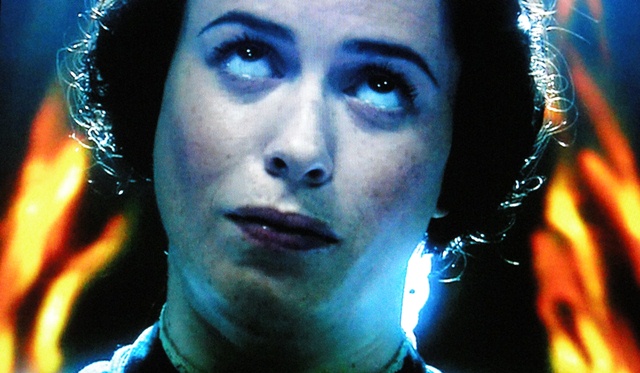
Also, look for Torchwood's Naoko Mori who plays Toshiko Sato. She appears briefly as Doctor Sato in Aliens Of London.


Additional Commentary: As often noted in previous Doctor Who coverage and in this entry as well, it is the allure of not only the chemistry between the Doctor and companion, because it is indeed their relationship that is always central to the journey of this fantastic franchise, but also the sense of wonder seen both through the alien eyes of the Doctor and his normally human companion. We get both the perspective of this ancient explorer as well as the vantage point of seeing the world and the unknown through the eyes of a proverbial newborn babe. After all, as humans we certainly are far less versed in the grand scheme of such things as the vast universe.

I've been reading Doctor Who And Philosophy: Bigger On The Inside and by and large have not loved it, but in full disclosure have read maybe one-third of the book. I certainly enjoy considering the philosophical possibilities and wonders of the universe when it comes to my favorite series, but for whatever reason the book has been mostly impenetrable for me. It's no slight on the writers either. Some of the essays have been highly technical and it makes efforts to go deep. Perhaps I just don't get it. That's certainly possible.
But one article in particular seemed fitting to note here as a springboard for some additional commentary and that is an article by Laura Geuy Akers titled Empathy, Ethics And Wonder [p.145-156]. The subject is eloquently tackled by Akers and it appealed to me, because I'm all about these things personally, which may be why Akers' article spoke so profoundly to me. Further it does shed light on why I am so drawn to the Doctor Who phenomenon. As it happened, Series 1 was the perfect focus for the analysis and Rose perhaps one of the great representatives on the subject in question.

The Doctor (as well as the series for that matter) is constantly pulled by a sense of wonder. In fact, as Akers notes in her article, empathy, ethics and wonder are central to the character. These factors are constantly operating behind the eyes of the Doctor. They may not always be easily defined but the Doctor certainly navigates by a generally specific bar of his own making taking these aspects of his character to heart.
Akers turned to the Oxford English Dictionary specifically on the subject of wonder. "The emotion excited by the perception of something novel and unexpected, or inexplicable; astonishment mingled with perplexity or bewildered curiosity." Boy, if that doesn't speak to the Doctor I'm not sure what does. If we take Christopher Eccleston's Doctor for example, and we could certainly look at Tom Baker, Matt Smith and David Tennant, but with Eccleston there are more than enough obvious moments whereby the Doctor proclaims "Fantastic!" at the sheer sight of wonder in Rose, a debut that fully underscores the essential commitment of the Doctor/companion component as core to the series. Eccleston's face lights with excitement over the wonder before him. The Doctor exclaims a similar excitement in Aliens In London with the arrival of the Slitheen spaceship crashing into the Thames. Yes, "Fantastic!," he declares. Rose shares his enthusiasm and we do too.


With respect to the operating factors of Akers article she writes accurately, "For the Doctor, science involves curiosity, caring, and respect for the phenomena he discovers. He's an ethical scientist, a scientist who prioritizes the unpredictable vitality of wonder over the firm possession of dry knowledge." How true.

We can look at the discovery of the spacepig in Aliens In London. Once again, a truly remarkable moment of wonder and discovery for the Doctor, but the military react in fear at the sight of a mutant pig running amok. This understandably normal human reaction causes a soldier to fire upon the space pig killing it. The Doctor reacts strongly horrified by the event noting the creature was merely "scared." He pleads with us to have empathy and to think before reacting to the unknown. We must consider these remarkable new things not as horrors, but wonders. We mustn't always fear what we do not understand, but embrace and attempt to accept or at least understand and respect. Tom Baker often used humor in the face of adversity as did Tennant and as Smith does today. They saw wonder and opportunity to discover even in the most dreadful of circumstances often using humor to defuse a situation.
As Akers notes, "A creature that doesn't fit into our taxonomy [like the spacepig] might be judged to be monstrous." She adds, "Our cultural and personal predispositions may lead us not into wonder but anxiety" or "dread."

So through the Doctor and the companion we arrive at two very different reactions sometimes and we enjoy both perspectives which is why the Doctor/companion combination works so effortlessly and brilliantly throughout the long-running series. It is undeniably one of the big draws for us. "Many phenomena that would leave humans bewildered are comprehensible to him. To the extent that he can, in fact, grasp things that for us would 'strain the imagination to the utmost'."

Finally, Akers points out a very insightful observation regarding the Doctor and his seemingly endless existence. The Doctor's "outlook" or world view is one that is contrary to a human's perspective. Learning new perspectives is "One of the most important benefits he gains from human companionship," as much as the companion benefits from the connection. We certainly understand the Doctor's desire for companionship too. It cannot be understated. When we think of the Doctor's tearful moment in The End Of The World as he reflects for a moment that he is the last of his kind we understand his need for others. But Akers writes, "His mortal friends are not just a buffer against loneliness--they are, as he would say, 'so much more,' giving him access to the human scale as a reference point." It is the human race that can "renew his own sense of wonder, his fascination and engagement with the infinite possibilities of existence in the universe as he encounters it." Well said. Akers adds that the human companion gives the Doctor's life "meaning." And the fact is, companionship, friendship, family, relationships of any kind are what ultimately connect us and bind us and give any of us meaning in our own lives. We are by nature social animals and Doctor Who captures that dynamic splendidly. The Doctor may be a Time Lord but he certainly shares these needs and desires with his human brethren.


But I would submit that nowhere is the dynamic more profoundly magical than in Series 1 and Series 2 in the care of Rose and the good Doctor, as portrayed by both Eccleston and Tennant. The dynamic between a Doctor and his companion always varies and differs from companion to companion. Martha Jones is clearly more grounded in her perceptions of Earthly things than Rose. Donna Noble, too, lacks the same kind of embrace for wonder that informed the Rose character for two series.

Could it be the Rose character's arrival in Series 1 and ultimately her journey with the Doctor be the perfect dynamic to symbolize the much greater rebirth of this re-energized franchise? Rose is, in effect, reborn leaving the Earth and essentially awakened from her humdrum existence. We know the Doctor's appetite for all things fantastic and wonderful is innate and real and part of who he is. The Doctor seems to have a kindred spirit in Rose. With Rose that brilliance is compounded and made all the more spectacular. Both hunger for adventure and discovery and in turn ignite an affection toward one another unlike any Doctor/ Companion before. Was it a mutual affection for the wonders of the universe that sparked an undying love affair? We know Rose rejected the idea of the ordinary as she scoffed at the notion of the mundane in the final episode of Series 1, The Parting Of The Ways. "Get up. Catch the bus. Go to work. Come back home. Eat chips and go to bed." Ugh. Can you imagine? Okay, yes, but I can identify with her Earth boyfriend Mickey. But for Rose the idea of such a life is rather tedious, which is why the kiss goodbye to poor Mickey is so moving in World War Three. We empathize with Mickey speaking of empathy. For Rose the idea of travelling back and forth in time is as wonderful as it is for the Doctor, but Rose more than any character fulfills the Doctor's void for a true companion. Rose says in The Unquiet Dead, "Think about it though - Christmas 1860 - happens once. Just once, and it's gone. It's finished. It'll never happen again. Except for you. You can go back and see days that are dead and gone and a hundred thousand sunsets ago. No wonder you never stay still." Rose marvels at that reality and is thrilled by this idea. She is so excited by this prospect she literally leaps at the chance to save her father in the excellently moving Father's Day. So while this aspect of wonder as Akers so eloquently writes about fills Rose and the Doctor, for the Doctor it also satiates his loneliness as the sole remaining Time Lord to have someone relish his journey with him.


Together though, they do offer different perspectives whereby sometimes one empathizes and the other does not. In The Unquiet Dead, the Doctor sees a moral righteousness to helping the Gelth. Rose is disturbed at the thought of re-animating the dead like zombies. Their moralities are different as the Doctor suggests in the episode. In Dalek, Rose empathizes with the surviving Dalek, while the Doctor is horrified at the notion of allowing it to live. In this application Rose is entirely innocent, ignorant, a true newborn to his reality as much as the Doctor is to Rose's in The Unquiet Dead, but the Doctor is working from a different reservoir of information. As Akers points out, the Doctor empathizes with the Slitheen in Boom Town as represented by the surviving Slitheen Margaret Blaine. Yet together, Rose and the Doctor share a similar view on Cassandra's fate in The End Of The World. So there are indeed different variables informing them from both their perspectives as human and Time Lord. But it is through the Doctor that Rose comes alive and experiences a rebirth. Likewise the Doctor, too, is reborn following the fateful events of his homeworld. Rose indeed energizes him with her own sense of wonder. There's a magic in their dynamic that is indeed unique as the Doctor/ Companion relationship goes. Wonder is at the heart of their connection. It's only natural that a Time Lord called the Doctor always inclined to make things better would find something comforting in a companion who strengthens and makes him better too.
Be sure to check out Laura Geuy Akers essay for more on this wonderful assessment exploring how empathy, ethics and wonder are central principles that inform these characters. Fantastic!