Nausicaä Of The Valley Of The Wind [Kaze No Tani No Nausicaä] [1984] was a true milestone that marked the arrival of Director Hayao Miyazaki and Studio Ghibli.

 Nausicaä Of The Valley Of The Wind, a film with an ecological message, was a story that germinated from the mind of Miyazaki and from his own manga adventure tale of the same name. His epic labor was the result of over 12 years of sporadic writing culminating in a text of fifty-nine chapters. The long-running serial seeded and blossomed into a picture that is still considered to be one of his most stunning achievements. It is an unrefined, personal favorites and delivers inspired, unforgettable cinema. Of course, it would be the first to flower in a string of amazing Miyazaki masterpieces over the next three decades from his own Studio Ghibli.
 Overflowing with ideas throughout the process of bringing Nausicaä Of The Valley Of The Wind to life, an animating studio was sown and dubbed Studio Ghibli. Ghibli is Italian for the hot wind that stretches the arid Sahara. This wind was a breath of fresh air and it was another crucial moment in Japan's anime history.
Partners Miyazaki and fellow Director Isao Takahata [Grave Of The Fireflies] were looking to make a bold statement. Their vision: create films with a global appeal. Today, Studio Ghibli films spread universally like a forest wildfire, or those self-described winds across the vast desert land.

 In the beginning, Studio Top Craft [The Hobbit, The Last Unicorn] was the animating group intricately involved in producing Nausicaä Of The Valley Of The Wind. Upon completion, Studio Top Craft closed its doors. Studio Top Craft President Toru Hara would become Studio Ghibli’s first CEO. Out of necessity, the fledgling Studio Ghibli became a priority so the talented animators could move forward on the equally wonderful Laputa: Castle In The Sky [1986]. With nowhere to turn, Takahata (who produced both Nausicaä Of The Valley Of The Wind and Laputa: Castle In The Sky) ultimately laid the groundwork to get Studio Ghibli firmly established so together they could affect their destiny and make film history.
 Takahata and Miyazaki collaborated together as far back as Takahata’s The Little Norse Prince Valiant [1968] for Toei Studios, as director and key animator respectively. Panda! Go Panda! [1972], directed by Takahata, soon followed with a screenplay and animation by Miyazaki. Takahata directed the TV series Anne Of Green Gables [1979] with scene design and layout by Miyazaki. Their fates were irrevocably sealed with lives clearly entwined as creators and friends.
 Those early formative months for Studio Ghibli started with a phone call from soon-to-be Studio Ghibli president Toshio Suzuki, then editor of Animage magazine, to Miyazaki requesting an interview. It was Miyazaki’s directorial debut on the TV series Future Boy Conan [1978], in association with Takahata, and the film The Castle Of Cagliostro [1979], which caught Suzuki’s attention and lured him to Miyazaki. Legend has it that Miyazaki ignored Suzuki for the better part of his in-person visit. Suzuki was passionate about Miyazaki’s concepts and their bond strengthened as Miyazaki realized Suzuki’s aspirations were genuine. Suzuki was the determined producer, a rare breed, Miyazaki required and quickly appreciated. Simultaneously, for a time, Suzuki was involved in production at the upstart Studio Ghibli while managing his Animage responsibilities. He was largely accountable for the publication and serialization of Miyazaki’s long-running manga, Nausicaä Of The Valley Of The Wind, of which the film remains quite faithful. The source comic debuted in Animage in 1982 and Animage publisher Tokuma pressed Miyazaki for a theatrical rendition of the manga. Juggling both positions became tricky and Suzuki followed his natural inclination to support the work of Miyazaki and Takahata. Suzuki followed his heart into the world of Studio Ghibli leaving the editorial life of Animage behind. It was Suzuki who fortified the studio vehicle that would become the voice of Miyazaki and Takahata’s creations. The culmination of these events led to years of the most colorful, fantastical and fruitful ideas espoused in animation to delight a planet. The proverbial holy trinity complete, Takahata producing, Miyazaki directing and Suzuki promoting, Nausicaä Of The Valley Of The Wind was their lovechild and to the world it was born giving us both a great film and the official establishment of Studio Ghibli to follow.
 Nausicaä Of The Valley Of The Wind is an environmental love letter. It had to be a labor of love for Miyazaki to bring his beloved heroine, the first of many, to life on the big screen. It is a cautionary tale, complemented with Princess Mononoke [1997], concerning the balance of man and nature and the fragility of that co-existence. Kindred spirit Ashitaka of Princess Mononoke is the spiritual brother to Nausicaä.
 Miyazaki set the stage here regarding his affection for female empowerment and wisdom. His stories are typically voiced through the courage of the shojo [young girl] as lead protagonist and heroine. Implementing a female in the lead is indeed one of Miyazaki's calling cards.
It is a parable of woman, man and nature within science-fiction fantasy. More specifically, it is the story of a young idealist and her special relationship with a unique breed known as the Ohmu and how their power could ultimately transform a dying world. This is the story of one of anime’s most beloved and shining characters, Nausicaä Of The Valley Of The Wind.
 The groundwork for Nausicaä, as a character, drew inspiration from a Phaeacian Princess in Homer’s The Odyssey coupled with elements of an insect-charming princess from Japan’s Heian Period [AD 794-1185]. This was Miyazaki’s template for Nausicaä.
Earth, ravaged by pollution, is not the planet we know. Miyazaki paints a warning. It looks foreign and feels alien. Civilization is infected. One thousand years have passed since The Seven Days Of Fire incinerated the planet. As a result, the proliferation of a sprawling toxic jungle, The Sea Of Corruption, threatens to spread and destroy the surviving human factions and thriving areas that remain. It may arguably be Miyazaki’s darkest cinematic hour next to Princess Mononoke.
 The first images we see and the sounds we hear are not the clean, life-affirming winds of the valley, but the gusting whirr of toxicity and twisting echoes of desolation. Skeletal remains and a lifeless, desperate world are met by the calm, soothing voice of Lord Yupa, eloquently spoken by Patrick Stewart. “Yet another village is dead… soon this place too will be consumed by the toxic jungle” concedes Yupa cloaked inside of vital, breathing apparatus. The establishing shots signal an epic tale of fantastic, apocalyptic survival, amidst the encroachment of despair.
The wizened Lord Yupa offers a nice contrast or balance to the wide-eyed innocence of Princess Nausicaä who sees the creatures of the toxic jungle through very different eyes. When we meet her she lays in a field of toxic spores as she gazes skyward into light, willowy poison flakes. It falls white like snow and despite its lethality she finds beauty in it.
 Kiki’s Delivery Service [1989] paid homage to the apocalyptic mis-en-scene with Kiki’s own unique bright-eyed opening. In contrast, Kiki lays back to dream in a healthy, vibrant field of green reflecting Miyazaki’s artistic mood five years later.
Like many of Miyazaki's heroines, Nausicaä is tender, selfless, brave, deceivingly mighty and skilled, a truly heroic warrior princess. She lives with her people on a stretch of land upwind from the infestation of the toxic jungle called The Valley Of The Wind. A plethora of large windmills dart the picturesque countryside. It is a naturally shielded location, prosperous and fertile, protected from the deadly spores that permeate other lands. A vast and dusty wasteland and dead seas separate the valley from the toxic forests where mutant insects of all shapes and sizes roam.

 The massive, caterpillar-like crawlers called Ohmu often swarm in herds with a predisposition for stampeding. The Ohmu are prone to fits of rage when molested by humans they view as invaders. Nausicaä empathizes and connects with the creatures’ plight. She intuitively knows their pain is misunderstood and utilizes her special power. She is a bug whisperer to bridge the communication gap between their world and ours. When enraged the herds wreak havoc and devastation with bright red eyes. The “insect charmer,” as Lord Yupa refers to Nausicaä, has a special way with all animals illustrated by her calming influence on a feisty fox squirrel that sharply bites her finger. Her patience wins the creature's heart.
Yupa is a legendary sword master revered across the land as an expert warrior who also acts as Nausicaä’s confidant and mentor. Yupa’s quest is to discover a solution to the toxic jungle. The film is filled with rich, beautiful characters and locations.
 With Earth increasingly factionalized and segregated [sound familiar?], there is a warring, imperial tribe called the Tolmekian Empire misguided by the stubborn arrogance and hubris of Princess Kushana. The Tolmekians are rapidly asserting their authority across the surviving lands deploying scorched earth tactics despite potentially catastrophic consequences. The people of The Valley Of The Wind witness a Tolmekian ship crash inside their valley. Amidst a fiery blaze, Nausicaä heroically saves Princess Lastelle [in chains], a prisoner of the Tolmekians abducted from her Pejite homeland. Following her extraction from the flames, Lastelle warns Nausicaä the cargo must be burned. The downed, contaminated Tolmekian craft has made matters worse by infecting the valley with spores from its hull. They begin infecting the trees and the water. Think the infestation of bugs and fish from non-native countries that plague nations today.
Exacerbating the conflict, Princess Kushana has unveiled an embryonic sack confiscated from Pejite for her own devices. Inside is a giant, throbbing cocoon, one of the last remaining ancient and powerful warrior gods. These powerful beings once annihilated the planet then turned to stone. Yupa heard rumor of the unearthing of an ancient warrior. It lives, it thrives and it has been brought inside the unsuspecting valley.
 The Tolmekians will stop at nothing to nurture the monster. The king, Nausicaä’s father, is overrun by Tolmekians. Nausicaä is overcome with fury. She ferociously thrusts upon them lashing out, like a feral animal, blinded by rage. Her irrational reaction is one understandably pure, basic, and linked to nature.b She mirrors the response of the Ohmu when threatened; creatures with whom she shares a natural empathy and connection.
At last, Yupa intervenes and calms Nausicaä, like Nausicaa calming the Ohmu. She regains her composure and implores her people to lay down their arms. War is not the answer. The Tolmekians urge the valley peoples to join them in resurrecting the warrior god. Princess Kushana makes clear her intention to use the creature to cleanse the Earth of the toxic jungle. The village elder warns such foolhardy actions will only end in destruction for all. Soon, the Tolmekians begin subjugating the people of the valley, removing their arms and enslaving them, but never breaking their will.
 Later, Yupa finds Nausicaä has absconded to a secret place, a secret garden greenhouse deep underground through a concealed passageway inside the castle walls. He is startled to find her shrine of living plants, those found in the toxic jungle, alive and well, healthy and unaffected by the same toxic plague. He inhales breathable air and is witness to her refuge. It is a beautiful scene and a delightful respite and haven from the violence. Her place is irrigated with fresh soil and clean running water.
 Flashing a little unexpected fan service. Not really. There's nothing gratuitous going on with Miyazaki folks. Back above, Nausicaä agrees to leave with some of the Tolmekians for Pejite. Whilst among the pillow-like cumulous clouds, the airship is attacked by a Pejite gunship. Engulfed in flames, she boards her own gunship inside the Tolmekian craft’s bay and escapes with Mito and Princess Kushana. Distracted by the sudden site of Princess Nausicaä, the Pejite pilot is shot down into The Sea Of Corruption. Nausicaä and company land in the waters below kept afloat by the buoyant aircraft. The Ohmu greet Nausicaä, but will not harm her. An intriguing flashback sequence from her childhood reveals clues to her special connection with the Ohmu.
 The creatures inform Nausicaä the Pejite pilot is alive and she quickly takes flight on her personal glider housed within her Gunship fleeing the hostile Kushana. Kushana is brought back to the valley by Mito. Nausicaä rescues Asbel, the Pejite pilot, from certain death at the hands of the jungle’s creeping critters. He is the brother of Princess Lastelle. Nausicaä and Asbel fall deep beneath the toxic forest into a pristine, pure cavity where they discover life has renewed and the air and waters run clean. The sea has evolved and the trees are now filtering the poisons left by the ills of mankind. It is a terrific example of evolution and nature's ability to rebound.
 Asbel and Nausicaä repair the downed glider and return to Pejite. Pejite is littered with the dead. Mangled bodies and bug corpses blanket the burning land. His people inform Asbel that they plan to retake the giant warrior using whatever means necessary including wiping out The Valley Of The Wind. By luring the insects to the valley everyone will die. Incensed, Asbel holds his people at gunpoint and tells Nausicaä to escape and warn her people. Asbel is knocked unconscious. Nausicaä attempts to enlighten the Pejite with the good news surrounding the jungle’s evolution. She pleads with them proclaiming the trees have purified the water, while the Ohmu are merely acting as sentinels to the land. She urges calm, but cooler heads do not prevail and she is taken captive as the Pejite take flight toward the valley.
Miyazaki implements Princess Lastelle’s mother as the life-affirming force of reason that frees Nausicaä so she may escape into the skies upon her glider in the hopes of saving her people. Once again, Miyazaki emphasizes life and salvation through the strength of the woman.
 In The Valley Of The Wind, Nausicaä’s people initiate an uprising, commandeer a tank and weapons and begin fighting back against the warmongering Tolmekians. The battle ends in a stalemate as the valley peoples hold up inside an old, impregnable, metallic shipwreck along the seashore utilizing it as their makeshift fortress. Nausicaä races against time in the hopes of staving off certain disaster between the Tolmekians and her people in a deteriorating standoff. Her battered, peaceful people proclaim with dignity, “We prefer the ways of the water and the wind.” Miyazaki never preaches his message, because this is the nature of a people and the philosophy of the living. As Nausicaä fast approaches she spots a stampeding Ohmu herd and is horrified by what incites their wrath. The Pejite have harpooned and brutally bloodied a baby Ohmu dangling it before the storming Ohmu mass as bait to fuel their fury and drive them toward the valley. It's a truly brutal sight.
Mito arrives on the battlefield to warn everyone that Nausicaä, a proverbial herald, is coming to halt the impending onslaught. Despite the warning, Kushana awakens the giant warrior prematurely unleashing the malformed behemoth. Dressed in a red Pejite dress, Nausicaä startles the Pejite pilots and brings the Ohmu baby down. Nausicaä is shot and wounded in the process. She weeps over the baby Ohmu in a truly touching scene.
 She is pained by its suffering. The baby motions to crawl into the toxic waters, but Nausicaä braces herself between the creature and the sea while acid singes her feet. Digging into the sand she pushes it back to safety. The Ohmu baby ceases its drive and connects with Nausicaä. The undaunted Nausicaä stands steadfast in her charge to bring peace and prevent the mass slaughter of her people and the Ohmu. Still, the enraged Ohmu throng presses onward through Nausicaä and the baby with bloodlust.
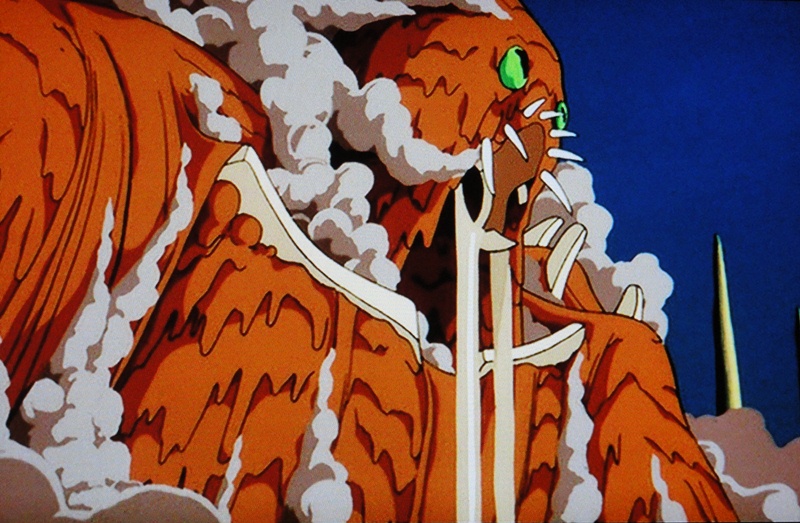
On the hilltop the warrior giant emerges dripping with deformity, a symbol of twisted humanity. Despite its weakened condition it projects a lethal beam of firepower laying waste to the incoming Ohmu. Inevitably its shape dissolves into a soupy, primordial puddle.
Nausicaä miraculously calms the Ohmu pursuit, which has surrounded the baby. Red eyes subside and give way to the serenity of tranquil blue. The herd of Ohmu lifts a lifeless Nausicaä toward the heavens with their tentacle-like feelers. The creatures pay an almost religious tribute to their beloved savior who stood before them willing to die. Revived, Nausicaa undergoes a Christ-like resurrection by her multi-legged friends who restore life. Her dress alters from red to blue, once saturated with the baby Ohmu’s blood, accenting the changing, hopeful emotional tone. The ancient writings foretold of a male hero who would come forth and renew life, but the answer to the prophecy was wrong instead giving witness to a young woman named Nausicaä Of The Valley Of The Wind.
 Nausicaä is symbolic of Miyazaki’s female ideal and would represent his standard for films to come. She is a selfless herald, the culmination of nurture and nature. Miyazaki illustrates this with a final shot of her blue cap beside a green seedling sprouting from the barren sands. Only through the nurturing touch of a woman combined with nature’s resilience will the planet survive. And so Miyazaki’s tale comes full circle, ending on a note of hope embodied by two key images that contrast to the film’s opening shots of skeletonized death.
Nausicaä Of The Valley Of The Wind is a brilliant action adventure, science fiction fantasy and drama too filled with the kind of heart and social conscience only Miyazaki could pen.
So what were US distributors thinking in 1995? It was originally released in the US as the heavily edited Warriors Of The Wind [1995] like so many Japanese films like those to hail from Toho. Miyazaki was justifiably mortified and ensured that a no edit clause was amended to all future licensing deals. This measure secured the proper treatment of all Studio Ghibli releases going forward with Disney Buena Vista. All studio productions are issued unedited and in their entirety as the creators intended them to be experienced. His film received the grand treatment and a second chance with Disney.
 The hand drawn 2D animation is a marvel to behold even more astonishing when considering how old the film is. It has its shortcomings and from time to time frames do lose detail or backdrops get simplified, but most scenes are fantastic - a sign of things to come. For example, Nausicaä’s underground greenhouse is a breathtaking sequence (see clip above). Character designs are exquisite, Nausicaä in particular. Her stylish blue uniform is striking and still holds its own distinct style decades later. Her blue skirt and kinky boots, like the film on the whole has stood the test of time. Let's face it, those boots are made for walking.
Mechanical designs are simple but inventively retro from Nausicaä’s personal glider and flying gunship to the hulking, early steampunk-styled, metallic warships. The steampunk style would be highlighted for Laputa: Castle In The Sky [1986] as well and later Katsuhiro Otomo's Steamboy [2004]. Bandai released a beautiful replica of the Gunship in 2011.
 Creature designs are astounding. Nausicaä’s feisty fox squirrel would find its way back to Laputa: Castle In The Sky. The mighty herds of caterpillar-like Ohmu with giant saucer-shaped eyes are magnificent beasts. Finally, the brief appearance of the fearsome warrior god is a classic. In fact, the giant warrior designs, explosions and deeply imaginative heavy tank mecha came compliments of fledgling animator/designer Hideaki Anno in a key animator role. Yes, these designs were by way of the future genius behind Neon Genesis Evangelion and Studio Gainax. Anno does with a disintegrating monster in the film’s conclusion what he would do for a variety of creatures in Evangelion - infuse his ideas with genius, horror and beauty.
Weaponry is ultra retro chic including Nausicaä’s modernized rifle and the Tolmekians’ medieval-like battle armor.
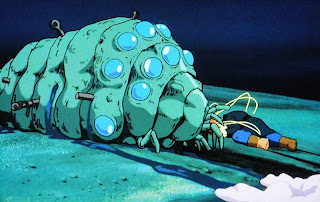 Mattes provided for the toxic jungle are soft in blue and grey colorations. The subdued colors enhance and illustrate Miyazaki’s message of a dying world. The classic look of the spore-infested jungle is like cover art from a 1970s fantasy novel. Be sure to see the film color on Blu-Ray.
Additionally, other techniques were utilized including cut paper methods for presenting the large Ohmu herds. This was part of the improvisational aspect of animation in the day without access to computer technology and CGI enhancements. Due to lower cel counts, at times, it lacks the fluidity of later Studio Ghibli productions, but it is remarkably painstaking in its artistry and holds up against much of today's computer-aided animation.
 Composer Joe Hisaishi provides the score. The sweeping, beautiful opening music is trademark Hisaishi that Miyazaki would come to rely upon for years to come. Despite highlights, some of the compositions have not aged well over the years, unlike his later soundtrack work. Time has not been overly kind to this film score due to a slight over reliance on vintage early-80s era synthesizers. Those dated electronic bpms [beats per minute] have a tendency to date the material. Some numbers lack the sophistication of his orchestral, string-driven suites that would flourish in his repertoire later.
Buena Vista, the distribution arm of Walt Disney, provides yet another sterling Studio Ghibli remastering. Voice talent for the creation of the English dub includes Alison Lohman, Uma Thurman, Mark Hamill, Edward James Olmos and the always commanding vocal presence of Patrick Stewart [Star Trek: The Next Generation].
 In the end, Studio Ghibli was official in 1985. Laputa: Castle In The Sky [1986] would follow and was the first official release by the studio. The gorgeous, timeless family classic My Neighbor Totoro [1988] would follow. Nevertheless, it was Nausicaä Of The Valley Of The Wind that became the inspiration for the legacy of Studio Ghibli. There is clearly an elegiac and mournful tone to Miyazaki’s message represented here by the emotional pain and struggle of its characters. The tale closes on a hopeful note regarding the harmony of man and nature beyond apocalypse. Nausicaä is a traditionally heroic female leader and one for which Miyazaki often returns. Nausicaä Of The Valley Of The Wind is a rare, definitively original science-fiction/ fantasy that stands the test of time and rules as a template for the traditional Miyazaki heroine. The film would fortify the relationships of three wise, visionary men, Miyazaki, Takahata and Suzuki, for generations, in much the same way producer Tomoyuki Tanaka, director Ishiro Honda and effects man Eiji Tsuburaya would represent Toho through film, elevating anime and animation to new heights. Come, reap the wild winds of Miyazaki and Studio Ghibli's first true labor of love.
Nausicaä Of The Valley Of The Wind: A-. Writer: Hayao Miyazaki. Director: Hayao Miyazaki.