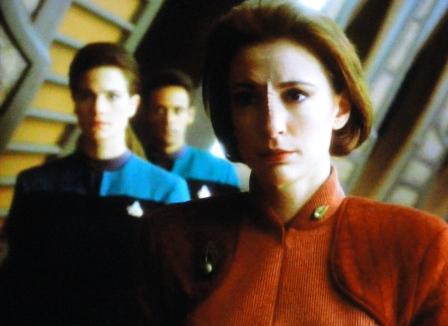
Secure Immaturity is forcing my hand much sooner than anticipated with the arrival of Will's wonderfully thoughtful Star Trek: Deep Space Nine [ST:DS9] Week. I was thoroughly jazzed about his analysis of the series, but ill-prepared to contribute. I've busted a move to offer my best analysis of this third series in the Star Trek franchise, behind Star Trek: The Original Series [ST:TOS] and Star Trek: The Next Generation [ST:TNG]. Starting at the beginning was my only option.*
 Proceeding forward, I'm most intrigued to see how ST:DS9 stacks up with Babylon 5. There will not be a concerted effort on my part to compare the two as I suspect I will see them quite differently, but I'm open to noting the similarities and differences having explored Babylon 5 here over a period of years. I suspect my ST:DS9 journey will be slow and labored like most of my efforts here at Musings Of A Sci-Fi Fanatic, but I hope to bring quality over quantity.
*
 But what of the question of Babylon 5 versus ST:DS9? Much fan-based finger pointing resulted from the two space station-based programs. Babylon 5 ran strong from February 1993-November 1998. ST:DS9 ran from January 1993-June 1999. It was clear the two programs would stir up a bit of controversy by running in parallel seemingly mirroring their journeys. Granted, both were radically different in appearance and the concept of life on a space station was certainly nothing new to science fiction concept in film or literature, but Straczynski understandably saw it different with good reason.
*
 A series of conversations and statements from the archive site of J. Michael Straczynski himself offer a great deal of insight into the controversy. "In the forty-plus years that television has been around, no one has done a series on a space station/ port of call. Now suddenly we have two within two months of each other being announced."
*
Both also had clearly defined universes with which to play from a substantive perspective. Yet, fans of both series dug in their heels and chose sides to some degree. Many enjoyed both. I prefer to enjoy the nuances and differences of two uniquely different systems of ideas. It doesn't seem implausible that one should expect some crossover in ideas and thinking when it comes to a station-based series. How much overlap occurs we shall see. Apart from speaking positively about creators Michael Piller and Rick Berman did Straczynski feel they had a hand in how it all played out? "No. Of that I am also confident. The only question in my mind is to what degree did the development people steer them? I have no reason to believe they are anything other than honorable, stand-up men. My area of concern has always been in the area of corporate influence and intent."
*
 Of course concerns over copyright infringement may have had some validity that never came to fruition. We may never know the full story. Creator of Babylon 5, J. Michael Straczynski, shopped Babylon 5 around for years before getting the needed backing to get it on air. ST:DS9's pilot, Emissary, aired just weeks before Babylon 5's debut. Straczynski began pushing for Babylon 5 in 1989. It was a science fiction epic in the making. He had vision and determination. He approached Paramount [home of Star Trek]. He provided the company with a series bible, pilot script, artwork, lengthy character background histories, and plot synopses for the first 22 episodes legend has it. This was certainly enough to raise one's suspicions in 1993, especially if your name just happened to be J. Michael. Paramount passed back in the day. Years later and the arrival of ST:DS9 was upon us. While Warner Bros. announced its support of Babylon 5, and Paramount quickly followed with its own announcement of a station-based franchise under the prominent Star Trek banner. Certainly, given ST:TNG's success in syndication, it seemed like automatic money. It was a masterstroke of marketing brilliance to utilize the Star Trek name, but would it be enough? Straczynski may have had grounds for a lawsuit, but it was not a foregone conclusion he could win and thus Straczynski moved on placing his sole focus on his epic Babylon 5. "That we have decided -- for the best interests of all -- for the time being to take a mature, "let's move forward" approach does not mean that I have to pretend nothing happened. Or shut my mouth about it." Babylon 5 was his baby and required all of his concentration as he would be the sole writer for the series with few exceptions. He had spent a good portion of his life developing it and needed to see it through, distraction-free. Taking on Paramount was not of paramount importance so to speak. According to Straczynski having ST:DS9 under the Star Trek banner for Paramount was a huge selling point.
*
"The fact that the two shows were so similar at that time, one a nobody show from nowhere, the other bundled with the STAR TREK (tm) name, came within an inch of killing Babylon 5. (Which wasn't helped by A Certain Studio telling advertisers that B5 was going to be crap, cheaply produced, and not to bother.) That's one of the main reasons why it took nearly a period of four months before we finally got the go order for year one, after everybody crunched the ratings, and the demos, and decided to take a chance on it. And even THEN we were told, "The syndie market can't sustain two shows like this; you're gonna get creamed." His remarks speak to the intense rivalries between studios within the business. He knew it was an uphill battle as a result of his prior efforts with Paramount. Fans would come to know it. I suspect some at Paramount knew it as well. Straczynski's remarks point to reasons behind the delay of Babylon 5.
 "There's little question in my mind that the suits at Paramount wanted to co-opt what we were doing with B5. I know that they *resented* the show because it was, at that time, their belief that they pretty much owned the space SF genre. I feel that they guided the development process in order to co-opt what we were doing. And nothing I've heard from my sources inside the studio has given me cause to think otherwise."
 It's understandable with accusations leveled against the unknown Babylon 5 why Straczynski might be defensive given the record. Ultimately, Straczynski concluded, "I have adopted a live and let live attitude re: DS9." All of this gave his show an even sweeter victory in the end for its creator when it concluded five years later with Babylon 5, Season Five, Episode 22, Sleeping In Light. Many felt ST:DS9 would absolutely annhilate Babylon 5. It didn't happen and both managed a kind of Cold War-like, peaceful coexistence with their very different, complex storylines and mythologies. In the end, weren't we fortunate to have both?
*
 As for that other port of call, ST:DS9 certainly had the weight of history in its favor and how it tackled new, fresh ideas for this series will be an interesting reveal. Even within the world of Star Trek franchising some have hotly debated ST:DS9 as the worst of the franchise. I suspect its deviation from the traditional Star Trek approach and spirit clearly retained in ST:TNG had much to do with it. ST:DS9 challenges in new, unexpected and exciting ways. Some have placed it at least better than Star Trek: Voyager. Still others rank it higher and place it in the esteemed category of the best of all Star Trek franchises. Of course, the debate will rage.
*
 We venture forth into the world of Star Trek: Deep Space Nine, Season One, Episode 1 & 2, Emissary. The episode opens in flashback referencing the events of ST:TNG, Season Three, Episode 26 and Season Four, Episode 1, The Best Of Both Worlds. Captain Jean-Luc Picard, then assimilated by The Borg, was forced to lead an assault on Starfleet at Wolf 359. The Federation Starships were under seige by the Borg cube and with seconds to spare following critical damage to the warp core of Sisko's ship, the USS Saratoga, Commander Benjamin Sisko manages to escape with his son while overcome with grief over the loss of his wife killed in the attack and left behind in the exploding vessel. The wonderful tome Star Trek: Deep Space Nine Companion, now long out of print, notes these exciting battle sequences were filmed exclusively for Emissary. The scenes depicting the battle of Wolf 359 were never actually filmed for the referenced ST:TNG two-parter The Best Of Both Worlds. Budgetary reasons wouldn't allow for it. The aftermath was all that materialized. Emissary takes those events a step further building upon that intricate Star Trek mythology.
*

 Three years later, long after that fateful shuttle escape, Sisko informs his son fishing on a lake they will be relocating to the orbiting space station, Deep Space Nine, off Bajor. Convinced it won't be so bad, father and son exit what begins in the holodeck room in a clever visual opening.
*
One thing is clear, ST:DS9 indubitably had the bigger budget over Babylon 5 for the special effects department, because the effects here are far superior on this particular Star Trek outing. They are more cinematic in scope and appearance. The work on Emissary garnered the series an Emmy Award for Outstanding Special Visual Effects [1993]. It's easy to see why. This was clearly a big production.
*
 On the scoring front, ST:DS9 received a quietly majestic opening theme, compliments of Composer Dennis McCarthy. The orchestral arrangement sets itself apart from ST:TNG and ST:TOS, both complete with the classic narrative opening "space, the final frontier" as the series calling card. This is absent from ST:DS9 essentially signalling to viewers this show is different. The music speaks to the isolation of the station as a remote outpost. Understandably, McCarthy received an Emmy nomination for Outstanding Main Title Theme [1993].
*
 Deep Space Nine will establish a Federation presence at the request of the Bajoran government following the withdrawl of the Cardassian Occupation of Bajor in which the Cardassians brutally stripped the planet of its vital resources. The Cardassian station was formerly called Terok Nor while under Cardassian Occupation. It is adorned with much Cardassian technology and architecture. But the station is clearly under some disrepair and in need of attention, thanks to the Cardassians, as Sisko acquaints himself with his surroundings. Chief Operations Officer O'Brien is assisting Sisko in the transition and warns there are still security pproblems on the station. I couldn't help but think of the Down Below on Babylon 5. There is indeed an intimate, enclosed, contained station vibe for ST:DS9 that was also well-represented on Babylon 5. Sisko tells his son they are going to have to "rough it" for awhile. Looking at the condition of Deep SPace Nine itself I couldn't help but think how perfect the larger metaphor was. The damaged station speaks to the personalities that inhabit its world. Afterall, like the station, we're all a little damaged to some degree and it speaks volumes about the kind of series and stories ahead.
*
 I couldn't help but notice how much more intrigued I was with ST:DS9 over ST:TNG's Season One opener, Encounter At Far Point. Though I suspect the natural flow of ST:DS9 owed some debt of gratitude to its precursor ST:TNG, which undeniably had to suffer the most growing pains to set pace and pave the way. ST:DS9 is more promising with its pilot.
*
Sisko walks up a series of stairs to an office occupied by First Officer, Major Kira Nerys. She is Bajoran and played with authenticity by a fiery Nana Visitor. This is a seamless exchange and one I hope to see more of as the series progresses.
*
 Major Kira is less than enthusiastic about the Federation presence as a native of Bajor. I'm sure one could find a few Iraqis with a similar distaste for the presence of American forces. The testy exchange is indeed intriguing and looks to provide a host of delicious character drama along the way.
*
Like any good space station with endless corridors and seemingly endless nooks and crannies, it has its fair share of questionable characters. Break-ins are quite the norm at present. Two smugglers, including a Ferengi boy named Nog, are busted by Chief Security Officer/ Constable Odo. Odo is ST:DS9's answer to Babylon 5's Chief Michael Garibaldi. Though, Odo is a Changeling, a shapeshifter able to use Terminator 2 morphing technology, which became commonplace, at the blink of an eye. Odo is steered with a steady hand by Rene Auberjonois.
*
The robbery is halted by Odo and a phaser blast by Commander Sisko. Odo informs Sisko he does not allow weapons on the Promenade. Quark, a Ferengi, enters, is played deliciously by Armin Shimerman. Now, I'm not a big fan of the Ferengi. I don't find the alien creature designs to be the least bit interesting. I'm absolutely appalled by their design actually and I have a physical revulsion toward the creatures. I tend to discount them. I'll have to get past that. All things considered we're fortunate to have Armin Shimerman in the role, because he generates far more depth than originally given the Ferengi on ST:TNG.
*
 Quark informs all involved the Ferengi thief, Nog, is actually his brother Rom's boy. Sisko informs Odo to place the boy in the brig in a power play to keep Quark on Deep Space Nine. Quark walks away unenthused by the arrival of Commander Sisko. Sisko informs Kira he is open to the Ferengi art of the "plea bargain" or negotiation for the boy's release indicating in a small way how Sisko plans to operate aboard Deep Space Nine in an almost morally ambiguous fashion when required. With Quark's intentions to vacate the station Sisko needs someone to remain and has his sites set on Quark.
*
Captain Jean-Luc Picard guests visiting the station with the Enterprise-D, my son's least favorite Federation vessel. I concur. Sisko meets Picard where he informs the Captain he was aboard the USS Saratoga at Worf 359. Picard's intense expression and that information serves to alert Picard of his unfortunate past trials with the Borg and that Sisko confronts him an understandable chip on the proverbial shoulder. This, of course, points to the fact that Picard was complicit in the death of Sisko's wife that tragic day. Without misssing a beat, Picard pauses, but moves on with the business at hand- a wise decision. The exchange makes for terrific drama and once again serves to alert the audience they will not find comfort and cliche aboard Deep Space Nine.
*
 Picard sets the table offering information on the historic conflict. The Cardassians ruled Bajor for half a century [I'm reminded of the Narn and Centauri scenario on Babylon 5]. Picard is an advocate for Bajoran entry into the Federation. Previously united factions within the Bajoran government, against the Cardassians, are once again at odds and internal strife is mounting. These political elements, while certainly not outside the realm of Star Trek, are more pronounced here and remind me of the internal conflicts on Minbar from Babylon 5. Sisko, acting as a devil's advocate, states the Bajorans may simply not be ready. Picard emphasizes Sisko's mission is to do everything possible "short of violating the Prime Directive" that they be readied. Picard has been briefed on Sisko's objections to the new assignment on the station. Sisko sternly points out his responsibility is to raising his son Jake as his own personal prime directive. He fears Deep Space Nine may not be conducive to that mission. Picard and Sisko, despite attempts by Picard at pleasantries, are clearly at odds as a result of Sisko built-in prejudices given their shared past. Picard points out Starfleet Officers do not always have the "luxury" of the ideal assignment. Sisko insists he is looking into civilian service possibilities back on Earth. One can't help but sense the kind of dark undertone that permeates ST:DS9 over and above the previous two incarnations of Star Trek based on this scene alone. It clearly exemplifies a paradigm shift in style and substance shaking our comfort zone.
*
Clearly, Sisko is a commanding officer that is presented with issues. He's a damaged man, as many of us are, which leads me to wonder about his fitness for the position myself. Although, I feel I've learned more about Benjamin Sisko in this one installment than anything I learned about Jean-Luc Picard through a good portion of the first season of ST:TNG.
*
Sisko makes his pitch to Quark to remain on Deep Space Nine to spearhead the effort of generating business as the stations resident gambler turned community organizer. Who better than a Ferengi? It's an amusing interaction and introduction to Quark and Odo.
*
 Sisko is a player and clearly gives us a glimpse of just what exactly is required to work with the many races and personalities aboard Deep Space Nine. If manipulation is required Sisko is inclined to implement accordingly. Certainly Captain Sheridan on Babylon 5 had to play similar games. Like Sheridan, Sisko is a good man. As he points out to Major Kira moments later while cleaning up debris, he is a Starfleet Officer unafraid to dirty his hands [on a number of levels] if needed. Sisko speaks frankly with Kira that Quark gambles the provisional Bajoran government will inevitably fall. Kira, not one to bet against Quark, agrees and suspects civil war will follow. Kira believes Kai Opaka, the Bajoran spiritual leader, is the only one who can prevent its fall. The frustrated Kira indicates religion is at the core of Bajor, but the spiritual leader lives in seclusion and is rarely seen. Religion is often central to conflict. A Bajoran monk comes for Sisko, "It is time." Throughout the Emissary, foreshadowing is utilized and applied that will inform the entire season to its very conclusion. You'll need to come back and reference the Emissary when that time comes.
*
 Sisko is brought to Bajor. My initial reaction of the planetary setting is one of awe. It is a beautiful place. The detailed matte work and special effects that went into creating it are flawless for 1993. One reason for Star Trek's visual success is Star Trek's preference for modelling work over CGI. CGI was used exclusively on Babylon 5 [for obvious budgetary reasons] and it's notable. CGI was employed on ST:DS9 and ST: Voyager, but the effects work in Emissary is fantastic. Minbar, Centauri Prime and even the central core portion of Babylon 5 station never looked close to this good. Presentations of Z'Ha'Dum, Mars and other external locations on Babylon 5 often looked digitized like an old video game. It's clear which series had the bigger budget and certainly that's an important factor in the look of a show. Take, for example, Deep Space Nine versus Babylon 5, the latter was exclusively CGI, while the former was exclusively a physical model. While Babylon 5 was certainly one of the best examples of that show's CGI, Deep Space Nine is a model and I love models [toy and female]. ST:DS9 has looked impressive thus far. Though, like ST: Voyager, ST:DS9 would employ CGI more frequently as the series progressed. We'll be sure to note any significant changes as part of Musings Of A Sci-Fi Fanatic's pro-modelling/ anti-CGI campaign.
*
Kai Opaka asks Sisko if he's ever explored his spiritual force, or pagh. It is the lifeforce that gives courage. She takes Sisko underground. She knows Sisko is a man in pain and implores him to look for "solutions from within yourself." She introduces Sisko to a glowing orb, a tear of the prophet. It lights the room and Sisko is transported to a beach. It was here he met his late wife, Jennifer. Sisko sees her again and he is alive reliving their introduction all over. He's like a kid in a candy store seeing her again. We are treated to a slice of Sisko's past and his emotional core. In the scenario, he has just graduated from Starfleet Academy and is overflowing with affection for his wife to be. Moments later he is transported back to the room of the orb. Opaka indicates there were nine orbs, the Cardassians have taken eight of them. Sisko must find the others. She fears the Cardassians will attempt to decipher their powers and potentially destroy the Celestial Temple. She implores Sisko to find the temple. It is a journey he is destined for and it is the only way she can unite her people. Sisko is as dubious about the reason he is chosen as we are, yet he is the emissary. He is the agent as it is defined, but of what? There are agents of good and evil. While I suspect Sisko is far from the latter it will be interesting to see how this pilot's theme carries this concept throughout the series.
*
Truthfully there's a lot of religious mumbo jumbo here and it is undeniably setting the table for a new mythology within the vast mythological universe of Star Trek.
*
Sisko visits the Promenade where a festive atmosphere is in full swing. It is teeming with alien activity. It is indeed the equivalent of Babylon 5's Zocalo. On some level I cannot help but be simply amazed these two shows managed to exist simultaneously on television. I'm awestruck by what J. Michael Straczynski was able to pull off against a powerful studio system. There are striking similarities in the set up.
*
 The science officers arrive aboard Deep Space Nine. We meet Chief Science Officer Lt. Jadzia Dax, a Trill, a species which shares a symbiotic relationship with a "slug." The slug is Dax. Sisko is an old friend of Dax and knows Jadzia looks terrific joking she must be 328 years old. The race is a bit like the Goa'uld on Stargate SG-1 that are hosted by the Jaffa. Chief Medical Officer Lt. Julian Bashir is clearly smitten with Jadzia and hopes to reunite with her later for dinner or a drink. Elsewhere, Bashir is clearly overjoyed to be working out on the "frontier" and "Wilderness" where "heroes are made." The hard-nosed, reality-based Kira is not impressed with the wide-eyed, overzealous doctor and gives him a little tongue-lashing. Certainly many relationships will develop on ST:DS9.
*
Sisko puts Jadzia to work on locating the orbs. She indicates she was worried about him. He admits he is happy to see her again referring to her as "old man," because Sisko was mentored and friends with the previous host, Curzon Dax, who now resides inside Jadzia.
*
Jadzia gets to work and with a touch of the orb is transported to a place where this device lends a bit of insight into her character. On an operating table a slug is removed from Curzon Dax and given to Jadzia. So who was Jadzia host to before or was she a host at all? Do the slugs give Trills extended life?
*
Chief Miles O'Brien visits the Enterprise-D to bid farewell to Captain Picard. O'Brien is played by a true acting giant in Colm Meaney. He's a natural. O'Brien was formally a recurring character on ST:TNG and is relocated to Deep Space Nine. The farewell is bittersweet. This sequence is more emotionally profound if you understand the context of the relationship between these men from ST:TNG.
*
 There's certainly a sense of one show passing the torch to another. Surprisingly, Colm Meaney's first appearance in the franchise dates back to ST:TNG, Season One, Pilot, Encounter At Far Point. The Enterprise-D exits the system.
*
Cardassian Gul Dukat arrives at Deep Space Nine. Dukat is also the character name of a character from Minbar in Babylon 5. Sisko and Dukat meet whereby Dukat informs Sisko his office once belonged to him only weeks ago. Dukat points out that Deep Space Nine is quite remote with poor defense systems implying the Cardassians could move in and take back whatever it might at any time. This is an interesting exchange and one that should make for some wonderful drama going forward by the Cardassian villain opposite Commander Sisko. Both actors are solid.
*

 Jadzia believes she may have ascertained the possible location of the Celestial Temple. Sisko believes it's worth a look, but they need to get past the Cardassians' watchful eye.
*
 In the Promenade one can't help but feel a sense of scum and villainy about the hive of activity there. Major Kira is certainly ST:DS9's answer to Babylon 5's Ivanova. Both are tough, no nonsense, fearless women. It will be interesting to see who is the more intriguing actress of the two. Kira shuts down the party in the Promenade to Quark's objection. Kira clearly has her beef with the Cardassians given her role on Bajor as a former freedom fighter. I see her less a terrorist as some have suggested and more a Browncoats-styled revolutionary a la Firefly. Perhaps more will be revealed.
  The Cardassians exit the Promenade with their winnings in a handbag. Aboard the Cardassian warship, the handbag is placed inside a compartment only the handbag is actually Odo who morphs back into changeling form. Odo infiltrates approved by Sisko himself. My only question was whether or not Quark was aware of his part in the Promenade shutdown by suppying Kira with the bag, which was actually Odo. The image suggests he may have had knowledge, but I wouldn't think he could be trusted. Still, there is the profit motive for Quark and the bit about his brother's son in the brig as motivation. I do wonder. Cardassian computers are crashed and shields and sensors are down as a result of Odo's intervention.
*
Did Quark know?
 Jadzia and Sisko launch in the shuttle Rio Grande, a Runabout transport ship. The ship design is definitely a more advanced riff on the Galileo from ST:TOS. Meanwhile, Odo is beamed back aboard Deep Space Nine safely. There is clearly a strong connection between Odo and Kira. It will be interesting to see where this goes. Again, visually, this is a far less gritty work than that found on Babylon 5. The standard pristine, clean, near sterile technology of Star Trek is impressive and the visual effects are top of the line thanks to those budgets.
  A wormhole opens and literally gobbles up the shuttle. Contact is lost with Deep Space Nine. Jadzia and Sisko realize they are 70,000 light years from Bajor and clearly the wormhole was their transport. Jadzia indicates, "It's not like any wormhole I've ever seen." And neither have we, as the effect is impressive and unique to ST:DS9. It's fascinating to see the unique presentation of wormholes from Babylon 5 to ST:DS9 and the Stargate franchises to Farscape. They are all special in their visual concept. Sisko hypothesizes this link may have been how the orbs found their way to Bajor. Sisko is excited by the prospect of discovering the first legitimately stable wormhole to ever exist. Returning back through the wormhole the Rio Grande loses velocity. The shuttle literally lands inside the wormhole on an atmospheric planet capable of supporting life. The wormhole is the location of the hidden Celestial Temple.
*

 Stepping outside of the shuttle Sisko sees a thunderous, dark, rocky landscape while Jadzia envisions flowery gardens and green, chlorophyll-infused vegetation. The two have completely different visions of their surroundings representing where they are spiritually. An orb appears zapping them upon their backsides. Jadzia is absorbed by the orb and transported back to Deep Space Nine. Sisko, too, is enveloped in bright, white light. Kira believes the Cardassians may be back on-line. Back inside the temple, the corporeal entity communicates with Sisko through visions of Jennifer, Picard, Jake and others.
*

 The Cardassians are exiting the airspace and heading to the site of Sisko's disappearance, the Denorius Belt. Kira asks O'Brien what it would take to relocate Deep Space Nine to the mouth of the wormhole. Kira believes the Bajorans must stake a claim to the wormhole, while begrudgingly admitting the need for a Federation presence as well. An away team is forged led by Kira including Jadzia, Bashir and Odo. Odo has his own personal stake in the matter as he has lived the life of a Bajoran, but was originally found near the Denorius Belt.
*

 Inside the wormhole, the being interrogates Sisko as a potential threat to their existence despite ovations that the human race values life above all else [well, some humans]. Sisko speaks to the beings via memories. A discussion of time and space ensues. Sisko maintains he lives on a linear time line with a distinct past, present and future.
*
 Back at Deep Space Nine, O'Brien creates a subspace field around the station to lighten the load for its six thrusters to move it to the wormhole. It's a treacherous undertaking, but O'Brien is the Irish equivalent to Scotty from ST:TOS. If anyone can do it O'Brien can by God, channeling Scotty if need be. O'Brien clearly does not have the same level of knowledge regarding the space station's operations as he did the systems of the Enterprise-D. His relationship with this foreign-built station is a work in progress and should make for some interesting situations if handled with that level of detail.
*
 Kira reaches out to Gul Dukat and advises he not enter the wormhole due to the potential for a hostile lifeform. Dukat plays dumb, but arrogantly suspects the lifeform may be more receptive to Cardassians. The Cardassian warship is unpersuaded and Dukat enters the wormhole where the temple resides.
*
 Sisko continues making a connection with this being in the form of his late wife and they kiss. Sisko revisits the point of her death while the creature tries to understand why he cannot let go of the past if his existence in indeed linear. The away team arrives, but the wormhole collapses. The beings find the nature of human choice and existence destructive. Sisko continues his communications utilizing baseball as an analogy concerning the consequences of life. He points to his actions of throwing a baseball. A pitch can lead to one hundred different, unpredictable responses in a manner of speaking. The game wouldn't be played if we knew the outcome. This is our human existence. "It is the unknown that defines our existence. We are constantly searching." He emphasizes that he has come in peace to coexist and learn. Puzzled, the ubiquitous being insists on knowing why Sisko cannot let go of the moment his wife died. After all this moment was in the past. These philosophical questions are powerful and ST:DS9 gets the dialogue right in generating a thoughtprovoking Pilot. It eloquently asks us why we are who we are and Avery Brooks does a splendid job delivering those existential questions in his first appearance. These beings, unaffected by space and time, will serve to further add an heir of mystery to the series as the Bajorans look to these lifeforms as prophets with Sisko as their emissary.
*
The away team returns to Deep Space Nine now at the base of the wormhole. The Cardassians hail the station inquiring of the whereabouts of Dukat. Kira indicates they are on the otherside of the wormhole and that it has closed. They are unconvinced with her explanation.
*
 The Cardassians flood the area with interference so that Deep Space Nine cannot communicate with the Federation. Their weapon systems fire. Kira requests "shields up!" But O'Brien asks "what shields?" Clearly, the writers work to throw off viewer expectations. The Cardassians require the unconditional surrender of the space staion or they will open fire. Kira requests one day to prepare. The Cardassian gives her one hour. If you're going to surrender, what preparations are needed for them to board? Just wondering. Just board!
*
Kira requests O'Brien shield all critical areas. Constable Odo must relocate people to safe areas. Doctor Bashir is gobsmacked that the Cardassians would ever attack a Federation outpost thinking his mission secure and free of the potential for war. O'Brien suggests he brush up on military history and make note of the Setlik III Massacre and the Border Wars. O'Brien notes Cardassians do not treat prisoners well.
*
 Sisko, still under analysis, is questioned about the past. He asks for help, but a representation of the Bajoran spiritual leader, Opaka, tells Sisko only he alone will find solutions from within. It is individual responsibility that is heralded here. "You exist here," the being repeats. Brooks gives an emotional performance as the beings suggests that his past experiences from his linear existence never prepared him for such a consequence. He concedes to this. He cannot move forward. Letting go is the hardest thing to do for humans. "You choose to exist here. It is not linear." Sisko crumbles as if indicating he is ready to move forward with tears streaming. Don't we all live inside of our memories, in the past, despite a linear existence.
*
Kira requests six photon torpedoes fire across the bow of the Cardassians craft. O'Brien indicates those six are the only weapons available to them. Kira knows and she knows they won't win the battle through weaponry hoping the Cardassians won't call her bluff. A message must be sent. The shots are fired. Nothing like a classic photon torpedo right? They really need to ramp up weapons systems aboard this station. Kira is hailed and suggests to the Cardassians that the Federation has made some necessary changes. Will the Cardassians call her bluff? The Cardassians report intel to the leader. The false info received from the station points to a fictitious supply of 5,000 photon torpedoes and integrated phaser banks on all levels. Their leader suspects it is an illusion, but they are uncertain. An aide suggests getting Cardassian reinforcements, but they know Starfleet will also arrive within a day.
*
Undeterred the Cardassians take action and fire upon Deep Space Nine. O'Brien creates a pulse wave beam to suggest they mean business. Station shields are weakening and explosions are mounting. "Bloody Cardassians!"
*
 Just as Kira prepares to surrender, the wormhole opens returning Commander Sisko. Dukat, in tow, signals his Cardassian warships to disarm. Damage is extensive, but the battle is over.
*
Sisko reports in the ship's log that the alien lifeforms have agreed to allow safe travel to the Gamma Quadrant through their wormhole. The Enterprise-D arrives and the Cardassians have left the building. Sisko meets with Picard whereby he informs the Captain of his change of heart leading Deep Space Nine. The two men shake hands. Benjamin Sisko is moving forward. Sisko does symbolize a sense of the reluctant hero unable to escape fate or destiny. Whether Avery Brooks proves to be the master thespian that Patrick Stewart was as Picard remains to be seen, but he does appear to be a competent choice to helm the ST:DS9 franchise. He looks to be a strong choice in a long list of terrific Starship Captains. Emissary easily rivals even exceeds the Pilot of ST:TNG Season One, Encounter At Far Point, in quality. With Deep Space Nine relocated at the mouth of the wormhole, exploration to the Gamma Quadrant allows for endless possibilties for the third in the Star Trek franchise. Politics, exploration, trade, interpersonal conflicts and war, like Babylon 5, would be at the heart of the newly established spinoff series. Further, unlike ST: TNG and its penchant for more stand alone-styled entries into its series, ST:DS9 was by far and away the most serialized of the Star Trek franchises. This, too, is similar to the serialized story arc of Babylon 5's Shadow Wars. ST:DS9 is one of the few series in the 1990s to go the route of serialized storytelling building on each successive episode more often than not. Emissary is a solid, thoughtful, challenging, ambitious opener and a shining example of what science fiction and serialized television has the potential to achieve. Between Babylon 5 and ST:DS9 1993-1999 was a potent, smart period in television especially for science fiction.
 *
Emissary: B
Director: David Carson [Star Trek: Generations]
Writer: Rick Berman & Michael Piller.
*
The Cast:
Commander Benjamin Sisko [Avery Brooks]
Major Kira Nerys [Nana Visitor]
Chief of Security Odo [Rene Auberjonois]
Chief Medical Officer Julian Bashir [Alexander Siddig]
Chief Science Officer Jadzia Dax [Terry Farrell]
Councilor Ezri Dax [Nicole de Boer] [Season Seven]
USS Defiant First Officer Worf [Michael Dorn] [Seasons Four-Seven]
Chief Operations Officer Miles O'Brien [Colm Meaney]
Jake Sisko [Cirroc Lofton]
Quark [Armin Shimerman]