We return to the crazy insane universe of Farscape. Case in point, D'Argo is frustrated and fuming over the fact Moya, their ship, is heavy into her pregnancy, as first revealed in Farscape, Season One, Episode 10, They've Got A Secret, and the ship's changes are affecting his quarters. On its face, it's sold as normal enough and that's no small challenge, but we're talking about arguing aliens aboard a living vessel that's expecting. Yes, we're a long way from Star Trek: The Original Series here and you have to love its irreverence. I love the fact the creators let it all hang out, take risks and dive into adventurous concepts and stories, like Moya's pregnancy, from day one, Season One. The creators wasted no time establishing Moya as a living vessel, and now throw a wrench immediately into the works with her pregnancy and make it a ship in trauma as a result. Now that is risky scripting. Farscape is a truly absorbing place and a 'verse simply filled with colorful characters alive with emotion and feeling. It's wonderful stuff even if it's not always successful in delivering an entirely compelling story. The Flax is one such example.


 There are a number of technical achievements in The Flax to be sure, and while it may not be the strongest episode of Season One it has its highlights and offers a turning point for the characters that is substantial. Welcome to Farscape, Season One, Episode 13, The Flax.
The Flax [a great name], is essentially a web, a "magnadrft mesh" in space established by the Zenetans for looting and piracy.
 John Crichton and Aeryn Sun pilot a transport pod in open space so Crichton might grow more familiar with bio mechanical technology a la Moya. Sun doesn't understand Crichton's southern expression "slicker n' snot." She chalks it up to her microbes failure to translate reminding us this is how the aliens communicate to one another aboard Moya first established in Farscape opener, Premiere.

 Crichton equates his piloting training in open space to that of a teen driving in a mall parking lot on a Sunday morning. Do you remember those days? We had a wide open, essentially vacant, military base we used when I was a teen. We were stopped typically by the military police, but a quick answer and a simple wave of my Mom's hand a la Obi Wan Kenobi as she leaned across my body from the passenger's side and we were Scott-free to go. Then fifteen and I was off terrorizing the natural inhabitants of a deserted military base. Good times. Innocent times. A time when the military police would just say "be careful" and send you away with a smile. Can you imagine that? Talk about far out.
Aboard Moya, Zhaan, Rygel and Ka D'Argo are getting testy. There seems to be an almost natural influence by Moya and her pregnancy on the team like an ornery mother in discomfort and in need of pickles or chocolate.

 Crichton and Sun are caught in the web of The Flax and the episode essentially establishes the setting for a relationship-building exercise between Sun and Crichton for the duration.
An unidentified vessel is scanned for weapons and allowed to attach to Moya. A rascally scoundrel type, a Zenetan pirate named Staanz, pays a visit complete with tattoos, body markings and, if you look carefully, grease under the finger nails. He's essentially a scavenger or garbage collector or as Staanz puts it, a garbologist. There are loads of great details in Farscape along with terrific establishing shots, mattes and colors employed on shots of Moya floating through space.

 Zhaan suggests they not pass judgment, but D'Argo scans the Peacekeeper data files and determines Staanz was a former Peacekeeper prisoner with a lengthy record. Remember Moya was a Peacekeeper-utilized vessel. Zhaan implores D'Argo not to make a hasty judgment about Staanz as they too were once prisoners and those Peacekeepers were not above recording character fabrications into their data files.
 D'Argo roughs up Staanz who admits to once being a pirate and a Zenetan gang member who ran The Flax.
Zhaan's conversation with Staanz speaks to the very heart of Farscape and its thematic elements of the dysfunctional and modern family. Zhaan asks Staanz if he intends to help two of their "complement" stuck in The Flax.
Staanz: "They're not family?" Zhaan: "No." Staanz: "Good. There's nothing worse than losing family."

 While Zhaan suggests they are not bound by blood, she is indeed developing ties to the group and her concern for them is indeed the natural response of a non-traditional family. In point of fact, socially the group is her family despite her words and she knows this to be true.
Meanwhile, efforts to break free of The Flax for Crichton and Sun continue to be futile. Crichton says waiting for the others to rescue them might be the best option, but level heads prevail and they get back to work.

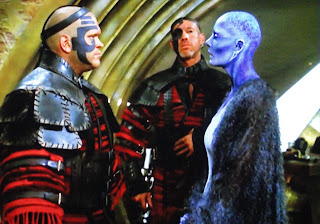 D'Argo requests Staanz help him reach a downed Luxan deep space voyager for some vital map information. After D'Argo's departure from Moya with Staanz, Zenetans arrive aboard Moya. The race indicates their scanners secured information that the Leviathan was pregnant. The Zenetans won't harm her and also point out that any efforts to commandeer a Leviathan typically end up in the death of its attackers. In fact, eighty Zenetans once died in such an attempt. How exactly? We don't know. Nevertheless, we have an idea as clear evidence exists that Moya, or any Leviathan, will find ways to protect itself. They've Got A Secret and Exodus From Genesis are both exceptional examples of the lengths to which a Leviathan will go. They prove that Moya will utilize any means necessary, like anti-bodies, to self-preserve. Zhaan adds, "a mother will protect her child," underscoring the series maternal and feminine component. The intolerable, insufferable Rygel simply can't keep his yap shut and challenges the Zenetans to a game inviting them to stay longer than expected to Zhaan's dismay. With friends like Rygel who needs enemies. Rygel is without question my least favorite character.

 On the transport pod, events lead to Crichton falling atop Sun prostrate for the continued establishment of their physical and emotional chemistry. I'm an unabashed supporter of these kinds of relationships, a shipper to a degree, of romantic or sexual relationships in science fiction. Crichton and Sun, Carter and O'Neill [Stargate SG-1], Mal and Inara [Firefly], T'Pol and Tucker [Star Trek: Enterprise], and Starbuck and Apollo [Battlestar Galactica, uh, the new series] to name a few. A little romance or sexual tension never hurt anyone. So with Crichton and Sun the attraction is indeed there and there is a delicious interplay between them. But things go from bad to worse as the pod begins to lose life support and the duo will need to de-pressurize. With just one space suit functioning, the one that fits Sun, Crichton will need to be given a chemical injection, a "kill shot," normally used on Peacekeepers/Sebaceans to slow the heart, while a second injection is to be applied to hopefully revive him. Crichton demonstrates the "lo-tech" CPR technique that humans use in the event basic Earth revival methods are required.
D'Argo ad Staanz wind up caught in The Flax themselves as the episode alternates between three different threads. Eventually they break free.
Before Sun gets to work, Crichton and Sun share an interesting character moment. You know these intimate exchanges tend to be among my favorites.
 Claudia Black is a sexy, stunning beauty. Crichton is out cold after the injection. He has roughly four minutes before expiration.
Elsewhere, a frustrated Rygel loses to the two Zenetans he confesses he knows of Staanz' whereabouts. Rygel loses and gives up their location in shame, but he is a petulant creature prone to irrational behavior and whim unfamiliar with self-discipline and restraint where required. As it turns out, in this instance, he bluffs the nasty Zenetans, lies to them, and sends them far, far away [to another galaxy maybe]. Zhaan is impressed. Thus our original belief that this once great king wielding great power over a great many minions now reduced to a cowardly toad is once again foiled by his clever move against these marauding buffoons.
 Staanz finds the Luxan Assault Piercer. D'Argo dreamt of serving aboard a ship like that as a boy. D'Argo is torn between his newfound family and thoughts of the one he misses dearly, but makes the very mature decision to save Crichton and Sun rather than satiate his own selfish desires demonstrating true honor in his heart and genuine commitment to this newly established makeshift group or family.
 Sun is unsuccessful in repairing the transport pod with just thirty minutes of breathable air remaining. As the pod grows cold, a now alert Crichton and Sun snuggle for warmth. Sun asks if Crichton saw anything approaching an afterlife following the kill shot. Surprisingly, he indicates he saw nothing. Why? Why didn't he lie given their circumstances to alleviate Sun's fears or at least assuage the dire circumstances of their situation? Nothing like death staring you in the eye to bring out true feelings. The twosome have landed in one another's arms on more than one occasion, but this is the first official kiss with potential as far as I can remember.
 D'Argo rescues his comrades. And in a strange twist it is revealed that Staanz is apparently the female of the species with eyes for D'Argo declaring "I love you." Bizarre as it might be it's quite funny.
Despite making the right call, D'Argo is upset with his decision this day in another sobering character moment. It's certainly easy to empathize with D'Argo, but it's not a Catch-22. Nevertheless he is disturbed not only by the fact he may never see his son, but also the indecision of a warrior's heart.
 The final moments are shared between Sun and Crichton as Crichton humorously confirms Sun's sex. With all that's transpired with the alien female you can never be sure. They smile. The scene itself takes place in a bubble atop Moya against a green screen and that set was apparently established for future use. It proved an awkward location for storytelling according to the Farscape companion book for Season One apart from this moment of intimacy. It was also expensive. It was then scrapped, and thus the set was implemented just once for The Flax.
 The Flax never centers completely on the downed transport pod and Crichton and Sun's efforts to survive like so many in a long line of genrific, classic tales including Galileo Seven [Star Trek: The Original Series], Sub-Smash [UFO], The Last Sunset [Space:1999], The Uninvited [Thunderbirds]to some degree The Gun On Ice Planet Zero [Battlestar Galactica], You Can't Go Home Again [Battlestar Galactica new] and many more. The Flax is good, but not as successful as many I've mentioned here because it distracts away from the survival tale with activities on Moya and other threads. More specifically though it never captures the sense of life and death in play here that some tales have done much better. The urgency is not conveyed as successfully as one might hope. Thus The Flax never quite achieves nirvana in that way.

 Funny enough, designer Rick Eyres notes his fondness for the transport pod he created in Farscape The Illustrated Companion. He likens his design to Thunderbird 2 "but cooler!" Therein lies a great example. It's a pretty cool-looking pod, but playfully adapting a response from the now classic Vice-Presidential debate of 1988 between Democrat Lloyd Bentsen and Republican Dan Quayle. "Designer, I grew up with Thunderbird 2: I played with Thunderbird 2; Thunderbird 2 was a friend of mine. Sorry, your transport pod is no Thunderbird 2." It's just not the same kind of iconic, classic design that captured the imagination so perfectly that it could ever stand the test of time. Shape, color, design functionality and cool - these are all factors that played into the perfection of T2. The pod, like The Flax isn't a devastating classic, but it interesting and does offer enough attributes to carry the day. By the way, doesn't mentioning Thunderbird 2 qualify this entry for FAB FRIDAY? And honestly that was an accident.
The Flax: C+. Writer: Justin Monjo. Director: Peter Andrikidis.
Pop culture reference: John Crichton: "This is fun. This is Top Gun. This is the need for speed."
 It's FAB FRIDAY people where all things green are blue or white are green and nothing is ever what it seems. Yes, once upon a time, Dinky Toys took liberties with those classic vehicles of yesteryear, The Eagle Transporter [1975], The Eagle Freighter [1975], The Interceptor [1971] and Thunderbird 2 [1967]. Dinky Toys was in no short supply of blue and green paint at their disposal and they were going to make damn sure that one day these children's toys would become fabulously collectible.
 I had the blue Thunderbird 2 complete with plastic yellow Thunderbird 4 many yarns ago. I recall a chance at purchasing The Eagle from an antique shop outside of Bath, England way back when too, but the price then was too exorbitant for my shallow pockets to justify.
 Dinky Toys, which beat Corgi Toys to the licensing deal with Anderson on diecast fun, was established in 1931 and was based in Liverpool, England. How fitting that Dinky should also be from the home of the FAB four, The Beatles, and land a deal to make all things FAB for the Andersons.
 Details and designs were certainly simple but these highly sought after vehicles still remain popular. Finding items in mint condition can prove difficult to be sure, but they do exist even though Dinky Toys closed its doors in 1979.
 For more faithful productions of some of these classic vehicle designs be sure to look out for castings from Product Enterprise, Ltd., a company that has designed vehicles for UFO and Space:1999 at great cost. It won't be long before those vehicles are suffering paint loss like those vintage Dinky. Saying Dinky is even FAB. Dinky.


