
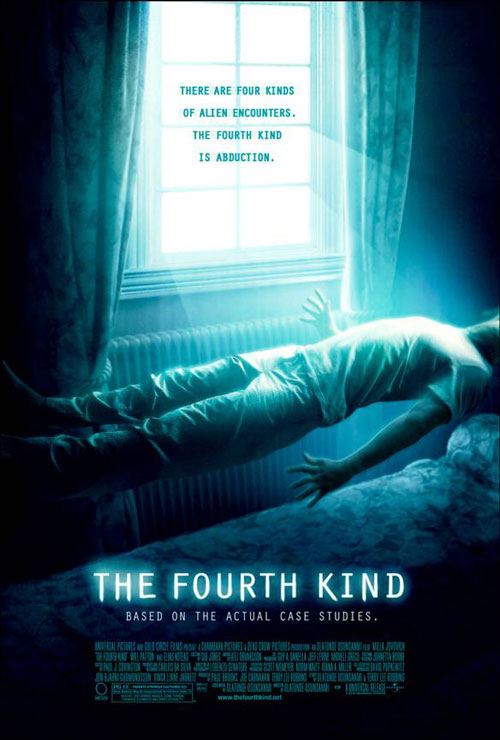
 Poster art for the The Fourth Kind.
The rare image offers a nifty take on J. Allen Hynek's scaling or close encounter classification system in ufology.
Poster art for the The Fourth Kind. Trouble indeed for Dual!.
 The creative team/ studio [AIC] behind Dual! Parallel Trouble Adventure [Dual!] [1999] serves up a half-hearted robot anime that just doesn’t pack the mechanized punch of a cerebral classic like Evangelion. It’s undeniably missing the inventive teeth needed to rise above the lot of average robot anime.
  Conceptually it has the trappings to be special, but winds up a half-baked, Evangelion-lite entertainment minus most of the thought-provoking infusion from a mind like Hideaki Anno and the thinktank that is Gainax. There is little reservation about the intention here. Creator Masaki Kajishima [Tenchi Muyo!] and AIC sought to capitalize on the success of the Studio Gainax mega-hit, though Kajishima has assured Dual! is an extension of Tenchi Muyo!. There are a lot of imperatives going on here. It delivers many of the key ingredients: three robots, teen pilots, a lead male protagonist, urban combat and so on. Though I suppose that serves as a bare bones description for many of the mecha-driven exercises in anime.
  Dual!, like many projects, lacks bite. It lacks originality. It lacks ingenuity. There is rarely an original hydraulic piston in its over sized mecha suit to be found. The idea of a dual universe is a good one, but hardly a new concept. The mirror universe or alternate universe concept is as tried and true a plot device as man stranded on a desert island, but it lacks the much required imagination needed to make it fresh and original. There is cel by cel envy for a whole host of productions that have preceded it. Dual! is just too damn generic and anemic for its own good. It’s hard to get jazzed about this anime when frame for frame, character for character, there's a sense of déjà vu.
 It sorely lacks the richness of story and character necessary for an anime series to succeed and have the lasting impact of an Evangelion.
 Kazuki Yotsuka versus Evangelion's Shinji Ikari. The images speak volumes about the character. Dual! begins with an object of alien origin. It is recovered at an excavation dig and from that moment forward a schism occurs in the space-time continuum and dual universes persist moving forward with alternate and very different realities. One existence looks much like Earth, while the other looks very much like [cough] Evangelion. Grand, new technologies have been cultivated as a result of this mysterious artifact. The key protagonist, Kazuki Yotsuka [Dual!'s very own awkward Shinji Ikari of Evangelion], is the sole unique entity. He alone somehow exists without a living, breathing copy on the other side.
  In time, he begins having disturbing visions of giant mecha battling in the streets outside his classroom windows. No one else can see. He alone is graced with a clairvoyant-like gift capable of witnessing a parallel dimension. Meanwhile, Professor Ken Sanada believes an alternate universe exists. His mission is to prove that theory true. Sanada’s beautiful daughter, Mitsuki [Dual!'s version of Asuka Langley Sohryu of Evangelion], ultimately brings her father and Kazuki together. Professor Sanada introduces Kazuki to the equipment he has built. It can teleport an individual to this dual Earth universe.
  As you might expect, Katzuki ends up in the parallel, troubled misadventure. It is there he meets the alternate cast of characters from his own world. They all behave quite differently with personalities opposite their other Earth selves.
  Instead of being the crazy Earth loon, Sanada is actually respected and supported by the UN who has funded the creation of an Earth Defense Command [EDC]. Does that sound like NERV?. The organization’s sole assignment is to stop the evil Rara. The series is sprinkled with a kind of silly humor and Rara is a lot more ridiculous and wacky than he is evil. In fact, his wife appears to wear the pants in the family. Mitsuki has also made her way to this new universe where she meets her rather unpleasant counterpart. She and Katzuki, it is determined, are quite adept of becoming pilots for the EDC. There's that young, gifted pilot plot device. Katzuki pilots Zinv, by far and away the coolest and best crafted and designed robot unit of the bunch, but certainly no Eva-01. The two partners also meet D [Dual!'s version of Rei Ayanami of Evangelion with a defect... er, make that more defects], a cool, emotionless female bioroid, from yet another lost time and race, with a strange gaping hole in her face where her eyeball should be. The hole is obstructed from view by an overlap of bright radioactive green hair. Brace yourself! The characters even live together. Where’s Evangelion's Pen Pen when you need him? Well, at least names were changed to protect the innocent victims from which this series was plagiarized.
  So does anything work for Dual!? The English dub provided is good. The animation is serviceable, but not extraordinary. Still, Production I.G. and Gonzo Digimation have no worries. Despite the vivid colors, the digital animation lacks warmth and gives the whole production a sanitary, cookie-cutter feel and sterile look.
  The undeniably sleek and original design of Evangelion's Eva-01. Some of the robot skirmishes and cockpit scenarios are solid. Gunparade March is a stronger example of a work that built upon existing tropes and expectations with an interesting look. Zinv is the best-designed mechanized giant here. Overall, the designs are not particularly impressive. Again, Evangelion is at the pinnacle of memorable, distinct mech and character designs thanks to Ikuto Yamashita and Yoshiyuki Sadamoto respectively. These men have offered true vision and talent.
  This image is a stark reminder of the battle between Eva-01 and the third Angel in the first two episodes of Evangelion. The final creations here look as if someone fell asleep at the sketching desk during the design stage. The fierce Eva Units have nothing to fear. Even when everything is working, the lack of artful, skilled animators combined with the weak execution of a weak script just cannot deliver the goods.
  Having said all of this, Dual! offers light, fair entertainment to the anime aficionado. While I am a detractor of the series, some otaku enthusiasts have found the light mood and less serious tone in Dual!, quite agreeable, approachable, acceptable, and even refreshing. The series has even garnered a sizable fan base. Where Evangelion has the potential to damage the more mature, adult mind, Dual! is more accessible for those seeking less complex fare. More mature otaku sensibilities should look elsewhere.
  When it comes to television, animation or film, I'm all about character and Dual! never substantially develops its characters. I hate to fall back on Evangelion, but Dual! forces the comparisons. Evangelion is chock full of touching, unexpected, deep character moments that gradually builds upon old information or foreshadow new information. It is a complicated weave of character building. Dual! simply doesn't offer that.
  It’s one thing to draw contrasts and comparisons between an anime series like Samurai 7 and Akira Kurosawa’s Seven Samurai. There’s a reason for the discussion. Samurai 7 offers an intentional reinterpretation. It’s a re-imagining of a classic. A debate is inevitable. Homage, tribute or shameless copy? These things are fair game. Should we be having the discussion on Dual! and Evangelion? Probably not. Dual! is nothing more than a pale imitation of much better productions on the market. It is an unabashed clone of far superior works. They say imitation is the greatest form of flattery and in some cases that is absolutely true. George Lucas paid considerable tribute to Kurosawa’s Seven Samurai using its influence for Star Wars, but did so within the framework of a space opera and fresh new ideas. As box office history would prove, that's flattery!. Dual! Parallel Trouble Adventure turns out to be a lifeless copy for the mind.
  I don't want to discount the hard work the creators put into these projects, because they do. Further, I'm a firm believer in supporting these productions and paying proper royalties to the artists involved. And if you enjoy robot anime, Dual! may not rank among the classics, but you could do worse. There's enough visual evidence here to glean what you'll find in that cockpit. Dual! is simply not an Earth-shattering event on originality. Perhaps in another universe it could have been a stronger adventure thus the quest to digest and pursue quality anime continues.
  "Don't make me angry... You wouldn't like me when I'm angry." -Bill Bixby as David Banner with that classic, eternally memorable line from the Pilot that would underscore the theme of each week's opening-
 One of the most impressive aspects of Kenneth Johnson's adaptation of the popular, ever-lovin' green-eyed thing that is The Hulk was just how distinctive his vision was for the reality-based character in The Incredible Hulk. The ascendancy of his television version of The Hulk was largely due to Johnson's attention to the human condition and the affect of variables on that condition within the real world. Most critics simply cannot separate the comic book from television. Instead of looking at the two vehicles as two entirely separate assessments on the character, critics have often discounted or derided the television series as something of an insignificant blip in the history of the hero. Others are more fair giving the series its due and noting its tremendous five season impact in the world of the live action superhero.
  Put simply, The Incredible Hulk genuinely builds a television mythology around its hero grounded in a drifter's journey that is wholly unique from the world established in the comic book. While it seemed only logical to take such a tact away from the outlandish nature of a comic book that would never be feasible technically for TV, such an approach is no less significant. The show still proved an incredibly difficult undertaking for Kenneth Johnson from a psychological vantage point. The fact Johnson could establish a man and a creature in a fashion so convincing in this manner was no small feat and indeed a remarkable achievement. Certainly, Bill Bixby and Lou Ferrigno took those ideas to the next level.
  Again, as everyone knows, The Incredible Hulk, the comic, was the creation of Jack Kirby and Stan Lee. Kirby took the inspiration from the classics, particularly the story of Dr. Jekyll and Mr. Hyde, and it coupled with a dose of Frankenstein. Part of my re-education on the subject came by way of Starlog Magazine #312 for purposes of specifics and a delightful article called The Historic Hulk by Will Murray. Marvel's The Incredible Hulk Encyclopedia [2003] is another terrific resource for all things Hulk including a segment on the classic Johnson TV series.
  When it came to coloring the great creature, Lee knew he had to avoid orange thanks to ownership by the Fantastic Four's ever-lovin' blue-eyed Thing. At first came the grey Hulk in its origins, revisited many years later to greater effect by Peter David and Todd McFarlane. Lee relented to the colorization of the Hulk as green, the creature we would come to know and love well.
  Speaking to origins and alternate universes, like the one created for television by Johnson, the Hulk wasn't the product of a radioactive experiment as expressed in the television series or even the Ang Lee film, but rather the result of a nuclear test blast. The explosion of a Gamma bomb impacted the heroic Bruce Banner when he made efforts to save Rick Jones from the test zone. And of course, Johnson differentiated his Banner from the comic books, by dubbing Bill Bixby as David Bruce Banner instead of simply Bruce Banner. So change in any of the diverse, myriad Hulk forms was and is inevitable.
  There have certainly been some significant and wonderful period runs within the Hulk 'verse. Herbe Trimpe [1968-1975] is renowned for his work on the book, though it was before my time. Later, as I mentioned, Peter David [1987-1998] had a huge run, while Bruce Jones [2002-2005] took the character to new, dark places. Both placed remarkable stamps on the mythology of the comic character. Of course my strongest recollection of the character came with the pencil magic of one Sal Buscema [1975-1985], brother of John, who really left an indelible image in my mind of the Hulk I loved from the comic books. Often I immediately recall Sal's work, which is why it was so disappointing to see his work derided in Starlog Magazine #312.
 Writer Will Murray, who wrote a great piece overall in The Historic Hulk, wrote "The book slipped into a long period of coasting." His remark is more a denunciation of the writing than Sal's artwork, but somehow Sal overcame these shortcomings with his magnificent and brave portraits of ol' green skin. Murray wrote the character spiralled in quality. "The Hulk stagnated, battling a crazy conga line of bigger and badder monsters." Well, Murray isn't completely wrong, but as a child I adored Sal's interpretation not to mention that conga line of monsters. If anything Hulk was all about the next round of monster beat-downs. I was good with that. In fact, there was rarely a month that went by for a long period that I didn't run up to the local drug store for the latest issue of The Incredible Hulk. There was a revolving door of cool appearances too from The Man-Thing to the U-Foes. Classics like Sal were all about presenting the great tradition of comic books in the "Mighty Marvel Manner!" as they used to say. I'm not quite sure they still say that. It lacks a certain gritty and grim requirement for today's superheroes.
  Anyway, after happening upon that terrific, but sobering, article in Starlog Magazine, it was refreshing to see Arnold T. Blumberg wax poetic on Sal in his coverage of the many phases of the Hulk's evolution in the Official Overstreet Comic Book Price Guide. Blumberg declared Sal's work as the "definitive incarnation" for many. Though, Blumberg, too, notes the soft storytelling of Sal's tenure, he does credit Sal with overcoming those weaknesses through sheer artistic will. In fact, as wonderful as David and Jones' work is, and I discovered it much later, Buscema created images that have remained with me through the years. His Hulk gives me warm reminders of a simpler time, a less angst-filled period in comic books and he definitely captures the nostalgia factor with his wonderful artistry and craftsmanship of the character. Sal even took the character into a long run of another favorite series of the period in The Defenders. Ironically, Johnson's TV hero taps into the psychological aspect of the hero that was never fully mined in those early age comics.
  Following that amazing run by Buscema, John Byrne took the reins for a short stint, but left rather abruptly and his handle on the character never generated more than a few strong issues notably of course the wedding of Bruce Banner.
  As a child I loved the comic book, but I also loved the show and for good reason the two never really felt completely connected. The show, while reality-based, was a lot like an alternate universe. Today, I've lost touch with the comic book, despite a handful of wonderful classic books that I still retain, but like the comic book the show still entertains me and remains a distinctive creation with a visionary lead by Bill Bixby as Dr. David Banner. Bixby absolutely delivers a psychological component in his flesh and blood creation that immerses us into a character that wasn't always on the mind of the comic book or the inevitable films in the same detail.
  The fact was those involved with the TV show knew there was no way to compete with the unlimited imaginations of a comic book and Johnson knew he needed to sell it to a mature audience looking for more than endless, raging Hulk action. There had to be psychological weight and complexity to the character to sustain the series' evolution so that viewers could relate. Johnson told Sean Egan in SFX #206 in April 2011, "I just wanted to do something that would belie the comic book origins and take us into the real world as much as one can possibly do." Johnson crushed it with The Incredible Hulk. What Johnson tapped into from the pages of the comic book for the realities of television was the outcast underpinnings of the comic book character as well as the deeper pathos of the Banner character. The comic book got it right many times over the course of its ongoing run, but Johnson's TV series got it right too, and in television terms smashed through a wall of limited expectations. Five seasons, after all, is like an eternity in television.
  So nearly four months after the appearance of the two Hulk pilot films, The Incredible Hulk and Death In The Family, Kenneth Johnson returned behind the writing chores for the series official debut with The Incredible Hulk, Season One, Episode 3, Final Round. Johnson would not return again until Episode 9, the oft-maligned Never Give A Trucker An Even Break.
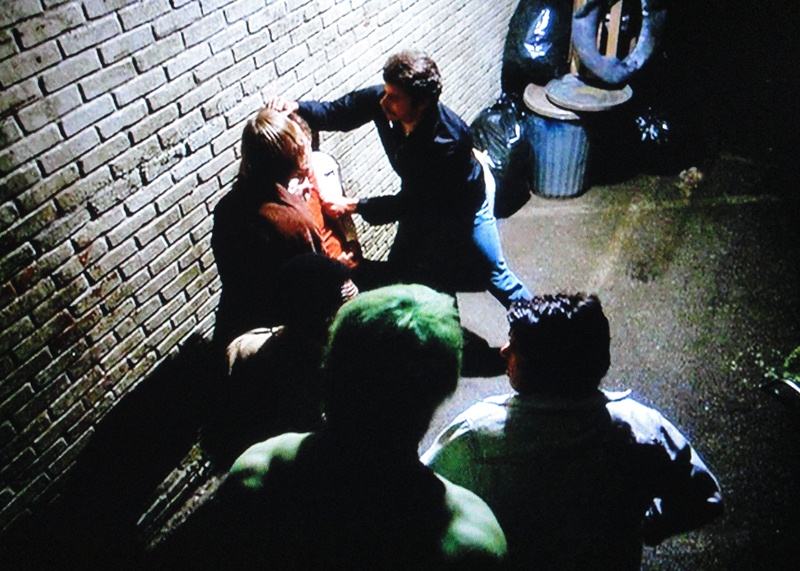
  The opening minutes of the episode sees star Bill Bixby as David Banner fronting as David Benson attacked by two thugs, but instead of transitioning into a startling metamorphoses he is saved by Henry "Rocky" Welsh who just happens to be a professional boxer.
  Welsh lands Banner work at the boxing gym he frequents. Welsh really hopes to be a "winner" someday. The Olympic's owner has a delivery to be made that Rocky always handles. Banner catches wind of it and challenges the owner. The owner overhears Banner and tells him to mind his own.
  En route home Rocky and Banner are jumped for a back alley scrub. Of course you know what that means. Here comes the Hulk! Fortunately, as a result of the scuffle, Rocky drops his package. It turns out to be heroin. Rocky is an unknowing drug runner. He's known about the ring as a "sweet" guy, but not a boxer, but he does serve the owner a purpose.
  As much as Banner, played with just the right touch by Bixby, knows Rocky needs to act, there's something inside Banner that understands Rocky's desire to achieve a dream. Banner sees that light and that spark in his eyes and simply cannot take that away from him, because Banner knows what it means to dream. Whether it was the dream to have the strength to save someone he loved or to one day cure himself of that which haunts him, Banner is sympathetic to Rocky's heart.
  The owner actually plans to drug Rocky and force induce a heart attack. Banner overhears the plan and breaks into the owner's office. He's discovered and Banner is knocked unconscious. No chance for anger there.
  "It can't always be like in the movies. Not everybody can be a Rocky." It's back to the lonely road for Banner. And as one reflects back on Banner's short stay, you begin to realize his impact and that of the Hulk's generally positive influence on those he encounters. Banner is making a difference in people's lives one town at a time.
  Actually, it's "I am your father," because using the contraction for "I am" simply doesn't have the same impact. If Darth Vader ever said "I'm your father" to Luke in The Empire Strikes Back, I suspect the moment might not have been as profound. When James Earl Jones speaks and draws out those words it's potent. I imagine a good deal of thought went into that singular moment. Actor David Prowse had no idea what the dialogue would be for that definitive moment until much later.
 School. Friends. Finding A Mom. Young Eddie Corbett has a full plate.
 Don't get me wrong, Bixby and these life-shaping series never taught me anything my mother, father or grandmother wasn't teaching me throughout the 1970s, but like those films that altered our view of the world like Star Wars, these series helped some of us define who we are. Not unlike the traditional values of the period this is easily reflected in the show's title. How often do you see the word courtship utilized today?
  The series' focus would center on Eddie's ongoing pursuit to navigate his father, Tom, into a courtship with another woman, any woman, who might just make a great new mom and make his father happy, because Eddie clearly wants both throughout the series, despite his innocence. Eddie has a big heart and is anything but selfish.
  The Courtship Of Eddie's Father aired for an outstanding three seasons and 73 episodes. It was the television adaptation of a film of the same name from 1963, and before that a book by Mark Toby, but as always Bixby made this medium something special to watch in each short, but stunning 30 minute installment. He even received an Emmy nod for his phenomenal work here in 1971 for Best Lead Actor Comedy.
  For me, in syndication, The Courtship Of Eddie's Father was one of those answers. It was one of those cultural moments that just happened to come along and time things right. It was both an education, without knowing it, and an irresistible, lovely piece of entertainment. It spoke to me in ways I didn't fully comprehend at the time, but still resonate with me today. Shows like this one and Family Affair [1966-1971] found me and helped guide me at a time when the television became an instrument of information. Thankfully, for me, it was The Courtship Of Eddie's Father and Family Affair. Obviously, I was one of the lucky ones.
 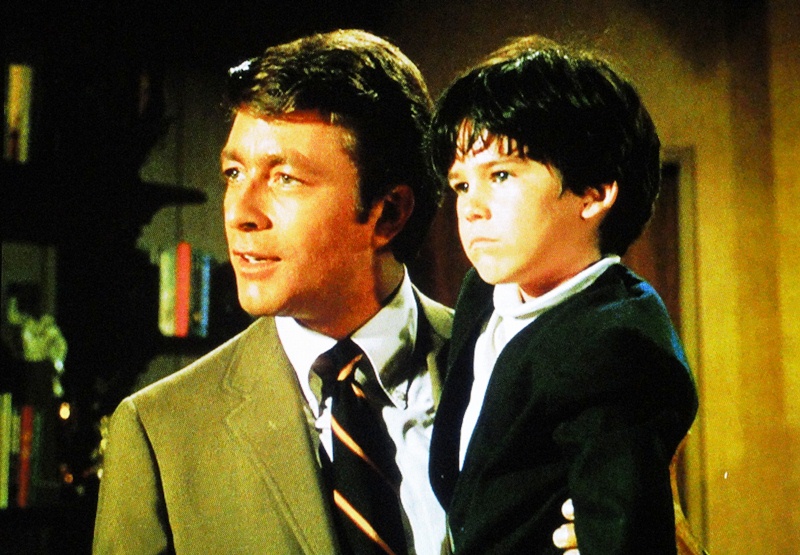 What of Eddie's mother? It's suggested briefly in the opening that Eddie's mother died, but no details are given.
  Creator James Komack, who plays recurring playboy character and photographer Norman Tinker, manages to slide or transition between comedy and drama on a dime. Walking that line is a very difficult proposition. His work, those involved and the actors chosen make the magic happen.
  Eddie and "Mr. Eddie's Father" visit the exhibit for Forbidden Planet. In thirty short minutes, there are many wonderful moments. The basic premise here is that Tom rushes home to keep a date with his son whom he nearly needs to postpone with due to the pressures of work. Mrs. Livingston can't stay and ultimately Tom must relent to taking his son out, because it's the right thing to do.
  Nevertheless, my healthy obsession for all things Bill Bixby did not disappoint and you would be wise to give this family show a chance given the fact we have the option. My nostalgic affection for it aside, my own kids immediately took to it. It certainly won't have the psychological impact for them that it did me with the security of two parents at their side, but it's a welcome diversion from everything else thrown out them from the Disney channel and Nickelodeon.
  Actress footnote: Miyoshi Umeki [1929-2007]. Mrs. Livingston. Miyoshi Umeki's role was significant opposite Bill Bixby and Brandon Cruz known for her sweet reference to Tom Corbett as "Mr. Eddie's Father." She was a very important component to the chemistry of The Courtship Of Eddie's Father with her soft, sweet, traditional Japanese woman awakening to American culture each episode. Umeki had a remarkable life as an artist. Born in Japan, Umeki became an American immigrant after World War II. She enjoyed a steady career as a singer in the 1950s recording many singles for RCA Japan [1950-1954]. She also released several recordings for Mercury [1955-1959] in the states. As an actress she was the first Asian American to actually win an Academy Award for Best Supporting Actress in Sayonara [1957], starring Marlon Brando. In 1958 she was nominated for a Tony Award and a Golden Globe in the film adaptation of the musical she was nominated for, the Flower Drum Song. Remarkably, for all her talent, she only appeared in four films [1961-1963] following her Academy Award. Later, following her role as Mrs. Livingston on The Courtship Of Eddie's Father [1969-1972], for which she was nominated for a Golden Globe, she retired from acting. Sadly, like Bixby years earlier, Umeki passed away from cancer-related complications.
