
 "Big things have small beginnings." -David, the film's android with a droplet of alien specimen held upon his fingertip, Prometheus [2012]-
 I finished watching the reimagining of Irwin Allen's Lost In Space on film [1998] for the second time recently. At the end of the film, I asked myself, what the hell was that? It was a film positively devoid of intelligence sadly enough and underscored by the positively atrocious casting of the Major Don West character. That's a bleak story for another day. Prometheus [2012], as science fiction revisits go, has much more on its mind.
  The stunning, quiet, influential, opening images established the production character of Alien. Well, there I was just 48 hours before my voyage to the cinemas reexamining the immaculate Alien [1979] in preparation for the return of auteur director Ridley Scott and Prometheus, his first science fiction epic since Harrison Ford's turn in Blade Runner [1982]. The wait was finally over. We were but mere hours away from a revelation. The pressure of over three decades pushed my expectations beyond the bounds of human capability really. As much as we might want the man behind those aforementioned films to be a god, isn't that a bit much to expect?
  Consider the fact Alien is over thirty years old, over a quarter of a century, and yet witnessing the film in fact proved to look remarkably fresh, still breathtaking in nearly every frame. This is indeed no small feat. When Alien was engineered, it was hardly expected to be heralded as the classic work of genius that it is today.
 The always brilliant John Hurt. The production design details and thought that went into every frame of the film continues to captivate the eye. The scripted, simple, but authentic dialogue, the lived-in reality of the Nostromo, the talent of an outstanding cast, a remarkably real menace and a minimal, brilliant score added up to one unforgettable classic that defined and influenced a genre for years to come.
  If you think my observations are but the mere ramblings of a lovestruck, stargazing fanboy incapable of objective analysis think again. Okay, while it may be partially true, I thought I might approach Alien with new eyes. I'm not talking about some slickly crafted, state-of-the art styled surgical implantation a la Minority Report [2002]. I'm referring to the aid and enlistment of my teenage son to offer a fresh perspective.
  The question posed to my son, famously referred to as the Boy Wonder, as much as your humble Sci-Fi Fanatic, was whether or not Alien still held up against its more sophisticated and slickly designed prequel, Prometheus, which clearly enjoys the benefits of over three decades of technological advancement.
  My son often scoffs at my nostalgic turns from Land Of The Lost to Battlestar Galactica, but somehow with Alien it was different. The young man is not a massive science fiction fan or especially horror. Furthermore, he was less than enthused at the prospect of seeing Prometheus when I first proposed the plan of a double bill to which he declined. Along with his exceptionally good heart, he is building a rather savvy, good, business sense too. As I said, he first declined seeing the new Scott Free production until the mention of a splendid, thin, green, twenty note bill entered the equation. To quote another film that has had the same kind of profound influence as Alien, A Christmas Story [1983], "Yes, truly, a little bribe never hurts." It's without question an authentic example of life imitating art no doubt.
  But I knew he might appreciate Prometheus if he gave it a chance. Before seeing that film I suggested we take a look at Alien, the film that spawned it. Of course, would it be the other way around? He watched holding his breath and I analyzed Alien over the course of two evenings.
 Speaking directly to the first fifty minutes of Alien, it's safe to say it is this crucial portion of the film that fans like myself have yearned to know more. It is this aspect of the film for which many hope Prometheus will lend answers to the many questions surrounding the derelict vessel, the space jockey, the cargo hold of eggs and face-huggers. Could we expect Prometheus to bring us closer to understanding those titillating mysteries that have propelled us to revisit the classic Alien time and again all these years?
 Alien arrives with the Nostromo literally awakening. So too does its crew awaken from deep cryo-sleep. Their snug pods open, the lights turn on and all are symbolically born into a world where death awaits them thanks to the tentacles of a massive, heartless corporation called Weyland-Yutani. The life-affirming analogy was not lost on my son and Alien is filled with these kinds of parallels.
  The crew receives a distress call, as Mother, the on-board computer, activates their lifeboat to respond to LV-426 to determine its origin. It's a risky proposition for a crew commissioned for off world resource mining and refining. When the craft lands systems malfunction and technology fails illustrating the fragile nature of the crew's equipment and the precarious nature of their existence.
  Later, of course, Ripley deciphers the signal not as a distress message, but as a "warning." With three of its crew already suited and out discovering and exploring this strange place pounded by swirling wind and dirt, howling sound effects to underscore the otherworldly eeriness amidst a habitat likened to a "primordial" soup, there's very little chance to stop the inevitable fate of a crew literally set-up by corporate greed. The crisis that would befall the crew of the Nostromo began the moment the signal was received and the vessel activated.
  Kane, playedby John Hurt, stumbles into the dark after the trio acknowledge the famous skeletal remnants of the iconic Space Jockey. A gaping hole in its chest and the strange appearance of holes in the ship's structure suggest of seemingly melted, normally impenetrable material suggests the Space Jockey was the victim of a potential struggle.
  A hazy, blue beam of light covers a cold space where egg sacks dart what appears to be the inner landscape of the vessel's equivalent of a cargo hold. The mere touch or penetration of the laser film is compounded by an unsettling vibration of sound, perhaps the one received in a transmission by the Nostromo.
 Fascinated John Hurt's character observes a sac through translucent skin in which he gleans life. Something moves, lives, breathes, thrives. It quivers inside almost excited by the prospect of a warm body at its threshold. Curiosity brings to Kane a life-altering and life-ending event. The egg opens like a flower blossoming and a spider-like face-hugger, as they are famously known, latches and adheres to the helmet of Kane. Acid melts the glass and before long Hurt is brought back aboard the Nostromo, against Ripley's good judgment, as countermanded by Ash, the ship's then unknown android lackey for the corporate arm, to lie prostate as an incubator for a new alien life. The process of life for this alien lifeform is indeed fascinating. It becomes clear that Ash is less interested in preserving human life than he is in sing it to fulfill a mission statement for Weyland-Yutani, a company that funded a deep space mission with more on its mind that ore mining. How this process plays out so gradually is one of the great genre-bending elements to a film that takes tropes and bends them into something beautiful, poetic and ultimately special in science fiction terror.
 Well, after fifty, knuckle-gripping, breathtakingly atmospheric minutes filled with either no soundtrack, haunting sound effects or an effectively minimalist score by Jerry Goldsmith, it was time to shelve Alien for the evening. It was late. It was time for bed. Besides Kane was in the midst of gestation. That and the image of an alien face-hugger's tail gripping a man comatose was more than enough to send a boy to sleep with.
 Those life-changing minutes through my son's innocent eyes prompted one of the best remarks: "Dad, that was really good, but terrifying, I'm going to need more money for Prometheus." Hysterical stuff. It was like his variation on that moment in Jaws [1975] when Roy Scheider sees the shark for the first time and stunned says backing up, "We're gonna' need a bigger boat."
 The Boy Wonder was literally freaked-out by Alien over thirty years after it was made. That my friends is living proof of a quality film. Yes, Alien was scary and still is. To further illustrate that point, a normally darkened room with only the glow of a teenage ipod and a closed door was now illuminated with a fish tank light,a butterfly nightlight stolen from his slumbering sister's room and a door half ajar. My son was not going into the good night lightly.
  I confirmed there were indeed no face-huggers and assured him he could leave the light off. He retorted, "That's okay. Just in case, leave the light on." Yes, that's an effective science fiction and horror classic called Alien. I share this story as my way of emphasizing why this film deserves a Top 10 spot in the list of greatest science fiction films ever made. It is not merely my mind waxing nostalgically on a film made more than a quarter century ago, but rather witnessing the details brought to life on film that still lure viewers in with its every anticipating frame. We are seduced by the beauty of a film and the mysteries that surround these characters. We are shocked at times in the way Kane was shocked by the arrival of that titular character. Alien was mean, lean, serious business and still rivets with its every moment. Alien is without question an enduring, timeless classic. This was just a nice way to revisit the film and bringing my son on board for it offered a unique perspective.
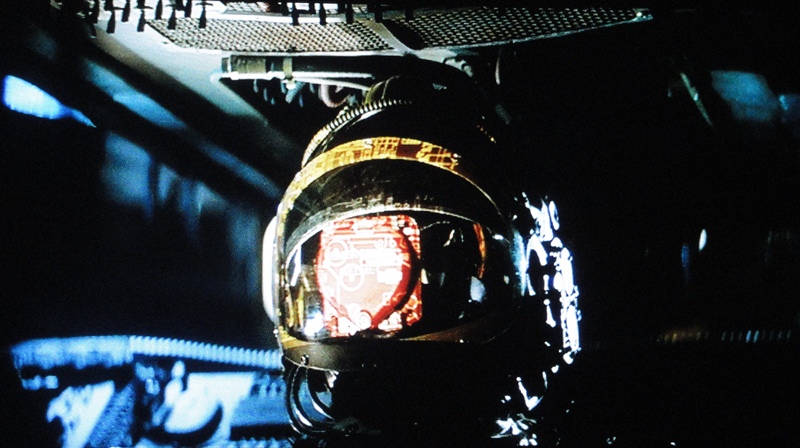
 Alien works for ten strong reasons. 1. Ridley Scott. A fearless director with a hunger to be bold, he is unafraid to hold the camera on a simple shot of a helmet or a computer screen. Each frame is filled with unique information and sometimes very clever subtext. We are invited into his world.
 2. The Alien. The xenomorph and overall appearance of Alien's design by Swiss designer H. R. Giger is clearly important and cannot be understated. His influence, like Ridley's on film, has been profound. The monster design for Alien is one of the best ever made. Predator would follow.
 3. The Mystery. The mysteries that surround Alien have continued to inform our thirst and hunger for more about the famous xenomorph. All of these unanswered possibilities continue to drive the franchise taking us full circle to Prometheus. Alien and its mythological foundations were incredibly intriguing. It's the very reason Ridley Scott has returned to that universe. In fact, as much as Alien is like two films, one of survival and one of discovery, it the this first portion of discovery that genuinely thrilled the mind. We wanted to know more. We wanted to go back to LV-426 to learn more about the derelict ship, the fate of the Space Jockey, where the eggs came from and so much more. It has been the why? that has fascinated us for years.
 4. Production and art design. The film looks amazing from the spaceships to the space suits to the ship's interiors to uniforms to the Alien itself. It never hits a false note. Seeing the carbon dioxide spew from the top of the space suits is ingenious. The attention to lighting and detail is simply unheralded. This was a universe where blue collar workers had now reached deep space. It was grungy, sweaty and uniquely beautiful. It was the anti-thesis in many ways of Prometheus' clean, antiseptic and pristine looking environment. The juxtaposition is noteworthy. Alien offers plenty to captivate the human eye.
  5. Visual effects. Supervisor Brian Johnson [Space:1999] and a host of visual effects creators additionally had a major impact on the world of Alien. For those who loved Space:1999, Alien took us deeper into that terrifying universe.
 6. The Cast & Sigourney Weaver. Weaver is amazing and the strong character she embodied endures as much as the film. Why else would she become the face of a franchise as much as the Alien? She largely filled the vacuum of the female heroine absent from cinema. The female hero was truly born. Additionally, the actors selected ensure the material is executed believably and sell us the tale convincingly delivering dialogue with natural flair. The casting on a film like Lost In Space [1998] for example could spell disaster. Bad acting and poorly delivered dialogue can ruin a film.
7. Subtext. Sex. Birth. Death. Human nature. There are loads of symbols in play that gives the material, written and visual, greater weight than would appear on its surface. What could look more like a female vagina than the top of that fleshy Alien egg sac?
 8. Jerry Goldsmith. The composer delivers a special and effective score that complements, and never overrides the horror.
 9. Mother. There is evidence that computer technology is sometimes at odds with humanity and not necessarily the crutch we might like it to be. Space:1999 ventured to ask whether technology could be trusted. Alien takes a similar tact.
10. No CGI. Thankfully the film benefits from the use of genuine craftsmen. It's never spoiled by the advent of computer technology. Good stories are often distracted by the detriment of computer graphics.
If the Alien is the perfect organism than Alien is nearly the perfect film.
 So what of Prometheus? Everyone wants to know if it holds up. Can it possibly deliver or match on the level of Alien? With all of Alien's sweat-making detail, claustrophobic confines and terrifying tension Alien set the bar. Certainly the right man was at the helm of Prometheus, but could Ridley Scott possibly meet expectations? High hopes have been drifting through deep space for decades and we had finally arrived to determine if Scott had done it again. For discovery of the answers to those questions, the Boy Wonder joined me with some apprehension. [SPOILERS DEAD AHEAD: RETURN AFTER SEEING THE FILM].
 What was discovered on new moon LV-223? Without question Prometheus is an ambitious affair. Some of the questions generated from Alien are indeed answered to a degree or at least we are more or less enlightened to the greater mythological picture. Much is proposed. More questions are produced surrounding themes of creation and genetic engineering by aliens dubbed the Engineers. Sadly, Prometheus while certainly a technically brilliant marvel of a picture on many levels, left me unsatisfied on a few fronts.
 Co-written by Damon Lindelof, Prometheus couldn't have found a scriptwriter more in touch with confounding its audience or creating more questions than answers than this man. As one of the primary scribes on TV series Lost, I've developed something of a love and less-than-love relationship with the writer. Hate is such a strong word. But, after investing years into Lost I found the metaphysical questions, the philosophical considerations and just plain endless puzzles to be overly mystifying to the point of unnecessary. As much as I loved the hell out of Lost for its first three seasons it lost me in the end to its seemingly endless list of unanswered questions. Lindelof was a large part of its success, but acted largely to its detriment as well.
 Lindelof strikes again here with Ridley Scott's metaphysical Prometheus. The visit to LV-223 is largely focused initially but, like Lost meanders and takes liberties with the story's focus.
 The inspired choice of actress Noomi Rapace, a new science fiction heroine to love. My exit from the theatre was less one of exhilaration, and rather more a quiet pondering. It left me deliberating, brooding, musing the arc of evolution and creation as it were in the hands of the mysterious Engineers. Michael Fassbender's agenda-driven David whispers to himself, "Big things have small beginnings," and Prometheus epically approaches its science fiction with big questions while sowing the small seeds to the massive Alien franchise that Prometheus would be intended to spawn.
 Prometheus is filled with big ideas and a few thrilling moments, but admittedly the fan of Alien in me was looking for something a little closer in spirit to the primal beast of that 1979 classic. Again, Prometheus is ambitious, but it lacks the singular, driving focus of Ridley's original sexy beast. While the film opens with the kind of pioneering spirit of the original Nostromo crew's unplanned detour, the operating variables are different in Prometheus and thus it feels different. None of the tension is immediately felt. When the terrors of outer space do finally arrive they too are largely unique and again the rules governing the scenario are decentralized and far less focused. In fact, it's hard to even put your finger on the enemy or in David's case that's exactly what you do.
 The old school thinker in me, that part of me that was raised and reared on miniatures and models, H.R. Giger suits and real tangible visual effects loved the film's substantive, physical strengths. Some of the vehicles and interior sets are stunning and the kinds of environments that computer graphics merely enhances and seemingly never detracts or distracts from. These are elements that certainly heralded Scott's return for many of us, but this film is much more Star Trek [2009] in its design and implementation of slick, new effects technology than the mood of 1970s space horror. Lindelof co-produced Star Trek by the way. I'm not sure I will ever love Damon Lindelof.
  Like most films today Prometheus relies heavily on CGI. The ships and technologies are simply stunning. Like a painting they are a large portion of this mostly beautiful film. It is when the CGI is executed most notably on the alien lifeforms, the Engineers and pre-evolved face-hugger tentacles. It is also used to express affected human personnel. Damn it all, I hate CGI! I hate it... sometimes! It sucks! [I know, hate is a strong word]. Used properly and it can be breathtaking, but use it on lifeforms versus spacecraft and technology and it takes me out of the moment flashing back to the kinds of inhuman applications found in Van Helsing [2004]. It feels like a short cut. Some particularly thrilling moments are compromised by bloody CGI to a degree. While the Engineers look mostly magnificent they still can't fool the human eye. They are probably the film's greatest strength as far as new creations go, but compare the CGI veins and colorations applied here versus the effects employed in Alien in all of their reality-based splendor and it's no contest. Water dribbling down the jaws and mandibles of a man-eating xenomorph will always triumph over a CGI tentacle or computerized alien teeth. There's simply no chance I'm going to approve. The human mind through the eye is far too sophisticated to be tricked by Mother. Mother is a computer and Mother is evil. Ironically, I wonder if the Charlize Theron character with all her Daddy issues wasn't the basis for the Nostromo computer system one day.
 To compound matters, Ridley goes Alien 3 in the end on us and delivers a pre-evolved, computer-generated xenomorph following a Hulk-sized CGI battle between an Engineer and a pre-evolved face-hugger complete with movements that would make Ang Lee's Hulk [2003] proud. Okay, it's not that silly, but the CGI jiggle was notable.
 One of the most thrilling scenes in science fiction memory. There are indeed plenty of moments to enjoy in Prometheus, and the cast is actually exceptional. Noomi Rapace shines as Elizabeth Shaw, Charlize Theron is quite tasty as Meredith Vickers and Michael Fassbender is splendid as David. Rapace, a Swedish actress and star of The Girl With The Dragon Tattoo original, genuinely sparkles in the way Weaver commanded the screen all those years ago. She's quite a find and it's easy to see why Scott was smart enough to sign her. Seeing her character again in a Prometheus sequel would be a highlight.
 Is Prometheus a proper prequel? Like the film proposes, that depends on what you believe. Indeed, there is plenty here to suggest an evolutionary move toward the setting of LV-426 and the creation of biologically-based weapons that both the Engineers and later humans would attempt to mine in the Alien franchise. The Engineers, as creators, were really no different than us as it turns out, but somewhere along the way they had a change of heart about their children.
 The impressive Engineers. So Prometheus leaves us at an interesting end at the film's closing. It's as if the film takes us to a crossroads or more appropriately a fork in the road. Down one road you'll find Alien, Aliens, Alien 3 and thus Alien Resurrection of which Prometheus offers a nice starting point from a mythological perspective. It's clearly another piece of the puzzle from the mind of the master. Now, down the other road is the road to a sequel regarding creation and the Engineers and in many respects an entirely different science fiction concept, franchise or at least a new story. Prometheus is indeed thoughtful and I would love to see where someone, because I doubt Scott would return to it, might take the prospect of a Prometheus sequel. James Cameron anyone?
 Nevertheless, the film is an altogether different animal. There is a thrilling, streamlined concept to be admired about the Alien picture and what it inspired that seems to speak to audiences about humanity and survival of the fittest. It was the perfect vehicle for the perfect organism.
Prometheus presents a very different thesis about creation and beginnings and is much grander in its scope. It's far less visceral and much more cerebral in nature though I was pleased Prometheus never let go of the horror aspects of this science fiction universe. Still, will it appeal to the masses? I don't know. People enjoy a nice bit of terrifying escapism, but when it gets too heady or too weird in its postulations people tend to turn off or run away, dub it weird and essentially scratch their heads. Keeping Prometheus mostly a secret may have worked to its advantage.
 I applaud Scott for his effort here and for his bold vision to attempt something unexpected and unique. I won't let him off the hook completely. Looking at Alien through a prism tantamount to microbiology is interesting, but the minimalist design approach is not quite as thrilling. The primal part of the fan in me wanted to see the big bad Alien. Much had been put out there suggesting something different about Prometheus as if not to disappoint fans like myself, yet I still couldn't quite let go of the fact this prequel, while recommended, had somehow not integrated the face of the franchise - the Alien. Somehow, some way I had still expected its arrival. All these years of waiting and that's a tough pill to swallow. Of course, that's my problem with the film personally.
 The audience I left with was mostly silent. It was mostly comprised of adults. I'm not sure if they were quietly contemplating the nature of existence or if they were fuming over the fact they never got an authentic Alien sequence as we've come to know and love. What did they see? Did they want this story to continue? No one left eager to see it again it seemed. I had two boys with me. One thought it was excellent. The other, mine, thought it was relatively frightening, a little incoherent at times, a little messy like evolution, but not nearly as good as the first film we had just watched a night earlier. I know I wasn't in a hurry to see the film again, but as of the release of this post I'm still thinking about it. It left an impression. It wasn't forgettable.
 My second favorite scene from the climatic minutes of Prometheus. Comparing the film is obviously like comparing The Road Warrior [1981] to Mad Max Beyond Thunderdome [1985], the DNA is there, but it's still a different animal. There's something about that 1979 film that will never be replicated. It captured every note perfectly. The whole thing converged at just the right moment in the universe. Films today are very busy. There's much more to thrill the eyes, and less the mind, with much of it nonsensical, pointless, white noise. Films often lack that brazen simplicity of Alien. Prometheus has more on its mind than Scott's original Alien, but it doesn't make it a better film.
 Truth is Prometheus is a little disappointing. Even the Engineer-manufactured concepts of alien beginnings never quite materializes into anything substantial for me to sink my teeth and yet it's a genuinely intriguing film. It stands on its own. It's not better than any of the other four films. It is merely different. Like the building blocks of life, when it comes to the Alien franchise this film is all about the strands of creation that would one day create one of the great films of all-time. This is a solid science fiction film. My son thought it was frightening in parts, but not nearly as frightening as Alien, and that says something about both films.
 I just wish Ridley had delivered the Alien prequel I had imagined and Prometheus just wasn't quite that film for me. It's also unfair for me to place that kind of expectation on the picture. This is an interesting picture with its head and its heart in the right place. The lack of a genuinely tangible villain in the film is of little consquence, because Prometheus is more interested in ideas and the existential. The film is more in keeping with the kinds of broader ideas associated with a picture like Blade Runner. Perhaps in time, like Alien and Blade Runner, I'll come to appreciate this one more. Referring back to the my ten reasons why Alien endures, I would note the lack of a triumphant Alien return and the improper application of CGI as the greatest detractors in Prometheus. A second viewing will be required to note the extent subtext is applied.
 It all comes down to the thread of belief established in the film. We all have beliefs. We all have different ones. Like those beliefs that are vast and varied, opinions on this film will be equally so. How you see this film is as subjective as a belief in Jesus Christ, God or belief in nothing. Scott asks those questions. It's hard to say where you'll fall on this picture, but you'll no doubt have your set of views on it like man on religion. Without question Scott still has me thinking about this film. Like the Rapace character, I'm still searching and perhaps that was Ridley's desire for this film.
Prometheus was a Greek figure, a Titan, who is alleged to have created man from clay becoming a champion of man before he was punished by Zeus for his creations. Prometheus is indeed a cautionary tale in this vein and echoes the title's roots through its themes of biology and creation. Like anything from the intelligent mind of Scott, he subverts and offers a new twist to a long held and long established mythology.
 Prometheus is both a contemplative film with elements of the science fiction horrors of Alien, but it's also one that really doesn't lend itself to Predators Vs Engineers and there's something to be said there. Big things have small beginnings and Prometheus genuinely takes that approach toward the seeds of its science fiction here enveloped within the scope of an epic journey. Still, that clever quote could be referring to Alien itself.
 The bottom line is with all of the build and excitement that surrounded one of the best trailers I had witnessed in recent memory complete with its horrific score I expected something a little different. I had imagined something slightly different and thus my expectation was different particularly when the bar is raised so high for a director like Scott. Here I was expecting him to build the perfect beast in my mind. That may be completely unfair, because Prometheus isn't Alien, but it's nowhere near The Phantom Menace of prequels either. Despite some minor disappointments, Prometheus is a mostly compelling science fiction yarn worthy of your mind and imagination. Days after seeing it I can't stop thinking about it. Smart science fiction combined with thrilling moments like Prometheus is a rare thing and the good ones can have that lingering effect. Alien: A+. Prometheus: B+.

 The H-Man [1958] sounds like the perfect superhero, but nothing could be further from the horrifying truth.
 "Big things have small beginnings." -David, the film's android with a droplet of alien specimen held upon his fingertip, Prometheus [2012]-
 I finished watching the reimagining of Irwin Allen's Lost In Space on film [1998] for the second time recently. At the end of the film, I asked myself, what the hell was that? It was a film positively devoid of intelligence sadly enough and underscored by the positively atrocious casting of the Major Don West character. That's a bleak story for another day. Prometheus [2012], as science fiction revisits go, has much more on its mind.
  The stunning, quiet, influential, opening images established the production character of Alien. Well, there I was just 48 hours before my voyage to the cinemas reexamining the immaculate Alien [1979] in preparation for the return of auteur director Ridley Scott and Prometheus, his first science fiction epic since Harrison Ford's turn in Blade Runner [1982]. The wait was finally over. We were but mere hours away from a revelation. The pressure of over three decades pushed my expectations beyond the bounds of human capability really. As much as we might want the man behind those aforementioned films to be a god, isn't that a bit much to expect?
  Consider the fact Alien is over thirty years old, over a quarter of a century, and yet witnessing the film in fact proved to look remarkably fresh, still breathtaking in nearly every frame. This is indeed no small feat. When Alien was engineered, it was hardly expected to be heralded as the classic work of genius that it is today.
 The always brilliant John Hurt. The production design details and thought that went into every frame of the film continues to captivate the eye. The scripted, simple, but authentic dialogue, the lived-in reality of the Nostromo, the talent of an outstanding cast, a remarkably real menace and a minimal, brilliant score added up to one unforgettable classic that defined and influenced a genre for years to come.
  If you think my observations are but the mere ramblings of a lovestruck, stargazing fanboy incapable of objective analysis think again. Okay, while it may be partially true, I thought I might approach Alien with new eyes. I'm not talking about some slickly crafted, state-of-the art styled surgical implantation a la Minority Report [2002]. I'm referring to the aid and enlistment of my teenage son to offer a fresh perspective.
  The question posed to my son, famously referred to as the Boy Wonder, as much as your humble Sci-Fi Fanatic, was whether or not Alien still held up against its more sophisticated and slickly designed prequel, Prometheus, which clearly enjoys the benefits of over three decades of technological advancement.
  My son often scoffs at my nostalgic turns from Land Of The Lost to Battlestar Galactica, but somehow with Alien it was different. The young man is not a massive science fiction fan or especially horror. Furthermore, he was less than enthused at the prospect of seeing Prometheus when I first proposed the plan of a double bill to which he declined. Along with his exceptionally good heart, he is building a rather savvy, good, business sense too. As I said, he first declined seeing the new Scott Free production until the mention of a splendid, thin, green, twenty note bill entered the equation. To quote another film that has had the same kind of profound influence as Alien, A Christmas Story [1983], "Yes, truly, a little bribe never hurts." It's without question an authentic example of life imitating art no doubt.
  But I knew he might appreciate Prometheus if he gave it a chance. Before seeing that film I suggested we take a look at Alien, the film that spawned it. Of course, would it be the other way around? He watched holding his breath and I analyzed Alien over the course of two evenings.
 Speaking directly to the first fifty minutes of Alien, it's safe to say it is this crucial portion of the film that fans like myself have yearned to know more. It is this aspect of the film for which many hope Prometheus will lend answers to the many questions surrounding the derelict vessel, the space jockey, the cargo hold of eggs and face-huggers. Could we expect Prometheus to bring us closer to understanding those titillating mysteries that have propelled us to revisit the classic Alien time and again all these years?
 Alien arrives with the Nostromo literally awakening. So too does its crew awaken from deep cryo-sleep. Their snug pods open, the lights turn on and all are symbolically born into a world where death awaits them thanks to the tentacles of a massive, heartless corporation called Weyland-Yutani. The life-affirming analogy was not lost on my son and Alien is filled with these kinds of parallels.
  The crew receives a distress call, as Mother, the on-board computer, activates their lifeboat to respond to LV-426 to determine its origin. It's a risky proposition for a crew commissioned for off world resource mining and refining. When the craft lands systems malfunction and technology fails illustrating the fragile nature of the crew's equipment and the precarious nature of their existence.
  Later, of course, Ripley deciphers the signal not as a distress message, but as a "warning." With three of its crew already suited and out discovering and exploring this strange place pounded by swirling wind and dirt, howling sound effects to underscore the otherworldly eeriness amidst a habitat likened to a "primordial" soup, there's very little chance to stop the inevitable fate of a crew literally set-up by corporate greed. The crisis that would befall the crew of the Nostromo began the moment the signal was received and the vessel activated.
  Kane, playedby John Hurt, stumbles into the dark after the trio acknowledge the famous skeletal remnants of the iconic Space Jockey. A gaping hole in its chest and the strange appearance of holes in the ship's structure suggest of seemingly melted, normally impenetrable material suggests the Space Jockey was the victim of a potential struggle.
  A hazy, blue beam of light covers a cold space where egg sacks dart what appears to be the inner landscape of the vessel's equivalent of a cargo hold. The mere touch or penetration of the laser film is compounded by an unsettling vibration of sound, perhaps the one received in a transmission by the Nostromo.
 Fascinated John Hurt's character observes a sac through translucent skin in which he gleans life. Something moves, lives, breathes, thrives. It quivers inside almost excited by the prospect of a warm body at its threshold. Curiosity brings to Kane a life-altering and life-ending event. The egg opens like a flower blossoming and a spider-like face-hugger, as they are famously known, latches and adheres to the helmet of Kane. Acid melts the glass and before long Hurt is brought back aboard the Nostromo, against Ripley's good judgment, as countermanded by Ash, the ship's then unknown android lackey for the corporate arm, to lie prostate as an incubator for a new alien life. The process of life for this alien lifeform is indeed fascinating. It becomes clear that Ash is less interested in preserving human life than he is in sing it to fulfill a mission statement for Weyland-Yutani, a company that funded a deep space mission with more on its mind that ore mining. How this process plays out so gradually is one of the great genre-bending elements to a film that takes tropes and bends them into something beautiful, poetic and ultimately special in science fiction terror.
 Well, after fifty, knuckle-gripping, breathtakingly atmospheric minutes filled with either no soundtrack, haunting sound effects or an effectively minimalist score by Jerry Goldsmith, it was time to shelve Alien for the evening. It was late. It was time for bed. Besides Kane was in the midst of gestation. That and the image of an alien face-hugger's tail gripping a man comatose was more than enough to send a boy to sleep with.
  The Boy Wonder was literally freaked-out by Alien over thirty years after it was made. That my friends is living proof of a quality film. Yes, Alien was scary and still is. To further illustrate that point, a normally darkened room with only the glow of a teenage ipod and a closed door was now illuminated with a fish tank light,a butterfly nightlight stolen from his slumbering sister's room and a door half ajar. My son was not going into the good night lightly.
  I confirmed there were indeed no face-huggers and assured him he could leave the light off. He retorted, "That's okay. Just in case, leave the light on." Yes, that's an effective science fiction and horror classic called Alien. I share this story as my way of emphasizing why this film deserves a Top 10 spot in the list of greatest science fiction films ever made. It is not merely my mind waxing nostalgically on a film made more than a quarter century ago, but rather witnessing the details brought to life on film that still lure viewers in with its every anticipating frame. We are seduced by the beauty of a film and the mysteries that surround these characters. We are shocked at times in the way Kane was shocked by the arrival of that titular character. Alien was mean, lean, serious business and still rivets with its every moment. Alien is without question an enduring, timeless classic. This was just a nice way to revisit the film and bringing my son on board for it offered a unique perspective.
  2. The Alien. The xenomorph and overall appearance of Alien's design by Swiss designer H. R. Giger is clearly important and cannot be understated. His influence, like Ridley's on film, has been profound. The monster design for Alien is one of the best ever made. Predator would follow.
  4. Production and art design. The film looks amazing from the spaceships to the space suits to the ship's interiors to uniforms to the Alien itself. It never hits a false note. Seeing the carbon dioxide spew from the top of the space suits is ingenious. The attention to lighting and detail is simply unheralded. This was a universe where blue collar workers had now reached deep space. It was grungy, sweaty and uniquely beautiful. It was the anti-thesis in many ways of Prometheus' clean, antiseptic and pristine looking environment. The juxtaposition is noteworthy. Alien offers plenty to captivate the human eye.
  5. Visual effects. Supervisor Brian Johnson [Space:1999] and a host of visual effects creators additionally had a major impact on the world of Alien. For those who loved Space:1999, Alien took us deeper into that terrifying universe.
  8. Jerry Goldsmith. The composer delivers a special and effective score that complements, and never overrides the horror.
  So what of Prometheus? Everyone wants to know if it holds up. Can it possibly deliver or match on the level of Alien? With all of Alien's sweat-making detail, claustrophobic confines and terrifying tension Alien set the bar. Certainly the right man was at the helm of Prometheus, but could Ridley Scott possibly meet expectations? High hopes have been drifting through deep space for decades and we had finally arrived to determine if Scott had done it again. For discovery of the answers to those questions, the Boy Wonder joined me with some apprehension. [SPOILERS DEAD AHEAD: RETURN AFTER SEEING THE FILM].
  Co-written by Damon Lindelof, Prometheus couldn't have found a scriptwriter more in touch with confounding its audience or creating more questions than answers than this man. As one of the primary scribes on TV series Lost, I've developed something of a love and less-than-love relationship with the writer. Hate is such a strong word. But, after investing years into Lost I found the metaphysical questions, the philosophical considerations and just plain endless puzzles to be overly mystifying to the point of unnecessary. As much as I loved the hell out of Lost for its first three seasons it lost me in the end to its seemingly endless list of unanswered questions. Lindelof was a large part of its success, but acted largely to its detriment as well.
  The inspired choice of actress Noomi Rapace, a new science fiction heroine to love. My exit from the theatre was less one of exhilaration, and rather more a quiet pondering. It left me deliberating, brooding, musing the arc of evolution and creation as it were in the hands of the mysterious Engineers. Michael Fassbender's agenda-driven David whispers to himself, "Big things have small beginnings," and Prometheus epically approaches its science fiction with big questions while sowing the small seeds to the massive Alien franchise that Prometheus would be intended to spawn.
  The old school thinker in me, that part of me that was raised and reared on miniatures and models, H.R. Giger suits and real tangible visual effects loved the film's substantive, physical strengths. Some of the vehicles and interior sets are stunning and the kinds of environments that computer graphics merely enhances and seemingly never detracts or distracts from. These are elements that certainly heralded Scott's return for many of us, but this film is much more Star Trek [2009] in its design and implementation of slick, new effects technology than the mood of 1970s space horror. Lindelof co-produced Star Trek by the way. I'm not sure I will ever love Damon Lindelof.
  Like most films today Prometheus relies heavily on CGI. The ships and technologies are simply stunning. Like a painting they are a large portion of this mostly beautiful film. It is when the CGI is executed most notably on the alien lifeforms, the Engineers and pre-evolved face-hugger tentacles. It is also used to express affected human personnel. Damn it all, I hate CGI! I hate it... sometimes! It sucks! [I know, hate is a strong word]. Used properly and it can be breathtaking, but use it on lifeforms versus spacecraft and technology and it takes me out of the moment flashing back to the kinds of inhuman applications found in Van Helsing [2004]. It feels like a short cut. Some particularly thrilling moments are compromised by bloody CGI to a degree. While the Engineers look mostly magnificent they still can't fool the human eye. They are probably the film's greatest strength as far as new creations go, but compare the CGI veins and colorations applied here versus the effects employed in Alien in all of their reality-based splendor and it's no contest. Water dribbling down the jaws and mandibles of a man-eating xenomorph will always triumph over a CGI tentacle or computerized alien teeth. There's simply no chance I'm going to approve. The human mind through the eye is far too sophisticated to be tricked by Mother. Mother is a computer and Mother is evil. Ironically, I wonder if the Charlize Theron character with all her Daddy issues wasn't the basis for the Nostromo computer system one day.
  One of the most thrilling scenes in science fiction memory. There are indeed plenty of moments to enjoy in Prometheus, and the cast is actually exceptional. Noomi Rapace shines as Elizabeth Shaw, Charlize Theron is quite tasty as Meredith Vickers and Michael Fassbender is splendid as David. Rapace, a Swedish actress and star of The Girl With The Dragon Tattoo original, genuinely sparkles in the way Weaver commanded the screen all those years ago. She's quite a find and it's easy to see why Scott was smart enough to sign her. Seeing her character again in a Prometheus sequel would be a highlight.
  The impressive Engineers. So Prometheus leaves us at an interesting end at the film's closing. It's as if the film takes us to a crossroads or more appropriately a fork in the road. Down one road you'll find Alien, Aliens, Alien 3 and thus Alien Resurrection of which Prometheus offers a nice starting point from a mythological perspective. It's clearly another piece of the puzzle from the mind of the master. Now, down the other road is the road to a sequel regarding creation and the Engineers and in many respects an entirely different science fiction concept, franchise or at least a new story. Prometheus is indeed thoughtful and I would love to see where someone, because I doubt Scott would return to it, might take the prospect of a Prometheus sequel. James Cameron anyone?
  I applaud Scott for his effort here and for his bold vision to attempt something unexpected and unique. I won't let him off the hook completely. Looking at Alien through a prism tantamount to microbiology is interesting, but the minimalist design approach is not quite as thrilling. The primal part of the fan in me wanted to see the big bad Alien. Much had been put out there suggesting something different about Prometheus as if not to disappoint fans like myself, yet I still couldn't quite let go of the fact this prequel, while recommended, had somehow not integrated the face of the franchise - the Alien. Somehow, some way I had still expected its arrival. All these years of waiting and that's a tough pill to swallow. Of course, that's my problem with the film personally.
  My second favorite scene from the climatic minutes of Prometheus. Comparing the film is obviously like comparing The Road Warrior [1981] to Mad Max Beyond Thunderdome [1985], the DNA is there, but it's still a different animal. There's something about that 1979 film that will never be replicated. It captured every note perfectly. The whole thing converged at just the right moment in the universe. Films today are very busy. There's much more to thrill the eyes, and less the mind, with much of it nonsensical, pointless, white noise. Films often lack that brazen simplicity of Alien. Prometheus has more on its mind than Scott's original Alien, but it doesn't make it a better film.
  I just wish Ridley had delivered the Alien prequel I had imagined and Prometheus just wasn't quite that film for me. It's also unfair for me to place that kind of expectation on the picture. This is an interesting picture with its head and its heart in the right place. The lack of a genuinely tangible villain in the film is of little consquence, because Prometheus is more interested in ideas and the existential. The film is more in keeping with the kinds of broader ideas associated with a picture like Blade Runner. Perhaps in time, like Alien and Blade Runner, I'll come to appreciate this one more. Referring back to the my ten reasons why Alien endures, I would note the lack of a triumphant Alien return and the improper application of CGI as the greatest detractors in Prometheus. A second viewing will be required to note the extent subtext is applied.
  Prometheus is both a contemplative film with elements of the science fiction horrors of Alien, but it's also one that really doesn't lend itself to Predators Vs Engineers and there's something to be said there. Big things have small beginnings and Prometheus genuinely takes that approach toward the seeds of its science fiction here enveloped within the scope of an epic journey. Still, that clever quote could be referring to Alien itself.
 The wait is over. Prometheus [2012] finally arrived from the mind of Ridley Scott. My reflections on Alien [1979] and Prometheus coming soon.
 It's FAB FRIDAY Earth inhabitants and what better way to spend it than launching a space trip to the moon. Welcome to the wonderful 'verse of all things Gerry and Sylvia Anderson.
 We turn our attention to those classic science fiction years and the home of the Alphans, Moonbase Alpha, and their own deep space exploration that pre-dated the fears associated with the discoveries of the crew of the fateful vessel known as Nostromo on that distant moon LV-426. Between humanity and the unknown Moonbase Alpha was home.
  "I liked the concept of having a Moonbase and using it as a nuclear garbage dump, and I liked the idea of a group of people being thrown out of Earth orbit and into a trajectory which they had no control over, as opposed to Star Trek where they had lots of control.... The fact that we would be at the mercy of the gods, so to speak, and that we were not equipped to go there was fascinating to me." This is a significant difference between Star Trek and Space:1999 and anyone who ever wrote about Space:1999 as a Star Trek knock off should have noted this distinction. There's no excuse for such slipshod comparisons. Landau continued, "This was 1973 and we were not that far away from 1999 at the time, so technologically and scientifically we were not really equipped to go out into deep space like that. ... So the fact that this enormous accident happened and thrust us into a situation that we were neither technologically or emotionally ready for was something that I found really fascinating." When viewers take Landau's comments into account it places into perspective the characterizations in the show that were established throughout Year One. These were denizens boldly going, but genuinely frightened as a result of being ill-prepared. Landau concluded, "We had a group of 300 or so people of all nations and although we were able to sustain that amount of life with hydroponics and so on, we were not really able to procreate beyond that, because we just couldn't sustain that evolutionary aspect." So Moonbase Apha was at once a life-giving force, a home and ironically a tomb of sorts.
  The design of Moonbase Alpha really never gets its due when you consider how it evolved from the much simpler Moonbase of the UFO series. The expanded base is iconic in appearance and immediately recognizable to fans of science fiction.
  What do the 2012 summer film's The Avengers and Prometheus have in commmon? Answer: The Hulk.
 Despite the success of The Incredible Hulk Pilot and its follow-up Death In The Family, executive producer/ writer/ director Kenneth Johnson has always been candid that the series was never an easy sell.
 According to an interview in Starlog Magazine #312 Johnson eventually settled on actor Richard Kiel, who played the villain Jaws, in the classic James Bond film The Spy Who Loved Me [1977] and Moonraker [1979], who came in at a hulking seven foot four inches.
  Following the establishment of Johnson's Hulk, the creative team had their issues with the green make-up applications and getting the hair right. Of course, even as viewers, you always got the sense from the eyeball test alone, that creators had their problems with that wiry hair. Johnson felt it looked like a "fright wig."
 So there was plenty to get right for the series to establish itself. Clearly, despite some push back from executives, Johnson generated the right ingredients to prove The Incredible Hulk had "potential" as an ongoing series. The Incredible Hulk would inevitably premiere in March 1978 with its first official series episode Final Round almost four months following the second pilot Death In The Family. The men and women that made the series go gave us a winner for five seasons.
  Thankfully, here we are with The Incredible Hulk, Season One, Episode 5, Of Guilt, Models And Murder. At this point David Banner has been a maintenance man at a boxing facility [Final Round], a zoo grounds keeper [The Beast Within] and now an industrialist's valet. By now, you begin to get the general rhythms of the series approach.
  All humor aside, we've covered this before and we'll do it again and sometimes episodes certainly diverge from formula like elements found within Of Guilt, Models And Murder whereby Banner must work to clear his name and test himself psychologically.
  Werewolf by night. The success of The Incredible Hulk undeniably resides within the nuanced performance provided by Bill Bixby and his self-effacing, seemingly tortured emotional and psychological journey. Without it, The Incredible Hulk would lack the emotional weight that makes the series incredibly, well, credible. After all, as kids we certainly adored those Lou Ferrigno moments, but as children we were also incredibly insightful to the conflicts within Bixby's performance and attuned to the world of a man locked in an emotional struggle. Bixby as Banner gave new meaning to inner demons and we understood that. Johnson and company ensured those stories were somehow understandable for children, but seemingly complex enough on an emotional level that adults could appreciate them then and now.
  The latest entry featured guest star Loni Anderson. The American actress and blond bombshell was best remembered as Jennifer Marlow on a TV series called WKRP In Cincinnati. I also remember her hot and heavy, on-again off-again relationship with actor Burt Reynolds. She's the face of the latest Hulk entry filled to the hilt with buxom babes.
 The story opens with a moving, sobering sequence of David Banner post-transformation. With his clothes shredded and his eyes receding back to normal, Banner wipes his face in a stranger's bathroom. The opening works brilliantly because Bixby brings the humanity in full to the character. We also haven't seen The Incredible Hulk open post-transformation leaving viewers with real questions.
 As he sits in contemplation he remembers the voices and words of Doctor Elaina Marks from the Pilot of The Incredible Hulk. In his mind he replays those events that assure David that the Hulk "won't kill because David Banner won't kill." What happened in this room just minutes earlier? Banner hurries off in fear horrified at the possibility of what he may have become.
 The cosmetics mogul, James Joslin, informs reporters of the events that transpired. His wife was acting, rehearsing and screaming out the window all for a part in a film. According to Joslin the Hulk entered their home and killed his wife. The Hulk picked up the woman and crushed her. Banner watches the news coverage and closes his eyes in shame and guilt. Cosmetics tycoon Joslin is spotted being consoled by Sheila Cantrell, played by Anderson, and Banner, watching a television news report, begins to question the reality of the story as he assimilates the information.
  Once upon a time Loni Anderson was considered the hottest thing in the world. I never did get that one. With the creature on the loose, a young, female hiker, inquires if Banner is a fellow traveller and wonders if they shouldn't travel together? Can you imagine a cute female asking a male stranger to hike together in today's world? There was a stunning innocence and freedom during the 1970s.
 Time to take a position with Joslin. Funny enough, Banner arrives at the man's residence carrying a bag. He informs a guard he's there to apply for a vacant position and the man actually lets him in despite all of the reporters being held at the gate. Can you imagine that today? N-O! With absolutely no identification Banner is allowed ont he property and with no references Banner is hired at Joslin's behest as a valet. Joslin recognizes Banner as the intruder from the evening earlier subscribing to the old adage, keep your friends close and your enemies closer.
  Big Hulks DO cry! Queue Roy Orbison Crying. Joslin leaves Banner in the care of Cantrell. Yet, interestingly, Sheila warns David that Joslin can be "vicious" and warns him to use care essentially stabbing Joslin through the proverbial back or is she?
  Cantrell explains the events of the evening earlier as she sees fit to craft them, just as Joslin crafted them earlier. She tells David Banner [Blaine] of the abusive confrontation between Joslin and Terry in classic primetime, retro, classic soap opera-like 70s style. Sanderson also witnessed the killing, which lends insight into the blackmailing. Cantrell believes the Hulk creature picked up Terry and exhibited tenderness - even tears. Could the Hulk have been reliving holding Doctor Elaina Marks in those final moments of the first Pilot film?
  At a junkyard, Banner asks Sanderson to go to the police with Cantrell rather than blackmail him. He laughs and tells Banner that Cantrell would never betray Joslin as she and Joslin appear holding Sanderson and Banner at gunpoint. Cantrell admits she killed Terry. It's clear, the Hulk's unexpected arrival was the perfect cover for the murder of course.
 The twists are rarely startling, but the episode has its dramatic moments with Bixby delivering the highlights. In fact, the first half is particularly strong. In one cool twist Banner actually steals McGee's hand held tape recorder from the car which he uses to record Cantrell's confession at the junkyard. Miraculously, somehow, through the transformation and the absolute disintegration of clothes, Banner manages to hang onto that recorder. The end is near with the evidence in hand.
  The closing score by Joe Harnell, The Lonely Man, is perfectly appropriate here as David never shares a tearful goodbye to anyone, but rather accomplishes his mission of clearing his good name and that of his alter-ego. While Banner is believed to be dead by the public-at-large, this is clearly a psychological response. This self-accountability speaks to the character of a man. It's clear that, while Banner may not know of the actions of his alter-ego entirely, Banner holds himself accountable and responsible for his actions and those of the Incredible Hulk. Now that is a hero for the ages and one rarely portrayed in television programming today. Of Guilt, Models And Murder: B-.
 Next Blog Issue: Terror In Times Square! Be afraid pilgrims!
