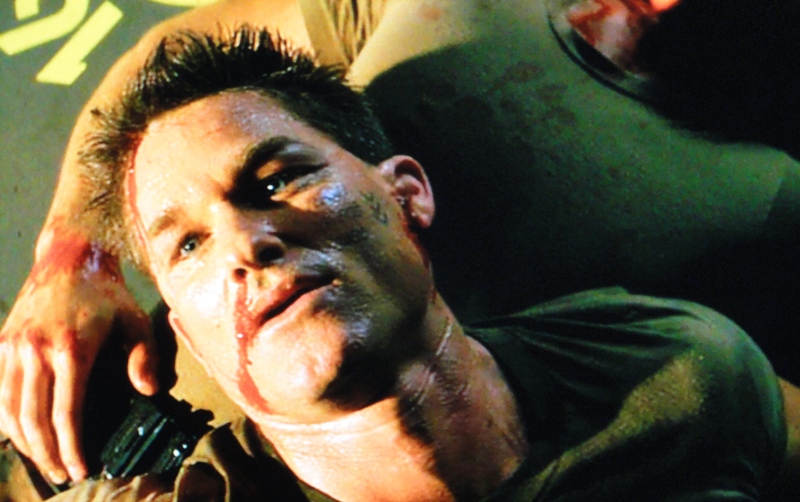
"I was replaced" - Todd [Kurt Russell]-
With Director Paul W.S. Anderson's Resident Evil: Afterlife [2010] now in the rear view mirror I thought it might be fun to take a look back at one of the films he cut his teeth on, Soldier [1998].
 I'm a fairly unabashed fan of director Paul W.S. Anderson's gratuitous and stylish action. He's one of those guilty pleasures to be sure. Further, it's hard not to have some respect for anyone who lands Milla Jovovich as their wife. Any man would receive begrudging respect from this Sci-Fi Fanatic. Anderson is an impressive director visually at the very least. It would seem he's the kind of artist cinemagoers either love or hate - a real product of the times. There isn't much in between with the man. Part of his success clearly goes to the heart of Anderson's visual flair combined with an obsession for future possibilities and violent extremes. There isn't a picture by Anderson that doesn't inject some form of violence or sense of apocalypse. His work is ambitious if not entirely successful in execution regarding the art of the story.
 The British filmmaker began his career with a small picture called Shopping [1994] before moving to the fulfillment of his oeuvre. His senses seemingly informed by quick moving images seemed the obvious candidate to pursue the video game stratosphere beginning with Mortal Kombat [1995]. The science fiction/ horror hybrid Event Horizon [1997] followed and was a striking space yarn as a ship dubbed the Event Horizon reappears. Events would suggest the vessel seemingly travelled to hell and back apparently bringing hell back along with it. The frighteningly atmospheric tale with a stellar cast was a personal favorite of mine and remains so.
  Visually, Anderson never backs off infusing his films with differing degrees of gore, but the realization of his future visions are what appeals most despite their imperfections. His pursuit of strong visual effects is certainly a defining characteristic of his work. His handle on character development has never been a strong suit, but for those interesting in moving pictures he more than compensates his lack of ideas with his stylized levels of violent choreography. It's this trade off that makes Anderson such an uncomfortable sell even for me. If you are open to the escape of a violent future and you have the stomach for it, Anderson's world is a dark rendezvous to be sure. I've never been a huge fan of horror, but his fusion of the genres keeps me intrigued and coming back for more.
 Resident Evil [2002] and Resident Evil: Afterlife, both of which he directed, are perfect examples of Anderson at the top of his game taking the best of both genre worlds and cultivating the Anderson vision. Death Race [2008], another brutally sadistic future, once again ripped by the critics, is still a well-executed variation on the horror/sci-fi combination. His race remakes Death Race 2000 [1975] to horrifying, cold-blooded effect. It makes The Running Man [1987] look like a Saturday morning cartoon, but Anderson's approach is very much a sign of the times. There's an almost sociopathic disconnect by the characters that populate his depictions. Perhaps it's a reflection of our world today, but it's certainly not anything that hasn't made it onto film for decades.
  He wrote and produced Resident Evil: Apocalypse [2004] and Resident Evil: Extinction [2007] as well as producing the science fiction horror nightmare that was Pandorum. Of all of the franchises Anderson has touched he has been the rare recipient of any kind of critical acceptance often savaged by writers upon each film's release.
  Somewhere very early on Anderson got behind a film called Soldier. It quietly came and went with little fanfare and became a box office flop. My views on the film are mixed and it was arguably unsuccessful for a host of reasons.
  Anderson is still establishing himself as a visual artist and has some way to go. As a fan of the steady hand of auteur director Ridley Scott, it's easy to see why Anderson is so adoring and envious of his fellow English countryman. Anderson certainly shares his strong sense of the visual, but there's something that's not quite as refined about his work, but he's getting there. While Anderson's films are graphic and visually powerful, he lack Scott's strong sense of narrative or character [most of the time], even within a strictly action-oriented picture. Anderson is hit and miss in this way.
  It's no surprise then that Soldier was a kind of prequel to Scott's Blade Runner. Soldier may be a bit like the poor man's Blade Runner, and while it never achieves the mood of the aforementioned classic, it does have a strong sense of place and environment. Anderson transports us to other worlds. We appreciate this most about the filmmaker, but it's not enough to save the film. Anderson's other strong suit is action, but Soldier's action isn't stylized enough for my taste. The use of color, mattes and appropriately applied CGI is near perfect in generating a post-apocalyptic look a la Mad Max in space. But Soldier definitely walks a very fine line of being at once interesting and at the same time mind numbingly poor in the script and pacing department, but this is early era Anderson.
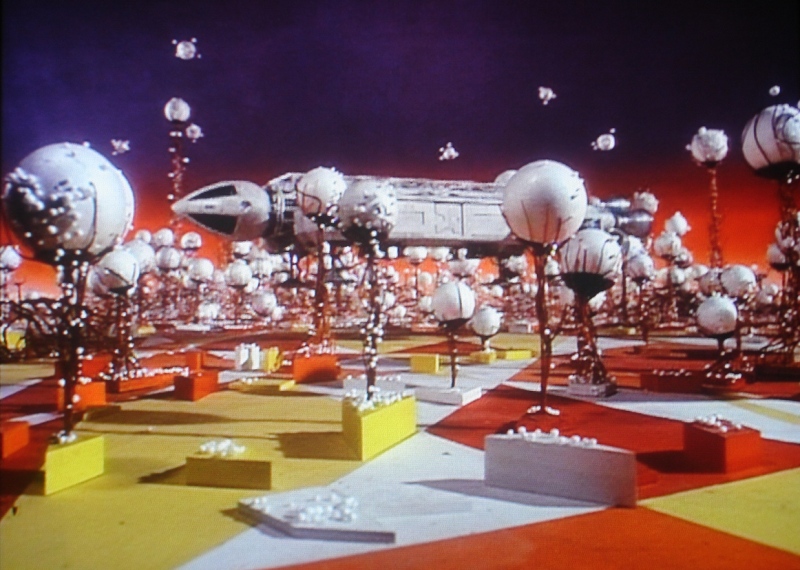
  Some always terrific space designs from Soldier to Event Horizon from the mind of Anderson. These things are dropping Aircraft Carriers on the moon (See first image above). The film stars fan favorite, actor Kurt Russell, who for better or worse is cast and thrown into a fairly limiting role. You can certainly see the appeal of it to an actor. The part requires a strict, almost entirely physical performance a la Tom Hanks' Castaway [not that the material is that good]. It's a genuine challenge especially for an actor as passionate as Russell.
  The film centers on one Sgt. Todd. That's it, no last name, just Todd. He is part of an elite battalion of genetically-selected, then trained, Soldiers under Project Adam. Those Eves must be something. The weak are killed. The new world order is less than empathetic to the weak. A vague, nameless, governmental entity cold-bloodedly selects missions to infiltrate and destroy. They seemingly cross the galaxy in a thirst for galactic dominance, an imperial thrust with little to no reason for their aggression.
  As the product of a nurtured, warring society, Todd essentially transforms into a killing machine, near robotic in his desire to kill. Any humanity he once had is nearly drained from his very fiber. There is little emotion to these men who are taught - kill or be killed. If a civilian stands between them and the enemy they are wiped out too without a thought. There is no pause. There is no hesitation. These are the ultimate Soldiers and sociopaths.
  The future face of The Commish and The Shield. Along comes a new generation of genetically superior warrior Soldiers to replace Todd's unit. These Soldiers have now made Todd obsolete. It's a fitting analogy to our own sense of dispensability in today's society. Following a battle of three-on-one, Todd is knocked unconscious and two men are killed. The three men are tossed upon the scrap heap of war history literally. Ships dubbed Dumpers transport refuse and other garbage to a neighboring planet. Todd is among the garbage. He is dumped on the planetoid like yesterday's trash. It clearly speaks to a world losing touch with their souls and their emotional cores. Anderson is the right man for the job.
  Todd is thought dead and left alone on the moon. As it turns out, other inhabitants have made lives for themselves there including a family who gives Todd a chance to survive among them.
  Thirty minutes into the film and Kurt Russell hasn't spoken a word of dialogue, but because the nature of these Soldiers is to be cold and inexpressive. As a result of the character design, little emotion is felt throughout the film and Russell is tasked with the impossible. He is asked to draw the audience in and make them care and he is in an unfortunately unenviable role. There is little connection made to any of the characters. This is once again one of Anderson's weaknesses. To make matters worse Anderson creates a film that spotlights characters without character. How's that for irony? While we feel for Todd's brainwashing, we are not emotionally-connected to the Soldier. As the inhabitants make efforts to connect with Todd [like the audience], they realize he is almost Terminator-like in his calculations with little reservoir for emotion. The group votes and casts Todd back into the debris fields of the forgotten planetscape replete with desert-like sandstorms that sweep everything in its path. Yes, Sgt. Todd is castaway once again.
 In one of the few moments in the film where we do feel something for Todd it is when Todd himself exhibits an emotional response on two occasions. The first is a rare and most poignant moment with the woman with whom he feels a connection. Beautiful women have that affect. Still, it is unnatural for Todd as he trembles nearly rejecting the embrace of the woman. Having spent some time with these new people and the family that sponsored his stay, Todd reawakens with some aspect of his humanity intact. Having been around the couple's son, Nathan, something triggers an emotional reaction within his years of programmed nurture.
  Sadly, out of fear, Todd is rejected and banished into the abyss of garbage where he continues to unearth his buried identity, self-worth and ultimately the individual - the thing most crushed through indoctrination. Sitting alone in a tube-like structure sheltered from the winds, Sgt. Todd sheds tears. The moment is made all the more affecting as Todd touches his tear to pull back and look at it. This is an awakening. It is a true moment of discovery and Russell nails the moment as he portrays a man out of touch with humanity, but feeling something previously alien to him for the first time. This is a true highlight in an otherwise cold tale of humanity and it underscores a glimmer of hope to the future of humanity in this otherwise small moment.
 We weep for Sgt. Todd who is nothing more than a number, his skin inscribed with a blood-type O-POS [O-Positive] perhaps denoting, like the blood type, the rare breed of Soldier Todd truly is and was. The people who connected with Todd on some level come to realize the error of their ways in banishing a fellow human being to the dusty netherworld of outer space. The concept of nature versus nurture is one of the film's greatest understated strengths, but might have benefited from a little more cultivation of the theme.
  Things come to a head when the newly acquired government Soldiers are sent to the moon for a training exercise under the orders that all civilians may be considered expendable simply to flex a lot of muscle and firepower. How's that for soulless and sociopathic? Soldier is a bit like a First Person Shooter game and the shooter is evil. The shooter wipes out anything that moves without a trace of humanity to pause them. Anderson certainly connects with this kind of visual stimuli.
 A hint of Rambo. When the ship arrives, Todd realizes who and what it is and immediately goes into that thing he knows best, Soldier-mode and killing. He does everything he can to protect the innocents, which separates him from the other Soldiers. Further, he is successful in doing so, once again proving the old adage that younger and newer isn't necessarily better. The old war dog, Todd, dispatches the enemy with sheer intelligence and cunning. These are facets of the character that are hardly in evidence throughout the film. It's like Rambo in space. It's a bit like outwitting young athletes who are always faster and stronger by being smarter and that is how Todd compensates. He is still the best.
  The story lacks in considerable substance, is weak on dialogue and strong on two-dimensional characters. Themes like nature versus nurture and man's isolation might have been better explored too. Soldier doesn't take time to develop these themes with any great degree of intelligence. In fact, had Soldier not ended with such cliched, mind numbing violence, but rather taken the Todd character into a more human direction, exploring these ideas and concepts, Soldier might have been a better film. Science fiction fans will revel in some visual aspects of the film, but the characters simply don't engage the audience enough to really care. Ultimately, the mostly one note Todd has changed, if just a little. His connection with Nathan, a young boy who assures the future generation of the Todd combat Soldier, also presents Todd with aspects of his being that had once been washed away including love and concern for others outside of one's self.
 We don't expect Todd to change that much, as a result of his years and years of training and psychic programming, but the character never shifts enough for the audience to fully connect. Soldier is a disappointment in the end spiralling into a final round of comic book violence. Riddled with bullets and the obligatory showdown between Todd and his replacement the final volley simply lacks some of the stylistic camera skill Anderson has displayed in more recent films like Resident Evil: Afterlife or Death Race. It's a little cheesy and silly. Well, Resident Evil is silly, but it looks really cool. Soldier is a satisfactory film for a variety of disparate moments just not one of Anderson's finest. It's also not of Russell's strongest roles. The role here makes Russell's Colonel Jack O'Neil character in Stargate [1994] look like a Chatty Cathy. His stoic behavior is so cold and detached he makes that aforementioned soldier in Roland Emmerich's film seem like a warm and cuddly fellow. I love Kurt Russell too. There's a part of me that believes the role could have gone to almost anyone. On the other hand, despite the limitations of the script provided to Russell, there's a part of me that believes Russell makes the film better. There's always that something in his eyes and face that is expressive and warm. There's a twinkle and a spark there. Dolph Lundgren-types simply couldn't pull off the face. Between Russell and Anderson I wanted to embrace this film more, but like the concepts presented in Soldier everything keeps the viewer at a distance. Anderson films are cold, but generally exciting. This one left me a little cool and stunted emotionally, where there were clear efforts made to draw out the emotion.
  Soldier was based on an episode of The Outer Limits called Soldier written by Harlan Ellison [Star Trek, Babylon 5]. That story in turn was adapted from a 1957 short story called Soldier From Tomorrow. This coupled with the fact Soldier was considered a "sidequel" or "spiritual successor" to Blade Runner made for an interesting premise and higher expectations. It's no surprise there was an element of Blade Runner in the mix too. The script was penned by David Peoples who co-wrote the script to Blade Runner. Peoples has had a fairly interesting scripting career beginning with his assistance on writing the aforementioned classic. Peoples also went on to write the Academy Award-winning Unforgiven [1992] starring Clint Eastwood. He also penned Leviathan [1998] starring Peter Weller, another good B film. He would write for another Rutger Hauer [Blade Runner] vehicle in The Blood Of Heroes [directed by Peoples]. He also co-penned the classic Terry Gilliam work 12 Monkeys [1995] starring Bruce Willis.
  Soldier was a financial disaster costing 75 million, but only earned 15 million in return. Critics, as with most Anderson pictures were largely very unkind to put it kindly. One writer wrote, "Everything in this film is criminally bland, except for Russell's badass attitude." But I do believe Russell brings something to the picture that elevates the cliches. Another writer said, "Soldier wants to be an intense thriller with cerebral significance," and I think it makes efforts to get there but never fully succeeds. One critic said, it was a "yarn that makes you long for the realism of Pigs In Space." Ouch. It's a great line though. Some writers noted the effects as "second rate," but they are mostly impressive in an otherwise downbeat film lacking in any joy at all. Still, Anderson has never been big on humor or joy in his pictures. One faults screenwriter Peoples for the "awful mess." One gent commented that the film had "all the charisma and liveliness of a tree." Some writers felt the junkyard planet was the appropriate location for Anderson's movie indicating it was "bound for the trash heap." The rare critic saw a glimpse of the positive in "the gradual socialization of Russell's character" and he's correct in noting that transformative highlight.
  But mostly, Russell's disaffected performance created a character that literally speaks 79 words. One of the most frequent is "sir." I'm not sure the film deserves this much attention, but then I appreciate Anderson's uncompromising approach to R ratings. I had mixed feelings about the film, maybe because I wanted to feel a bit more. In more assured, veteran hands the film might have been a more interesting social commentary or struck a more confident emotional balance. After all, who wants to be replaced, become inferior or obsolete? It's a wonderful human question. Unfortunately, subtlety may not be Anderson's greatest strength. As it is, the premise of Soldier is an interesting attempt at something different and oddly human especially for Anderson. But then something begins to happen, slowly, like the change within Sgt. Todd. It's small, but the transformation is enough that we feel something for this hardened man. Unfortunately, with emotion control at the core of this film, it's hard to know what to feel. Oddly enough, Anderson brings us one of his most human efforts or, like Todd, at least he tries.
 Soldier: B-