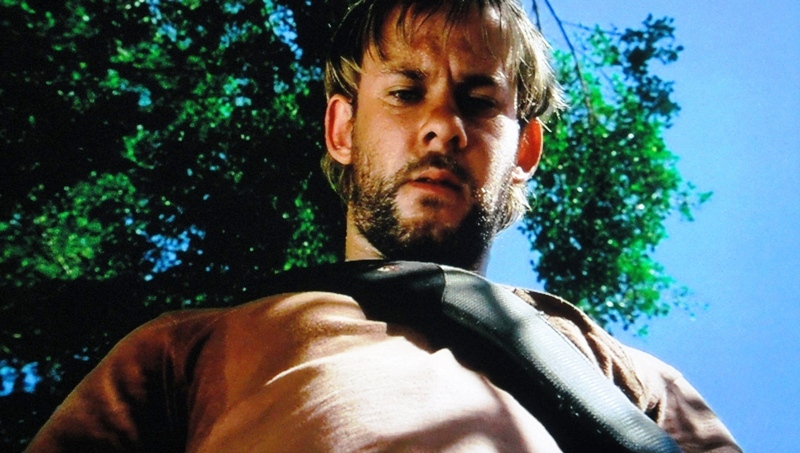
Monday, April 16, 2018

LOST S1 E24: Exodus (Part 2)

"If anyone hears anything or sees anything..." -Jack-
 
"...like a security system that eats people."
-Hurley-
 
"Do you think we're being punished... things we did before... the secrets we kept... the lies we told."
-Sun-


The well paced and slow burn of mystery that has been sprinkled throughout Season One has finally led us to the three part (according to my Blu-Ray collection) season finale, Exodus.

LOST's creators have cleverly paced their mystery yarn over the course of a full season by delving into a number of unique back stories for its ensemble cast in anthology style. The result has been a season of wonderfully fascinating stand alone stories simply about damaged people like any one of us while offering small bits of island mythology. And we are right there with them, all just a little bit lost in this life.


It's all finally coming to a nice little head here at season's close as we look at LOST, Season One, Episode 24, Exodus (Part 2).

The search for dynamite at Black Rock (Portsmouth) continues.

This may be the episode that goes down as LOST's version of the red shirt as Dr. Leslie Arzt with a sweaty beige shirt is all blown to smithereens. He wasn't made annoying to a fault for no reason and compounded with that name Leslie. Why exactly did he tag along with Jack, Kate, Hurley and Locke? Yes, he had to go. He was the Jar Jar Binks of LOST, but clearly George Lucas just couldn't hear the deafening volume of his own annoying character that screamed for a much required death scene. And of course Rousseau exits upon arrival there. Clearly, the Frenchwoman isn't stupid.


Highlights: Locke and Jack tensely removing dynamite to the analogy of the game Operation. The handling of the dynamite is fairly well-rendered and as intense as scenes go as our would be heroes move away from Black Rock and into the Dark Territory as its referred.

The raft scenes and character interaction between Jin, Michael and Sawyer are always good. Just escaping into that big blue ocean alongside these people is an experience alone.

Sayid and Charlie seek to find Claire's baby Aaron now missing and in the hands of Frenchwoman Danielle Rousseau as her potential bargaining chip to regain her own daughter Alex from The Others.


There were many theories that the series hinged on baby Aaron and that The Others were strictly after Aaron. Just as Danielle had lost her baby to them years ago and where most others perished from that expedition. If this would hold true the future would not bode well for the remaining survivors of Oceanic Flight 815.

Overall, penultimate Season One entry Exodus (Part 2) (of three parts) is a bit like the middle child. It's hard to stand out, yet is a required part of this trilogy of episodes moving the story forward to its rousing conclusion.


Flashbacks: Sun, Jin, Sayid, Charlie, Michael, Walt.

Writer: Damon Lindelof/ Carlton Cuse.
Director: Jack Bender.

Thursday, April 12, 2018

The Twilight Zone S2 E22: Long Distance Call

"You're travelling through another dimension, a dimension not only of sight and sound but of mind.
A journey into a wondrous land whose boundaries are that of imagination.
That's the signpost up ahead.
You're next stop, The Twilight Zone."

Reading Marc Cushman's book trilogy on Lost In Space (Irwin Allen's Lost In Space: Volume One: The Authorized Biography Of A Classic Sci-Fi Series) has inspired me to revisit the many tentacles of Irwin Allen's imagination be it Voyage To The Bottom Of The Sea (1961) here, Lost In Space (1965-1968) or the many shows his very actors and stars populated inside and outside of his own fantasy worlds.


The Twilight Zone is one of those series that enjoyed a great many guest stars. It was The Love Boat (1977-1986) or Fantasy Island (1977-1984) of the late 1950s and 1960s. Each year The Twilight Zone runs endlessly on the SyFy channel on New Year's Day and you'd think I'd have seen all of them by now. Some it seems I've seen several times while others have proved surprisingly allusive. That's bound to occur for a series that ran five seasons complete with 156 episodes.


So I've cherry-picked some of these brief episodic tales for personal reasons just to see some of the faces I grew up with and adored. Raised and reared on their work I wanted to see their performances elsewhere.

My warm up was The Twilight Zone, Season One, Episode 25, People Are Alike All Over (1960). It featured the late great Roddy McDowall (1928-1998) whose list of credits is vast and impressive. McDowall starred, of course, in Planet Of The Apes (1968) as Cornelius and went on to continue in that fantastic series of films. The Mars-based tale People Are Alike All Over offers a very Bradburian like cautionary tale on humanity with a nice twist that predates The Keeper (1966) concept from Lost In Space by six years.


Season One, Episode 28, A Nice Place To Visit (1960) featured Sebastian Cabot. As a fan of Cabot in his role as Giles French (Mr. French) on family drama Family Affair (1966-1971) it was another must see. This little heaven and hell tale sees Cabot shine. But like any of these little tales there's never long to really showcase the acting chops of any one actor. They are there seemingly more to serve the story and yet it's a nice bit of star power for the fans to enjoy particularly looking back today.

Season Two, Episode 7, Nick Of Time, features William Shatner (Star Trek) in one of two of the more popular or better known episodes of The Twilight Zone. So it's with my intention to look at some of the episodes that slipped through the cracks for me that piqued my personal curiosity.


On the cusp of the eve of the Netflix release of the Lost In Space reboot (yes, I'll be binging that one with much anticipated pleasure this weekend), this writer couldn't help but look back to the classics of television. Am I naïve enough to think the Netflix Lost In Space will be the same? I can't imagine it will come close to the charms of the 1960s original, and I have no expectation it will, but I'm still interested to see what they do with this retelling of the concept. The general framework is there from the original from the family to the vehicle to Smith, but it's a brave new world isn't it?


Actor Bill Mumy, as Will Robinson, was a big part of the success of Lost In Space along with the rest of that amazing cast. I hope they cast the series well and do it justice even if contemporary justice when compared to the many series that continue to retain classic status today like the original Lost In Space and The Twilight Zone. These series were by no means perfection, but warts and all there aren't many fans who believe they can successfully be recreated. Though the appeal of the anthology series (Black Mirror, Electric Dreams) is returning with a vengeance too.


The biggest highlight thus far for me was The Twilight Zone, Season Two, Episode 22, Long Distance Call (1961) featuring one Billy Mumy in one of three appearances on the series alongside It's A Good Life (1961) and In Praise Of Pip (1963).

(SPOILER) In the story, Billy (his character name in the story too "It's me Billy"), has a close relationship with his grandmother. When she passes he can still speak with her through a toy phone. In the end, through an accident, Billy almost dies, but his father pleads with his mother to give Billy back to them and he survives in a rather uplifting ending when it comes to The Twilight Zone.


Channeling Rod Serling imagine if you will for a moment a different ending here. I did. How about Billy dies and the father, or perhaps the mother who was angry at Billy's imaginary connection to his grandmother, picks up the phone only to discover it works. Not only does the mother hear her in-law's voice on the other end but the voice of her son now taken away at the young age of five. I might have enjoyed that more perverse ending in some ways more in keeping with eerie expectations of The Twilight Zone. As Long Distance Call stands though it's a rather affecting emotional plea.


The Twilight Zone episodes always present a short story with a thoughtful bit of social reflection that continue to stand the test of time. They may not enjoy the compelling pace of today's television but they are incredibly smart for their vintage.

Long Distance Call is by no means among the series best, but seeing a sweet little Billy Mumy making contact with the twilight zone is always a highlight.

Director: James Sheldon. Writer: Charles Beaumont/William Idelson.

Wednesday, April 11, 2018

Voyage To The Bottom Of The Sea

"Seaview's job is never finished.
As long as there are destructive forces in the world.
As long as there are secrets of nature to be probed, believe me, there'll be work for us." -Admiral Nelson-

The amazing, titillating, action-packed and colorful mind of Irwin Allen was brought to life in a host of great entertainment throughout the 1960s and 1970s in both film and television.


Voyage To The Bottom Of The Sea (1961) was next in a long run of grand, epic, big, bold production efforts by writer/producer/director Irwin Allen.


Allen's name was synonymous with the epic film including such pictures as The Lost World (1960) and Five Weeks In A Balloon (1962). His name is even more notably tied to the disaster picture thus the name that often accompanied the man---master of disaster. The Poseidon Adventure (1972), The Towering Inferno (1974) and The Swarm (1978) are all memorable classics chock-filled with grand ideas. And, another thing Allen was known for, big name stars. Even more impressive and memorable to science fiction aficionados was the fantasy worlds of Allen's television arm of work including Voyage To The Bottom Of The Sea (1964-1968), Lost In Space (1965-1968), The Time Tunnel (1966-1967) and Land Of The Giants (1968-1970). All are special and impressive in their own right.


Part of the inspiration for revisiting the fantasy worlds of Irwin Allen has been the pleasure of reading author Marc Cushman's trilogy of authorized books accounting Irwin Allen's path to Lost In Space, which includes some significant coverage on Voyage To The Bottom Of The Sea among other films. The book's are highly informative and offer a Seaview-like window into the world of Allen's science fiction I haven't quite had the pleasure of submerging upon (one too may underwater euphemisms, but Allen might be proud).


Voyage To The Bottom Of The Sea, the film, introduced us to the science fiction submarine known as Seaview. Complete with its glass-nosed, observational face and a nuclear arsenal it remains one of the great maritime and nautical vessels. It would be a key character to the film and series that was critical to success in Allen's mind, a man who relished the technical and production work of his creations more than his dialogue.

The film was made for roughly two million dollars and the implementation of those sets and props made it possible to receive a green light on the Voyage To The Bottom Of The Sea (1964-1968) TV series that followed three years later, Allen's first major foray into a proper TV adventure series.


The film and the series draws obvious inspiration from the world of Jules Verne of which Allen was clearly inspired.

The film is largely deficient when it comes to story and driving a sound narrative, but the sheer color and inspiration on screen more than compensate at times for its shortcomings.

Performances are universally good even when the script by Allen and Charles Bennett is less than buoyant in quality.


And when all else fails Allen always populated his productions with stars. Barbara Eden (I Dream Of Jeannie) is a joy to watch here along with a cast that includes Walter Pidgeon, Michael Ansara (a true genre stud who appeared in all kinds of science fiction), Peter Lorre, Joan Fontaine, Frankie Avalon and Robert Sterling. Of the entire cast only Eden and Avalon remain as of this writing.

The cinematography, effects work and costume and set designs are all meticulous and the picture quality here is generally glorious on Blu-Ray.


Pacing too was mostly far superior to pictures of the period such as Byron Haskin's Robinson Crusoe On Mars (1964), a film concept that wasn't too far off in idea from Allen's own space family Robinson castaways in Lost In Space. There was indeed a great deal of jockeying at the time for the rights to make a space family Robinson story happen and the always persistent, driven and creative Allen was the victor.


The use of a fake squid and a real octopus in Voyage To The Bottom Of The Sea may be jarring to some, particularly young eyes, but there is something rather sensational about effects work that doesn't rely on a computer. Science fiction from the 1960s and 1970s was exceptionally detailed and creative and still looks staggeringly epic. This fan of the period is as down with the creative work of the day as an undersea periscope


Voyage To The Bottom Of The Sea offers a bizarre science fiction tale regarding the Earth surrounded by a fiery and radioactive Van Allen Belt. Now Allen had an ego, but could this be another less than self-effacing nod to his own legacy in film?

It may be imperfect science fiction, but alas Allen was all about escapist entertainment and Voyage To The Bottom Of The Sea makes for a fairly immersive affair given its vintage. The film is by no means essential viewing to the series, but worth your time if you're a fan of Irwin Allen's production work and attention to detail. It shouldn't disappoint as colorful, quality science fiction B movies go.


Director: Irwin Allen. Writer: Irwin Allen/ Charles Bennett.


Friday, January 5, 2018

2016 And 2017: Bye Bye Bye Bi-Retrospective

The passion for this blog comes and goes unfortunately. Such are the rhythms in this life for me.

When 2016 ended I had little energy for this thing. I was like Superman with a necklace chock full of kryptonite. I write when I feel it of course. At least I try. I can't say it's getting easier to write. Far too many external concerns have taken me away from this place. The ebb and flow of those issues will have an impact going forward but we will always do our best.


Nevertheless, we'll look back and try to look ahead.

The highlights for me in 2016 were likely writing about anime's Blue Submarine No.6 (1998-2000), Stargate Universe (2009-2011) and SG-1 (1997-2007), the Ascension (2014) mini-series, The Expanse (2015-present), Space:1999 (1975-1977) and anime's Knights Of Sidonia (2014-2015).

We took a peek at Continuum (2012-2015) starring the ever so hot Rachel Nichols (are we still allowed to say that in 2018?). We even wrapped up a look at the original Battlestar Galactica's Saga Of A Star World (1978).


Winter hibernation may have had a roll in enjoying a long siesta well into 2017. For whatever odd reason, that spectacular first season of pop culture sensation LOST (2004-2010) pulled me from my slumber. I know. Crazy, but appropriately so was the show.


We saw a sprinkling of Battle Of The Planets (1978) in both 2016 and 2017. We also carried over Stargate SG-1 and Stargate Universe into 2017 along with Knights Of Sidonia, The Expanse and Terminator: The Sarah Connor Chronicles (2008-2009).


Apparently we took 2016 off regarding a look at Kenneth Johnson's The Incredible Hulk (1977-1982) but bounced back to that transformational series again in 2017.

We also jumped back in time for a taste of Land Of The Lost (1974-1976), but then leaped way ahead to the Ronald D. Moore re-imagining of Battlestar Galactica (2003-2009) as well as doomed spin-off Blood And Chrome (2012).


I began a series of posts dedicated to spaceships. That makes sense here at Musings Of A Sci-Fi Fanatic so why not. One of those focused upon was the Daiku Maryu from anime Gaiking (aka Dino Mech Gaiking) (1976-1977) of which I'm currently painting an iteration of here at home when I have a free moment or two and those are scarce I can tell you.

As a general overview regarding these last two years, I found the Netflix film What Happened To Monday? (2017), starring Noomi Rapace by Norwegian director Tommy Wirkola, to be one of my favorite science fiction films. It was one of the most satisfying stories in two years worth of subpar science fiction.


So what lies ahead for Musings Of A Sci-Fi Fanatic? Honestly this writer has no freaking idea.

Of late I've been travelling back in time, of a sort, and enjoying some Criterion edition Blu-Ray films over the last year and exploring some of the classics. As many here know, despite my love of quality science fiction, I'm not a huge fan of mainstream action films or effects heavy superhero films. They just don't interest me including Star Wars. Though, truth be told, I broke down to attend with my son, both of us skeptical mind you, and we found Star Wars: The Last Jedi, to be a marked improvement over The Force Awakens and enjoyed it considerably. He found it to be easily the best of the last three pictures including Rogue One.


But I've been having a love affair with these Criterion releases. To prove that point out some of the films I've enjoyed of late include: Ingmar Bergman's The Seventh Seal (1957), Sam Peckinpah's Straw Dogs (1971), Andrew Haigh's 45 Years (2015), Guillermo del Toro's The Devil's Backbone (2001), David Fincher's The Game, Ang Lee's The Ice Storm (1997), Wim Wenders' Paris, Texas (1984), Peter Weir's Picnic At Hanging Rock (1975), Roman Polanski's Tess (1979), Terry Gilliam's Time Bandits (1981), Martin Rosen's Watership Down (1978) and Erik Skjoldbjaerg's Insomnia (1997).


The Criterion film thus far that I'd rank as my absolute favorite would be Jan Troell's The Emigrants (1971) and The New Land (1972). These are striking and beautiful films. It's a journey worth your time. The two films clock in at a whopping, epic 393 minutes. It's easy to see the influence of these two films on a beloved series like Little House On The Prairie (1974). There are literally scenes within these two films that struck me as mirrors to scenes regarding the plight of the Ingalls family despite the adaptation of that series based on the books (1935) of Laura Ingalls Wilder. The Emigrants and The New Land are astonishing films with long establishing shots, intimate close-ups, often little dialogue but powerful in terms of emotional resonance. The Emigrants, a foreign film, was nominated for best film in 1972 but was ultimately taken out by The Godfather.


The Criterion films that I found less than mesmerizing, even a bit labored or slow in some fashion for my taste, would be Hal Ashby's Being There (1979), Lars Von Trier's Breaking The Waves (1996), Karel Reisz's The French Lieutenant's Woman (1981), Steve McQueen's Hunger (2008), Byron Haskin's Robinson Crusoe On Mars (1964) and Jean-Pierre Dardenne and Luc Dardenne's Two Days, One Night (2014). Many more to go folks.

As for revisiting science fiction here at the site whether it be those vintage era, nostalgic glory days or something more contemporary of high quality this writer hopes to spend some time offering something of quality to you here on your visits.


What I will do and what I'd like to do are clearly two very different, competing objectives.

There will definitely be more of The Expanse. I adore that series and the books from which it is sourced. The latter have delivered exciting, expansive reading. I'm itching for more Battle Of The Planets, Stargate Universe, and Space:1999 to be covered here.

In anime I would love to finish Knights Of Sidonia, Attack On Titan (2013-present) and explore Mazinger Z: The Impact and Space Battleship Yamato 2199 (aka Star Blazers 2199). I also intend to watch the two live action Attack On Titan (2015) films as well as the Japanese release of that new Shin Godzilla film (2017). I am eagerly anticipating the Mazinger Z: Infinity film in 2018.


Currently I've been watching Robotech (or Macross) (1985), a series best enjoyed through a young person's rose-colored glasses, but still ever so influential with significant attention paid to character for an animated series of this vintage.

On the strictly science fiction front as entertainment, this writer, or more fittingly, this viewer is eager to see The Expanse Season Four and Colony Season Three to air in 2018 on television as well as new Netflix series Altered Carbon. In theatres in 2018 the most anticipated science fiction films for me would be Alex Garland's Annihilation, Mortal Engines with minor interests in Pacific Rim: Uprising, The Predator and Alita: Battle Angel.


So we'll certainly see how things go people. But wherever you are out there, all the best to you and much health in 2018.