 Could a title like Battle In Outer Space [1959] possibly disappoint a genre fan looking for, well, battles in outer space? Perish the thought. We're about to find out if a film with a title straight from the book of K.I.S.S. could possibly fail the dreams of fan boys everywhere. We continue our look at the films of Ishiro Honda, Eiji Tsuburaya and the team at Toho.
 If it appeared a trademark of Ishiro Honda to incorporate scientific cooperation into his science fiction [The Mysterians, Battle In Outer Space, Gorath] and fantasy pictures it's because it was indeed part of his personal world view. This was indeed a thematic component infused within Honda's work. Galbraith IV notes an interview with Honda whereby Honda admits, he "explored the theme of international conflict and cooperation through science for the common good." This belief was born of the second World War and Honda's own trials through that period and his witness to its devastation. Honda embraced science and mourned the lack of trust between nations. "That's why even in my films after Gojira, I've made it an established practice to have the scientists of the world get together for the sake of cooperation."
  The Mysterians introduced two important components in Honda's work. First, cooperation between nations and the cautious application of science and technology for preservation of the planet. He applied this principle to his natural love for science and science fiction.
 Whereby Gojira [1954] paid tribute or homage to the likes of American-based film King Kong [1933] or The Beast From 20,000 Fathoms [1953], and Rodan [1956] to Them! [1954], The Mysterians [1957]was Toho's answer to Earth Vs. The Flying Saucers [1956]. Battle In Outer Space continued to build upon the Honda space opera epic two years later.

 Honda's second go round at pure sci-fi proves how expertly crafted and beautifully filmed Honda's science fiction could be. Splendid effects and model work, gorgeous mattes, a multi-national sense of epic Tohoscope. Yes, Honda was indeed shooting big and outside of the United States, Japan was the only country making film on such a large scale.
  Along with the masterful quartet of producer Tomoyuki Tanaka, director Ishiro Honda, composer Akira Ifukube and special effects master Eiji Tsuburaya, a fine cast was assembled, but apart from Koreya Senda [Varan The Unbelievable], most are not the Honda mainstays we've come to expect. New genre face Ryo Ikebe would return for Honda's third picture in the trilogy, Gorath [1962] as well as The War In Space [1977] for understudy director Jun Fukuda. He also starred opposite Akihiko Hirata and Akira Kubo in Submarine I-57 Will Not Surrender [1959] the same year, a film I would love to see released in America on Blu-Ray, but DVD would suffice. The film also introduces beauty Kyoko Anzai to the genre, another real stunner in a long line of Toho dolls. Unfortunately, these hired guns are but mere bodies minus any real substance within the adventure tale.
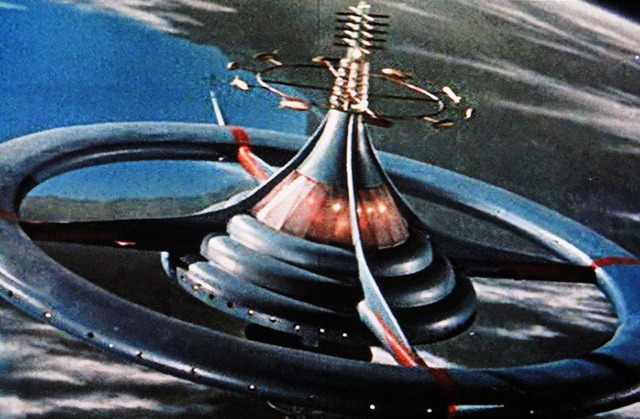
  In space [remember, a battle takes place there], a spinning top-like satellite spins in orbit around the Earth. Manned with offensive capability it defends itself against incoming UFOs. Despite its efforts the station is no match for alien weaponry and is disintegrated.
 Somewhere in Japan a passing UFO has a magnetic effect on a metal bridge lifting it into the air. Special effects master Eiji Tsuburaya's work is seamless and flawless in execution. As a result of the levitating bridge the train crashes into the valley below and the bridge is delicately placed back on the cliff ledge. The disaster is dubbed a mystery along with the explosion of space station JSS3. Other unexplained phenomenon are happening across the globe.
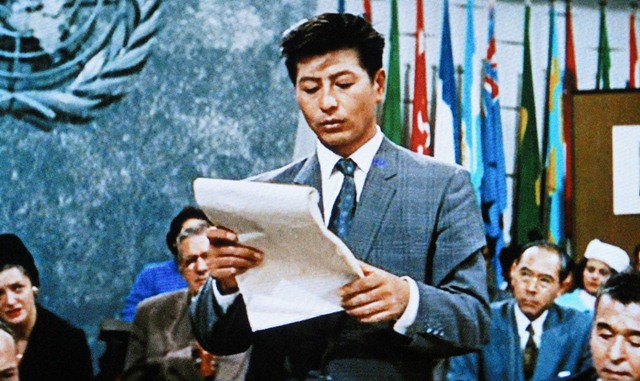
 A global summit is called and it is postulated that a freeze-ray is responsible for the loss of gravity on several international incidents. The summit considers the intentions of the extra-terrestrials. The global initiative hopes that these beings are "peace-loving" too. I found that remark rather interesting. Without question Honda was a nationalist, but a man of peace, but also a man exposed to the atrocities of war between nations. Thematically Honda's films are largely the result of these massive, life-altering weapons of mass destruction. The resulting atom bomb in many ways made Honda the director he was and would continue to be. Just look at the central message of predecessor The Mysterians. Still, it does not change his message or his desire for peace through scientific gathering and cooperation. This is Honda. Of course, let's not be naive, if defense is necessary weapons will be employed against these alien invaders ad nauseum. Battle In Outer Space once again takes up the message of peace and science and the co-existence of these variables.
  Weapons testing commences on special metal S250 utilizing a human-sized variation on the maser tanks implemented in The Mysterians.
Through an effort toward international cooperation, Japan unveils its very own SPIP, a spaceship, two actually, the result of a major global initiative and credited as such.
A foreign head of state or ambassador named Dr. Achmed begins wreaking havoc in the spaceship hangar bay under the influence of aliens attempting to steal the heat ray cannon or atomic heat cannon as its called. Wearing a turban Achmed, an Iranian representative, declares Earth will become a colony of Natarl before being usurped by a red ray from the overhead saucer.
 Somehow, and I'm not exactly sure how, Earth has determined that the aliens of Natarl have built a base on the moon and are preparing to launch a strike. As a countermeasure, Earth prepares to launch the SPIP on a fact-finding mission. Where is Kumi Mizuno when you need her?
 A "brave" crew of eight will launch on SPIP Ship 1 led by Dr. Adachi. Ship 2 will also have eight led by Dr. Richardson. We may not have Kumi, but Kyoko Anzai will have to do nicely along with Ryo Ikebe. The launch site is typically impressive with SPIP Ship 1 and SPIP Ship 2 in the background.
 The attractive leads spend some time laying in the grass and gazing at the moon under a moonlit night. It's a beautiful little scene and one you rarely see in cinema today. It's nice to see in a science fiction tale with scale and scope, but the character parts are poorly written. The sweet, romantic moment is interrupted by a fellow astronaut toying with their peace. The scene is broken by actor Yoshio Tsuchiya [Matango].
 While driving Iwomura, played by Tsuchiya, is visited by a deep-voiced alien who takes command and control of his vehicle. The alien informs Iwomura that their "life energy" has been implanted into his brain and he will now be controlled by their signal. For all intents and purposes, like Dr. Achmed, Iwomura will be a living robot.
 The outlandish ideas are bold and exciting and probably play into the stereotypical perception of crazy Japanese cinema, but when Toho made fantasy and science fiction films of this nature they were always big and unabashed in their epic nature. Here is that implied transformation and it actually works beautifully. There is nothing gratuitous. A simple trickle of blood is all that's needed to tell the creepy little tale.
 In truth, of all the characters in the film, Tsuchiya is the highlight as far as the cast goes and that's not saying much, because even his meaty little role is limited. The material is simply not there for the actors to really spring into life on screen. In fact, Gerry Anderson's Tracy family on Thunderbirds [1965-1966] have more personality. The Iwomura character is perhaps the exception.
 Later, the SPIPs prepare for launch in a grand sequence as only Honda and Tsuburaya could commit to film. It's worth noting that while the SPIPs are extremely simple, streamlined and elegant in their design complete with their shining metallic bodies and red tips, they are beautifully exquisite for it.
 The SPIPs leave the Earth's atmosphere and enter outer space. En route to the Moon they even come across space station debris and a floating human body, which moves the crew pause for a sweet moment of prayer, a rare thing to see in film. A short time later the aliens launch glowing rock meteors or alien space torpedoes at the ships. The SPIPs use the atomic heat cannon to destroy all objects. The lightning like ray signature is kind of like the precursor to King Ghidrah's own special talent.
  On board Ship 1, a deep-voiced alien reaches out to Iwomura. Guess what section he handles? Yes, the atomic heat cannon unit. The aliens order him to cut power to the weapon. Unfortunately for our heroes, the heat ray is their only offensive capability.
 A crewman checks on Iwomura and a skirmish breaks out as Iwomura closes valves to the heat ray cannon. Ship 1 suffers a near hit by the glowing meteorites, but thanks to side burners turns things in their favor as the SPIP narrowly averts the glowing rock. The aliens continue to warn the "Earthlings" to stay away from the Moon or die. These are nice stark options.

 As the SPIPS move to landing position, rotation and full thrusters are activated. The scene plays like a live action version of Atari's Lunar Lander. Pure good fun.
 Automatic defense systems are activated. Fitted with nifty space suits and ray guns, the teams exit their respective rockets with hopes to find answers. These have to go down in the long pantheon of great space suits next to Star Trek, Space:1999, Sunshine, etc..

 To research, the ships have been fitted with some well-designed shuttlecraft suitable for Moon travel. It's the kind of Moon unit that would make Lost In Space, Space:1999 or Thunderbirds proud. Etsuko Shiraishi, played by Anzai, worries about Iwomura, but Adachi wisely understands the mutinous Iwomura is a liability affected by alien influence.
 While searching for the alien signal in their land craft, Iwomura is awakened by the aliens to destroy the SPIP. The land craft or Moon All Terrain Vehicles and overall production design and matte work on the Moon is quite special.
 The Moon vehicles can fly employing an air cushion system placing them comfortably in International Rescue territory. Somehow these aliens are smart enough to implement mind control remotely but never detect the two moon buggies and the silver-suited travellers of Earth hiding about the Moonscape surface. Go figure.
 Meanwhile, Iwomura breaks free of his constraints now tasked with destroying the SPIP.
Sadly, in typical Honda fashion, the music sounds terrific by Ifukube, but for long stretches not much happens as our travelling team walks about the moon surface. I kept playing Walking On The Moon by The Police in my head for one segment from Regatta de Blanc [1979].
 Sound effects are also recycled from Rodan as the sounds of the Meganurons [dragonfly larvae] are used here to alert you to the Natarl. Elsewhere, the deep-throated Natarlian implores Iwomura to "hurry." These are not the orders of an alien race striking fear in hearts and minds, but these were much more innocent days in entertainment.
  The group finds the entrance to the underground base of operations on the moon in much the same way scientists found the underground lair of The Mysterians. Upon discovery, the men task Etsuko with collecting the atomic heat cannon. It seems a daunting task for just one pretty female after the terrain that was just traversed, but, well, good luck. In all sincerity, it's merely a reason to put the pretty Japanese babes in jeopardy to be saved by handsome leads. Who better to rescue other than Kyoko Anzai? Okay, Kumi Mizuno is a nice choice, but she's not in this picture.
 So these strange little, masked aliens, also in nifty space suits, converge on Etsuko with their Meganuron sound effects and alien claws. Be sure take a look at those paws. Etsuko is captured.
 Back at the rockets, Iwomura succeeds in blowing up Ship 1 of the SPIPs. He makes his way to Ship 2. Now we know why there were two rockets. Hopefully, they will stop Iwomura before it's too late.
 Major Chiro Katsumiya, played by Ikebe, comes to Etsuko's rescue complete with ray gun. The creatures bounce around with their strange little helmets which, once again, are simple but effectively designed. Somehow, Ikebe breaks Etsuko free of ten aliens single-handedly and mows them all down with a single shot of his gun. The Matango these critters are not! What a missed opportunity. Battle In Outer Space had a chance to be truly frightening, but the villains here feel like nothing more than little people from The Wizard Of Oz in weirdly designed space suits with no real plan for their attack. There's nothing vicious about these little guys. Could the Earth really be in that much peril? Perhaps they are just really good with technology, but mano a mano they offer nothing spectacular in their ability to fight.
  The aliens give the Earthlings ten seconds to surrender. Essentially the battle in outer space consists of a Natarlian base and a band of Earthlings. But I almost keeled over in laughter when the alien gave its ultimatum and literally began counting. You'd never see that from Balock in Star Trek: The Original Series, The Corbomite Maneuver. Here it for yourself and laugh away.
 So bring on the atomic heat cannon. Why don't the aliens just directly zap the cannon and the Earthlings? Are they that bad a shot? Before long the Moon vessels begin attacking as well. Aliens begin to fly out of the alien base like bees from a molested hive. The Earthlings manage to damage the base. As a result the signal controlling Iwomura is destroyed. I really need to get one of these. How about something in diecast?
 In the final showdown between the Moon buggies and the flying saucers there's of course all the requisite shooting and laser fighting, but very little hits its target from either side. Let me retract my thought regarding their abilities with technology. They are indeed very bad shots.
 Upon returning to the SPIP to their horror the crew discovers one of the SPIPs has been destroyed and suspect Iwomura of sabotaging the automated defense system.
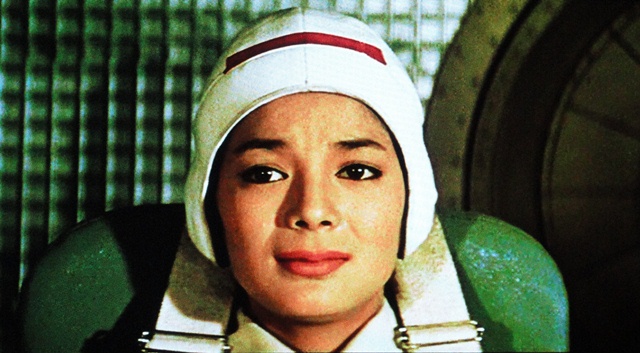 Not Kumi Mizuno, but Toho babe with potential! Iwomura, now free of mind control, sits on a rocky ledge firing his weapon and gives the others cover while they escape. He informs his comrades that he had destroyed the SPIP. So he fires away like he's hitting clay pigeons. He bids them farewell as he sacrifices his life to save them. In the end, sadly, despite the opportunity to be saved, Iwomura is vaporized and the others return home.
 Back on Earth Honda's message is We must come together to fight our greatest enemy and protect Earth. As the united nations converge at their conference the politicians prove they can say the most profoundly stupid things. These absolutely hysterical closing remarks prove with leaders like these how can we lose? Of course these are the politicians and NOT the rocket scientists.
 So fighter rockets are built for combat. Atomic cannons are readied. Now a small point about the modelling drama. There is nothing more dramatic than Japanese weaponry emerging from the ground. When the cement covers slide away to reveal heat ray cannons [essentially markalite cannons] and maser guns and the like, it's a sight of pure, unadulterated geek anticipation. It's simply wonderful and to think Honda was doing this in the 1950s is truly something, because one day anime would take such ideas and run with it to new heights. Think of the emerging city of Tokyo-3 and other covert operations that are submerged in the Geofront of the wonderful series that is Neon Genesis Evangelion and you get the idea. Well, Battle In Outer Space offers a small sampling of terrific live action cinema ideas. Of course, with today's technology it could be truly awesome.
 Manned rockets are launched into space. Fighter squadrons and saucers joust with laser fire in a pre-Star Wars spectacle. The saucers have one tactical advantage in that their lasers can shift all around while the rocket cannon fire must be straight. The battle rages on and on and on and on. This is where Honda and Tsuburaya took The Mysterians into an endless Tsuburaya effects spectacle that goes on too long. That and some poor editing ensues, but only in spots. More character and less effects spectacle would have benefitted Battle In Outer Space.
 Eventually that endless battle crashes down to Earth and wreaks significant havoc in cities like New York. It's the perfect excuse for explosions, destruction and general chaos compliments of the Toho team.
 The mothership lands in Tokyo via approximately 6-8 puppet strings. It causes much annihilation sucking up all manner of cars , buildings and people. It's a particularly impressive sequence. Unfortunately it cannot distract from the lack of compelling human drama but its exciting enough. The atomic heat cannons go into full operation destroying the mothership.

 Victory ends in final images of Americans and Japanese celebrating. This is a particularly poignant moment as Honda was indeed channeling his true believer in the spirit of global cooperation. He yearned to see nations working together rather than battling one another. Those final images cement that belief and honor the memory of Honda and all that he made efforts to build upon within the kaiju eiga genre or in his science fiction pictures like Battle In Outer Space. The picture would have benefitted immensely from a much more character-based approach especially had Honda generated stronger material for the international face of his picture. While there are aspects to appreciate about Battle In Outer Space the film really should have been so much more. But, Honda was no doubt learning lessons as he progressed forward because character elements would take a stronger hold in future pictures. Many of the suggested elements that are in play here that I wanted to see explored in greater detail feel like they were in Honda's much better Invasion Of Astro-Monster [1965]. While that film falls squarely within the kaiju eiga genre, the 1965 film is the perfect fusion of giant monster and science fiction. The character components are much stronger. Ikebe and Anzai don't have nearly the chemistry or material to work with that Nick Adams and Kumi Mizuno had alongside Akira Takarada, a trio that taps into the triumvirate concept first established in Gojira. So Battle In Outer Space looks terrific, but rings hollow on character like a cavernous valley on the Moon.

 Victory ends in final images of Americans and Japanese celebrating. This is a particularly poignant moment as Honda was indeed channeling his true believer in the spirit of global cooperation. He yearned to see nations working together rather than battling one another. Those final images cement that belief and honor the memory of Honda and all that he made efforts to build upon within the kaiju eiga genre or in his science fiction pictures like Battle In Outer Space. The picture would have benefitted immensely from a much more character-based approach especially had Honda generated stronger material for the international face of his picture. While there are aspects to appreciate about Battle In Outer Space the film really should have been so much more. But, Honda was no doubt learning lessons as he progressed forward because character elements would take a stronger hold in future pictures. Many of the suggested elements that are in play here that I wanted to see explored in greater detail feel like they were in Honda's much better Invasion Of Astro-Monster [1965]. While that film falls squarely within the kaiju eiga genre, the 1965 film is the perfect fusion of giant monster and science fiction. The character components are much stronger. Ikebe and Anzai don't have nearly the chemistry or material to work with that Nick Adams and Kumi Mizuno had alongside Akira Takarada, a trio that taps into the triumvirate concept first established in Gojira. So Battle In Outer Space looks terrific, but rings hollow on character like a cavernous valley on the Moon.
Battle In Outer Space: C+. Writer: Jojiro Okami/ Shinichi Sekizawa. Director: Ishiro Honda.
 Additional Commentary: Stuart Galbraith IV dubbed Battle In Outer Space a "superior invasion epic rivaled only by George Pal's War Of The Worlds [1953], Earth Vs. The Flying Saucers [1955], and Independence Day [1996] in terms of scale" in his book Monsters Are Attacing Tokyo! [p.139]. On those terms Galbraith wouldn't be wrong. It's epic! And I never did much care for Independence Day. But it's missing a face for the film, a true human component. Battle In Outer Space is indeed the Japanese equivalent of Earth Vs. The Flying Saucers. It looks terrific in Tohoscope. Honestly, the production values, mattes, model work, effects and performances are all superb. It's a truly exceptional outing on this level, but it's all fluff on top of a fairly serviceable script with absolutely faceless characters. In fact, identifying with the characters is part of the problem here. There isn't a soul to care about, not really. In fact, the Iwomura character is one of the few to develop throughout the film and in the end he is left behind on the moon to be forgotten, like the film. Battle In The Outer Space is an awesome undertaking for its time, but it's slow and underdeveloped by today's standards. A little character building could have gone a long way. All of the effects and spectacle in the world will never replace the human component, which is why the films starring Kumi Mizuno are remembered with such affection. Kyoko Anzai? Who? The use of faces not particularly well known to fans of these genre pictures stateside seems awfully fitting as one simply cannot connect with the film on a humanistic level.
  Despite its vintage era production, The Mysterians is the better of these first two sci-fi pictures, but Gorath will round out the Honda space opera trilogy and his foray into pure science fiction. Jun Fukuda's The War In Space [1977] was conceived as a kind of Battle In Outer Space 2, but you'll be the judge of whether or not Fukuda was more or less sucessful than this original. While The Mysterians may have been a bit repetitious perhaps efforts by the aliens to abduct Earth women might have improved Battle In Outer Space's chances.
  Galbraith's Japanese Science Fiction, Fantasy And Horror Films notes producer Tomoyuki Tanaka made every effort to squeeze in a monster to the Toho fantasy pictures. Even Honda's science fiction fare was not immune as the appearance of Mogera [derived from the Japanese term for mole] would attest in The Mysterians. The monsters were there to "help sell the movie, even when the plot didn't call for one" [p.28]. Perhaps one of the greatest surprises about this sophomore science fiction effort is that Honda filmed it without once turning to a monster for the picture. And while taking this more realistic approach it fails to succeed entirely due to its inherent disregard for character.
  While one of the weaknesses of The Mysterians would be the juxtaposition of "colorful," but "ridiculous" and "out of place" alien costumes amidst a "straight-faced adventure," according to Galbraith, Battle In Outer Space tones it down a touch. Still, the design work is effective, simple yet believable. Even the aliens are sound in design not like the Power Rangers type stylings of those invaders from space found in The Mysterians.
 By comparison, Galbraith truly enjoyed Battle In Outer Space even moreso than The Mysterians. It's a tough call and I certainly enjoyed the production values on both. He called Battle In Outer Space "one of the best space operas ever produced." He even felt this second film in the science fiction trilogy "improves upon the story ideas introduced in The Mysterians" and noting, what I consider to be the film's strengths, a film "replete with beautiful color Tohoscope photography and Perspecta stereophonic sound."
 Galbraith sees the film as a "flashy spectacle" noting it was breaking relatively epic ground as space yarns go. He believes the film should be forgiven for its "almost total lack of story and characterizations." Yes, it's an impressive effort and Tsuburaya makes it a far more palatable affair than Varan The Unbelievable, but its hard to forgive entirely for the lack of attention and detail to character. The human story is what allows a film to endure and hold up to repeat viewings and its mostly absent here. It's a splendid film to see for its effects work as I've mentioned. Miniatures, models and those "manta-ray" alien ship designs with their "glowing underbellies" makes a feast for the eyes.
 Galbraith knocks lead actor Ryo Ikebe as "bland," but again it falls back on a languid character script with not much for the actors to sink their teeth.
 Galbraith concluded, "Battle In Outer Space succeeds in an area where nearly all U.S.-made science fiction films by this time fail-showmanship and an ability to produce something visually exciting." It's funny, I couldn't agree more with Galbraith's final remarks on the film, but we go our separate ways in terms of the film's degree of success as entertainment. Galbraith believes it "remains one of Japan's best science fiction films." Not having a thorough grasp on Japanese science fiction and if you don't count kaiju eiga, that statement may actually be entirely true, but it doesn't change the fact something better is certainly waiting to be made. I look forward to seeing Space Battleship Yamato [2011] for example. Again, the human drama is the compelling variable here for me. It's the characters you care about that always anchor the proceedings of a story no matter how big or small. It would be interesting to see what you think about Honda's Battle In Outer Space. Honda certainly doesn't fail to deliver when it comes to the promise of the film's premise and title, put simply, this is a battle in outer space. That might be enough for some.


