 "I don't know the answer to that question? If I knew I would tell you." -The Look Of Love, ABC [from the shining classic The Lexicon of Love]-
What happened to ABC? For the answer to that question, please see above. Honestly, to this day, I'm not entirely sure. Most of all, where is Mark White? There are disbandments and then there are disbandments. I miss Scottish band Danny Wilson, Aztec Camera [Roddy Frame] and even When In Rome, but ABC disassembled in a big way very quickly.
 The Lexicon Of Love [1982] was the culmination of a chemical reaction that owed its power to lead singer/ songwriter Martin Fry [the sole remaining factor behind ABC and certainly the key to its magic], guitarist/ keyboardist Mark White, drummer David Robinson and David Palmer, bassist Mark Lickley and sax man Stephen Singleton with meticulous production by maestro Trevor Horn [The Buggles, Frankie Goes To Hollywood].
 Together the act struck immediate gold with their masterstroke that was The Lexicon Of Love. Gold, of course, came in the form of gold records and gold lame suits.  ABC was at the forefront of the New Romantic movement and the new wave that delivered us a melodic antidote to those raucous punk rock years, owing a debt of gratitude to the likes of Bryan Ferry and Roxy Music. Along with Duran Duran, OMD, Spandau Ballet, Thompson Twins and The Human League, ABC was in the thick of it. But, like many of those acts the media loved them, lifted them up, labelled them and then attempted to bury them. Like many of those acts, ABC proved versatile, adaptive and ultimately resilient out from under the labels to generate a legacy of its very own. These bands, with ABC, have long been considered instrumental in defining an era and a sound. Perhaps Duran Duran being the only band to get the short end of the legacy stick, although that appears to be changing in recent years given their staying power as one of the few still ripping it up as pop alternative pop goes.
 But ABC as it was assembled would last for but a single, shining, bright moment on the world stage never to be the same again beginning with its art rock commercial disaster that was Beauty Stab [1983] a year later.
 Interestingly, ABC managed to avoid the perception issues concerning legitimacy of talent that would dog Frankie Goes To Hollywood out of the gate under Horn's direction in 1984. Frankie's Liverpool was a disaster and ended the band. Beauty Stab shared a similar fate under one of Horn's apprentices, Gary Langan, guidance, but Fry regrouped and moved on undeterred and unmolested by the failure.
 Martin Fry led something of a charmed existence regarding people's perceptions of him musically. Avoiding the pigeonhole, ABC is still often regarded as an artistic triumph, one of the ground breakers of a period. Of course, Fry deserves credit for sticking to it and not faltering. He altered the trajectory of the band's legacy with his third effort.
 ABC's rebirth arrived in the form of a thoroughly experimental pop adventure called How To Be A Zillionaire [1985], an over-the-top studio production that was as vibrant and colorful as the animation and characters he assembled for it yielding the pop gem Be Near Me.
 Back in the fold as a legitimate player, Fry calmed things back down, dropping the gold lame in favor of suits oozing cool, sophisticated pop suave in the form of Alphabet City [1987] secured that legacy. Quite frankly, it was When Smokey Sings that assured Fry's staying power in the history books.
 Fry became something of a duo with Mark White by this point. The original quintet shrunk to a threesome for Beauty Stab with Fry, White and Singleton remaining from The Lexicon of Love. In fact, it was White and Singleton who enlisted Fry's talent for their initial band, Vice Versa, following an interview by Fry for his magazine Modern Drugs pre-The Lexicon Of Love. The ill-advised re-direction of Beauty Stab led to the cartoon gimmick of How To Be A Zillionaire before ending in the resulting duo of Fry and White.
 Fry and White added a visual gimmick with American photographer David Yarritu and British fashion journalist Fiona Russell-Powell [she wrote for The Face] for the cartoon fantasy that was How To Be A Zillionaire.
Fry and White took the reins, donned the suits sans gold, went all debonair and lullaby for Alphabet City. Fry was indeed one silky smooth crooner who proved fearless in covering a range of styles. All of this followed an unfortunate diagnosis of Hodgkin's Lymphoma [a cancer originating in the white blood cells] for which Fry was treated successfully. To this day, Fry continues to surprise, but more on that in a moment.
 Each successive ABC recording stood in marked contrast from the one that preceded it. Fry was, if nothing else, an original. He and White continued to endure and ventured into the house-infused era of the late 80s with the underappreciated Up [1989] and even worked with Paul Rutherford [Frankie Goes To Hollywood] for selections on his solo classic Oh World. But Up is a true joy - a music celebration.
 The lush, cosmopolitan feel and sophistication of Abracadabra [1991] was unfortunately released to diminishing returns with MCA and the duo of White and Fry went their separate ways dissolving ABC as a duo. Fry was left essentially a solo act still operating with his much deserved and well-established ABC moniker.
 This was a natural breaking point that resulted in a significant hiatus for Fry. To this point, Fry had capped off a decade of classic music beginning with The Lexicon Of Love, a unique recording to end all recordings. As always, we deal with essential productions here at Musings Of A Sci-Fi Fanatic and The Lexicon Of Love could arguably and easily make any top ten list from the 1980s. Each and every track is undeniably perfect. It remains a critically important recording and one that influenced a generation. NME ranked it in its Top 15 of the 1980s best. It listed at number three for 1982. Q Magazine listed it within the Top 50 British recordings of all-time. That gives you a swagger and some cachet in the music world.
  The Lexicon Of Love's ten glorious tracks include: Show Me, Poison Arrow, Many Happy Returns, Tears Are Not Enough, Valentine's Day, The Look Of Love, Date Stamp, All Of My Heart, 4 Ever 2 Gether and The Look Of Love Part 4. Like other Horn productions, The Lexicon Of Love is worth noting as a production masterpiece too. With Horn's hand in the studio at the launch of ABC, so commenced an unprecedented run of studio work that cannot be understated. His influence here is profound. Additionally you had alumni from The Art Of Noise, including Anne Dudley, J.J. Jeczalik and Gary Langan, all backing Horn for ABC's debut. This is not insignificant. Still, what the legacy of a decade of great pop music proved was that Martin Fry had the goods. He was the real deal. ABC was not a mere flash in the pan or puppet of the Trevor Horn show. The Lexicon Of Love instead was not merely the magic of Horn, but the convergence of extraordinary talents at just the right moment in time. How does that happen? I don't know the answer to that question indeed Mr. Fry. These intangible facts are one of music's great mysteries.
 Following the magnificent magnum opus that was the production overture of ABC and company, Fry continued his pop reign.
 When the 1990s continued following Abracadabra, Sheffield, England wunderkind Fry had to map out a return at some point. There was just too much warmth and talent in that voice. A much anticipated Viva Love stalled and disappeared from a planned release schedule only to appear on a compilation years later. Eventually things took off again for Fry, six years after Abracadabra, with the soaring grace of Skyscraping [1997], a production that featured the epic beauty of its title track and that old ABC style in Stranger things. It was pure Fry. It was pure sophisticated ABC pop. Two delightful new songs arrived for Look Of Love: The Very Best Of ABC [2001], particularly Peace And Tranquility.
 A stunning eleven years later, more than a decade and a lifetime in dog years, Fry surprised the retro music fan world with Traffic [2008], an imperfect effort, but one with a solid handful of terrific pop songs including Minus Love, Way Back When and Love Is Strong to name just a few. The pop effort reunited Fry with David Palmer in the studio and gave fans a welcomed return to the pipes of Martin Fry. We can only hope it's not the start to another decade long dry spell before ABC rises again, but don't hold your breath.
 Nevertheless, Fry never sat idle for that eleven year gap and his extracurricular activities have indeed been interesting. Much of his time has been spent performing live. Still, if you look hard enough you will find Fry has contributed vocals to a handful of interesting tracks including Burt Bacharach's This Guy's In Love With You from Harry Hill's Funny Times [2010] project. New Man is a cracking electronic number with a sample of Gary Newman's Cars for Sonic Hub. He also contributed a remake of the James Bond theme Thunderball for Shaken And Stirred: The David Arnold James Bond Project [1997]. Fry's contribution to remixer Arthur Baker's project, Merge [1989] on Mythical Girl is another highlight as well as a collaboration with M People's Northern Soul [1991] on Life. These small side projects are certainly a pleasure, but nothing can compare, nothing can compare when Martin sings on a full-on ABC effort.
 When it comes to essential classics, what do you do after delivering one of the true pop classics in The Lexicon Of Love when it's your first. Martin Fry's been looking for that answer and it's been a pleasure to listen to those new discoveries, but you never forget your first. Thanks Mr. Fry.
ABC Discography: The Lexicon Of Love [1982] */ Beauty Stab [1983]/ How To Be A Zillionaire! [1985]/ Alphabet City [1987]/ Up [1989] */ Absolutely [1990] / Fantastic Compositions [Japan; 1991]/ Abracadabra [1991]/ Skyscraping [1997]/ The Lexicon of Live [1999]/ The Look Of Love: The Very Best Of ABC [2001] */ The Ultimate Collection [2004]/ Traffic [2008]. * essential. There were various compilations and too many to count. The list above is the key to the ABC kingdom.
 "I think Force Of Life embodied that notion that here were people in an environment that could be invariably hostile, encountering things about which they had not the faintest idea. It was taken from an emblem of the life they had left behind - that caterpillars turn into chrysalides and chrysalides turn into butterflies. These are natural rhythms of our lives. Well it seemed to me perfectly reasonable to suppose that this process was universal throughout all life, and that it would happen in the most extraordinary and interesting and completely mind boggling way without understanding what made it work." - Scriptwriter Johnny Byrne of Space:1999, Year One, Episode 9, Force Of Life [FAB #60, p.16]-

 It's FAB FRIDAY April flowers! Welcome to the wonderfully wicked world of all things Gerry And Sylvia Anderson.
 When I think back to all of the writers and critics who lambasted Space:1999 in the early going as nothing more than a space series attempting to be a pale imitation or knockoff of Star Trek: The Original Series I really can't get over how just wrong they got it. Space:1999 and Star Trek are apples and oranges. They couldn't be more different.
 I have been wanting to get back to my look at Space:1999 and revisit of the classic series, but that analysis has been much delayed. I'm not exactly sure why. I place Space:1999 on a pretty high pedestal in the pantheon of science fiction series. As such, I want to give it the proper, thorough treatment. A certain amount of time is required for it and I suppose I felt I simply would be applying myself properly to the material.
 Well, Space:1999 Year One arrived on Blu-Ray in December of 2010. It was instantly purchased and remained one of those packages I had been dying to open until now. So, the time has come.
 I had originally wanted to kick off the Blu-Ray set by beginning my coverage on Space:1999, Year One, Episode 9, Force Of Life. Of course, I had already covered the episode extensively along with Alpha Child and left off the series there. Well, if you know anything about assembling one of these blog entries complete with images and video, it can become something of an organizing nightmare. Things just don't always respond as you would expect. The climb in creating one of these can be something of a challenge to get things just right. I thought better of going back and essentially monkeying with those entries, despite my affection for them both. Some things are better left undone.
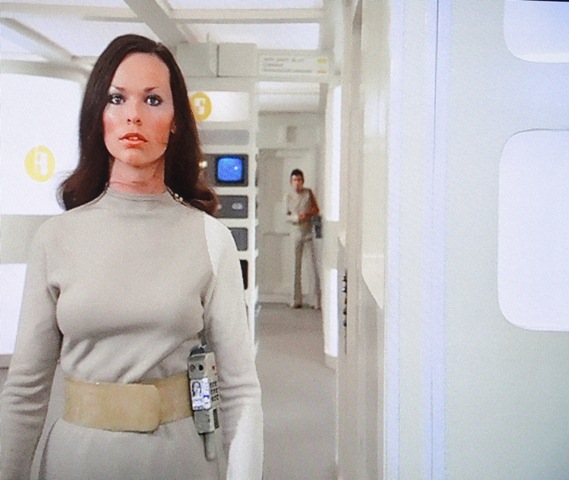

 Instead, I thought I would revisit Force Of Life as a separate entry, hence Force Of Life [Repaint]. Who better to reflect upon the script than the man who wrote it himself, Johnny Byrne? I had uncovered some additional material in FAB magazine that I found insightful regarding the making of the episode by writer Johnny Byrne. Force Of Life remains one of my favorite stories from Space:1999 Year One and perhaps one of my all-time favorite science fiction stories ever to grace television.

 My desire for revisiting the episode, first covered here, was to note the technical differences between the original DVD release and the Blu-Ray mostly. The images from the story, thanks to director David Tomblin, are striking and I remember them vividly. Without even looking at my previous coverage I snapped away to bring you a visual look back via the new Blu-Ray edition. I wanted to draw from Force Of Life for the exercise because, again, director David Tomblin's work on the installment is so striking it left such a profound impression on me from the first time I saw it at a very young age.

 Getting back to my original point, viewing Force Of Life again I was struck by how haunted, eerie and truly frightening that episode still remains. Actor Ian McShane turns in a brilliant performance as Anton Zoref, a man transformed by an alien presence, whereby his thirst for warmth and heat leads him on an internal struggle to retain his humanity while creating a path of devastation that would lead to several deaths on Moonbase Alpha. His journey, although affected by an alien presence, splendid captures the darkness at the heart of man.
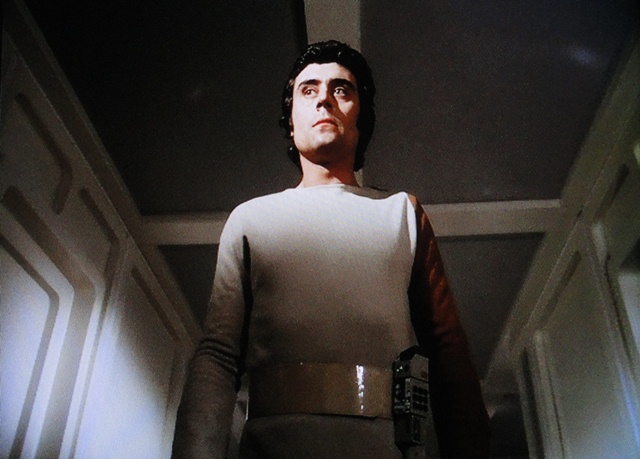
 I certainly don't ever remember Star Trek leaving me so truly disturbed and moved by such a tale in this particular way. The minimal, spare use of music accentuates the strange, life-altering world of Zoref [an anagram for frozen] as he moves about Moonbase. There was something truly claustrophobic and imprisoning about that Moonbase as epic in scale as it was. There was no place to run. You could not hide. If death was coming, you could not escape it. Moonbase was both a home and a prison. Its denizens reflect that dichotomy notably in Year One, Episode 11, The Last Sunset [the episode for which our coverage will commence with soon].
 The story certainly doesn't end well either for Anton. It ends horribly and as a child my heart broke for this man and his wife devastated the inexplicable pain of their forced separation. The force of life is indeed powerful, but it would be precisely that essence that sustains us which would be ripped from the existence of one Anton Zoref by the sheer mystery of space.
 Force Of Life is a beautiful, but frightening and tragic tale and works on so many different levels of science ficiton and horror. I was never as unnerved by the certainly equally memorable Star Trek in quite this way. Space:1999 absolutely gripped me with fear. We never knew exactly what alien forces lurked around the corners of those absolutely marvelous aesthetics of Keith Wilson's set production on Moonbase. Yes, Space:1999 had its fair share of alien encounters, but they were incredibly varied and sometimes, in the case of Force Of Life, we wondered if the enemy wasn't always lurking within us.
 For more on the outstanding series Space:1999, be sure to look for author John Kenneth Muir's book Exploring Space:1999, check out his insightful coverage and exclusive interviews over at John Kenneth Muir's Reflections On Film/TV or stick around for The Sci-Fi Fanatic's own coverage of this classic series right here. Going forward we'll be mixing up coverage on Thunderbirds, UFO and Space:1999. F-A-B!


