Tuesday, April 1, 2014

Star Trek: TNG S1 Ep20: Heart Of Glory

"Why do you mock me? Why do you wish to anger me?"
 
-Worf-

Star Trek: The Next Generation (1987-1994) is arguably a slog through Season One. Though I have stayed on task looking at each individual episode, at one point, following Season One, Episode 9, The Battle, I had considered ending the agony by jumping ahead to Star Trek: The Next Generation, Season One, Episode 20, Heart Of Glory. Hopefully for fans of this series interested in tagging along on my Season One journey the decision to remain faithful to my episode by episode coverage was worth it.


My coverage of the series, particularly on those first eleven episodes, has not been overly kind or glowing. They were certainly less than stellar, and to that point to make parallels to Star Trek: The Original Series (1966-1969) would be generally laughable. Of course, that all changed for me over the course of Season Two and Season Three, as it did for many, ranking ST:TNG among the top five best science fiction series ever created. Until now though, ST:TNG would hardly register on anyone's radar.

My son, The Boy Wonder, no doubt speaking from the ignorance of anything but heavy exposure to ST:TOS and out of loyalty, appropriate for this episode, noted ST:TNG to have its shortcomings. "It's not Star Trek without Spock." Oh, but it is. I've tried to convince him, but alas he has taken flight from his interest with this series for video games.


In fact, the characters are always the draw for the best series and ST:TNG is no exception. Heart Of Glory, as you know, centers on the character of Klingon Worf. And to my absolute and surprise, when I experienced Heart Of Glory, it was the Worf character, the performance by Michael Dorn, the strong direction by Rob Bowman (The X-Files) grounded in a tight script by Maurice Hurley, Herbert Wright and D.C. Fontana that snapped me from my ST:TNG malaise. Also, little did I know this was anything but a fluke, but rather the start of a real affection for this Worf character.  I had never been particularly fond of Klingons and yet the writers and performers indeed won me over. I was turning Klingon. Do you remember the song Turning Japanese (1980) by The Vapors? Same idea.


Prior to Heart Of Glory, on the series in general, the first season is populated with deficiencies. Sometimes poor dialogue, weak story ideas and a lack of direction concerning character would have a tendency to take their toll. Season One is awkward and incomparable to the first for ST:TOS, but it's not without its moments and perhaps those points kept its chances afloat. Heart Of Glory is one of those major highlights.

Despite the strength of Heart Of Glory and a few standouts, Season One of ST:TNG unconvincingly offered little evidence to suggest that it might one day rival ST:TOS. It's rather remarkable what ST:TOS achieved in a single year given the obstacles a television series must overcome.


When I originally penned the bulk of this post it was before the series arrived on Blu-Ray in all of its glorious color and vibrancy. There is a good deal of grain to the episode here, but the high definition is notable. The format cannot repair the substance of certain episodes that teeter on the brink of boredom but it does re-invigorate the series as a visual experience. For Heart Of Glory it's a revelation taking the infant series to another level.

I've had my quibbles with the series to date. There was real separation from the classic ST:TOS and adjustments had to be made. The crew was going where "no one has gone before." Gone were the females as objects of pure desire. Gone was the rough and tumble Captain James T. Kirk supplanted by the more cerebral and pensive Captain Jean Luc-Picard. Though, there were moments, like the ones in Heart Of Glory, where I started to really like this Captain. My affection was growing for him in Coming Of Age (Ep19) and others as well.  It wasn't love yet, but Patrick Stewart was fashioning his role in a way that was uniquely his own. I was beginning to really like this fellow.


The cast, though a little uncomfortable in the first season, was really beginning to win me over. Though, for me, Denise Crosby as Lt. Tasha Yar was the odds on favorite to be removed. And fortunately that wasn't far away.


But much of what I liked about ST:TNG clearly came together for the story called Heart Of Glory. This was an episode worth writing about. Bowman's effort captures a sense of atmosphere, tension and intrigue with some of the best character drama of the first season.

The story emphasizes a real sense of scale with a massive production set called The Batris where Number One, Data and Geordi La Forge beam over from the Enterprise-D and into some terrific suspense and atmosphere before stumbling upon and rescuing three Klingons just moments before the vessel explodes.


The Klingons speak of the Federation officers as infidels quickly aligning their beliefs within a relevant contemporary political context.

Worf, a Klingon and Federation Officer, is like a US soldier who also happens to be Muslim. The context of the story here and the Klingon focus deliver a perfect analogy and a genuinely compelling little tale of conflicted loyalty and trust.

Worf's loyalties to the Federation are tested as his Klingon brothers by blood make every effort to manipulate him to their love for the glory of war.


There are many in Star Trek fandom who love to dress like Klingons and speak Klingon and engage in Klingon rituals. And interestingly I was beginning to understand their love for Klingon mythology. That world never really spoke to me a youngster, but ironically the Klingon-centric Heart Of Glory was the first story to really get the old ST:TOS juices flowing. It was the kind of excitement I had for watching the classics. And this story was delivering something fresh without aping those originals and transforming them into the likes of those earlier ST:TNG efforts of Season One.

Much of the credit goes to the story and, as I mentioned earlier, Dorn's performance. As the Star Trek: The Next Generation Companion Book noted, Michael Dorn "had presence." Dorn helped evolve his character into an important player on ST:TNG eventually leading to his key involvement for several seasons of Star Trek: Deep Space Nine (1993-1999). That's an impressive development from the bowels of obscurity, to a recurring role, to unexpectedly become an important cog in the franchise wheel. In fact, it is written that "Worf, the lone Klingon in Starfleet, almost suffered from Gene Roddenberry's insistence that 'no old races' - that is, alien races that appeared in the original Trek- be featured at first in order to distinguish TNG from its predecessor." Fortunately, in this instance, Roddenberry lost that battle. No one is an island.


Bob Justman (1926-2008), associate producer and supervising producer on ST: TOS and ST:TNG, "was among those lobbying for a 'Klingon marine,' a concept the Great Bird finally agreed would show in the most obvious way the difference between this generation and the last - detente and even alliance with the Klingon Empire." It was all part of the new thinking and a move toward eradicating racism. Nevertheless, there would still be plenty of enemies and isms to mine. And speaking of races, tough to get around those Ferengi, at least in ST:TNG.

As the companion book notes, Worf is "absent througout the evolving first-season bible," but his impact beginning right here with Heart Of Glory is indeed significant.

The Enterprise-D receives word from Starfleet of a battle in The Neutral Zone. Number One suggests saucer separation for safety but the option is discarded. Readouts indicate the potential for Romulans - the first mention of them this Season. Some of these threads would materialize further in S1, Ep26, The Neutral Zone further bolstering a series establishing itself.


La Forge has activated a visual acuity transmitter connected to his visor to transmit what he sees on the Talarian freighter back to the bridge. The visuals are beamed over to the bridge main screen and Picard calls the images "extraordinary." The scope of the sequence is another first for the series. To reiterate, the set piece for the sequence is one of the most impressive from Season One. There is a real sense of a failing, damaged vessel. It is large in scope and much more sophisticated that a simple colorized matte backdrop. The music and sound effects also give a unique vibe to the remote islolation of the ship.  All of this combined with Geordi vision sets the tone for a great episode.

There's a rather humorous moment when La Forge spots the metal fatigue in the ship's structure. An inquiry into how long before the hull ruptures results in a response of "It's impossible to to be exact - I'd say five minutes."  Five minutes is more or less a pretty accurate read from impossible. Only La Forge can go from impossible to five minutes in a breath. And where is a Data data analysis when you need it? Lapses in some story logic regarding radiation and safety are forgivable. You're in a forgiving mood when it comes to the strength of this story's intrigue and sense of adventure.


The Away team and Klingons beam away to safety in a nick of time. One minor annoyance. When the team beams over they begin moving before fully materializing. It always annoyed me to see life forms move in the Transporter Room after being beamed aboard before they were fully materialized. I much preferred when they remained still until the materialization was completed.

Heart Of Glory would be the first true character study regarding the question of allegiances for Worf and one of the more fascinating character depictions in Season One. The rescued Klingons include Captain Korris of the Klingon Defense Force and Lt. Konmel. Kunivas dies on the operating table. Picard and company make for an interesting exchange as Picard and Worf pick apart the art of Klingon deception.


The character interaction and script is so strong Heart Of Glory delivers scene after scene of engaging drama.


In Sick Bay, Kunivas dies and the Klingons (including Worf) look skyward and howl in the traditional Klingon rite of passing dubbed the Klingon Death Ritual - the first time presented in the Star Trek television mythology. The howl notifies the dead "beware a Klingon warrior is about to arrive." It is unsettling to see Worf unite through his common cultural bond with these deceitful Klingons clearly of questionable character. A discomfort enters the viewer's mind as a result of Worf's cultural outreach. Worf is like family and our concern grows.


Feelings of concern are amplified as Korris attempts to cultivate sympathy by referring to them as "Brothers, lost among infidels." The art of persuasion is powerful, but this bonding, especially between brothers forged by blood, almost works as a kind of inverted Stockholm Syndrome only these guests/prisoners essentially exert influence or a form of empathy on their host captor - Worf. Korris shows nothing but disdain for Starfleet. Heart Of Glory works not only as a great character study, but as a study on Klingon lore.


The previous sequence speaks to the character and the quality of Worf's heart, but his Klingon brothers continue their efforts to manipulate him through their blood connection. Will Worf sway? There's an element to the story that once again probes the depths of nature versus nurture - the influence of our established homes versus our genetic make-up. In a sense, these Klingons are like children separated at birth. One has been exposed to the act of kindness repeatedly, while the others led an entirely different existence. You know what they say about kindness? Never mistake it. This is at the core of Worf and the struggle within his very own heart of glory.

As much as Spock shared both a human mother and Vulcan father, and lived an internal struggle within between the influence of two worlds, Worf, too, has two competing aspects affecting his very fiber - Klingon and humanity. These are always fascinating existential questions on Star Trek. And as much as Data is perceived as ST:TNG's answer to Spock, much can be said of Worf's own comparable journey. Elements of this wonderful character study would continue throughout the series and it all begins here. Worf is the product of a disciplined race, a true warrior, tempered by the influence of humans within a melting pot of professionalism. We are asked to consider that which is more powerful in our lives - that of the influence of nature or that of nurture. Worf shall answer that question here in Heart Of Glory securing the importance of his character to the others on this new series.


Konmel admits to Worf the truth of their presence on that Talarian cargo ship. Worf discovers the two Klingons destroyed one of their own Klingon vessels. The Klingons speak of the corruption of the Klingon empire and the birthright of all Klingons to battle and that the peace with the Federation is nothing more than an illusion. A colleague of mine would agree with that assessment.  He once held the Klingons in the esteemed position of ultimate enemy status until it was usurped by the driving forces of the Borg. It is the peace that makes them soft or as Korris pleads, it makes his "heart wither and die." Like radical fundamentalists, Worf sees his fellow Klingon brothers twisting and contorting their belief system to suit their own warring desires.

On the bridge, Picard understandably shares his experience with Riker and Data regarding Worf's behavior at the Klingon Death Ritual. Questions of trust are in play.  Could Worf possibly fall prey to natural cultural impulses?  Picard shows concern for Worf and the influence of his people on him and how he will handle that connection. Picard says it was "like looking at a man that I had never known." Picard makes an important point about how little we sometimes really know regarding those close to us and the influence of one's primal nature.


Worf offers the Klingons a tour of the Enterprise-D and they dream of glorious battles. "Perhaps your dreams of glory no longer fit the time," says Worf suggesting a more evolved Worf. The Klingons frown upon "civilized men" and Worf's personal beliefs are challenged by them with each exchange.

On the bridge, a Klingon cruiser arrives in their airspace. The Captain of the Klingon cruiser asks of the survivors of the destroyed Klingon cruiser T'Acog, destroyed by Korris and Konmel. Picard informs the Klingon captain of the fate of the Klingons.  He is shocked to discover the escapees are alive. He demands they be turned over. Picard justifiably attempts to get as much information as possible about what has transpired. After all, he is dealing with Klingons and the art of deceit is not a new concept. But issues of rendition, harboring, political asylum, refugee status, extradition and a host of other political scenarios fall into question depending on the information available.


Tasha Yar is sent to secure the criminals. Worf is asked to step aside. The Klingons plea for his aid as a blood brother pushing the conflicted nature within Worf. There is an almost child-like innocence to Worf, as Klingons go, as a result of his sheltered, farm-reared existence on Gault and the "kindness" he has received in his life.

Worf returns to the bridge and is notfied by Picard of the Klingons' wish to recover the two prisoners. Worf knows they will be executed. He looks to Picard for other options as a result of his nurtured existence by humans and as an officer in Starfleet. This further illustrates how different Worf is as a result of his upbringing.The performances are strong throughout.


Worf requests permission to speak with the Klingon Captain who has demanded the prisoners. Worf exhibits the human act of compassion once again highlighting this is a new era in Star Trek. Worf understands they must be punished, but also understands the natural inclination by Klingons to yearn and burn for past Klingon glories. Worf feels it to his bone and core and like Spock must seek control of primal urges. Worf pleads that the Klingons have a chance to die in battle with honor. The Klingon captain denies the option.


Elsewhere, the Klingon prisoners plot their escape. Utilizing components from their belts and boots. A makeshift weapon is created. The breakout happens and two security die along with Konmel. Korris is on the run. He makes way to Main Engineering. Korris demands to speak with Worf, his "countrymen." Worf and Picard go to him.

What is clear is that Korris is essentially a traditional, throwback Klingon and makes ovations to Worf to join him. Worf demands that he put down the phaser. Worf makes the only case he knows and proves he is truly enlightened.


Korris angrily growls, "I don't care what you look like, you are NO Klingon!" Worf replies, "perhaps not." Ultimately killing Korris Worf does indeed respect the traditional Klingon desire to die with honor in battle and even gives him the Klingon Death Ritual. It is a sobering moment, but offers a glimpse, as does much of the episode as to the character at the heart of Lt. Worf.


Picard reports the Klingons have been killed to the Klingon Captain. He inquires of Worf how they died. Worf replies, "they died well." Picard offers to return the bodies, but they are to be discarded as refuse. Worf is offered a place among the Klingons should his Federation service conclude. Worf indicates he will stay with the Enterprise-D. This is a fine, closing moment and harkens back to the flavor and spirit of all that was splendid with ST:TOS.

"The bridge wouldn't be the same without you."

Heart Of Glory gets the tension just right and positions the cast accordingly to create a sense of genuine excitement with a worthwhile tale to be told. It's honestly the first time I felt the series had a consistent pulse. At its core, the tale asks us the question of change, progress and the ability to evolve into something greater than primitive religion, culture or hostile mores. There are compelling social and political questions in play throughout Heart Of Glory not to be missed and still relevant today. Some episodes have tapped into what makes Star Trek work so beautifully, but Heart Of Glory gets it right start to finish.


One of the great thematic threads of Heart Of Glory is to what degree Worf's heart is a heart of loyalty to his new Starfleet family. Which side will he fall if asked to choose? We all need to make a choice and often times must choose sides. Life forces these choices when two opposing forces meet head on and face to face. Sitting it out isn't an option and certainly not for a Klingon with a heart of glory.

Battlestar Galactica (2004-2009) begged thematic questions of divided loyalty between Cylons and humans. Aeryn Sun was also faced with similar themes early on regarding her loyalties to the Peacekeepers race or her newfound makeshift family in Farscape (1999-2003). The Tok'ra were by no means Goa'uld in Stargate SG-1 (1997-2007). Humans were faces with differentiating between the two. And questions of trust are abound in all of these wonderful series.


Heart Of Glory is another splendid example of this theme in action and succeeds by infusing ST:TNG with the spirt of the classic series. This Klingon-centric story would establish Worf and offer a glimpse into the fragile Klingon - United Federation Of Planets alliance. Heart Of Glory would plant the seeds of the ongoing Worf/Klingon saga, the story of Khitomer and the Romulan betrayal detailed further in Worf-centric stories like the brilliant Sins Of The Father (S3, Ep17). Implications regarding Worf's family would follow in Family (S4, Ep2) and Homeward (S7, Ep13). This is the kind of foreshadowing and serialization that would make the new series such a success and influence genre television for years. Most of all, like the irreplaceable original series, Heart Of Glory places emphasis on character over effects, Worf stands out as a real highlight by capturing one of the real character highlights of the first season. While it may still be a little rough around the edges it lays the groundwork for better things to come especially for Worf. This one definitely has heart.

Heart Of Glory: B/B+.
Director: Rob Bowman.
Writer: Maurice Hurley, Herbert Wright, D.C. Fontana.

Friday, March 28, 2014

Science Fiction Non-Fiction: Gareth Edwards (Monsters)

 
"It was mainly all Adobe. So it was edited on Premier, the visual effects were all composited on After Effects, and most of it was painted using Photoshop. But for ... the creature stuff, I mainly used 3ds Max. The platform used to create them, as well, is one accessible to ordinary people. They were all just done on a regular - well, a fast - PC. My background is computer graphics. I got frustrated with filmmaking at film school. There's just a huge sense of compromise when you try to make a film properly. Computers promised for a long time that you could go off and make a movie on your own, so I just sort of learned how to use a computer and how to do it in the hope that in six months I could go and make a movie. It actually took me about a decade to work it out."
 
-Gareth Edwards on Monsters, SciFiNow #47, p.30-

Now about that compromise, what can we expect from Edwards with Godzilla (2014)?  Something tells me it's on a completely other level and scale. Maybe he used two computers to recreate the carnage and the apocalypse. We know he can do it.  The images selected give you a sense of Edwards' vision as there are both images from Monsters (2010) and Godzilla.

For more on Monsters, in anticipation of the greatest monster of them all through the eyes of Edwards, click here.

Godzilla (2014) Promo III

And the excitement builds... or crumbles.

Wednesday, March 26, 2014

Foster The People: Torches & Supermodel

"I have tried so hard not to be like them. I have found they don't ever say what they mean. There is a truth. There is a light, if you'd follow me there. I've been searching for the directions and I'm convinced the world doesn't know what it needs. There is a hope for the hopeless, I can promise you that."
 
-The Truth, Foster The People (possibly my favorite song on Supermodel)-

It's not always exactly what is sung by the burgeoning Mark Foster but how the track is delivered through voice modulation. Foster is proving a master behind the microphone as much as the studio as the front man behind trio Foster The People.


I understand why people write reviews for recordings immediately upon release for the sheer fact they need to be timely with these things. Their respective publications or web sites require up-to-the-minute coverage in all of the latest and greatest music releases. But one thing I'll never understand is how these writers can offer a fair assessment on a product after just a few simple spins. Perhaps the verdict is based upon just one listen. I don't know. I do know this - a proper assessment of any recording, while entirely subjective anyway, takes a little more time to appreciate. The music has to simmer upon the ears like a fine Italian gravy on the palette.


Another aspect of the music critic that never sits well with me is how they write about a new act like some kind of hot property that only they know about. These new faces are hoisted high atop pedestals. Within the span of just a few short years and just one additional album release later, the sophomore effort, and suddenly the once hot act is relegated to banishment with the pedestal kicked out from under. The music is quickly written off as some kind of sophomore slump or the work of newly anointed has beens. The writers almost seem eager to usher in the new wave of hot new properties at the expense of legitimate talent. When it comes to music and the music industry, it sucks being old. It's too bad that's the perception created too. But, like science fiction, the reality is much different. Fans of science fiction are more than happy to give genre pictures a fair shake where critics are quick to write them off, discard them or simply write about them in almost unfounded fashion with no basis or real appreciation or understanding for the genre. The same holds true for music fans who know a good thing when they hear it and are more than happy to remain loyal to an artist's journey when critics have quickly marched on.


Foster The People is one of those bands for this music listener that will hopefully stick around. Of Monsters And Men is another.

When Foster The People arrived with the studio trickery of Torches (2011) it was something of a revelation for me. Upon hearing Pumped Up Kicks and ignorantly downloading the Free Download of the Week on iTunes, Helena Beat, I was quickly turned on to this new band I was about to carry a torch for myself. iTunes has introduced me to a few bands this way.


With Torches, the trio of genre mix-master/vocalist Mark Foster, bassist Cubbie Fink and drummer Mark Pontius had meticulously crafted an album of sparkling alternative pop so refined and so unique it was painful to listen to - in a good way. Foster admitted he spent excessive effort and time getting Torches just perfect and, truth be told, it was, in my opinion, one of the five best recordings of 2011. Acts certainly have the chance to do that with the first one.

Without wasting another moment I downloaded the entirety of Torches and quickly discovered the recording was a flawless masterpiece of alternative pop that seemed to take its cues from the glory days of masters of the 1980s as much as it was infused with Foster's ingenous ear for a melody and crossing genre lines within music. It was a sonic experience.


Call It What You Want, Houdini, Waste, Life On The Nickel, Don't Stop (Color On The Walls), Miss You, Warrant, I Would Do Anything For You, Broken Jaw and of course Helena Beat and Pumped Up Kicks were simply flawless. It became required iPod listening on my summer runs.

I became so obsessed with all things Foster The People that I purchased the bonus track edition of the CD.  Yes, another CD clutters my basement. Not good. But I had to have those songs. The Best Buy (and it pains me to mention the name of a company that has no understanding of customer service) exclusive included Love and Chin Music For The Unsuspecting Hero. And you guessed it, those latter two songs were amazing too. Foster The People had adopted this listener and my foster days were over.


Since that arrival I waited with baited breath for the next release to come from Foster The People like a giddy school girl. That day arrived with Supermodel (2014). And, to be expected, once again the critics were quick to jump and pounce on their once heralded new band as nothing more than yesterday's news. How fleeting fame.


Alternative Press gave it one star and called it "All flash and no substance."  Spin answered with "the songs suck." Rolling Stone countered with two stars.  I never did care for Rolling Stone, but I bet Bob Dylan gets five stars. Others were notably more fair. Q Magazine called it an "album of transition." That's arguably a better posture toward the record, but better yet, it's really not.  Supermodel is simply not the same as Torches and that should be celebrated. I'm not delusional. Supermodel doesn't quite rival the flawless pop gems of Torches, but it still has some killer moves and grooves and it takes a little acclimation passed the super star gloss on the surface of those songs. Case in point, my son, the Boy Wonder, also was not a fan of the Supermodel recording and initially had a strong negative, knee-jerk reaction, but one week later and he's had a change of heart.  Nevertheless, he still ranks it below Torches and that is certainly understandable. Artists have a long time to work on those debuts, but Supermodel is more than outward, surface appearances.


I've been listening to Supermodel. I've been absorbing it every day since its release one week ago. It's easy to submit to you that Supermodel isn't nearly as precious and perfect as Torches in its production. But even Mark Foster admitted he was in a different place while making the project and was less concerned with studio perfection, and rather embracing of the imperfections. Supermodel is indeed imperfect and when compared against Torches it may not seem quite as sparkly. There is an edge to it. It's a little more raw and guitar driven in spots, even spare, but as the recording begins to work its way into your mind you can't help falling in love with this beauty too.


Immersing myself into the sounds of Supermodel has been an experience and there is no shortage of good songs here either. A new band would be proud to sport this Supermodel on its arm if it was their first date. But as second albums go, the verdict is in, Foster The People continues to amaze and grow artistically. That's a tough line to walk, but Mark Foster and company pull it off even slowing things down demonstrating the act's less synthetic and more vulnerable side.

The problem is Supermodel isn't as instantly catchy or hook-laden as Torches. The melodies are there, but they take a little more work down that runway. Are You What You Want To Be?, Ask Yourself and Coming Of Age grow on you and are lead off winners to the recording. Pseudologia Fantastica is another grower. This song and others ask you to throw out some of your preconceived notions of the band and expand the horizons a bit more. Best Friend is quite possibly the one song that is accessible in the context of Torches and oddly the least interesting.


And just when you think the remainder of the album is going to go down hill like the Supermodel image of the album cover with a female purging, the production keeps growing stronger to its inevitable end of the iTunes bonus track Tabloid Super Junkie. Yes, I pre-ordered to get that one. It's gone now.

The album finishes on a glorious high with The Truth. Things get delicate, unexpected and even moving with Goats In Trees and Fire Escape, the recording's natural conclusion.

Like the trigger word Supermodel, there's a lot going on here and the effort will likely force different reactions in different listeners. But it is a stick of audio dynamite. Like Foster's penchant for mixing styles, he has a way of introducing his new sounds with echoes of the past. Hints of New Order, Supertramp and The Fixx - I swear I hear their influence whether through vocal play or musicianship.


So, if you're looking for smart, good-looking pop sounds look no further than Foster The People's latest Supermodel. Like the white, blazing hot sounds of Torches, Supermodel is shining down another catwalk with retro style and shimmering new sounds. There's nothing not to like about this girl. It may not be as meticulous as their debut but their's nothing unpolished about this diamond. With this girl another classic face is born in music.

It's a delight to witness the evolution of a band happening before your very ears. Depeche Mode had an interesting arc from those early synthetic glory days. But despite any of the electronic wonder of Foster's sound there is indeed much blood pulsing through every beat of the band's first two recordings. *// There are some artists you enjoy so much you wish they had an instant discography as big as those amassed by The Beatles or Duran Duran. In time. So of course following my appeasement for all things Foster The People my next thought was, what's next and when?

Friday, March 21, 2014

Stargate Universe S1 Ep6: Water

"It looks like we entered the Hoth system. Empire Strikes Back. Second Star Wars movie. Okay, I refuse to call it Episode Five."
 
-Eli Wallace always there with just the right amount of humor and referencing pop culture like John Crichton. Crichton would be proud.-
 
"Everyone is lying."
-Eli-
 
"Yeah, grownups do that sometimes."
-Dr. Nicholas Rush underscoring that with lies comes the question of intent for the characters of Stargate Universe-
 
"Damn he's a lot of work."
-Everett Young on his familiar refrain regarding Rush-
 
"Always consider the greater good - that's it."
-Dr. Nicholas Rush to Tamara Johansen-
 
"This is beautiful out here."
-Everett Young capturing the essence of a show that brings back the awe and wonder of space-

Much had been made in critical circles, both fans and critics alike, of Stargate Universe (2009-2011) mirroring the darkness of Battlestar Galactica too much. Some of that inspiration is undeniable as an aesthetic there but in terms of mythology and mission and character dynamics the shows are unique.


Kenneth Brown of Blu-Ray.com made the comparisons himself in his own review of SGU sadly finding little contrast between the two series. A closer examination of SGU is required beyond the surface appearance of shaky cameras and sometimes low lighting. SGU reveals something much deeper as a survival series and as a series of exploration and more on that lighting in a moment.


Fortunately, despite even making character comparisons and associations, Brown submits the actors of SGU "enchant and enthrall." Still, he believes their personalities lack the "wit and charm" of the previous incarnations, but that they are the "saving grace" against unrefined scripting. His description of Dr. Nicholas Rush and the capabilities of the cast is at least fair.  And, in truth, those previous incarnations were written with heavy accents on the wit, grace and style often associated with comic book-like adventure.  It's tough to make that comparison to SGU, a series that is taking a much more grounded, real and deliberate approach to life in the void of space and its unknowns.

Brown notes, "Dr. Rush is both a tragic Shakespearean construct and a volatile menace to anyone who brushes against his ego-fueled madness. As selfish and conceited as any fledgling villain could be without being entirely unlikeable, he perpetually damns and redeems himself, making him an invaluable component of the series. The rest of the characters are just as engrossing, elevating any mediocre writing, bland dialogue, and prevailing genre cliches that dot the proceedings."


But I have to argue against the knock on scripting as something much more immersive, refined and suggestive than Brown gives SGU's writers credit. My experience has been one that appreciated the authentic, real exchanges that happen organically between the characters on SGU. There's also a strong visual component to this series as characters reveal themselves. The problems encountered aboard the Destiny seem reasonable and logical and are not tidied up with a bunch of non-sense techno babble, but rather common sense or just sheer luck.


Brown complained, "SGU doesn't have much focus beyond its characters, and its stories sometimes flounder as a result." Again, SGU continues to impress thematically with sound titles focusing on basic survival which serve the characters and with how each contends with a crisis.

I'm not picking on Brown, because I love his reviews, but just shedding some light on the kind of arguments that SGU was finding itself up against.  It brought a lot of baggage along when it tried to make a name for itself.  The series was indeed running alone in the dark of science fiction space.


And the series still continued to find its way to be sure with remarkable grace and intelligence. How ironic then I find myself reviewing Stargate Universe, Season One, Episode 6, Water, the same name given to Battlestar Galactica, Season One, Episode Two.  It's a commodity that's important when attempting to survive in open space with limited resources. Both the Battlestar Galactica and Destiny put their own unique spins on the subject. Moonbase Alpha and others were faced with their own limitations so let's be fair here.

Thus far, the Destiny and its new denizens have literally struggled to sustain existence. That struggle, that journey began when the humans arrived aboard her through the Stargate to discover the CO2 scrubbers were shot. The system exhausted oxygen was at a premium and had to be repaired over the course of the three part Air.


Out of the fire and into the fryer, as they say, with Episode 4 and 5, Darkness and Light respectively as the Destiny re-nourished its power supply by passing through a star on its own pre-programmed trajectory. The two-parter also offered a nice reflection of both elements of good and evil that make up the crew. These respective motivations are, in essence, the composition of many complex aspects of ourselves rather than a mere, single caricature. It speaks to the complex personalities aboard the Destiny.

The latest challenge is the Destiny's diminishing water supply.

There is indeed a sense of raw survival pushing these human survivors to the brink of disaster as Season One witnesses efforts to see the Destiny reset herself after years of abandonment.

Once again, the creators are generating a truly sensational science fiction series with their Stargate brand.


The Destiny approaches a frozen, Hoth-like planet, as Eli notes, and gives the group a chance at gathering ice to melt for the Destiny. Everett Young and Matthew Scott take the assignment. Scott has been a character, portrayed by Brian J. Smith, that I took a shine to from the very beginning of the series.  Everett Young, on the other hand, took some warming for me, but as of this particular episode his character is really beginning to ring true and demonstrate a depth I hadn't seen initially.

There are plenty of interpersonal moments between characters.  Second Lieutenant Vanessa James, she previously of the broom closet and the recipient of Matthew Scott's male libido in Air Part I, comes along to witness Scott and Chloe Armstrong hot and heavy generating some palpable, understandable tension on the series.


Some understandably misunderstood the Scott character in the early going as it appeared he was a bit of a bed hopper.  Smith also expressed some disappointment that the character had not been given a fair shake suggesting the Scott and Armstrong characters were indeed friends and that their friendship had grown, but that it wasn't conveyed on screen. And it wasn't early on which can certainly justify both Scott's feelings on the matter as well as those critical of that relationship feeling rushed.


Speaking of rushing, Rush, too, continues to be a magnificent creation.  Heated exchanges between Rush and Eli as well as others are often gripping. Further, they are not heated for the sake of the overly dramatic. There is often genuine external stress placed upon the crew and Rush continues to walk this amazing tightrope in motivations. He often presents scenarios that appear to be in keeping with the "greater good" as he would call it, but underneath those eyes there always seems to be another agenda, a more selfish, singular greater me, myself and I agenda. Actor Robert Carlyle seems to effortlessly walk the line and keeps viewers guessing and glued to their seats. If that's not great a performance AND good writing then I don't know what is.


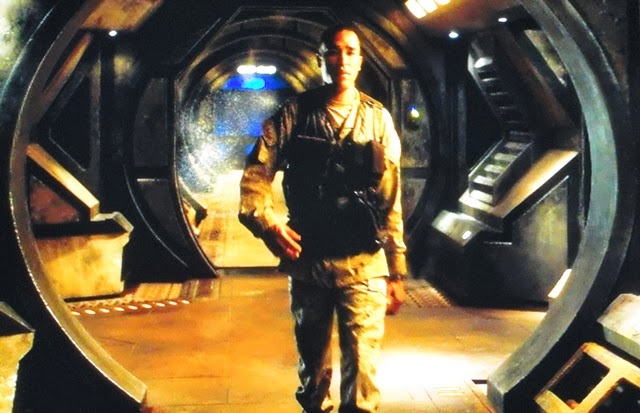
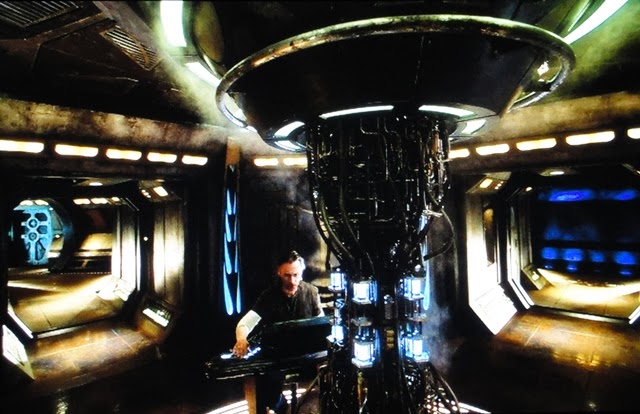
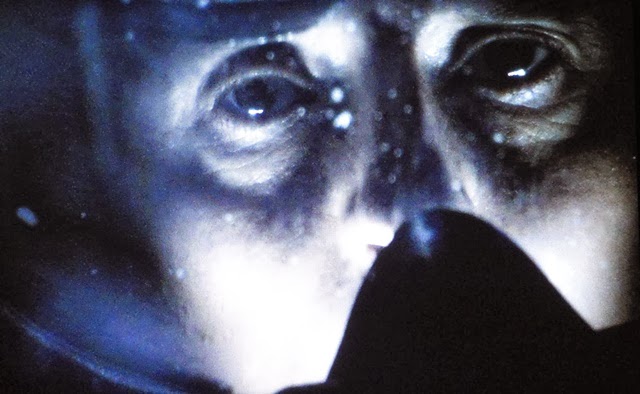
The production design team behind the series continues to stun beyond the special effects and ship design departments and beyond expectations. The men are suited with Ancients' space suits able to withstand the elements and they are simply marvelous to behold. There is a genuine sense of care and quality meticulously taken with the look of this series in almost every frame. These suits easily rank among the best from Space:1999, Star Trek: The Original Series, Sunshine and many more. In fact, they are quite similar to, and quite possibly remnants of Stargate Atlantis, Season Five, Episode 10 and 11, First Contact and The Lost Tribe re-purposed here. There is an almost H.R. Giger-esque quality about their shape, look and design. Combined with the expertly positioned lighting throughout Water and you have yet another solid, handsomely crafted entry in this special science fiction series.


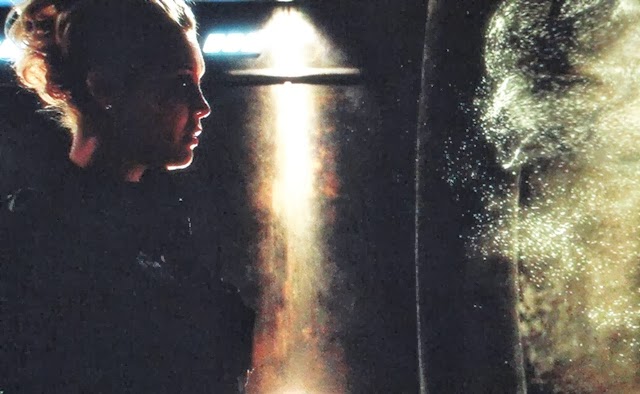
The mysteries of space are given some time here too. Tamara Johansen is left in charge aboard the Destiny and presented with her own challenges.  She discovers a life form on the ship - a whispy cloud of particles or granules of sand - yes, the same sand from the sand planet that followed Matthew Scott back through the Stargate in Air Part III. All seems fairly innocuous until one military member meets a fairly gruesome, horrific fate. As it turns out the organism(s) is the source of the Destiny's water woes. SGU begins to bleed these rather interesting elements into the serialized aspect of the series. There are unintended consequences to the crew's efforts.  One step forward and maybe two steps back or vice versa.


There is something mysterious about the creatures too. We don't understand them. They don't understand us. They don't look like us and aren't your standard humanoid aliens from the Stargate universe. They simply look for sustenance and life too - like us. Attempts at communication are at once magical, beautiful, but also scary like efforts made to communicate with the aliens in The Abyss (1989), but ultimately these organisms suggest they are lost in space as much as the humans.


SGU is endlessly fascinating especially on a visual level as drama is allowed to play out through discovery and human exploration without the constant distraction or barrage of humorous one-liners we had grown so accustomed to on the previous Stargate outings.  This is truly a more wondrous series as sci-fi goes without every becoming quite as dark as Battlestar Galactica.

As I mentioned earlier, there is a visual component to each episode that underscores the theme and I completely connect with that.  Every episode blows my mind by the sheer beauty of its cinematography and lighting used to convey its themes and moods. Blue is often the color of choice for this frozen water planet and you could simply get lost in the unknown with these unexpected adventurers. Look at all of the episodes to date here and you will see a unique color palette that amplifies atmosphere, mood and emotion accordingly.


Even as Young and Scott struggle to get water and both men find themselves attempting to think their way out of a truly desperate situation Young still stops, perhaps in a moment of exhaustion and helplessness, to recognize the beauty of the universe around them. I love that little moment. They did it in Darkness too with the gas giant and in Light with the blazing star and they pause for a moment here. For me, Young captures the beauty of the vastness of space. It reminded me of simple moments of my own walking from my car to the house only to find myself stopped by the sheer delight of the stars and enveloped by the silence around me. Those moments are special.  Young captures the stillness of these moments and reminds us how small we are. Yet those instances of appreciation give us strength too as Young too finds himself reinvigorated to push on. The universe is indeed vast and breathtaking and SGU truly takes time to recognize that aspect of this new series. It's truly mesmerizing and I hope SGU continues to immerse us in this world and not lose sight of it.

This is certainly not to say that the previous Stargate series didn't have its moments whether it was Elizabeth Weir looking out across the ocean from Atlantis or Jack O'Neil holding an injured Samantha Carter.  Those moments are equally special. Star Trek: The Next Generation takes time to witness Wesley Crusher appreciating the universe in ST:TNG, S2, Ep10, The Dauphin too so this isn't new, but it's entirely how SGU approaches the moment and the nuanced approach created for this series.


Like air, warmth and water, all precious commodities, SGU is proving to be just as precious within the genre. I'm head over for it. Each new entry delivers something special to ponder as if to bask in the glow of the stars but in the special approach to its sci-fi. It's a refreshing change.

I'm overcome by excitement at the potential wonders that wait me on SGU. There's been talk of a new Space:1999 series, and though SGU is gone, I would make efforts to round up all of the technical and creative people behind SGU and hire them immediately and give this thing another go under that banner. Under the Space:1999 brand perhaps the known lost in space concept just might work out.


As writer/director/producer Robert C. Cooper noted in SciFiNow, "This came out of a desire to not do a planet with trees on them. We did a lot of running around in trees in the last two series, and we really wanted to demonstrate that this show is going to be about exploring a really cool, mysterious, interesting universe. How can we create alien worlds that are going to be a challenge for us and beautiful?Water is another near perfect and jaw-dropping example of a series deliberate in its approach to story, character and experiencing the universe in a new way.


Water: B+.
Writer: Robert C. Cooper/Brad Wright/ Carl Binder.
Director: Will Waring.