 "Now it begins."
"You musta done somethin' bad."
"All she can do is take you straight to hell."
 In honor of Halloween and in celebration of the frightful annual holiday, I'm returning to some unfinished business begun quite some time ago for the Lance Henriksen blogathon. I had originally planned on covering Pumpkinhead [1988] for the celebration of Henriksen's work over at John Kenneth Muir's Reflections On Film/TV, but decided upon a look at Millennium Season One, which evolved into Profile And Measures Of The Millennium Man.
 As it turned out, I was very pleased to venture into Millennium territory. It led me to an investigation of a series that tackled dark subject matter better than just about any I've ever seen. In fact, it's a particularly perfect series for October and Halloween. One episode that is pitch perfect for the festivities would be Millennium, Season Two, Episode 6, The Curse Of Frank Black. If you're twisted enough, place the TV in the window, turn up the volume, dress up and scare the dickens out of the little ones. It's all in good fun and in the spirit of the day. It's also fitting to mention Millennium at this time and pay tribute with a film starring Lance Henriksen as it is appropriately the 15th Anniversary marker of that series' arrival. Be sure to check out Back To Frank Black for additional coverage on all things Millennium and Frank Black.
 There are plenty of terrific Halloween films for the occasion including any one of those first three Halloween pictures, Trick R' Treat [2009], John Carpenter's Prince Of Darkness, the documentary on A Haunting In Connecticut and much more. There are options to experience fear with the lights out. But let's not forget the wickedly delicious cult classic Pumpkinhead.
 Covering Pumpkinhead may inevitably lead me to that mythic and final third Henriksen post I had planned for that blog-a-thon week that I never completed behind Profile And Measures Of The Millennium Man and Images Of Millennium [Season One]. Consider the would-be final post the third and final contribution to my own Lance Henriksen tribute trilogy a year in the making. Well, some day.
 In the meantime, somewhat unexpectedly, I turned to cult film Pumpkinhead to offer observations on a film I haven't seen since its release. It is a remarkable little picture really that earned a little over 4 million in limited release, but continues to vine out a following. For a film made on the proverbial shoestring budget, it looks, feels and sounds terrific. The lighting and color use is magnificent with cool blues and hellish reds. The sound effects, notably one seemingly lifted straight out of the dying dog cage scene, reminisces of John Carpenter's The Thing [1982] whenever the monster appears. It shouldn't come as any surprise that the ingenious Winston actually worked with Rob Bottin on that aforementioned classic.
 Pumpkinhead arrived with effects wunderkind Stan Winston and actor Lance Henriksen stepping out of supporting roles and into their starring roles as director and actor respectively. Their association was no doubt linked to their combined efforts on Aliens [1986] a few years earlier. It's always fascinating to see those stars we love age before our eyes and its incredible to be reminded of just how fit and even spry actor Henriksen was in the role of Ed Harley, a loving, nurturing father of a young boy and owner of run down pit stop, Harley Grocery, on a long, lonely highway complete with an all too prophetic sign Leaving Hope. Henriksen's Ed Harley was a far cry spunkier than the thoughtful, world-weary character of Frank Black he created for Millennium. Harley's country drawl and plain speaking points to the isolation and simplicity of a poorer segment of society that values the thankful little things of this short existence. Some look down their noses to the Ed Harleys of the world, but Harley is a man that makes the most of the very little he has in this life. With his son and the love he has for his boy Harley understands he is rich beyond words.
 The film directed by the late, great Stan Winston was orchestrated by a man best renowned for his stunning, life-like creature and effects work in front of the camera.
 See below for a list of the fine projects and the wonderful creations Winston has touched on his amazing journey a legacy that led Stan Winston Studios.
 I recall seeing Pumpkinhead mostly for the monster that Winston had created as a young man. Visits to the local video shop always had me flipping the VHS boxes for the latest and greatest creature feature. I was impressed by the creature beyond words. It was a horrifying beast with such incredible detail. Pumpkinhead is a perfect illustration of hard work and physical labors brought to life. Reliance on ones and zeroes to create something from nothing in a CGI environment still couldn't replicate the impressive beauty of something as horrific as Pumpkinhead.
 Note the tremendous creature effects and lighting in this sequence and in the accompanying photos.
 Note the accompanying pictures of the beast in all its splendorous detail. Seeing the film today, there was an appreciation for its simplicity of location, unknown casting [Jeff East, the young Clark Kent in Superman in 1978, appears] and story that were simply unobserved at a time when I irrationally hungered for the next appearance of the demon beast.
 Of course, Henriksen, who I didn't fully appreciate at the time, truly immerses himself in the part as much as he invested himself in the role of Frank Black in Millennium.
 Henriksen really fills the role of Harley infusing the character with his all-encompassing work ethic and manifesting attributes of a true, simple, local country bumpkin. Henriksen becomes the southern man.
 Harley witnessed the great creature, Pumpkinhead in 1957 as a young boy, a demon seed [literally] brought to life and summoned to take revenge.
 Today, a group of young dirt bikers accidentally kill Harley's boy while he's stepped away from the grocery in a tragic accident. The death of a child is always jolting and unexpected. Consider the death of the young girl in John Carpenter's Assault On Precinct 13 [1976], but unlike that film, the event here isn't the result of a band of sociopaths, but of careless, reckless teenagers.
 Instead of facing the consequences of this awful event the kids turn and run in fear, but are torn in doing so. One young man remains in an effort to set things right with Harley. Its a truly appalling affair and it speaks to the small town trust Ed Harley had in leaving his son Billy behind for a few short minutes with his dog.
 The young man offers to help, but Harley seethes with rage with vengeance in his heart.
 Watching Pumpkinhead is an experience and for all its simplicity it never feels like a typical horror film. It's a "creepy, unusual horror film" as Ken Hanke of Mountain Xpress describes it. Felix Vasquez Jr. of Film Threat accurately reflected, this "monster movie is still harrowing, creepy, and better than modern horror fare." These men are exactly right. Of course, Henriksen touches these films and often injects a unique sense of humanity even into the most rote affairs and scripted formulas. Winston also makes efforts to present something special here that separates it from the nameless rabble of shlock horror. Mood, mood and more mood is generated throughout the picture cranking out atmosphere like a relentless dry ice machine.
 Brought home, Harley tenderly tends to his son son Billy who finally lets go in his arms. It's a moving sequence and one I would have appreciated that much more if it was just a little longer. Getting to know these characters was a highlight.
 It's a very tender moment.
The film is filled with mist or fog, red lighting like the interior of the creepy old woman's cabin in the swamp–she who raiseth the creature. Like the centerpiece of Winston's film, Pumpkinhead, the picture is one moody son-of-a-bitch. The darkened pumpkin patch, the birthplace of Pumpkinhead is an atmospheric set piece and one that exudes unspeakable evil.
 Henriksen does a splendid job of playing a weakened Ed Harley who is clearly not in the right frame or state of mind as he pursues revenge for the death of his son.
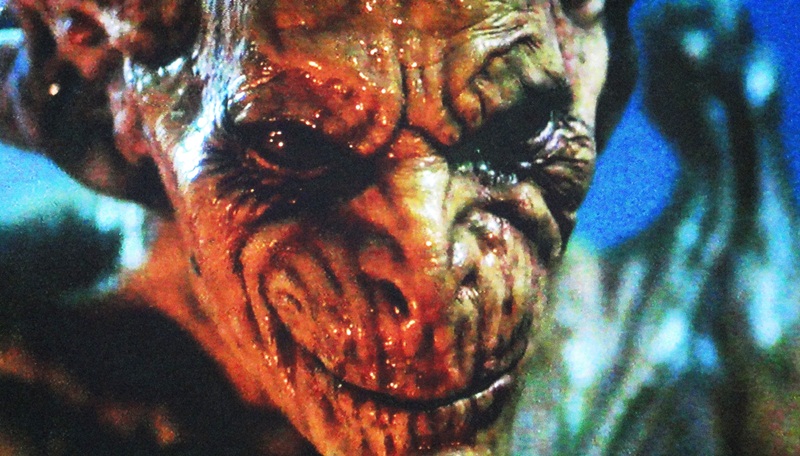 The witch conjures the creature forth utilizing Harley and the boy's blood to give life to the massive animal with freakish hands.
As the killings mount Harley is affected by each death. The murders happen as an extension of his own hands. He experiences and feels each life-taking event. The link between both Ed and the creature is one of blood. The experience begins to haunt Ed Harley, a good man, who realizes his actions are wrong-headed. The word of warning from the spirit of his late son were not enough to quench Harley's pain intitially, but the question of "why" begins to haunt his tortured soul.
 Harley visits the old woman regretting his decision. "It's gotta run its course now." Ed swears he will stop the creature. He must end the cycle and save those he can. The old woman tells him he will fail.
There are moments when the snarling monster suddenly appears with its enormous hands and giant fingernails clasping its victims' heads that you literally jump back in your seat.
 Winston gives his final moments even greater resonance when Harley appears to take on features of the creature, while the creature becomes almost humanoid in appearance in its own face. Harley, a basically good man driven to the unthinkable by the death of his son knows what must be done. As parents we empathize in a way that was lost on me as a younger man without the knowledge of that kind of love. Understanding the connection between his pain and that of Pumpkinhead, Harley must make the greatest sacrifice to end the horrors of the demon's mission. "Kill me," he pleads near mortally wounded with Tracey one of two survivors.
 In the end, the dead are tended to by witch as she secures the source of an eternal legacy. The rites and keys an underworld of evil are protected once again so that they may one day rise up. The image of the dead creature presents the necklace of Ed Harley. The image lends visual proof to the doppelganger that this thing was to Ed in blood and reality.
 Pumpkinhead is a short and, not-so sweet morality play, but it hits all the right notes in a short period of time. It is a dark story of the human cost of retribution that doesn't end well. Winston even gives real flesh and blood to his cast in each of their small roles. Conscience is part of these characters juxtaposed against a world infused with symbols of heaven and hell. Pumpkinhead complete with prehensile tail and curved legs is a symbol of the devil himself. When it enters a broken down, abandoned church, the symbol of the cross literally sends it into a rage. The characters too have soul in this revenge tale complete with an unrelenting monster. Winston is mostly successful in his outing thanks to its use of symbols and poetic subtlety of message. It's rare to see horror plumb the depth of the human conscience as Pumpkinhead does.
 Henriksen and Winston delivered a solid, small, little cult film with real power thanks to the chemistry of their combined talents and a script with something to say despite a genuine lack of joy. Pumpkinhead offers a horrific and tragic fairy tale, a minor story with a subtle lesson about power, vengeance and the price of deals made with the devil. If you haven't any plans to smash some pumpkins this year, the iconic horror figure that is the occult-based Pumpkinhead has a few ideas of his own to share. You won't go wrong with this creepy little number as mood pictures go, especially at night in the dark, but if you want something with a little less smash and grab and a little more snap, crackle and pop you can't go wrong with just about anything from the Stan Winston library. As grim fairy tales go Pumpkinhead will grow on you. It's one of the best of the patch.
 Happy HallOWEeN people!
 Director footnote: Stan Winston [1946-2008]. Visual effects supervisor, make-up artist and director. Films of note that spotlight the work of Stan Winston include: The Thing [1982], The Terminator [1984], Aliens [1986], Predator [1987], Pumpkinhead [1988], Leviathan [1989], Edward Scissorhands [1990], Predator 2 [1990], Terminator 2: Judgment Day [1991], Batman Returns [1992], Jurassic Park [1993], Interview With The Vampire [1994], Congo [1995], The Ghost And The Darkness [1996], The Island Of Dr. Moreau [1996], The Relic [1997], The Lost World: Jurassic Park [1997], Lake Placid [1999], End Of Days [1999], Galaxy Quest [1999], What Lies Belenath [2000], Pearl Harbor [2001], A.I. [2001], Jurassic Park III [2001], The Time Machine [2002], Big Fish [2003], Terminator 3: Rise Of The Machines [2003], Constantine [2005], Zathura [2005], War Of The Worlds [2005], Doom [2005], Iron Man [2008], Terminator Salvation [2009]. Stan Winston Studios, now Legacy Effects continued with Pandorum [2009], Avatar [2009] and more.


