Monday, February 10, 2014

Stargate Universe S1 Ep4: Darkness

"Eli, it's beautiful."
-Chloe Armstrong in awe of space-
 
How fitting the title should be Darkness. Stargate Universe is a thrilling and unique entry in the science fiction universe minus the comic book trappings of its two predecessors and quickly ranking amongst my favorite science fiction series.


I've been trying to get my head around the word dark to describe the series.  I'm making efforts to separate SGU and Battlestar Galactica in this early going given the many comparisons that were made at the time of SGU's release.  Dark is just not the appropriate application of the word to this series beyond the initial aesthetic and use of shadows and lighting which is indeed in step with the popular BSG.  When people use that word for BSG there is a sense of nihilism about it.  SGU is certainly not nihilistic. It's more appropriately real, realistic, grounded in tone and less the comic book stylings of the previous two Stargate adventures of which I adore. In effect, it lends the series description as something darker by its very nature. There is plenty of character complexity to be sure, but it doesn't share that sense of spiraling nihilism that was often associated with BSG.  Are there some misguided people aboard the Destiny? Yes. Are they frustrated and experiencing a sense of helplessness that informs their responses? Yes. Is there an occasional bad seed? Maybe. But by and large, there is much awe and beauty that surrounds the struggles of the denizens aboard Destiny? Through it all, space is something of a mystery and an inspiration and a joy to behold and explore. So any oversimplified comparisons to other series would be unfair as SGU makes its way into the darkness of space to explore its own unknowns and make its own path within the genre.


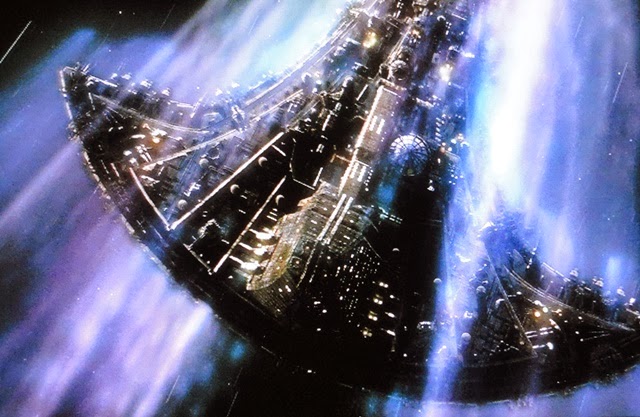
Perusing the web of late for reaction to SGU has certainly proved interesting.  It's surprising to see how many felt SGU was some kind of BSG clone on arrival.  As I noted in my look at Air, there was indeed homage stylistically via the camera work, but in no way do the two universes remotely resemble one another apart from the dark aesthetic and approach to the state of the art effects shots pertaining to the Destiny, which I love by the way.


Blu-Ray.com called SGU derivative of BSG and other science fiction. In fact, Kenneth Brown was less than enthusiastic about the scripts. Fortunately, for me, where others have perceived derivation I have found understated inspiration. SGU is the recipient of an already established mythology and plays within its own established rules and universe.  If anything it riffs on itself. But SGU certainly puts a new spin and astoundingly fresh approach on old concepts within the long-running series. And certainly the series is inspired by ideas and programs that have come before. But with a little patience and unexpected discovery I am quickly learning SGU was something special in its own right within the franchise and the genre itself.


From the opening moments of Stargate Universe, Season One, Episode 2, Darkness, it's a pleasure to see the fish-out-of-water scenario unfold as people legitimately struggle to survive, exchange good humor and natural banter rather than rapid fire comic quips.  Without question Stargate SG-1 and Stargate Atlantis had humor, action, conflict and character drama down to a formulaic science, but there is something much more authentic about the situational interactions aboard the Destiny.  There is a real sense that these strangers are getting to know one another. They are disarming each other with humor, but not taking the humor beyond the normal parameters of what might be perceived as funny in a natural exchange between people who are generally unsettled. The viewing experience is indeed refreshing and real.  It once again illustrates just how different Cooper and Wright and the creative team behind SGU were approaching their new concept.


Geek moments are appropriately comedic as even Eli Wallace expresses his natural geek intellect as many would referring to various sci-fi obsessions to lessen the palpable tensions.  In Darkness, Eli expresses a healthy respect for Planet Of The Apes and many of us connect to Wallace, though he's a math genius, as a projection of ourselves out there in the void.

Dr. Nicholas Rush takes his character to the brink exhibiting a mean streak in his frustration, agitation and general irritability over being tired and attempting to resolve power issues on the Destiny before they fail.  Water reserves are also fast becoming an issue but that theme is reserved for Episode 6, Water. But it's clever to see the series foreshadow struggles that would take greater prominence down the road in their journey.


Each single word title cleverly captures a general theme concerning the struggle of all those aboard the Ancients vessel.  And through each and every struggle we become even more invested in these characters wondering what exactly their destiny will be.

The characters continue to shine a little star light onto their lives and loves and continue to offer a little more depth with each new installment.  Utilizing the Kinos a number of secondary, recurring characters step up and record a small window into who they are for posterity.  Their hopes, dreams and fears are recorded as a time capsule in the eventuality their final fate awaits them prematurely.


Holy Toledo! Even Vanessa James is in awe of herself.


I continue to be blown away by how much I love the authenticity of this group of universally expert actors in their respective roles. Carlyle as Rush absolutely shines in his performance in Darkness and steals the first half of the episode.  Smith is excellent as the faith-based Matthew Scott.  Louis Ferreira ironically steps out of the darkness a bit more with his role as Everett Young. David Blue is infinitely likable as Eli Wallace and is no clone of SGA's fantastic Rodney McKay (not that you could or should ever have another).  Additionally, Chloe Armstrong and Tamara Huffman continue to exhibit signs of life.


Many were underwhelmed by Darkness further adding to criticism of the series. There is no telling the impact concerning the loss of formula from the original two Stargate series. It was no doubt taking its toll with fans and critics. Seeing Darkness for the first time, this science fiction fan was positively riveted with the stakes in play for those aboard the Destiny. The tension and the performances are handled with the steady balance of seasoned creative people with a plan and experience.


One notable moment in the final minutes of SGU really spoke to me. A final sequence captured the mood and spirit of the new Stargate and the potential ahead. Staring into the darkness all aboard stand at a window of the Destiny positively overcome by the beauty of gas giant.  They are in rapture over the beauty before them escaping the immediate concerns of this mortal coil for a few moments of release. It is this wonder of space that I have not seen often in the Stargate franchise or any other for that matter.  Quite frankly it was breathtakingly beautiful in its tenderness and simplicity and just capturing the beauty of the cosmos. The moment reminded me of the beauty surrounding Sunshine in this fashion or in the way Joss Whedon's series captured the elegance of space that surrounded the Serenity. One could even point to Doctor Who episode The End Of The World starring Christopher Eccleston and recall the Doctor with companion Rose in awe of space captured as poetry on film. In Darkness SGU takes time to see the light and there's hardly a note of darkness, like BSG, about that.


Veteran Stargate director Peter Deluise (who makes an appearance in the episode) really brings his A game and demonstrates what a capable and effective director he has become over the years framing and lighting the episode in keeping with its theme.  Brad Wright, too, writes another gem in Darkness, followed by its sequel, Light.

All of the performances, the visuals and theme are complemented beautifully by a striking score from Joel Goldsmith. Come one, where is that soundtrack people? The melodies are haunting and epic like Greg Edmonson meets Vangelis as siphoned through the mind of Goldsmith. It's just gorgeous.


Taken in total, the series has left me in awe of how expertly crafted each episode has been from opening to closing frame.  There's much to be said about experiencing a series like this on Blu-Ray too without commercial interruption.

Darkness is exceptional science fiction. The more deliberate, thoughtful pacing of the series is welcomed and should not be seen as a negative, but a stimulating and pensive rumination on space and situation for the survivors.  There is much hope and light to embrace in the darkness and, if anything, so far, Air and Darkness offer more than ample proof of that.


Darkness: B/B+.
Writer: Brad Wright.
Director: Peter Deluise.


Actress Ona Grauer appeared in SG-1, S6, Ep4, Frozen as well as SGA, S1,Ep1, Rising.


Utilizing the Ancient communication stones first introduced in SGA, S5, Ep18, Identity.

Director Peter Deluise (right) in action.


Speaking to an Ancient Kino. Actress Julia Benson appeared in SGA, S3, Ep3, Irresistible.


Friday, February 7, 2014

Science Fiction Non-Fiction: Kenneth Brown (Stargate Universe)

"It's time for another round of "Name That Show!" The category? Sci-fi dramas. Ninety seconds on the clock... and here we go. This steely SyFy series represents a game-changing milestone in a long-established franchise. In it, a massive spaceship is home to a band of human survivors who narrowly escape a devastating planetary attack. Its armed forces personnel are at constant odds with other members of the crew, and a precarious struggle for dominance soon develops. On one side, a stalwart military man who places honor and loyalty above all else; opposing his authority, a once-mild-mannered woman reluctantly thrust into a position of power when she's determined to be the highest ranking official left standing. Between them? A callous, arrogant, self-interested doctor clinging to his own shady agenda. The conflicts the crew is forced to deal with? Constant clashes between the ship's soldiers and scientists, emerging opportunists, waning morale, fading hope, the loss of vital resources, mysterious deaths, and a crippling fear that their journey might not bring them to Earth. The tone? Dark and bleak. The visuals? Gritty, minimalist, and draped in shadow. Alright, contestants... name that show! If you said Battlestar Galactica, Ronald D. Moore's groundbreaking 2004 reinvention of an aging pop culture relic... you're correct! However, if you said Stargate Universe, Brad Wright and Robert C. Cooper's 2009 offshoot of Wright's staggering ten-season-strong Stargate SG-1... erm, you're also correct."
 
-Kenneth Brown, Blu-Ray.com-


Brown is an excellent writer at Blu-Ray.com and he makes an effective argument for the similarities between Battlestar Galactica and Stargate Universe.  Framed in this way it's hard to deny his suggestion that SGU is nothing more than "derivative." Without question that aforementioned description tends to shadow both series in overarching generalities where it appears SGU has cloned BSG. Reading that assessment would hardly warm any discerning viewer to SGU, particularly if they didn't care for BSG.

To level that comparison is an unfair oversimplification when the substance of these two distinct universes tastes very different as a viewing experience with easily as many contrasts.

For starters, SGU isn't dealing with Cylons. The two series are both working in already pre-defined universes with BSG re-imagining the 1978 classic and SGU working within the rules of the Stargate mythology, and the endless sea of gates.

Are there questions of trust in both series? Sure. That's hardly a new idea.  The root of that distrust creates a very different impression between characters.

BSG was rooted in the idea of extremist transplants living amongst us in a post-911 world and the fact that they might actually kill you. Characters are on hyper-guard.  SGU's distrust is rooted in fear of the unknown. People are not on the run, but actually trying to survive and understand one another and their surroundings.  With SGU it's the frustration and helplessness of not knowing how to operate an alien craft and find a way home that affects judgment and behavior towards one another countered by one man with an insatiable appetite for exploration. Remember, the survivors on SGU are comprised of a sizable number of untrained and untested personnel beyond the usual civilian and military experts hardly trained for such a scenario.


Brown's humorous take more than suggests an overlap of inspiration from BSG. Given the proximity of SGU's release, it's easy to understand why and more than a little influence in tone or camera style may be leveled.

Does Dr. Nicholas Rush work as a version of Dr. Gaius Baltar? Certainly, but BSG is hardly a first when it comes to distrusting doctors. Rush could just as easily be a more complex variation on Dr. Zachary Smith (Lost in Space).

Stargate has also been co-mingling military and civilian dispatches long before Moore's story arrived. BSG executed many things brilliantly coupled with the political winds of the day, but to place it on a mantle as some kind of progenitor or antecedent would be false.

In other words, as director John Carpenter said in SciFiNow #33, "Show me a filmmaker that hasn't been influenced by Night Of The Living Dead."  There has been plenty to inspire SGU drawn from science fiction and those predecessors certainly predating BSG. Both series are more than one-dimensional owing plenty to that which has come before.

Are both series dark and bleak? Battlestar is truly the bleakest of the bunch. Babylon 5 and other series have offered their own share of dark along the way. But the media has its darlings, in politics and television, and, today, the darker the better in some eyes.


To be honest, and clear, I'm not sure dark or bleak are the correct adjectives to describe SGU.  It's certainly more grounded, realistic and thus more serious given the potential consequences surrounding the human struggle, but it's not dark and bleak in the strictest sense often associated with BSG. I mean to say that it doesn't feel pessimistic or nihilistic like BSG sometimes felt. There is a much more human thread in SGU thanks to the separation in approach from the comic book adventure touches of the previous two incarnations.

As Robert Cooper noted in SciFiNow #33, the approach to dramatic movement was as much inspired by shows like Firefly and The Shield as it was BSG.  The hand held camera approach, of which many attribute to inspiration from BSG, was an application that intrigued them for their own universe dating back to a number of other programs.  In fact, SGU's director of photography on Air actually shot the "documentary style" for The Shield. So creating "that sense of realism" is not new to BSG. The fact both shows implement it and are set in space created something of a protective backlash against SGU.

I don't discount Brown's above opinion. It's a good one and he's has an excellent critical eye. He knows how to make a convincing case and an argument can be made for the similarities. But SGU is not BSG and not by a long shot. They work, flow and function very differently as the sum of those comparative parts given the different variables working against them.


As much as BSG and SGU share common ground, the now cancelled SGU series feels remarkably different thanks to their respective mythological foundations.  The origin of these stories also informs how they reveal themselves along the way and those beginnings are unique and thus so are these respective serials.  The only way to fully understand is to experience both series for yourselves.  They are both worthy of your time, but SGU is no clone and while it may pay homage to a long legacy of science fiction film and television, or share a camera aesthetic with the likes of BSG, it is very much its own story.

One thing is clear, like my experience with BSG (most of the time), I am fully immersed in every detail and hanging on every minute of Stargate Universe, but the experience indeed feels very different from the former.

Thursday, February 6, 2014

SciFiNow: Top 10 Sci-Fi Anime Plus 10

Perusing my entire back catalog of SciFiNow magazines has revealed some missed treats from the archives worth considering here at Musings Of A Sci-Fi Fanatic. SciFiNow #20 (2008) features a Complete Guide To spread for Sci-Fi Anime. Time for another anime list.


I've delivered several lists in the past from Anime Insider here and here to my very own Animate! The Sci-Fi Fanatic BIG 20: Anime.  Still, I knew anime fans would enjoy yet another fine look at the always colorful and intriguing world of anime.


From that particular article, SciFiNow posted their Top 10 Best plus 10 additional favorites.  I've offered folks here at the site several starting points and opportunities to take a look at what is often considered some of the finest within the anime medium.  There are indeed plenty of launching points into the universe of Japanese anime. Here's yet another look.  These appear to be in no particular order.

1. Freedom (2007-2008).


2. Akira (1988).


3. Ghost In The Shell 2.0 (1995; an update of the original film).


4. Appleseed Ex Machina (2007).


5. Neon Genesis Evangelion: The Series (1995-1996).


6. Steamboy: Director's Cut (2004).


7. Laputa: Castle In The Sky (1986).


8. Cowboy Bebop: The Series (1998).


9. Final Fantasy VII: Advent Children (2005).


10. Mobile Suit Gundam Seed: The Series (1979-1980).


Adding to an already interesting and not unacceptable list above, SciFiNow added ten more impressive gems to wet your whistle.

10. Paprika (2006).


9. Dirty Pair (1985).


8. Bubblegum Crisis (1987).


7. The Girl Who Leapt Through Time (2007).


6. Cyber City Oedo 808 (1990).


5. Dominion (1985).


4. Spriggan (1989).


3. Urusei Yatsura (1978).


2. Patlabor (1988).


1. Doraemon (1969).


Surprisingly some of the aforementioned I've never seen, but once again, this is clearly a taster of what's available as written by SciFiNow contributor Tom Hopkins. The list is a little random and omits some of the very best, but it's still fun. It's also nice to see another perspective.


Personally, Neon Genesis Evangelion, Ghost In The Shell, and Patlabor are essential viewing.  The Girl Who Leapt Through Time is a sweet little film gem in the spirit of something by Hayao Miyazaki on a scripting and artistic level.  Again, there's plenty to try.