Tuesday, December 13, 2011

Star Trek: TNG S1 Ep10: Hide And Q

The return of Q was less than a titillating thought for me given I was not overly impressed with Encounter At Far Point. I was always a much bigger fan of that recurring Bond character and weapons designer of the same name.

The Q character, played by John de Lancie [Stargate SG-1], isn't completely devoid of good ideas particularly with its allusion to the more extensive association of the intriguing Q Continuum mentioned here early in the Star Trek: The Next Generation mythology. And de Lancie, always a strong choice in television*, is entirely believable with all of his dangerous and child-like enthusiasm.

It's worth noting the character succeeds despite more than a passing resemblance to William Campbell's Trelane from Star Trek: The Original Series' The Squire Of Gothos or even the concept of the powerful, spoilt child-like entity.

So, no, Q is not entirely original, but you can see the seeds of an effort by ST:TNG to take the idea further and expand on it.

Personally, Q's affection, desire and overall hunger for games as an avenue of discovery and learning does tend to grate on the nerves. On the other hand, "the play's the thing" sees Star Trek: The Next Generation, Season One, Episode 10, Hide And Q deconstruct Shakespeare and cleverly spin the theatrically-trained Patrick Stewart into a world of Shakespeare gone mad. "All the galaxy's a stage" recites Q.

One of the notable highlights for me from the episode that touched the nostalgia button was ST:TNG's use of set design. The simplicity of these production sets and the appropriate application of alien-pink, red or green backgrounds may send younger generations into fits of rage and discontent, but for the fan of classic ST:TOS the approach reminds us of just one of the outstanding qualities of ST:TOS. If the creators were purposefully attempting to recall the strengths of that original series with such designs to sell the show it works for this science fiction aficionado. Was it part budget, part homage? Perhaps it was a bit of both. Nevertheless, it is one of the few strengths of this first season that engages me and has me responding positively to its general recycling of ideas. Hide And Q, Skin Of Evil and other entries from Season One get the look of Star Trek almost right.

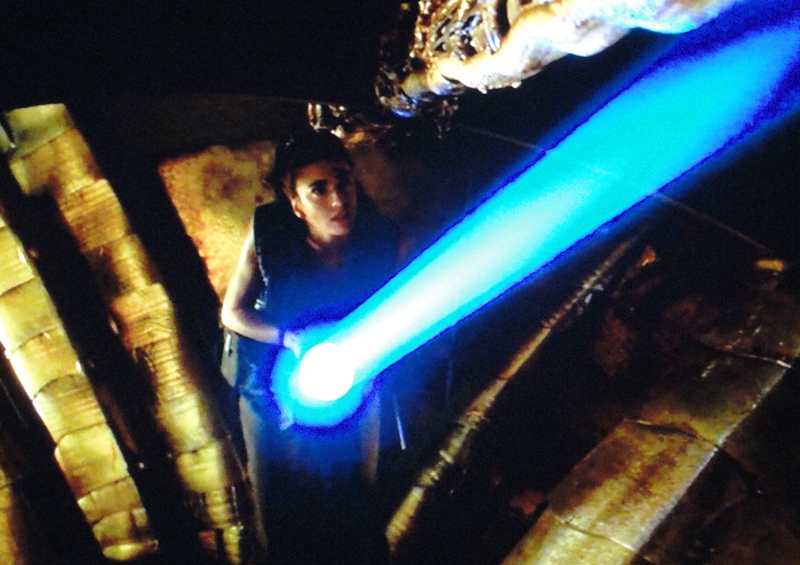
Commander William Riker is involuntarily put to the test by Q on a nearby planet, along with Data, Geordi La Forge, Worf and Wesley Crusher. Aliens in Napoleonic costume and gear complete with laser-powered muskets attack the away team. Riker is even given the power of Q. How will Riker respond to the elixir of power? Tasha Yar's sudden and inexplicable death in Skin Of Evil wouldn't be the first death of a crew member as Worf and Wesley are both bayoneted and killed by the alien infantrymen before the team's very eyes. The now powerful, god-like Riker, reacts immediately saving his friends and returning life to their lifeless bodies. Where is Q when you need him Denise?

Riker uses his great power to see to it the Enterprise-D reaches the ailing mining colony of their mission. There, a dead colonist girl begs the question if Riker will play god and use his power once again. It's hard to imagine a promise halting a good decision especially when considering how quick Riker appears to enjoy those powers a short time later. This one while philosophically in the right frame of mind doesn't quite sit right. It's a little too convenient. If the Prime Directive can be broken we can break that promise for the little girl just this once.


The simplicity of the planetary adventure is always a good one and I enjoy elements of its retro-look. But, like Denise Crosby's performance here and other still stunted elements to the infant series, Hide And Q never quite passes muster or hits its mark. Much of its weakness is generated from poor dialogue, which weighs down some good concepts. Writer C.J. Holland and Gene Roddenberry deserve credit for the effort, but just as much blame for its faults. It's symptomatic of the overall, overarching, usual lack of urgency or just plain compelling material found in Season One.

Just as Q continues his exploration of humanity, Hide And Q never moves the needle much beyond the antics of Encounter At Far Point, the series opener. Still, something about it is slightly more entertaining and to some degree less forced and for that the series is moving in the right direction. There are encouraging signs in character development too.

The idea of power and its use is central to the story's theme. The implications of altering what should BE comes into question. Captain Jean-Luc Picard cautions Riker about the use and application of that power clearly within the context of our human understanding and sense of morality. Q is attempting to influence human development and evolution. The interference by Q through the application of power puts Riker to the test. The story nicely posits the concept of events unfolding naturally and that we cannot change them and should not change them. This is not who we are. Picard understands this and mentors Riker appropriately.

Initially, Number One responds to the challenge with maturity and sound judgment, but ultimately makes entirely human mistakes and Hide And Q is a fine example of why Riker is Picard's Number One. Jonathan Frakes' performance is a highlight and there is great emotion in his eyes when he decides to respect Picard's direction despite some reservation.

As the entry proceeds it is clear Q's influence has a deleterious affect on Riker's thinking and his relationship with Picard. Riker begins to assume traits similar to those of the insolent Q. There is a selfish quality to his voice and his commands. It is a great illustration of power's drug-like influence. When Riker calls a meeting on the bridge he makes efforts to assure his bridge mates that he is the same man. He attempts to assure he has not changed, but in fact, it is clear he has been affected and the impact on those around him is palpable. Riker has the potential to become Charlie X or Q. They even begin to distrust whether he is entirely human within his frame of mind. Riker admits, "Everyone still looks uncomfortable." Picard responds, "power corrupts."

Riker, feeling a natural affinity toward the Q Continuum suggests they admire the human potential for "growth." La Forge posits whether or not is "fear" of humanity that motivates them.

When Q arrives, Picard questions his "need" for costumes. "Have you no identity of your own?," inquires Picard, a question that could be posed to ST:TNG as a series to this point. Our human identity is indeed unique and entirely different to that of Q. Picard makes efforts to remind Riker of this, of who we are and what makes us uniquely human. To demonstrate the point, Riker becomes Q's pawn. Riker offers his crew mates gifts authorized by Picard to teach Riker. Wesley becomes ten years older. Data is offered humanity to which he declines, because ultimately Data, one of the series most human characters, understands himself better than anyone what it means to be human. Data quotes Shakespeare to make the point of what it means to be. "This above all, to thine own self be true." The gift of sight is granted to La Forge who declines despite the beauty of that gift. "The price seems a little too high for me." The price of power is often at great sacrifice. Worf is granted the affections of a Klingon female to which he rejects her ovations. Worf has chosen loyalty to the Starfleet over his former home. The principled Worf continues to develop in his initially limited role.

Q's efforts fall flat as Riker learns a valuable lesson from those close to him. Q is recalled to the Q Continuum like a spoilt child that recalls the final moments of ST:TOS, Season One, Episode 2, Charlie X, an equally powerful and immature being in his own right. Data wonders how Q can manipulate space and time so easily. Picard closes with the kind of profound statement that to this point often seemed forced, contrived and overly political. This is a solid out and the kind of Picard that has been sorely lacking throughout Season One when he posits, "perhaps someday we will discover that space and time are simpler than the human equation." Hide And Q, while imperfect, ends stronger than most of Season One has revealed itself to date.

Hide And Q: C. Writer: C.J. Holland and Gene Roddenberry. Director: Cliff Bole.

*Actor footnote: John de Lancie [1948-present]. Q. Actor de Lancie is best known in a widely varied career as Q on Star Trek: The Next Generation and Frank Simmons on Stargate SG-1. But de Lancie has appeared on a host of interesting television and film efforts. On television de Lancie appeared in a number of genre classics beginning in the 1970s on The Six Million Dollar Man [1977-1978], Emergency! [1978-1979] and Battlestar Galactica's Experiment In Terra [1979]. He also appeared in Days Of Our Lives, The Thorn Birds [1983], MacGyver [1986], Murder, She Wrote [1986], Star Trek: The Next Generation [1987-1994], L.A. Law [1991], Batman: The Animated Series [1993], Picket Fences [1996], Touched By An Angel [1997], The Real Adventures Of Johnny Quest [1999], The West Wing [2000], The Practice [2001], Stargate SG-1 [2001-2002], Charmed [2004-2005], The Closer [2005], Breaking Bad [2009-2010] and Torchwood: Miracle Day [2011]. He's appeared in much more and has had roles in films as far flung as The Onion Field [1977] and The Fisher King [1991] to Gamer [2009]. His role as Q would feature in eight installments of ST:TNG including, Encounter At Far Point, Hide And Q, Q Who, Deja Q, Qpid, True Q, Tapestry and All good Things.... He would appear in one episode of Star Trek: Deep Space Nine in Q-Less. He would finally end his run with three episodes of Star Trek: Voyager in Death Wish, The Q And The Grey and Q2.

Friday, December 2, 2011

Wanda Ventham

It's FAB FRIDAY!

It's time for another look back at one of those special gifts from the wonderful world of Gerry and Sylvia Anderson. Wanda Ventham [1935-present] made a splash with her first appearance in UFO, Season One, Episode One, Identified as Colonel Virginia Lake. Like those UFOs she all but disappeared until her reappearance in the series with Episode 19, The Cat With Ten Lives. She proceeded to contribute to UFO as a major player with each successive episode until the series finale, Episode 26, The Big Sleep. She appeared in a total of 9 UFO episodes.

Ventham also appeared in several episodes of Roger Moore's The Saint [1962-1969].

In other notable science fiction appearances Ventham guest starred in the Doctor Who story the Image Of The Fendahl [1977] starring the Fourth Doctor Tom Baker. She also starred in two other Doctor Who entries opposite Second Doctor Patrick Troughton for The Faceless Ones [1967] and Seventh Doctor Sylvester McCoy for Time And The Rani [1987]. Each installment of Doctor Who arrived roughly ten years apart spanning thirty years.

But, yes, wanda, wanda, wanda! There really is no other fish called Wanda when it comes to the incomparable Wanda Ventham. She's like the epitome of 1960s and 1970s sex kitten. And for the ladies, she's the mother of Benedict Cumberbatch (Star Trek: Into Darkness).

It's a toss up for the ultimate in FAB between Wanda Ventham and Gabrielle Drake. Interestingly, Drake starred in ten episodes and Ventham in nine and the two actresses shared just one entry together, Identified.

Who gets your FAB award from UFO?


Wednesday, November 30, 2011

Farscape S1 Ep10: They've Got A Secret

It has become readily apparent to me, despite my late arrival to the series, that Farscape [1999-2003] has quickly attained the rank of one of my all-time favorite science fiction adventures based solely on Season One. Whether or not the series retains that affection beyond Season One is to be determined.

Farscape is at once an exhilarating thrill-ride and contemplative journey on ideas old and new. There is often a fresh new resonance to old concepts as well as unanticipated approaches to science fiction principles. there is no question the creators and writers spin ideas on their heads and often leave the viewer with unexpected revelations that defy expectations. The new Battlestar Galactica [2004-2009] took that same approach and worked wonders within Ronald D. Moore's mournful universe and reimagining of the more hopeful original by Glen A. Larson. Farscape defies similar probabilities by plopping our Earth hero in a topsy-turvy, far-out universe where even ships can give birth. Of course, with Farscape, there is a strange, but delicious balance, between the seriousness of situational drama and humor. Stargate Atlantis [2004-2009] and Stargate SG-1 [1997-2007] certainly used humor to great effect as well, but Farscape is just plain odd at times in the most imaginative of ways. That defiance of science fiction convention is what makes the series so special. You relish every unexpectedly colorful turn. Like the classic Star Trek: The Original Series [1966-1969], even some of the weaker moments in the series offer the science fiction fan something the eyes, ears and mind can celebrate. This is why Farscape ranks among the very best even next to the classics.

If there was ever pause to illustrate just how different Farscape is from any other science fiction series, it would have to be the latest installment, whereby the spotlight is on the living vessel itself, a Leviathan called Moya.

Starlog Magazine #261 really delivers on the premise that is genuinely highlighted in this episode. "Farscape is not a typical 'ship' show, like Star Trek. And the Moya is not a typical starship. 'This is not a ship a ship with any form of military hierarchy on board,' says O'Bannon. 'This isn't the Enterprise. This isn't Babylon 5." Indeed, there's rarely anything typical about this sparkling series. Farscape is the real deal and like the unique mothership that is Moya, this is a one of a kind series all its own.

Welcome aboard. It's Farscape, Season One, Episode 10, They've Got A Secret. For a series so utterly filled with aliens and technicolor it never ceases to amaze me how Farscape is perhaps one of the most human science fiction adventures ever created. It takes human ideas, concepts and realities and dresses them up like no other, but it maintains all of the emotion that we as humans connect to. The creators never veer away from the emotional core of its cast of characters making it all the more real.

The entry begins as the crew attempts to locate installed or semi-installed Peacekeeper devices that have been sewn into the ship that is Moya. Peacekeeper technology was integrated within her.
Despite John Crichton's observation that the team remains in the Uncharted Territories, Aeryn Sun wisely cautions that Moya could get close enough to Bialar Crais to cause re-activation of some of the Peacekeeper mechanisms aboard her.

Ka D'Argo informs Pilot he has discovered some on-board Peacekeeper equipment. Despite Pilot's inaudible instructions he attempts to remove it physically. He is shocked, rocked back and thrown deep inside Moya sliding through a long shaft to an eventual halt. D'Argo proceeds to kick out a Peacekeeper plate causing an explosion, which jettisons him outside of the ship purging him like excrement to a potentially grim fate. The episode offers Moya a physical sense of dimension and the sloping effect of corridors gives viewers a genuine feel of space and internal structure to the living ship.
D'Argo is picked up in his floating frozen state and returned to Moya after 30 minutes in a miraculous life-saving attempt. Efforts at reviving D'Argo return him with smiles as he looks into the Delvian P'au Zotoh Zhaan's eyes and recalls his former lover Lo'Laan.

Meanwhile, our dear Leviathan shakes and rumbles. Crichton is concerned about Moya. Pilot is uncertain and Crichton wonders if Pilot is well. Pilot indicates D'Argo's last known location was Tier 21 speaking to a tier system within Moya.

Pilot is attempting to send DRDs [Diagnostic Repair Drones] to assist Crichton and Sun who are investigating. Unfortunately all is not entirely well with Pilot. As a creature sharing a symbiotic relationship with Moya, he is feeling uneasy clearly affected by whatever it is troubling Moya.

Crichton is bemused by the very fact he walks within a living ship and can only make a comparison from his world to Jonah and The Whale. The reference is to an Israeli prophet in the 8th Century B.C. from The Book Of Jonah who was swallowed by a big fish or whale. The same reference could imply the scenario created for Walt Disney's Pinocchio [1940]. There's further suggestions that reminisce of Richard Fleischer's Fantastic Voyage [1966] and the idea of exploring the internal complexity of the living body. Here, each week, we have a team, a family literally living inside a creature. They've Got A Secret amplifies that suggestion as powerfully as any episode to date. Though, Episode 3, Exodus From Genesis is perhaps the greatest complement to this sense of physical exploration, which makes sense given both episodes share the same scriptwriter.

When Crichton and Sun do find the DRDs they are busy repairing a hole in Moya. They in turn strike Sun with a purple glue-like substance. Crichton intervenes before further damage is done. The DRDs, Moya's answer to the human autoimmune system, protect her, but why are they attacking her previously acceptable passengers?

Crichton finds Zhaan who is attempting to work on the unconscious D'Argo. Crichton presents the purple "superglue"-like substance to Zhaan in the hopes she may have some ideas so that he might release Sun who is stuck elsewhere.

Zhaan is unable to raise Pilot. It appears D'Argo ingested some bioparticles that were clearly part of Moya's defense system or body during the explosion.

Finally, Sun is able to break free from the purple jello mold thanks to a Zhaan-concocted solvent applied by Crichton. Sun and Crichton wonder if it's not a viral weapon implanted by the Peacekeepers. Is it bio-mechanoid or something more capable of affecting Moya as well as Pilot and D'Argo. All kinds of hypotheses are bandied about as the crew of Moya is left to scratch their heads.

Escorted to his quarters D'Argo dreams of Lo'Laan and looks lovingly at Zhaan who goes along with his delusions, like a daughter or son might with their aging parent. Zhaan finally asks "Who is Lo'Laan?"

Elsewhere, Crichton learns how Sebaceans are inoculated against "Space-transmitted diseases" as he calls them. Crichton is moved by the advancements in this farscape. "Disease and death are rampant on my world." This is a terrific little scene delivered by Ben Browder with his usual twist of wry humor at the end.


Things continue to go from bad to worse concerning Moya's functionality within established norms. Refrigeration is down and something smells in Denmark. Pilot reports to Crichton and Sun that he is seeing intentional signs of sabotage to Moya. Crichton even notes the DRDs are repairing one another. The DRDs see their humanoid passengers as something of a foreign, potentially harmful invader to Moya.

Pilot is sick. His vitals are weak. Sun is able to take Pilot's controls and get things stabilized on the rocking ship. In a nice bit of arc-building and story connectivity, Crichton tells Zhaan he suspects Sun has some natural inclinations to work Moya's controls. Thanks to the Pilot DNA insertions made on her while in the care of Namtar in Episode 9, DNA Mad Scientist. There's an interesting interrelationship between Sun and Pilot that will be revealed in Season Two. Zhaan insists Pilot's biological influence was flushed from Sun's body. Crichton isn't so sure.

Moya is quickly usurping all control of her vessel's functions. Atmospherics is all that remains.

Rygel arrives in D'Argo's quarters snooping around the goods because Rygel, to this point, is undeniably the most self-absorbed of the crew. D'Argo awakens and calls him Jothee and demands he come close to him. D'Argo hugs Rygel. D'Argo continues his fantasy speaking with his perceived son Jothee and offers the viewer information concerning of his life prior to his arrival on Moya.

The lights and air are begin to cease function. These facilities merely benefited the crew, as part of the symbiotic connection, and Pilot controlled these functions. Pilot is currently unavailable and Moya is in charge.

Sun reports that Pilot's blood is nutrient-starved. Crichton suspects a virus and humorously pipes to Sun then "get him some nutrients."

Zhaan has determined this is not the work of a virus, and that particles are distinctly Moya-derived. Sun investigates further.

Rygel is tucked in by D'Argo under the illusion that he is Jothee. D'Argo continues pining for Lo'Laan.

Crichton finds D'Argo and tells him things are pretty dire, but Crichton is perceived by D'Argo to be Mackton, the disapproving brother of Lo'Laan, the woman D'Argo married. Slipping from his delusion, D'Argo informs Crichton he saw a Peacekeeper shield "holding something back" down in the shaft tier. His clarity is ephemeral. D'Argo isn't much help as Crichton calls him "short-circuited."

Crichton is blocked by DRDs and must find another route. Sun is doing her best at the controls. Finding another route, Crichton runs into hundreds of DRDs clearly in a defensive posture. It's like Harrison Ford running from the Stormtroopers in Star Wars as they fire upon him and he makes a run back sliding toward the entrance hole where he is greeted by more DRDs on the other side. Sun manages to shut down the DRDs. Sun explains the DRDs are vital to services. There is still a lack of clarity by the crew over the DRDs new found role. Everyone is still in the dark concerning Moya.

Zhaan, Crichton and Sun attempt to make sense of Moya's intentions regarding the DRDs. Is Moya trying to kill the crew?

Crichton wonders if shutting down Moya might not be the only way to save her "and us."

Elsewhere, Rygel is getting a piggyback ride as that subplot continues. D'Argo arrives with Rygel in command and turns to Zhaan whom he believes to be Lo'Laan and he kisses her. It is a sweet, loving moment as Zhaan not only allows D'Argo his brief moment of happy escape, but seemingly allows herself one moment of flight too. It is gentle. It is kind. It is loving. It is Zhaan who gives him that. This is the kind of emotional current the writers find time to inject into the often strange proceedings. Through all of the tension and ignorance over the criticality of their situation the writers find that opportunity to break down the character walls.


The folks behind The Muppets rarely hesitate to infuse, inject or insert ;) sexuality or sensuality into this Farscape. Amidst all of the crew's problems, D'Argo reveals much about his past in the episode including the death of his wife at the hands of her brother Mackton. Heartbreakingly, D'Argo sent his son Jothee away against his wishes because he was charged with Lo'Laan's death despite his innocence. D'Argo reveals much to his crewmates as they mirror aspects of his past life. Mackton arrested D'Argo. Mackton was a Peacekeeper. Mackton was Sebacean. Lo'Laan was Sebacean. Tears fall from Zhaan's eyes with this discovery. Powerful family secrets are revealed as the running theme in They've Got A Secret.

Sun informs the crew she has found the physical connections to Moya's higher functions. In order to sever the link she must physically cut them. This is significantly traumatic. Once again, the surrogate family is faced with another violent physical act reminiscent of the act forced upon Pilot in DNA Mad Scientist. Sun refuses to do it alone unless everyone agrees. "This isn't my decision alone. If I do this, we all have to be apart of it." They do. This is just one more building block between this group of survivors who continue their journey learning about what each holds dear in their hearts. How far are they willing to go in making dramatic, severe decisions?

Crichton heads into the shaft. Sun has cut through the protective casing of Moya's system cables. Once again, it's worth noting the sets and the colors. Crichton's space suit is exquisitely conceived and is notable in a long line of amazing spacesuits to grace science fiction television from Star Trek: The Original Series to UFO and Space:1999 or Battlestar Galactica to Stargate Atlantis. Each have produced some incredible costume designs. Farscape is populated with beautiful production work.

Traipsing down the inner walls of Moya's (uterus or intestine?) internals, Crichton discovers something very special indeed. As Sun begins cutting Moya's higher functions, Crichton announces something profound. Moya has a baby! Moya is pregnant! All of the the hypotheses that seemed so logical throughout the episode go out the window. Moya has been simply trying to protect its unborn child and its efforts to nurture the baby Leviathan. As Sun nearly finishes the cutting of the life-giving cables, everyone shouts for her to stop! A baby's life depends on it! Sun ceases just shy of inadvertently taking Moya's child.

This is a powerful moment of realization.


Like Star Trek: The Original Series Farscape is an unabashedly great looking production filled with color. The suggestion of abortion and that accompanying debate is not lost. There is a visual and atmospheric intensity here that speaks to that issue and how life and death here resonates in the future landscape of Farscape and the survival of Moya's offspring will be revealed in time. Such ideas are always powerful and profound. Consider the late Steve Jobs born in 1955. No one can deny the global impact of the man on technology and the way we communicate and yet his parents immediately placed him up for adoption rather than resort to abortion prior to his birth. This is certainly a considerable reality for reflection. In the fictional universe of Farscape, what will decisions of the crew mean going forward?

Crichton reaches Moya and somehow Moya is taught to understand their symbiotic relationship may persist and endure without harming her unborn child.

Pilot explains his role to Crichton that he is there to serve Moya and "she may do whatever she feels is necessary to ensure her survival." This extends to the fetus, which is alive and well.

Crichton believes The Peacekeepers didn't want it to happen. Efforts were made to prevent reproduction.

Sun inquires if D'Argo is okay and he thanks her for saving him in the Prowler.

This is a powerful exchange that speaks volumes about the barriers that are falling between these comrades on the run. Sun is changing and this openness is leading to a softening in others like that of the warrior heart of D'Argo. These are the moments that build friendships and families.


While the entry tackles the concept of health and disease, it is a red herring for something far more logical and beautiful - the gift of life. This natural reaction of a mother to protect her young is mis-perceived throughout the entire episode. As lives are nearly snuffed away, the secret is discovered that these were but actions of an overprotective mother. What greater presentation of the things we as humans value and connect to so vividly than the maternal nature of a living ship. Once again, as far out as Farscape takes us, it somehow manages to keep us close thanks to its extraordinary ability to present human pain, joy and celebration in such an inventive and magnificently affecting and real manner. Our courageous ship and crew harbor many secrets and, yes, they've all got them from Moya to D'Argo and everyone in between. Don't we all? Does it get more human than that?

Director Ian Watson was brought on board for the entry as a character-centric, performance director. The creative team behind Farscape looked to place some of the action-oriented artists, Tony Tilse, Andrew Prowse and Rowan Woods on hold, to breath life into the entry, and breathe life they did. This would be Watson's first of many directorial entries in the series. Ironically, this solid entry would be writer Sally Lapiduss' second and final outing for the show following her other worthy tale, Exodus From Genesis, but she certainly lends the story a sensitive, maternal touch amidst the general Farscape pandemonium.

Looking at the big picture, They've Got A Secret places the child at the center of the story, D'Argo's son Jothee, and more importantly Moya's baby. Could the symbolism of such a moment be any less significant for the crew that is Moya? Children are at the heart of any family. The crew of Moya are now actively looking to protect one of their own together. With the Peacekeepers on the prowl, they've got a very big secret indeed.

They've Got A Secret: B. Writer: Sally Lapiduss. Director: Ian Watson.

Pop culture reference: John Crichton: "Is there some kind of What To Expect When You're Expecting A Baby Leviathan book - Dr. Spock, Mr. Spock?"

Director Footnote: Ian Watson. Director of 15 episodes of Farscape. Four episodes in Season One, four episodes in Season Two, five episodes in Season Three and two episodes in Season Four.

Monday, November 28, 2011

The Courtship Of Eddie's Father Theme

This will bring back memories for some. This is the delightfully charming theme song to The Courtship Of Eddie's Father [1969-1972]. The series ran for three seasons and 73 episodes. The series starred Bill Bixby.

As an homage to Bixby I intended on putting this up about a week ago. It was November 21, 1993 that Bixby passed away succumbing to cancer at the premature young age of 59.

There are actors, singers and icons in your life that remind you of a significant period in your existence, a time that became part of the fabric of who you are for a span and Bixby, for me, was one of those people. Apart from his, well, incredible run as Dr. David Banner on The Incredible Hulk [1977-1982], Bixby also played Tom Corbett on the unforgettable series The Courtship Of Eddie's Father that switched up comedy and drama with seemingly relative ease. There were moments in that series that spoke to the many childhood dilemmas and troubles one faces in youth. Bixby always handled those delicate quandaries with sensitivity and sincerity. The Courtship Of Eddie's Father remains one of those series that had a profound effect on me as a child. We all have them. As insignificant as the series may be to most, it arrived at a good time in my own life and clearly influenced my own view of the world. And who says TV doesn't influence?

The theme song was comissioned, written and recorded by Harry Nilsson, but was surprisingly never released on record. Here's that classic, elusive theme song, Best Friend, and a sample of the show's always original openings.

Thursday, November 24, 2011

Thanksgiving

Happy Thanksgiving.


Wednesday, November 23, 2011

Star Trek: TNG S1 Ep9: The Battle

As I continue my season long disappointment with Star Trek: The Next Generation, Season One I kept thinking about an interview I recalled with actor Martin Landau concerning his disappointment over the writing and some of the scripts that were assigned to him for his two year stint on Space:1999. As a fan of that series I have always been mildly saddened by his remarks suggesting the stories weren't good enough. Landau may have a point about some of the character elements in that series maybe not getting enough traction as far as development. But, I can imagine Landau, had he been assigned the role of Picard, might have had a few things to say about ST:TNG Season One as well.

Season One of ST:TNG makes the character development on Space:1999 feel like five seasons of Babylon 5. How about even a half season of Firefly? Okay, I'm exaggerating a bit here, but Space:1999 always did get a bum, undeserved wrap.

How is it, for whatever reason, ST:TNG always manages its way into the upper echelons of science fiction lists despite the weight of its first season, an unbalanced second season and a good number of lemons to boot along the way? To quote Obi-Wan Kenobi in Star Wars Episode II: Attack Of The Clones, "Curious?"

With all that Space:1999 achieved in two years as far as establishing an original mythology, a strong vision, a cast of intriguing characters with great potential and amazing visual effects, arriving over a decade before the first episode of ST:TNG aired, I wonder how it is this miracle series is continually relegated to a status far below that of ST:TNG? Would ST:TNG make the top ten lists based on its first two seasons? I suspect those are questions in this universe that shall forever go unanswered floating like endless stardust into the black void of space.

In fact, it's interesting British mastermind Gerry Anderson picked American thespian Martin Landau, while Gene Roddenberry selected British stage actor Patrick Stewart to helm and steer their collective ships. Both are incredibly strong actors. Just as Landau housed doubts about Space:1999 going into that unlikely commitment, Stewart too understood Star Trek: The Next Generation as a healthy pay check and secretly pondered the unlikely potential to go beyond one year, never mind the intended six year plan. You just never know.

What Landau and company achieved in just two seasons for Space:1999 versus what it took those backing ST:TNG to achieve over the course of seven seasons, one could argue Space:1999 was largely a bigger success despite cancellation. Let the debate begin. On the other hand one could argue Space:1999 might have achieved even greater heights had it gone seven years. Can you imagine? Oh the places we could have gone before.

In the meantime, we reach the ninth installment of Star Trek: The Next Generation, Season One, Episode 9, The Battle. Space:1999 delivered a classic called Force Of Life for its ninth installment. Does ST:TNG deliver as big at this point as Space:1999 did back in 1975?

"Ugly, very ugly" declares one of the equally distasteful looking Ferengi, a race of profiteers and traders, over the free offer by one of their own of Picard's old vessel the U.S.S. Stargazer. It's a derelict ship offered to the crew of the Enterprise-D.

The Captain is experiencing mental breaks with reality and reliving moments from his past aboard the Stargazer, abandoned nine years earlier by Picard and his then crew.

The Battle of Maxia. Data retrieves and reveals records that indicate Picard fired upon and destroyed a vessel while under a flag of truce. Audio files reveal Picard's voice, but Picard has no recollection. DaiMon Bok has forged the audio recordings. How?

Picard continues to suffer bouts of headaches. The question remains, how are the Ferengi responsible? Riker intervenes contacting the silly Ferengi prompting one to respond, "I'm all ears."

As Picard experiences mental conflict thanks to the Ferengi's manipulations of the Captain I couldn't help but feel a certain deja vu. The Battle was beginning to exhibit elements of schism reminiscent of Season One, Episode 5, The Enemy Within and Captain James T. Kirk's own psychic battle of sorts from Star Trek: The Original Series. It's very subtle.

Picard transports over to the Stargazer where this tale of revenge becomes more and more evident. Ferengi DaiMon Bok is looking to exact revenge on the Captain who took the life of his son during the Battle of Maxia.

The early boyish look of the always capable Number One. The Stargazer approaches the Enterprise-D. The Ferengi plan, the act of one sole Ferengi, outside the blessing of his comrades, is to see Picard destroyed. A thought maker is discovered in Picard's quarters. The device is altering Picard's good sense as he plans to fire upon the Enterprise-D leaving them no option but to fire back in self-defense ensuring certain death for Picard.

The Ferengi Captain, DaiMon Bok, is incarcerated for engaging in "this unprofitable venture." The Ferengi are clearly disgusted by their colleagues actions in using their resources for a personal motive. It is noted there is no profit in revenge as Picard agrees, "there never is." "Let the dead rest and the past remain the past." The thought makers are destroyed and Picard is saved. The episode does offer a little more information regarding the motivations of the Ferengi, but it doesn't make any more entertaining. No worries though, DaiMon Bok returns for Season Seven, Episode 22, Bloodlines.

Denise Crosby seemingly confused and uncomfortable in her role throughout Season One. There are certain aspects to Stewart's performance as Picard, Jonathan Frake's Number One [often finding himself in the tightest and most difficult of situations alternating between taking orders and giving them at the drop of a dime] and supporting roles from Gates McFadden and others that are entirely natural and strong on their own. Unfortunately, once again, the material here is weak and not entirely convincing particularly with the laughable thought maker as a storytelling device.

Seeing the return of the Ferengi offered me little comfort since their abysmal introduction in Episode 5, The Last Outpost. Thus far, the Ferengi have been poorly implemented as a race within the ST:TNG universe. Where is the Borg when you need them?

In the Star Trek: The Next Generation Companion, writer Larry Nemecek made note of Rick Berman's accurate reflections on the Ferengi dubbing them a "disappointment as a major adversary" and ranking the creatures high on the "silliness quotient." I couldn't second that emotion more.

There is little, credible logic to some of the shifts in the story. Picard verbally shares the famous Picard Maneuver and demonstrates he does indeed have the ball... wherewithal when required. At this point, you can only hope it's not just a story.


The idea of Picard as a sound tactician and captain has yet to be fully revealed. This is certainly a sticking point regarding the politically correct, ever so contemplative Captain thus far in the series. But far be it from me to be too hard. He is a Starfleet Captain after all and he had to be on the ball most of the time to get there.

Director Rob Bowman returns for his second outing following Episode 6, Where No One Has Gone Before. The Battle is a step back. Stylistically the episode isn't poorly constructed, but Bowman is working with thin material here. Bowman wouldn't truly shine until he took the reins of what I consider to be the season's hallmark, Episode 20, Heart Of Glory.

The Battle is both a mental battle of Picard versus Picard, but is far from the engaging Kirk versus Kirk of The Enemy Within. Mind you, both are entirely ludicrous, but Star Trek: The Original Series sold the idea and made it incredibly entertaining thanks to a script by Richard Matheson. The Enemy Within, did so much more with the dichotomy of the Captain's character, however great the impossibility of its science fiction. At least it was extraordinarily good fun. Even The Battle isn't a very convincing battle as battles and revenge tales go. Granted the title, The Battle, is as much a reference to Maxia as it is any present struggles. Is this the best you've got!? As much as this as much a mental battle as a physical one, Picard's maneuvers aren't enough to engage the viewer. Once again, ST:TNG misfires in its lackluster first season run.

May the legendary Picard Maneuver lead us to the light at the end of a fairly dismal Season One tunnel and right this ship.

The Battle: C-

Writer: Larry Forrester & Herbert Wright. Director: Rob Bowman.