Wednesday, October 6, 2010

Starman

"We are very civilized, but we have lost something. You are all so much alive, so different. I will miss the cooks and the dancing and the singing and the eating" - Starman-
*
I know. It comes as no surprise, predictable even, that The Sci-Fi Fanatic should go ahead and select Director John Carpenter's Starman [1984] for the official Radiator Heaven John Carpenter Week blogathon. My efforts to select a John Carpenter film were pained, a bit tortured even. Carpenter's filmography is so strong it was hard to select just one. But, as love stories go Starman may be perfect. In some ways, Starman is the anecdote, or the anti-Carpenter, a far more hopeful and pretty picture than we are normally accustomed to seeing from THE Man.
*
Carpenter's The Thing [1982] is one of those films that shaped my childhood. Escape From New York [1981] was another of his classics. Finally, Big Trouble In Little China [1986] concludes a trilogy of some of Kurt Russell's finest work, all with auteur John Carpenter. These were films that resonate with me today. My love and affection for the Russell/Carpenter marriage began with their ABC film Elvis [1979]. Those Russell films aside Carpenter has delivered a long line of essential pictures. Assault On Precinct 13 [1976], Halloween [1978] and The Fog [1980] with Jamie Lee Curtis, Prince Of Darkness [1987], They Live [1988] and In The Mouth Of Madness [1995] with Sam Neill are generally high on any fan's film list. His work has been the inspiration of endless remakes and/or riffs of his work, likewise Howard Hawks and others have served as Carpenter's inspiration. For a wonderful appreciation of Carpenter's rich history be sure to check out Author John Kenneth Muir's The Films Of John Carpenter [2000]. It's a tough book to put down.
*
I was torn on what to discuss here. There is, of course, Prince Of Darkness [1987]. This was a film I visited while in theatres and about ran me out of the cinema because it was so damned frightening. I wasn't sure I could articulate just how damn disturbing that film was to me. Perhaps someday I will, but when the character, played by Lisa Blount, was controlled by Satan my heart was breaking. When she ever reached into that mirror to take Satan's hand and bring the realization of evil to apocalyptic fruition I was paralyzed. Finally, pushed through the mirror to the underworld, with the mirror broken, we had the image of Blount sinking in some kind of evil, primordial fluid being pulled down by her master. What left such a mark on me with that film was that the Lisa Blount character appeared to awaken from her Satanic control. Her hand outstretched pleading for help back toward the mirror, the doorway to life gone, she appears frightened, alone and it is that moment of the film that left me scarred for years. The build to that singular moment when Blount's character was lost to unspeakable evil with no ability to return left me completely shaken. Ultimately, I decided not to write about Prince Of Darkness, but I share that traumatic moment with you just the same.
*
In the middle of all of this incredibly well-executed darkness, tension and the unnervingly frightful thrills came a little film called Starman. This film was by all accounts a love story, filled with love and light and hope. Back in the day, the last thing I fully comprehended was that the film was actually directed by none other than John Carpenter. THE John Carpenter of "You've gotta be fucking kidding me" The Thing fame. Yes, the same John Carpenter where a grandma stood near a fog-filled door, while a young boy sat hiding in terror. Yes, John Carpenter who made street punks and gang members in New York freakishly creepier than creepy. Why on Earth would John Carpenter direct Starman? Was he on a drug-addled binger? It was such a change of dramatic pace and a radical departure, an about face from his previous work, Starman almost seems out of place. Despite a clearly brilliant, but young career, John Kenneth Muir suggests the director was appearing "pigeonholed." One suspects John Carpenter was looking to shake it up, and perform an unexpected genre-busting, auteur-defying act by offering fans a love story within the context of the Carpenter touch. Okay, so he did Elvis [1979], the film that kick started the Carpenter/ Russell love affair, but on the whole Starman just didn't feel like John Carpenter on film on its surface. Look a little deeper and the auteur's hand is definitely guiding this alien enterprise.
*
Once again, from his thought provoking, well-researched, informative tome, The Films Of John Carpenter, Muir makes an interesting point. Carpenter's films are "consistent" and Muir references Actor Kurt Russell once making the same observation that Carpenter was one of the most recognizable and instantly identifiable of the auteur-styled directors. He points to a distinctive "personal ethos" behind his work, which makes Starman all the more curious. Carpenter made a play within the Hollywood game to change expectations up following the critical backlash lambasted upon The Thing and the quieter follow-up Christine [1983], based on the work of Stephen King, with something tangibly different from the horrors associated with his oeuvre. Ultimately, as a result of Starman's modest success, Carpenter was asked to continue his run in Hollywood outside of that trademark "ethos." Carpenter was offered other films like Fatal Attraction [1987] and H2O [1998]. But it becomes apparent with Big Trouble In Little China [1986] and Prince Of Darkness [1987] Carpenter was interested in returning to his own unique creations and the things which makes him tick. All of this leads me to believe Starman was essentially an aberration, albeit a beautiful one, under the steady direction of a special director.
*
Another reason I selected Starman was to give it another visit. Until this writing I had only ever saw Starman one time. To be truthful, I was never particularly fond of it. It never grabbed me in the way John Carpenter films grabbed me or scared the shit out of me. It just never left a huge imprint. When it was released on Blu-Ray I had little desire to pick it up or give it another try that was until John Carpenter Week hit me like a bolt from the blue. In the end, Starman seemed like my chance to analyze it through wiser, more potentially perceptive eyes. I considered that perhaps I never fully appreciated the film's substance as a younger man. The year was 1984. High School was a struggle. Duran Duran reigned and I was attempting to find love [of a sort] myself. In the end, this was my opportunity to revisit the strange film called Starman.
*
Another facet to the film was that it starred the always engaging actor Jeff Bridges. Jeff Bridges had to have been an interesting choice for Carpenter. The actor has a very natural, likable quality that is entirely comparable to Kurt Russell. I wonder if Russell was unavailable. Russell was getting busy with Goldie Hawn over on Swing Shift [1984]. Nevertheless, if I wasn't going to tackle a Kurt Russell/ John Carpenter collaboration, Jeff Bridges was the next best thing. He's had an endlessly fascinating career and I have admired his work in much the same way, both just years apart in age [Russell born East Coast, Bridges born West Coast]. Bridges easily ranks among my favorites and the opportunity to revisit one of his films I didn't fully appreciate seemed like a good idea. I thought that I must have missed something special in this picture back in the day.
*
Bridges, like Russell has a long list of films I treasure. If I had to choose favorites between the two it might be close. Russell would have the edge, but Bridges is a seasoned remarkably natural actor with an equally mesmerizing charisma. This is why I was so surprised by my lack of affection for the film when I initially viewed it. The studied, mannered, deliberate almost method-like approach to his character in Starman with his ticks and mannerisms didn't quite appeal to me then. But that was then and this is now. I might feel differently.
*
Kurt Russell's film resume is sick, but I believe Jeff Bridges comes close. For me, Fearless [1993] by Director Peter Weir and Terry Gilliam's The Fisher King [1991] rank among my personal favorites. Of course there are films like Ridley Scott's White Squall [1996] and Jagged Edge [1985] that are solid and endlessly entertaining. As he prepared for Starman, Bridges was hot property and came off minor film classics like Tron [1982] and Against All Odds [1984]. With Starman Jeff Bridges was nominated for a Best Actor Academy Award and Golden Globe Award. He took home a Saturn Award for Best Actor. He lost the Academy Award that year to F. Murray Abraham for Amadeus. He lost in good company with Sam Waterston who was nominated for The Killing Fields. Some decried injustice. We're about to find out.
*
Starman also features Actress Karen Allen in the sharing of top bill. The spitfire actress has never fully captured me even with Raiders Of The Lost Ark [1981], but again I was young and naive. There is indeed a certain likability factor to her talent. There is something raw and sexy about her. It will be interesting to see how I respond to her and the chemistry between her and Bridges. Starman cometh with spoilers.
*
A transmission from Voyager 2 requesting life forms visit the planet Earth reach deep space. Voyager 2 sent those transmissions in 1977. Well, life has received that request and arrives on Earth in the form of a Starman looking like Jeff Bridges. On Earth, Jenny Hayden, played perfectly by Karen Allen [an actress I truly underappreciated once upon a time], looks achingly, longingly at earlier film footage of her with her now deceased husband, Scott Hayden, also played by Jeff Bridges. She misses him and is clearly in a lost and lonely place without his company.
*
The alien ship is picked up on radar and jets are dispatched. The ship crashes in a fiery blaze near the home of Jenny Hayden. A bright, shapeless, blue light is drawn to her home. It is night and Jenny lays [with terrific, bare, naked legs mind you] restless. The mysterious arrival enters her home and absorbs information happening upon photos and a strand of hair from the late Scott Hayden. The creature assumes his physical appearance in a creepy little, An American Werewolf In London-like transformation. There is an intimacy to the proceedings that is both eerie and quintessential Carpenter. He brings his unique touch transforming even this picture from standard, sappy, sentimental Hollywood fare into something real and genuine on an emotional level. Jenny witnesses the alien child grow within seconds into her late husband. She is both disturbed, stunned and intrigued. As any human would react, Jenny immediately grabs her gun prepared to kill this bizarre intruder. Unfortunately how do you kill something with the face of the man you loved? She knows this thing is not her husband, but her mind is overruled by her heart and the desperation of wanting to see him again. Despite the fact it is entirely illogical, Jenny yearns to see her husband despite knowing it can't possibly be.
*
Bridges spent many weeks observing small children to master their linguistics and/or movements to capture the actions for his newborn-type reality. His performance is never static throughout the film. His transformation, as he learns, becomes more fluid, but it is ever so subtle or restrained. It is a nuanced, delicate, gradual performance that he nails. The alien visitor has come to, well, just that- visit. Bridges creates an incredibly believable, alien creature that has taken up residence within the vessel of a human figure. His movements, facial ticks, twitches are like that of a squirrel or gecko to give the impression of something entirely alien. Bridges was nominated for an Academy Award for his performance for a reason, one of the best foreign, fish-out-of-water roles that I can recall. Passed out in the corner, overwhelmed by her discovery Jenny sits in a heap, while the alien absorbs her home videos. There are sequences that play out almost documentary-like as if a study in human behavior.
*
Jenny awakens and rushes to her car intending to run. Starman picks up new objectives. Emergency Transmission. Observation Craft Destroyed. Environment Hostile. Completed Symbiotic Transformation. Rendezvous Third Day Landing Area One [Arizona].
*
Jenny and Starman ride off in her classic, orange red 1977 Mustang Cobra [shhweet!] away from Ashland, Wisconsin. The radio reports of a meteor crash. Once again, Carpenter underlines the distrust of the government entity so prevalent in his work. You will never hear the truth. Elsewhere government officials probe the crash site, while the public gets an entirely different story.
*
In a desperate effort to escape, Jenny drives her car toward an oncoming van to get their attention. A man with a tire iron gets out enraged. Jenny screams she is being kidnapped. The man with the tire iron tells Starman to let her go. Starman utilizes his awesome power to frighten the would-be savior away with a melting tire iron and an explosion. I can't help but note that this is once again a beautifully shot Carpenter picture.
*
As Jenny Hayden and Starman communicate on their road trip, Starman finds Scott Hayden's old baseball cap in her glove compartment. Placing it on his head he looks to Jenny and says, "I look like Scott." She winces and looks away at a loss for what is transpiring. It would have the same affect on anyone. This is a lovely little scene and really captures the quality of the lead performances and the connection the two characters are making.

*
Meanwhile, the government has relocated Starman's ship to a hangar for analysis. The agent, Mark Shermin [played by Charles Martin Smith], has also received information on the car and plate following their incident with the van. Inside the spaceship they find a gold disc with greetings in 54 different languages.
*
Speaking of communications, the two stop at a gas station to fuel the Cobra. How about this for a classic little Carpenter moment.

*
Jenny expresses her fear of being kidnapped by Starman to him. With the gun pointed at her head, he releases the cartridge from the gun and tells her "I mean you no harm Jenny Hayden."
*
Starman informs Jenny he must be in Arizona in three days. His people will leave without him. If he is left behind he will die. It is here Jenny is given reason to care beyond the surface appearance of a creature resembling her late husband. It is here Starman becomes sympathetic.

*
The two companions stop at a "food station."
*
Starman happens upon a dead deer tied to the roof of a hunter's car. He is compassionate and finds the human race primitive but leaves the deer. Inside the diner, Starman gazes upon a picture of Jenny and her husband Scott. He asks her to "define love." Karen Allen gives such a tender, sensitive performance in Starman when you consider her spitfire role in Raiders Of The Lost Ark. You'll look at Raiders differently.

*
Jenny exits to the bathroom planning once again to part company with Starman. She asks the waitress to give Starman her keys. She cares for him, but is interested in parting company. In some ways, she is interested in going home back to the comfort of mourning. Once again, the pain of loss and memory retains its hold in allowing us to move forward. Starman exits to the parking lot and from the diner window Jenny witnesses Starman bring the deer back to life. It is a moment of pure magic. It is abruptley ended when the hunter rushes out and punches Starman in the face reminding Starman of the unpredictability of this human race. Starman returns the favor. He is quickly jumped by three other men. Jenny Hayden saves Starman and has a change of heart as her fondness grows for this strange visitor. As Jenny peels off in her Cobra leaving the men in the dust, Starman flips them the bird and through the window mouths "Up yours." He's beginning to fit in just fine.
*
Jenny shares more of her past as the two connect. The score, provided by Jack Nitzsche, is synthetic but fittingly beautiful in accompanying the film's tone even if it isn't as perfect as a John Carpenter composition. Held over at a hotel, Jenny begins to derobe forgetting for a moment that Starman is not her husband. While Jenny bathes Starman changes channels with his hand and settles on images of love from From Here To Eternity [1953]. Seeing its principals kiss, Starman goes to Jenny's bedside to kiss her. Interrupted by the arrival of police, Starman and Jenny head off in their Cobra. Seeing Starman holding the pistol, the officers shoot and kill Jenny Hayden. Using his marbles [metallic marbles], he encases himself in a kind of alien forcefield driving the Cobra into an oil tanker that explodes. From the flames he walks away unscathed holding Jenny in his arms in another beautiful cinematic image that reminsices of Beauty And The Beast.
*
Stowing away in tractor trailer, Starman heals Jenny Hayden and kisses her in a lovely sequence. The Christ-like conceit of saving Jenny through resurrection when revealed is also well-handled by the knowledge he can restore life through the earlier deer sequence. It would have been largely convenient and a hard sell had the deer scene not been established.
*
When Jenny awakens Starman is gone. At the diner Agent Shermin locates Jenny and phones her. She attempts to ease interest in Starman by insisting she was not kidnapped, but unfortunately the government doesn't care about her. Starman has hitched a ride west with the diner's night cook. While on his roadtrip an attempted smoke ends violently in coughing. As he speaks and mimics the red neck driver one realizes Starman's only contact to date has been Jenny Hayden.
*
At a roadblock, Jenny gets a fellow to help create a diversion so she can save Starman who is about to be discovered. She hugs Starman as she escapes under a bridge and catches a lift with a passing pick-up truck. She is pleased to see him. She is beginning to worry for him. Starman is winning her over and reawakening Jenny Hayden. He is beginning to realize he is not good for her safety. I couldn't help but think about this film as a story about communication. It is the essence of relationships and this film recognizes the importance of it and why any real relationship takes time and patience and it walks through that process naturally.
*
Now on a train, the two grow closer to their destination and in turn grow closer. All wet, the two change clothes and in the process and the heat of the moment kiss and get naked. For a moment Jenny is lost in the love of her former life and at the same time realizing she is okay with the fact this is not Scott Hayden even noting slight facial differences. She is letting go. Also, in a universal way, it emphasizes the human need for companionship, contact and love in any form and that it comes to us in different ways. Doors close and doors open.
*
Jenny and Starman have connected intimately. He smiles pleased to watch Jenny sleep. Awakened, he tells her, "Strange, I think I am becoming a Planet Earth person." Jenny wishes for him to stay on Earth. He presents her with some joyous news. He has given her a baby, despite her overtures that she is unable to have children. She will have a baby boy. She grabs and holds him in love. It is the most normal, natural reaction to the news I could expect in a film. She asks which star in the heavens is his so that she may tell the child one day where her father is.
*
Jenny and Starman have overshot their destination. They are in Las Vegas, Nevada, but they will get him home she assures. With no money, the two win a $500,000 bonanza on the slots thanks to Starman's handy little power. Elsewhere officials have deducted the trajectory of Starman's ship's descent to before the crash and know he is headed to Arizona. They intend to capture Starman and study him. It is considered a combat mission. Shermin attempts reason by reminding him the alien was invited here as a result of the transmissions sent from Voyager 2. Is this how we welcome visitors?
*
In the final run, Starman expresses aspects of his utopian homeworld, but that it lacks life and vitality like that found on Earth. This is a sweet moment that also alludes to Starman's own fondness for Jenny Hayden.

*
When Starman admits to missing all of these wonderful things on our planet including the human life, we are reminded of how special these things are. Personally, I love my life. I believe I get this unhealthy obsession for it from my grandmother. At 92, she said to me recently, "Gord, I know I'm old... but, I don't really want to die." You talk about choked up. That will do it to you. I understand why she feels this way. She is a joyful, happy 92 year old. It may be a rare thing, but behold, I see it in her beautiful, prettiest eyes of 92. And this is why I enjoy life- singing, eating, laughing, thunderstorms on a rainy day- all of it. It's all good and the film Starman reminds us of what's important just as Starman reminds Jenny Hayden. He unveils the joy of life from the shroud of darkness that hung over her like a cloud that fateful day he arrived. When Jenny Hayden tried to run away to go back to the sadness that eveloped her, Starman pulled her back, a stranger who rekindled her spirit and joy for life. It's a precious thing to be treasured and Starman is all about that right down to their final, simple moment eating cherry cobbler together. These are the things in life to enjoy. At a food station, Starman and Jenny are finally surrounded by law enforcement. It is here that Shermin seeks to do right by the alien visitor. Jenny asks him to let Starman go. He must go home. Starman is a calling card to humanity for the respect of all life. Shermin creates a story and tells the officers they had the wrong subjects. Jenny and Starman make it to the crater as the aliens arrive.
*
Helicopters are inbound. Time is running out. If there appear to be similarities throughout the film to a certain other alien visitor it is not by accident, because both Starman and E.T.: The Extra-Terrestrial were being considered simultaneously by the same company for a time until Starman was ultimately shelved in favor of the former.
*
As they run, Jenny and Starman are fired upon, but remain unharmed until the alien ship's arrival. Like E.T., Starman grows weaker and is dying and must return home. The minimal special effects of the arriving alien vessel are impressive and still look magnificent by today's standards. A beam of red light penetrates the air surrounding Jenny and Starman replenishing his strength. Once again, lighting is an important component in the film's climax suggesting a range of feeling and mood [See Science Fiction Images In Techni-COLOR]. The red and blue colors flood and surround Starman and Jenny suggesting a union of two worlds. The colors are warm and embracing. There is a glow of love about them and with the flutter of flakes falling about them there is something entirely pure about the moment suggested by the appearance of something akin to gentle snow.
*
Muir offers some additional commentary in The Films Of John Carpenter. "Carpenter's lighting technique in this sequence captures their oneness beautifully and has thematic value. The two lovers stand together under a beam of rich, blue light, ..., the world has turned to a fiery red hue. This lighting, which pinpoints Jenny and Starman's togetherness, also points out what exists outside the blue serenity of human connection: a red light suggestive of hell." That's an interesting take and not out of the question. Jenny wants to return with him, but he tells her she would die there. This is the sweet, final goodbye.

*
Well, E.T. never said goodbye to Gertie quite like that. I can't remember seeing a sweeter tale than Starman within the genre a more mature audience. Starman is sweet. The final shot of Jenny Hayden looking to the sky is lovely and I don't know if I've ever been more attracted to Karen Allen than I was after seeing this film. She's just beautiful. While it was terribly cruel in some ways that Jenny had to say goodbye to Scott Hayden twice, she was able to say goodbye properly to Starman. In this, there was closure for her and with their child hope for her future, which was not present when we first met Jenny. Starman is a startlingly simple film. It certainly doesn't grab you by the throat like most Carpenter films. It unravels slowly and effectively tells its little tale of love. This is an understated, everso gentle film that won't appeal to everyone, but given the right mood and a calm, open heart, Starman will find its place with you. And the funny thing is, if I had to name five favorite Carpenter films in order, Starman wouldn't make that list, but that speaks to just how damn good John Carpenter really is.
*
Starman: B+
*
Additional commentary: The film on the whole feels different than most Carpenter productions, because Carpenter wasn't involved in the music, the production or writing, which is normally a staple of any John Carpenter production. His hand is typically all over a film and in the case of Starman, he takes the Director's reins alone delegating to other Hollywood participants. One of the most significant things about the film for me personally was my essentially non-plussed attitude toward it upon my first viewing years back. It lacked all of the things I loved about Carpenter films. In some way, I think I refused to believe it was actually a Carpenter film when I first viewed it. This built-in expectation certainly didn't work in its favor. This couldn't be the same man who brought me Snake Plissken and Michael Myers. I just refused to believe it was him. I think I blocked that information out at a subconscious level preferring to believe Carpenter himself had been hijacked and abducted by an alien lifeform himself like the one from The Thing. This seemed more conceivable. Yes, I had my troubles with the film once upon a time. Now, I felt a little something different. I wasn't approaching respectability. I already had that for Carpenter. There is indeed a very un-Hollywood approach to Starman and it is quirky and weird as love stories go. But, the timeless quality of the films themes of love and intimacy shined through for me in a way now I never fully appreciated in my young, testosterone-laced heart. This was intended to be a different experience and one I can certainly accept now.
*
On another front, Starman presents human cloning pre-dating its heated discussion by years. How would you react to see the return of a loved one in this way? On another level, Starman presents a story about coming to terms with loss and how we process these things.
*
Starman was co-produced by Michael Douglas, a formidable presence in Hollywood. Several directors were considered before reaching a decision on Carpenter including Adrian Lyne and Tony Scott among them. John Kenneth Muir's meticulously researched and insightful The Films Of John Carpenter delves further into the issue of Starman's conflict with E.T.: The Extra-Terrestrial as noted earlier. The studio was concerned and "shelved" Starman "fearing that the two projects were too similar in tone and story." Two scripts were being developed for years regarding alien visitation, Columbia let the other go to a rival company and settled on Starman. The other became Steven Spielberg's blockbuster, ironically embracing the same critic's hearts who ravaged John Carpenter's The Thing [1982]. In almost a doubly ironic move, the resulting box office of The Thing up against E.T.: The Extra-Terrestrial forced Carpenter to re-evaluate his status working within Hollywood's game inevitably taking on Starman. Life is funny. Directing Starman was the result of that assessment according to Carpenter on the commentary track found on Big Trouble In Little China [1986]. In essence, Starman, like the visiting lifeform that was The Thing, is indeed the anti-Thing. Carpenter looked to make an entirely different impression. The film was one of the most notable science fiction film dramas of 1984 and was received well critically, if not embraced at the box office. The film, as referenced in John Kenneth Muir's The Films Of John Carpenter, was often considered the best science film of 1984. This was no faint praise with competition including Star Trek III: The Search For Spock, 2010: The Year We Make Contact with Roy Scheider as well as Dune by David Lynch in the running. Carpenter's quiet, little, alien love story, intimate on a character level unrelated to sexuality was like the little film that could against these much bigger pictures. Funny that Starman would be the only film for which John Carpenter would receive an Academy Award nomination, never winning, but then, what does the Academy really know?
*
Years ago, I think Starman left me unaffected, but as we grow older and appreciate life the days these things change. Carpenter gave us a film about treasuring life. John Kenneth Muir points to the work as one of Carpenter's most "human." I believe, in all of Carpenter's work there is hope [however small the glimmer may seem] or at least the potential for hope, but Starman is indeed the most hopeful of all or as John Kenneth Muir states, "John Carpenter on an up day."
*
Muir points to the two principals for the film's dramatic success. Starman really said something about Carpenter's ability to bring out the best dramatically from his performers. To some this may have seemed surprising, but to those intimately familiar with the details of Carpenter's work, it was always one of his strong points. Carpenter knows how to get into the head of a character.
*
Rex Reed of The New York Post penned his surprise at Carpenter's talent calling his film "A likable, unheralded surprise." John Nangle of Films In Review called the film "stiff." A descriptor I believe he mistakenly pegged to Carpenter, but more appropriately should have been assigned to the intentional performance of Jeff Bridges. Nangle calls it a "voyage to nowhere." Nangle misses the point of Starman, which is clearly like a slice of life, just as the slice of dutch apple pie meant living to Starman. Nangle's criticism is wrong-headed and quite frankly Carpenter's steady, reserved hand is truly telling. Carpenter never paints a picture that is needlessly sentimental or emotional just for the sake of pulling on heartstrings. He never goes there. The reactions of its principals and their motives are natural, understandable and logical. The character emotions are never revealed to simply get an audience reaction. Carpenter presents these characters and earns our affection for them. Sure, Starman strolls along on its roadtrip. There isn't alot of noise, car chasing and other associated violence that often accompanies today's Hollywood fare. But Starman stays with you when its over. His visit means something. Given where Jenny began and where she ends her journey, Nangle has to be dead. How could you miss the revitalization of the human spirit? "Voyage to nowhere"!? Do your heart beat Nangle? Carl E. Rollyson, Jr. of Magill's Cinema Annual 1985 offers the best summation. "This is a quiet, modest motion picture." Precisely, or as Muir writes, "Starman sees mostly with wonder and awe" not unlike a child. Bridges brings that to the part of his alien stranger. As Muir points out in his book, the alien role is a terrific "dramatic tool." He beat me to the punch by mentioning Star Trek IV: The Voyage Home as an example that came to my mind. Other "alien" concepts of a similar vibe might include films like Crocodile Dundee, and even Rain Man. These "outsiders" help us see the world through new eyes appreciating life in new ways or helping us to reignite a passion for the simple things. In Starman's case he learns of Earth living, love, beauty and marriage.
*
There is a great segment in Muir's writing whereby he compares the philosophical differences to existence between John Carpenter and Star Trek creator Gene Roddenberry and makes for a wonderful comparison. He points to Starman as Carpenter's vision that most closely mirrors the kind of "optimism" found in Roddenberry's work without intentionally shooting for it. Muir takes his thinking further. Starman certainly isn't all wonder and lollipops as the darker side of humanity does rear its ugly head as framed by Carpenter by fear or government agents. Muir indicates Star Trek: The Next Generation [1987], upon its introduction years later, attempted to fuse concepts of Starman into its own equation. I'm not so sure, but Muir certainly argues the point and may be right utilizing Encounter At Far Point and the arrival of Q as the example. Muir believes the Data character is also a "reprise" of the Starman concept. It makes you wonder. Data's movements and sense of discovery do reminisce of Starman. Fascinating.
*
Muir makes the point that many saw Starman as the "flip" of The Thing, but thankfully follows up the thought with the fact that it is not a particularly "illuminating" observation. I had to howl when I read that, because The Thing and Starman are so diametrically opposite that I knew my "anti-Thing" comment was easy. Better yet, Muir points to the interesting approaches both masterful directors Spielberg and Carpenter take to tell their tales. True. Muir analyzes the character of E.T. as a kind of "imaginary friend" for children. Starman, in many ways, is for a more mature audience. Muir looks at Starman as symbolic and representative of an almost angelic, "Christ"-like force to the spiralling Jenny Hayden. He is there to guide her as much as she guides him home. In many respects both characters deliver one another home. Nangle may not have enjoyed the voyage, but how could he miss it?
*
Muir discusses the directorial approach by Carpenter to Starman, which is worth noting. There is indeed a physically intimate appeal to this film. One of the reasons the film resonates so long after seeing it and why we care so much is Carpenter takes that camera in up close and personal to his principals. Carpenter has a "pre-occupation with faces and eyes" and takes the camera and places the viewer inside of this relationship. It works.

The stunning face of Karen Allen.
Muir justifiably attempts to right a wrong regarding the craft of Karen Allen. Roles like Starman or Rain Man get all of the obvious attention for their quirky, methodical, dramatic displays, but Allen's performance is special. She is adorable and believable in her role as Jenny Hayden. She really never got her due for it either. She is the heart of the story in many ways and she was perfectly cast to bring that emotion to the screen through those close-ups of her eyes and face. Muir points to the final image of the film, one of my favorites, and says: "In just one shot, Allen is able to suggest great sadness and hope, all at the same time." Amen.
*
Muir closes touching on many of the things I witnessed as I viewed Starman that Jenny Hayden was a prisoner of the past. It is all of this underlying drama that makes Starman very light science fiction, but a far more compelling human drama.

Saturday, October 2, 2010

Star Trek: DS9 S1 Ep1 & 2: Emissary

"The Prophets await you." Prophetic words that would inform the journey of Commander Benjamin Sisko until the close of Star Trek: Deep Space Nine.
*
Secure Immaturity is forcing my hand much sooner than anticipated with the arrival of Will's wonderfully thoughtful Star Trek: Deep Space Nine [ST:DS9] Week. I was thoroughly jazzed about his analysis of the series, but ill-prepared to contribute. I've busted a move to offer my best analysis of this third series in the Star Trek franchise, behind Star Trek: The Original Series [ST:TOS] and Star Trek: The Next Generation [ST:TNG]. Starting at the beginning was my only option.
*
Proceeding forward, I'm most intrigued to see how ST:DS9 stacks up with Babylon 5. There will not be a concerted effort on my part to compare the two as I suspect I will see them quite differently, but I'm open to noting the similarities and differences having explored Babylon 5 here over a period of years. I suspect my ST:DS9 journey will be slow and labored like most of my efforts here at Musings Of A Sci-Fi Fanatic, but I hope to bring quality over quantity.
*
But what of the question of Babylon 5 versus ST:DS9? Much fan-based finger pointing resulted from the two space station-based programs. Babylon 5 ran strong from February 1993-November 1998. ST:DS9 ran from January 1993-June 1999. It was clear the two programs would stir up a bit of controversy by running in parallel seemingly mirroring their journeys. Granted, both were radically different in appearance and the concept of life on a space station was certainly nothing new to science fiction concept in film or literature, but Straczynski understandably saw it different with good reason.
*
A series of conversations and statements from the archive site of J. Michael Straczynski himself offer a great deal of insight into the controversy. "In the forty-plus years that television has been around, no one has done a series on a space station/ port of call. Now suddenly we have two within two months of each other being announced."
*
Both also had clearly defined universes with which to play from a substantive perspective. Yet, fans of both series dug in their heels and chose sides to some degree. Many enjoyed both. I prefer to enjoy the nuances and differences of two uniquely different systems of ideas. It doesn't seem implausible that one should expect some crossover in ideas and thinking when it comes to a station-based series. How much overlap occurs we shall see. Apart from speaking positively about creators Michael Piller and Rick Berman did Straczynski feel they had a hand in how it all played out? "No. Of that I am also confident. The only question in my mind is to what degree did the development people steer them? I have no reason to believe they are anything other than honorable, stand-up men. My area of concern has always been in the area of corporate influence and intent."
*
Of course concerns over copyright infringement may have had some validity that never came to fruition. We may never know the full story. Creator of Babylon 5, J. Michael Straczynski, shopped Babylon 5 around for years before getting the needed backing to get it on air. ST:DS9's pilot, Emissary, aired just weeks before Babylon 5's debut. Straczynski began pushing for Babylon 5 in 1989. It was a science fiction epic in the making. He had vision and determination. He approached Paramount [home of Star Trek]. He provided the company with a series bible, pilot script, artwork, lengthy character background histories, and plot synopses for the first 22 episodes legend has it. This was certainly enough to raise one's suspicions in 1993, especially if your name just happened to be J. Michael. Paramount passed back in the day. Years later and the arrival of ST:DS9 was upon us. While Warner Bros. announced its support of Babylon 5, and Paramount quickly followed with its own announcement of a station-based franchise under the prominent Star Trek banner. Certainly, given ST:TNG's success in syndication, it seemed like automatic money. It was a masterstroke of marketing brilliance to utilize the Star Trek name, but would it be enough? Straczynski may have had grounds for a lawsuit, but it was not a foregone conclusion he could win and thus Straczynski moved on placing his sole focus on his epic Babylon 5. "That we have decided -- for the best interests of all -- for the time being to take a mature, "let's move forward" approach does not mean that I have to pretend nothing happened. Or shut my mouth about it." Babylon 5 was his baby and required all of his concentration as he would be the sole writer for the series with few exceptions. He had spent a good portion of his life developing it and needed to see it through, distraction-free. Taking on Paramount was not of paramount importance so to speak. According to Straczynski having ST:DS9 under the Star Trek banner for Paramount was a huge selling point.
*
"The fact that the two shows were so similar at that time, one a nobody show from nowhere, the other bundled with the STAR TREK (tm) name, came within an inch of killing Babylon 5. (Which wasn't helped by A Certain Studio telling advertisers that B5 was going to be crap, cheaply produced, and not to bother.) That's one of the main reasons why it took nearly a period of four months before we finally got the go order for year one, after everybody crunched the ratings, and the demos, and decided to take a chance on it. And even THEN we were told, "The syndie market can't sustain two shows like this; you're gonna get creamed." His remarks speak to the intense rivalries between studios within the business. He knew it was an uphill battle as a result of his prior efforts with Paramount. Fans would come to know it. I suspect some at Paramount knew it as well. Straczynski's remarks point to reasons behind the delay of Babylon 5.

"There's little question in my mind that the suits at Paramount wanted to co-opt what we were doing with B5. I know that they *resented* the show because it was, at that time, their belief that they pretty much owned the space SF genre. I feel that they guided the development process in order to co-opt what we were doing. And nothing I've heard from my sources inside the studio has given me cause to think otherwise."

It's understandable with accusations leveled against the unknown Babylon 5 why Straczynski might be defensive given the record. Ultimately, Straczynski concluded, "I have adopted a live and let live attitude re: DS9." All of this gave his show an even sweeter victory in the end for its creator when it concluded five years later with Babylon 5, Season Five, Episode 22, Sleeping In Light. Many felt ST:DS9 would absolutely annhilate Babylon 5. It didn't happen and both managed a kind of Cold War-like, peaceful coexistence with their very different, complex storylines and mythologies. In the end, weren't we fortunate to have both?
*
As for that other port of call, ST:DS9 certainly had the weight of history in its favor and how it tackled new, fresh ideas for this series will be an interesting reveal. Even within the world of Star Trek franchising some have hotly debated ST:DS9 as the worst of the franchise. I suspect its deviation from the traditional Star Trek approach and spirit clearly retained in ST:TNG had much to do with it. ST:DS9 challenges in new, unexpected and exciting ways. Some have placed it at least better than Star Trek: Voyager. Still others rank it higher and place it in the esteemed category of the best of all Star Trek franchises. Of course, the debate will rage.
*
We venture forth into the world of Star Trek: Deep Space Nine, Season One, Episode 1 & 2, Emissary. The episode opens in flashback referencing the events of ST:TNG, Season Three, Episode 26 and Season Four, Episode 1, The Best Of Both Worlds. Captain Jean-Luc Picard, then assimilated by The Borg, was forced to lead an assault on Starfleet at Wolf 359. The Federation Starships were under seige by the Borg cube and with seconds to spare following critical damage to the warp core of Sisko's ship, the USS Saratoga, Commander Benjamin Sisko manages to escape with his son while overcome with grief over the loss of his wife killed in the attack and left behind in the exploding vessel. The wonderful tome Star Trek: Deep Space Nine Companion, now long out of print, notes these exciting battle sequences were filmed exclusively for Emissary. The scenes depicting the battle of Wolf 359 were never actually filmed for the referenced ST:TNG two-parter The Best Of Both Worlds. Budgetary reasons wouldn't allow for it. The aftermath was all that materialized. Emissary takes those events a step further building upon that intricate Star Trek mythology.
*
Three years later, long after that fateful shuttle escape, Sisko informs his son fishing on a lake they will be relocating to the orbiting space station, Deep Space Nine, off Bajor. Convinced it won't be so bad, father and son exit what begins in the holodeck room in a clever visual opening.
*
One thing is clear, ST:DS9 indubitably had the bigger budget over Babylon 5 for the special effects department, because the effects here are far superior on this particular Star Trek outing. They are more cinematic in scope and appearance. The work on Emissary garnered the series an Emmy Award for Outstanding Special Visual Effects [1993]. It's easy to see why. This was clearly a big production.
*
On the scoring front, ST:DS9 received a quietly majestic opening theme, compliments of Composer Dennis McCarthy. The orchestral arrangement sets itself apart from ST:TNG and ST:TOS, both complete with the classic narrative opening "space, the final frontier" as the series calling card. This is absent from ST:DS9 essentially signalling to viewers this show is different. The music speaks to the isolation of the station as a remote outpost. Understandably, McCarthy received an Emmy nomination for Outstanding Main Title Theme [1993].
*
Deep Space Nine will establish a Federation presence at the request of the Bajoran government following the withdrawl of the Cardassian Occupation of Bajor in which the Cardassians brutally stripped the planet of its vital resources. The Cardassian station was formerly called Terok Nor while under Cardassian Occupation. It is adorned with much Cardassian technology and architecture. But the station is clearly under some disrepair and in need of attention, thanks to the Cardassians, as Sisko acquaints himself with his surroundings. Chief Operations Officer O'Brien is assisting Sisko in the transition and warns there are still security pproblems on the station. I couldn't help but think of the Down Below on Babylon 5. There is indeed an intimate, enclosed, contained station vibe for ST:DS9 that was also well-represented on Babylon 5. Sisko tells his son they are going to have to "rough it" for awhile. Looking at the condition of Deep SPace Nine itself I couldn't help but think how perfect the larger metaphor was. The damaged station speaks to the personalities that inhabit its world. Afterall, like the station, we're all a little damaged to some degree and it speaks volumes about the kind of series and stories ahead.
*
I couldn't help but notice how much more intrigued I was with ST:DS9 over ST:TNG's Season One opener, Encounter At Far Point. Though I suspect the natural flow of ST:DS9 owed some debt of gratitude to its precursor ST:TNG, which undeniably had to suffer the most growing pains to set pace and pave the way. ST:DS9 is more promising with its pilot.
*
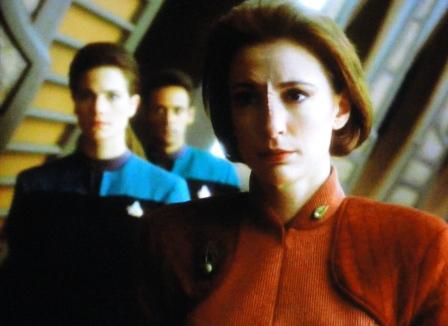
Sisko walks up a series of stairs to an office occupied by First Officer, Major Kira Nerys. She is Bajoran and played with authenticity by a fiery Nana Visitor. This is a seamless exchange and one I hope to see more of as the series progresses.

*
Major Kira is less than enthusiastic about the Federation presence as a native of Bajor. I'm sure one could find a few Iraqis with a similar distaste for the presence of American forces. The testy exchange is indeed intriguing and looks to provide a host of delicious character drama along the way.
*
Like any good space station with endless corridors and seemingly endless nooks and crannies, it has its fair share of questionable characters. Break-ins are quite the norm at present. Two smugglers, including a Ferengi boy named Nog, are busted by Chief Security Officer/ Constable Odo. Odo is ST:DS9's answer to Babylon 5's Chief Michael Garibaldi. Though, Odo is a Changeling, a shapeshifter able to use Terminator 2 morphing technology, which became commonplace, at the blink of an eye. Odo is steered with a steady hand by Rene Auberjonois.
*
The robbery is halted by Odo and a phaser blast by Commander Sisko. Odo informs Sisko he does not allow weapons on the Promenade. Quark, a Ferengi, enters, is played deliciously by Armin Shimerman. Now, I'm not a big fan of the Ferengi. I don't find the alien creature designs to be the least bit interesting. I'm absolutely appalled by their design actually and I have a physical revulsion toward the creatures. I tend to discount them. I'll have to get past that. All things considered we're fortunate to have Armin Shimerman in the role, because he generates far more depth than originally given the Ferengi on ST:TNG.
*
Quark informs all involved the Ferengi thief, Nog, is actually his brother Rom's boy. Sisko informs Odo to place the boy in the brig in a power play to keep Quark on Deep Space Nine. Quark walks away unenthused by the arrival of Commander Sisko. Sisko informs Kira he is open to the Ferengi art of the "plea bargain" or negotiation for the boy's release indicating in a small way how Sisko plans to operate aboard Deep Space Nine in an almost morally ambiguous fashion when required. With Quark's intentions to vacate the station Sisko needs someone to remain and has his sites set on Quark.
*
Captain Jean-Luc Picard guests visiting the station with the Enterprise-D, my son's least favorite Federation vessel. I concur. Sisko meets Picard where he informs the Captain he was aboard the USS Saratoga at Worf 359. Picard's intense expression and that information serves to alert Picard of his unfortunate past trials with the Borg and that Sisko confronts him an understandable chip on the proverbial shoulder. This, of course, points to the fact that Picard was complicit in the death of Sisko's wife that tragic day. Without misssing a beat, Picard pauses, but moves on with the business at hand- a wise decision. The exchange makes for terrific drama and once again serves to alert the audience they will not find comfort and cliche aboard Deep Space Nine.
*
Picard sets the table offering information on the historic conflict. The Cardassians ruled Bajor for half a century [I'm reminded of the Narn and Centauri scenario on Babylon 5]. Picard is an advocate for Bajoran entry into the Federation. Previously united factions within the Bajoran government, against the Cardassians, are once again at odds and internal strife is mounting. These political elements, while certainly not outside the realm of Star Trek, are more pronounced here and remind me of the internal conflicts on Minbar from Babylon 5. Sisko, acting as a devil's advocate, states the Bajorans may simply not be ready. Picard emphasizes Sisko's mission is to do everything possible "short of violating the Prime Directive" that they be readied. Picard has been briefed on Sisko's objections to the new assignment on the station. Sisko sternly points out his responsibility is to raising his son Jake as his own personal prime directive. He fears Deep Space Nine may not be conducive to that mission. Picard and Sisko, despite attempts by Picard at pleasantries, are clearly at odds as a result of Sisko built-in prejudices given their shared past. Picard points out Starfleet Officers do not always have the "luxury" of the ideal assignment. Sisko insists he is looking into civilian service possibilities back on Earth. One can't help but sense the kind of dark undertone that permeates ST:DS9 over and above the previous two incarnations of Star Trek based on this scene alone. It clearly exemplifies a paradigm shift in style and substance shaking our comfort zone.

*
Clearly, Sisko is a commanding officer that is presented with issues. He's a damaged man, as many of us are, which leads me to wonder about his fitness for the position myself. Although, I feel I've learned more about Benjamin Sisko in this one installment than anything I learned about Jean-Luc Picard through a good portion of the first season of ST:TNG.
*
Sisko makes his pitch to Quark to remain on Deep Space Nine to spearhead the effort of generating business as the stations resident gambler turned community organizer. Who better than a Ferengi? It's an amusing interaction and introduction to Quark and Odo.

*
Sisko is a player and clearly gives us a glimpse of just what exactly is required to work with the many races and personalities aboard Deep Space Nine. If manipulation is required Sisko is inclined to implement accordingly. Certainly Captain Sheridan on Babylon 5 had to play similar games. Like Sheridan, Sisko is a good man. As he points out to Major Kira moments later while cleaning up debris, he is a Starfleet Officer unafraid to dirty his hands [on a number of levels] if needed. Sisko speaks frankly with Kira that Quark gambles the provisional Bajoran government will inevitably fall. Kira, not one to bet against Quark, agrees and suspects civil war will follow. Kira believes Kai Opaka, the Bajoran spiritual leader, is the only one who can prevent its fall. The frustrated Kira indicates religion is at the core of Bajor, but the spiritual leader lives in seclusion and is rarely seen. Religion is often central to conflict. A Bajoran monk comes for Sisko, "It is time." Throughout the Emissary, foreshadowing is utilized and applied that will inform the entire season to its very conclusion. You'll need to come back and reference the Emissary when that time comes.
*
Sisko is brought to Bajor. My initial reaction of the planetary setting is one of awe. It is a beautiful place. The detailed matte work and special effects that went into creating it are flawless for 1993. One reason for Star Trek's visual success is Star Trek's preference for modelling work over CGI. CGI was used exclusively on Babylon 5 [for obvious budgetary reasons] and it's notable. CGI was employed on ST:DS9 and ST: Voyager, but the effects work in Emissary is fantastic. Minbar, Centauri Prime and even the central core portion of Babylon 5 station never looked close to this good. Presentations of Z'Ha'Dum, Mars and other external locations on Babylon 5 often looked digitized like an old video game. It's clear which series had the bigger budget and certainly that's an important factor in the look of a show. Take, for example, Deep Space Nine versus Babylon 5, the latter was exclusively CGI, while the former was exclusively a physical model. While Babylon 5 was certainly one of the best examples of that show's CGI, Deep Space Nine is a model and I love models [toy and female]. ST:DS9 has looked impressive thus far. Though, like ST: Voyager, ST:DS9 would employ CGI more frequently as the series progressed. We'll be sure to note any significant changes as part of Musings Of A Sci-Fi Fanatic's pro-modelling/ anti-CGI campaign.
*
Kai Opaka asks Sisko if he's ever explored his spiritual force, or pagh. It is the lifeforce that gives courage. She takes Sisko underground. She knows Sisko is a man in pain and implores him to look for "solutions from within yourself." She introduces Sisko to a glowing orb, a tear of the prophet. It lights the room and Sisko is transported to a beach. It was here he met his late wife, Jennifer. Sisko sees her again and he is alive reliving their introduction all over. He's like a kid in a candy store seeing her again. We are treated to a slice of Sisko's past and his emotional core. In the scenario, he has just graduated from Starfleet Academy and is overflowing with affection for his wife to be. Moments later he is transported back to the room of the orb. Opaka indicates there were nine orbs, the Cardassians have taken eight of them. Sisko must find the others. She fears the Cardassians will attempt to decipher their powers and potentially destroy the Celestial Temple. She implores Sisko to find the temple. It is a journey he is destined for and it is the only way she can unite her people. Sisko is as dubious about the reason he is chosen as we are, yet he is the emissary. He is the agent as it is defined, but of what? There are agents of good and evil. While I suspect Sisko is far from the latter it will be interesting to see how this pilot's theme carries this concept throughout the series.
*
Truthfully there's a lot of religious mumbo jumbo here and it is undeniably setting the table for a new mythology within the vast mythological universe of Star Trek.
*
Sisko visits the Promenade where a festive atmosphere is in full swing. It is teeming with alien activity. It is indeed the equivalent of Babylon 5's Zocalo. On some level I cannot help but be simply amazed these two shows managed to exist simultaneously on television. I'm awestruck by what J. Michael Straczynski was able to pull off against a powerful studio system. There are striking similarities in the set up.

*
The science officers arrive aboard Deep Space Nine. We meet Chief Science Officer Lt. Jadzia Dax, a Trill, a species which shares a symbiotic relationship with a "slug." The slug is Dax. Sisko is an old friend of Dax and knows Jadzia looks terrific joking she must be 328 years old. The race is a bit like the Goa'uld on Stargate SG-1 that are hosted by the Jaffa. Chief Medical Officer Lt. Julian Bashir is clearly smitten with Jadzia and hopes to reunite with her later for dinner or a drink. Elsewhere, Bashir is clearly overjoyed to be working out on the "frontier" and "Wilderness" where "heroes are made." The hard-nosed, reality-based Kira is not impressed with the wide-eyed, overzealous doctor and gives him a little tongue-lashing. Certainly many relationships will develop on ST:DS9.
*
Sisko puts Jadzia to work on locating the orbs. She indicates she was worried about him. He admits he is happy to see her again referring to her as "old man," because Sisko was mentored and friends with the previous host, Curzon Dax, who now resides inside Jadzia.
*
Jadzia gets to work and with a touch of the orb is transported to a place where this device lends a bit of insight into her character. On an operating table a slug is removed from Curzon Dax and given to Jadzia. So who was Jadzia host to before or was she a host at all? Do the slugs give Trills extended life?
*
Chief Miles O'Brien visits the Enterprise-D to bid farewell to Captain Picard. O'Brien is played by a true acting giant in Colm Meaney. He's a natural. O'Brien was formally a recurring character on ST:TNG and is relocated to Deep Space Nine. The farewell is bittersweet. This sequence is more emotionally profound if you understand the context of the relationship between these men from ST:TNG.

*
There's certainly a sense of one show passing the torch to another. Surprisingly, Colm Meaney's first appearance in the franchise dates back to ST:TNG, Season One, Pilot, Encounter At Far Point. The Enterprise-D exits the system.
*
Cardassian Gul Dukat arrives at Deep Space Nine. Dukat is also the character name of a character from Minbar in Babylon 5. Sisko and Dukat meet whereby Dukat informs Sisko his office once belonged to him only weeks ago. Dukat points out that Deep Space Nine is quite remote with poor defense systems implying the Cardassians could move in and take back whatever it might at any time. This is an interesting exchange and one that should make for some wonderful drama going forward by the Cardassian villain opposite Commander Sisko. Both actors are solid.

*
Jadzia believes she may have ascertained the possible location of the Celestial Temple. Sisko believes it's worth a look, but they need to get past the Cardassians' watchful eye.
*
In the Promenade one can't help but feel a sense of scum and villainy about the hive of activity there. Major Kira is certainly ST:DS9's answer to Babylon 5's Ivanova. Both are tough, no nonsense, fearless women. It will be interesting to see who is the more intriguing actress of the two. Kira shuts down the party in the Promenade to Quark's objection. Kira clearly has her beef with the Cardassians given her role on Bajor as a former freedom fighter. I see her less a terrorist as some have suggested and more a Browncoats-styled revolutionary a la Firefly. Perhaps more will be revealed. The Cardassians exit the Promenade with their winnings in a handbag. Aboard the Cardassian warship, the handbag is placed inside a compartment only the handbag is actually Odo who morphs back into changeling form. Odo infiltrates approved by Sisko himself. My only question was whether or not Quark was aware of his part in the Promenade shutdown by suppying Kira with the bag, which was actually Odo. The image suggests he may have had knowledge, but I wouldn't think he could be trusted. Still, there is the profit motive for Quark and the bit about his brother's son in the brig as motivation. I do wonder. Cardassian computers are crashed and shields and sensors are down as a result of Odo's intervention.
*
Did Quark know?
Jadzia and Sisko launch in the shuttle Rio Grande, a Runabout transport ship. The ship design is definitely a more advanced riff on the Galileo from ST:TOS. Meanwhile, Odo is beamed back aboard Deep Space Nine safely. There is clearly a strong connection between Odo and Kira. It will be interesting to see where this goes. Again, visually, this is a far less gritty work than that found on Babylon 5. The standard pristine, clean, near sterile technology of Star Trek is impressive and the visual effects are top of the line thanks to those budgets. A wormhole opens and literally gobbles up the shuttle. Contact is lost with Deep Space Nine. Jadzia and Sisko realize they are 70,000 light years from Bajor and clearly the wormhole was their transport. Jadzia indicates, "It's not like any wormhole I've ever seen." And neither have we, as the effect is impressive and unique to ST:DS9. It's fascinating to see the unique presentation of wormholes from Babylon 5 to ST:DS9 and the Stargate franchises to Farscape. They are all special in their visual concept. Sisko hypothesizes this link may have been how the orbs found their way to Bajor. Sisko is excited by the prospect of discovering the first legitimately stable wormhole to ever exist. Returning back through the wormhole the Rio Grande loses velocity. The shuttle literally lands inside the wormhole on an atmospheric planet capable of supporting life. The wormhole is the location of the hidden Celestial Temple.
*
Stepping outside of the shuttle Sisko sees a thunderous, dark, rocky landscape while Jadzia envisions flowery gardens and green, chlorophyll-infused vegetation. The two have completely different visions of their surroundings representing where they are spiritually. An orb appears zapping them upon their backsides. Jadzia is absorbed by the orb and transported back to Deep Space Nine. Sisko, too, is enveloped in bright, white light. Kira believes the Cardassians may be back on-line. Back inside the temple, the corporeal entity communicates with Sisko through visions of Jennifer, Picard, Jake and others.
*
The Cardassians are exiting the airspace and heading to the site of Sisko's disappearance, the Denorius Belt. Kira asks O'Brien what it would take to relocate Deep Space Nine to the mouth of the wormhole. Kira believes the Bajorans must stake a claim to the wormhole, while begrudgingly admitting the need for a Federation presence as well. An away team is forged led by Kira including Jadzia, Bashir and Odo. Odo has his own personal stake in the matter as he has lived the life of a Bajoran, but was originally found near the Denorius Belt.
*
Inside the wormhole, the being interrogates Sisko as a potential threat to their existence despite ovations that the human race values life above all else [well, some humans]. Sisko speaks to the beings via memories. A discussion of time and space ensues. Sisko maintains he lives on a linear time line with a distinct past, present and future.
*
Back at Deep Space Nine, O'Brien creates a subspace field around the station to lighten the load for its six thrusters to move it to the wormhole. It's a treacherous undertaking, but O'Brien is the Irish equivalent to Scotty from ST:TOS. If anyone can do it O'Brien can by God, channeling Scotty if need be. O'Brien clearly does not have the same level of knowledge regarding the space station's operations as he did the systems of the Enterprise-D. His relationship with this foreign-built station is a work in progress and should make for some interesting situations if handled with that level of detail.
*
Kira reaches out to Gul Dukat and advises he not enter the wormhole due to the potential for a hostile lifeform. Dukat plays dumb, but arrogantly suspects the lifeform may be more receptive to Cardassians. The Cardassian warship is unpersuaded and Dukat enters the wormhole where the temple resides.
*
Sisko continues making a connection with this being in the form of his late wife and they kiss. Sisko revisits the point of her death while the creature tries to understand why he cannot let go of the past if his existence in indeed linear. The away team arrives, but the wormhole collapses. The beings find the nature of human choice and existence destructive. Sisko continues his communications utilizing baseball as an analogy concerning the consequences of life. He points to his actions of throwing a baseball. A pitch can lead to one hundred different, unpredictable responses in a manner of speaking. The game wouldn't be played if we knew the outcome. This is our human existence. "It is the unknown that defines our existence. We are constantly searching." He emphasizes that he has come in peace to coexist and learn. Puzzled, the ubiquitous being insists on knowing why Sisko cannot let go of the moment his wife died. After all this moment was in the past. These philosophical questions are powerful and ST:DS9 gets the dialogue right in generating a thoughtprovoking Pilot. It eloquently asks us why we are who we are and Avery Brooks does a splendid job delivering those existential questions in his first appearance. These beings, unaffected by space and time, will serve to further add an heir of mystery to the series as the Bajorans look to these lifeforms as prophets with Sisko as their emissary.
*
The away team returns to Deep Space Nine now at the base of the wormhole. The Cardassians hail the station inquiring of the whereabouts of Dukat. Kira indicates they are on the otherside of the wormhole and that it has closed. They are unconvinced with her explanation.
*
The Cardassians flood the area with interference so that Deep Space Nine cannot communicate with the Federation. Their weapon systems fire. Kira requests "shields up!" But O'Brien asks "what shields?" Clearly, the writers work to throw off viewer expectations. The Cardassians require the unconditional surrender of the space staion or they will open fire. Kira requests one day to prepare. The Cardassian gives her one hour. If you're going to surrender, what preparations are needed for them to board? Just wondering. Just board!
*
Kira requests O'Brien shield all critical areas. Constable Odo must relocate people to safe areas. Doctor Bashir is gobsmacked that the Cardassians would ever attack a Federation outpost thinking his mission secure and free of the potential for war. O'Brien suggests he brush up on military history and make note of the Setlik III Massacre and the Border Wars. O'Brien notes Cardassians do not treat prisoners well.
*
Sisko, still under analysis, is questioned about the past. He asks for help, but a representation of the Bajoran spiritual leader, Opaka, tells Sisko only he alone will find solutions from within. It is individual responsibility that is heralded here. "You exist here," the being repeats. Brooks gives an emotional performance as the beings suggests that his past experiences from his linear existence never prepared him for such a consequence. He concedes to this. He cannot move forward. Letting go is the hardest thing to do for humans. "You choose to exist here. It is not linear." Sisko crumbles as if indicating he is ready to move forward with tears streaming. Don't we all live inside of our memories, in the past, despite a linear existence.
*
Kira requests six photon torpedoes fire across the bow of the Cardassians craft. O'Brien indicates those six are the only weapons available to them. Kira knows and she knows they won't win the battle through weaponry hoping the Cardassians won't call her bluff. A message must be sent. The shots are fired. Nothing like a classic photon torpedo right? They really need to ramp up weapons systems aboard this station. Kira is hailed and suggests to the Cardassians that the Federation has made some necessary changes. Will the Cardassians call her bluff? The Cardassians report intel to the leader. The false info received from the station points to a fictitious supply of 5,000 photon torpedoes and integrated phaser banks on all levels. Their leader suspects it is an illusion, but they are uncertain. An aide suggests getting Cardassian reinforcements, but they know Starfleet will also arrive within a day.
*
Undeterred the Cardassians take action and fire upon Deep Space Nine. O'Brien creates a pulse wave beam to suggest they mean business. Station shields are weakening and explosions are mounting. "Bloody Cardassians!"
*
Just as Kira prepares to surrender, the wormhole opens returning Commander Sisko. Dukat, in tow, signals his Cardassian warships to disarm. Damage is extensive, but the battle is over.
*
Sisko reports in the ship's log that the alien lifeforms have agreed to allow safe travel to the Gamma Quadrant through their wormhole. The Enterprise-D arrives and the Cardassians have left the building. Sisko meets with Picard whereby he informs the Captain of his change of heart leading Deep Space Nine. The two men shake hands. Benjamin Sisko is moving forward. Sisko does symbolize a sense of the reluctant hero unable to escape fate or destiny. Whether Avery Brooks proves to be the master thespian that Patrick Stewart was as Picard remains to be seen, but he does appear to be a competent choice to helm the ST:DS9 franchise. He looks to be a strong choice in a long list of terrific Starship Captains. Emissary easily rivals even exceeds the Pilot of ST:TNG Season One, Encounter At Far Point, in quality. With Deep Space Nine relocated at the mouth of the wormhole, exploration to the Gamma Quadrant allows for endless possibilties for the third in the Star Trek franchise. Politics, exploration, trade, interpersonal conflicts and war, like Babylon 5, would be at the heart of the newly established spinoff series. Further, unlike ST:TNG and its penchant for more stand alone-styled entries into its series, ST:DS9 was by far and away the most serialized of the Star Trek franchises. This, too, is similar to the serialized story arc of Babylon 5's Shadow Wars. ST:DS9 is one of the few series in the 1990s to go the route of serialized storytelling building on each successive episode more often than not. Emissary is a solid, thoughtful, challenging, ambitious opener and a shining example of what science fiction and serialized television has the potential to achieve. Between Babylon 5 and ST:DS9 1993-1999 was a potent, smart period in television especially for science fiction.
*
Emissary: B
Director: David Carson [Star Trek: Generations]
Writer: Rick Berman & Michael Piller.
*
The Cast:
Commander Benjamin Sisko [Avery Brooks]
Major Kira Nerys [Nana Visitor]
Chief of Security Odo [Rene Auberjonois]
Chief Medical Officer Julian Bashir [Alexander Siddig]
Chief Science Officer Jadzia Dax [Terry Farrell]
Councilor Ezri Dax [Nicole de Boer] [Season Seven]
USS Defiant First Officer Worf [Michael Dorn] [Seasons Four-Seven]
Chief Operations Officer Miles O'Brien [Colm Meaney]
Jake Sisko [Cirroc Lofton]
Quark [Armin Shimerman]

Friday, October 1, 2010

Music Addiction & The Physical CD

I really can't get these bloody wrappers off fast enough- can you?

I've come to the conclusion I now know what it takes for me to purchase a physical CD in 2010. Do you still purchase CDs? For quite some time now I've essentially been downloading music. Mind you, I'm all about artist support. I want to pay for it. It's the right thing to do. Granted, it's a bit frustrating at times.
*
I have a healthy love and habit for all things English. I actually switched countries on iTunes recently in an attempt to grab songs from the United Kingdom. EENNHH! The buzzer let me know I was not allowed to do that and sent me packing. I'm all about borders and legally entering countries so I went about things the only legal way possible. If the rare song or the new recording isn't available on iTunes it's off to Amazon or some valid variation thereof. I find that if I'm looking at a NEW CD release like the latest from Maroon 5, Hands All Over, and I find I'm probably looking at a potential 5-6 song download, then I draw the line. That's it. I'm spending the extra two bucks for the full CD for a crack at the liner notes to boot. The wonderful bonus to all of this is that I actually retain a hard backup.
*
By and large friends there aren't that many CD releases where I simply have to have the full CD nowadays. Case in point: I downloaded about three songs from the NEW Goo Goo Dolls recording Something For The Rest Of Us. I purchased one song from Dido's latest, Safe Trip Home, that qualified as listenable. I grabbed three from the NEW Crowded House Intriguer. This was a tough decision because Neil Finn's latest with the band sounded like an all around solid piece of work. There's still potential there for a buy.
*
So the purchase of a full-length CD just isn't an imperative as it was for me ten years ago. Still, there are some artists I simply can't resist. You have your bands too I'm sure. Well, for me, OMD [Orchestral Maneuvers In The Dark], one of the forerunners for clever electronic pop, has managed to keep my attention when others have fallen off the map. The Human League is high in that category too. They have one, Credo, due out before Christmas and prolific they're not. Their last classic Secrets came out in 2001. a-ha allegedly gave their last live performance before disbanding and released one new single. I imported the CD because that was the best option. The song is called Butterfly, Butterfly [The Last Hurrah] from their latest retrospective a-ha 25 [The Very Best Of].
*
More importantly, OMD's Andy McCluskey and Paul Humphrey's reformed [finally] for a NEW OMD CD called The History Of Modern. Yes, that's me opening it this evening. I can't tell you how excited I was to skip downloading to take in the whole collection. The group still including Martin Cooper and Malcolm Holmes has reunited for their latest oxymoron-titled masterpiece of a gem. With one foot to the future and one sound foot in the past, the CD is a nifty, sparkling collection of pop that is simply perfect. There aren't many CDs I get excited about, but this is one of the few in 2010. Additionally, I picked up the UK CD single for their song If You Want It, which included an exclusive b-side called Alone. I still have to grab those rare b-sides and they don't last long for the groups that used to be considered popular Popular Music. Do you remember searching for the b-sides? I remember filing through vinyl 12" record bins to get the rare stuff and then burning those rare vinyl items to CD-R. Ah, what a wonderful world of dynamic technology, ever-changing and ever-costly.
*
In fact, my love of music is so powerful I once began writing a book on 80s music. Can you imagine Musings Of An '80s Music Fanatic? It could have been. I had two literary agents and the rejections kept on coming despite some nice support from those agents. It never came to pass. The book was shelved, while my love for the music of the 80s remained and life moved on. This led to writing for a music publication for a time called The Lexicon. The editor was a fine gentleman and I penned a number of exciting interviews with Naked Eyes vocalist Pete Byrne, Spandau Ballet vocalist Tony Hadley, Icehouse vocalist Iva Davies, Double vocalist Kurt Maloo and finally Duran Duran at The Mercer Hotel in New York City following a performance on one of the morning shows. I spoke with Frank Zappa's guitarist, Warren Cuccurullo, in the dressing room, vocalist Simon LeBon and keyboardist Nick Rhodes, a class act, while girls gathered for a night on the town. All were a unique bunch of musicians and artists. I may bring you an 80s classic right here from time to time.
*
Like any fan of music, some will qualify as classic masterpieces [Thompson Twins: Here's To Future Days], while still other CD classics may be considered the classic guilty pleasure [Cutting Crew: Broadcast]. We all have them. So be gentle. But there you have it friends, my excitement for '80s music continues to offer a well of inspiration. So apart from being a frustrated writer, the music worthy of my addiction and my hard earned dollars today is the sound of artists worthy of a tangible purchase and my premeditated disregard of the virtual download. And while this is endlessly subjective where do you stand on music today and how to get it?